The Left Berlin News & Comment

This is the archive template

Jean-Marie Le Pen: Life and Death of a Nazi

John Mullen writes about the Nazi and colonial origins of Jean Marie Le Pen, and how they continue to influence French politics today


10/01/2025

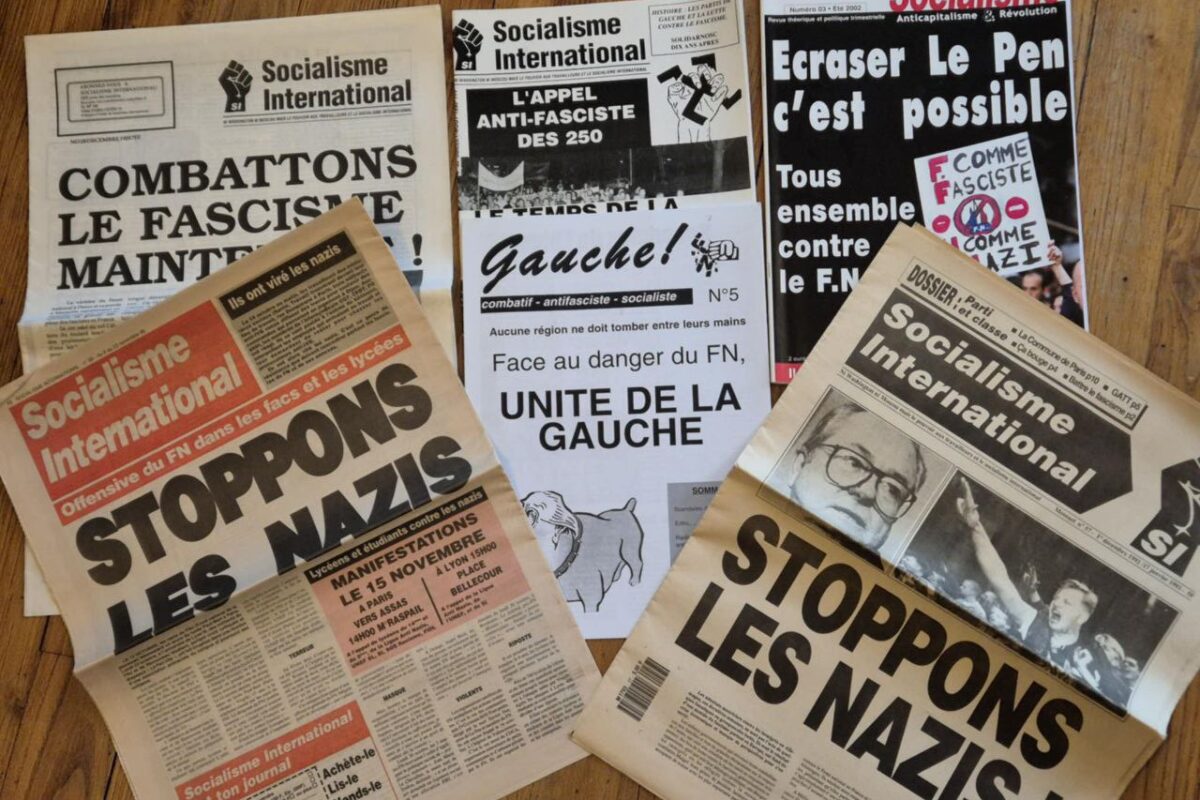
Photo provided by the author

Jean Marie Le Pen, the most influential French fascist leader since World War II, died on Tuesday January 7th. The same evening, crowds of mostly young people gathered in Paris, Lyon and Marseille to celebrate, to chants of “Bonne Année et Bonne Santé: Jean-Marie est décédé!” (Have a good year! Good health to you! Jean-Marie has passed away!) Extremist Interior Minister Bruno Retailleau immediately denounced the jubilation as “shameful”. Meanwhile, the press are publishing collections of Le Pen’s family photos, and President Macron officially expressed his condolences to the Le Pen family. Prime Minister François Bayrou paid homage to his being a “fighter”, while recognizing fundamental disagreements with him. And Jordan Bardella, chair of the fascist National Rally organization declared that Jean-Marie Le Pen “always served France, and defended her identity and sovereignty”.

On the radical Left, Jean-Luc Mélenchon of the France Insoumise wrote “The combat against this man is over. The fight goes on against the hate, racism, islamophobia and antisemitism which he spread”. The front page of the Communist daily paper L’Humanité published the headline “Hate Was His Trade” with a photograph of a German-made army knife engraved with Le Pen’s name. The knife was recovered from where he had left it, in a house where activist Ahmed Moulay was tortured and murdered during the Algerian War in 1957. Manon Aubry, a France Insoumise Euro MP, spoke yesterday of the death of a “notorious racist and antisemite”, while Philippe Poutou, leading member of the Nouveau Parti anticapitaliste, rejoiced at “this good news. The death of a racist, a colonialist, a fascist, a torturer, a murderer and a homophobe”.

A lifelong Nazi

Jean-Marie Le Pen turned to fascism young. At university in Paris in the late nineteen forties, he sold the newspaper of the far-right monarchists of Action Française. The publication was edited by Xavier Vallat, former “Commissioner in charge of Jewish Affairs” under the Nazi-controlled Vichy government. Le Pen was first elected as MP for the Poujadist far-right movement when he was 27, in the 1950s. In the early 1960s, when the war against Algeria was tearing France apart, he was in the army, fighting against Algerian independence. He was particularly involved in torturing prisoners, and always claimed that colonization was a positive thing. He never forgave Charles De Gaulle for having finally accepted Algerian independence.

In the 1960s, isolated politically, he nevertheless worked at maintaining the fascist tradition, setting up a company recording and releasing far right speeches and songs. One record, of songs and speeches of the Third Reich, explained on its cover: “These are the songs of the German Revolution […] Adolf Hitler’s rise to power and that of the National Socialist Party were characterized by a powerful movement of the masses, popular and democratic, which triumphed following regular electoral consultations, circumstances which are generally forgotten”.

In the 1970s, Jean-Marie Le Pen succeeded in piecing together the divided far-right remnants to found the Front national (FN), which decided to make a series of key tactical changes. Its Nazi core was to be hidden, and election campaigns, instead of street fighting, were to be the priority. Expressing antisemitism was shelved, while anti-Arab racism and islamophobia became almost the sole focus. Finally, traditional racism based on fake theories of biological hierarchy was left behind, the new discourse being based on “incompatible” cultures and the “war between civilizations”. As the FN formed, a deep economic crisis was returning to Western Europe, and with it increased pressure on the ruling class to turn popular anger against scapegoats.

Le Pen remained a nazi all his life. In 2010, at the age of 81, he declared in a seminar with student journalists: “In National Socialism, there is socialism. There was a considerable socialist content that transformed German society far more than any other political force had done.” And, just last September at 96 years of age, he was filmed in his home singing with an invited neo-nazi rock band called “Match Retour” (Rematch). The name refers to their hope of a second chance to impose nazism in Europe.

Tactical changes

Le Pen led the FN in France from 1972 to 2011. Talk shows could get record audiences by inviting him as a guest, and complacent interviews became common. Le Pen made the most of them. He declared that the existence of the gas ovens used to massacre Jews and others was “a detail of Second World War history”. Informed that a Jewish singer, Patrick Bruel, had joined others in protesting against the FN, he commented about there being “a whole ovenful” of his opponents soon.

The media loved these incidents, which they referred to as “slips” but which were really carefully thought-out interventions aimed at strengthening the hard-line fascist core of the FN. Once he had achieved a fairly large number of people who supported him on other questions, he would launch these antisemitic provocations. These were widely denounced, and the softer Le Pen supporters were then challenged to move further into nazi politics.

For many years, the FN built itself up slowly, helped by three important factors. First, the massive discredit of traditional left parties of government who were turning to neoliberalism and showing time after time that they had very little to offer ordinary people. Second, the very limited understanding on the radical left of the importance of stopping fascist parties by mass campaigns, including direct actions to prevent their activities. Third,, the historic weakness of the vast majority of the French Left concerning the fight against islamophobia, the form of racism which was gradually becoming the core of reaction in France.

The FN tried to keep its core of hardline nazis a secret. But in 1987, investigative journalist Anne Tristan infiltrated a branch of the FN, and noted how the hardliners talked: “Look, if you kill an Arab when Le Pen gets 0.5% of the vote, you get an outcry immediately, and you get called a racist” said one activist. “When Le Pen’s at 15%, people make less fuss. So we need to keep on, and, you’ll see, when we’re at 30%, people will stop yelling”.

Fascist breakthrough

On the 21st April 2002, Le Pen caused the biggest political earthquake of the last forty years in France by getting through to the second round run-off of the presidential elections. Tens of thousands protested all night in cities around France. Ten days later on May 1st, well over a million demonstrated against the fascists. Le Pen was easily defeated in the second round of the elections polling just under 18%. Five and a half million people voted for him. But this was a breakthrough which accelerated the rise in the fascists’ popularity and respectability. In 2017, ten and a half million voted for them, and in 2022, thirteen million.

Since Marine Le Pen, the daughter of Jean-Marie, became president of the FN in 2011, a determined and generally successful campaign of “image detoxification” has taken place. Nazi links were to be more comprehensively hidden, even organizing street demonstrations was to be avoided. She expelled her father from the organization (since he would not give up his sarcastic-toned antisemitism) as well as some other open nazis. She instructed MPs to concentrate on respectability, and was eventually to be seen at pro-Israel “marches against antisemitism” in 2023. Marine Le Pen’s femininity was also used to reassure voters that the old fascist values, generally associated with virility and masculinity, were no longer at the centre of the RN’s politics.

This week, Marine Le Pen’s worry is to organize a funeral for her father which does not give space for the open nazis who adored him. She hopes not to threaten the fragile respectability her party, renamed National Rally, has so successfully built up. She has chosen a family funeral after a Catholic mass in the Breton town he was born in. This will probably be followed, though, by a disgusting “homage” ceremony in Paris, which must be opposed.

Le Pen’s death is the time to re-explain and remobilize people against the fascist National Rally, which, preferred by Macron to the radical Left, is now closer to government than it ever was when led by Jean-Marie Le Pen.

6th International Marxist Feminist Conference 2025 Call for Papers

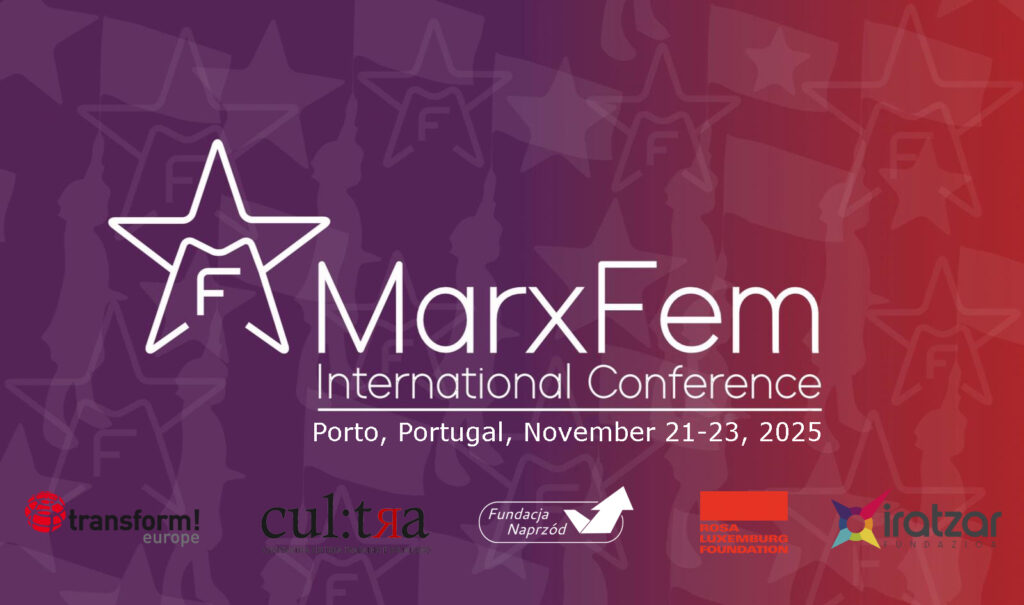
6th International Marxist Feminist Conference 2025


08/01/2025

We invite scholars, activists, and artists to submit their proposals for papers, essays, workshops, performances, or artistic interventions. Join us in rethinking bodies, territories, and practices through feminist, decolonial, anti-capitalist, and ecological lenses!

Founded in 2016, the Marxist-Feminist Conference is held every two years and is organised and funded by transform! europe in cooperation with the Rosa Luxemburg Foundation, Iratzar Foudantion, and Fundacja Naprzód.

We invite you to contribute to the programme of the 6th edition, which will take place from 21–23 November 2025 in Porto, Portugal.

For submission requirements and the conference timeline, please read on, and visit the official Marxist-Feminist Conference website for more details.

Theme for 2025: Decolonise Bodies, Territories and Practices

At a time characterised by militarism, in which the far right and fascism are on the rise and gaining power, violence – material and symbolic – is becoming widespread and normalised, threatening our lives and taking away our rights.

We need to resist and respond to these dark times. We do not abandon the project of a just life for all and that is why we mobilise to build an anti-capitalist feminist project. We summon intelligence, imagination, solidarity, sharing and ways of collectively producing knowledge and action as tools of resistance and of combating all forms of oppression and inequality.

This conference seeks to be part of the answer. It therefore wants to join forces, share knowledge and ideas, weave networks of solidarity and restore hope by taking and claiming the floor. Daring to build a common project – feminist, anti-racist, decolonial, anti-capitalist and ecological – is the challenge we face.

We have defined three axes of debate for this conference:

  • Decolonise bodies and reclaim them as self-determined territories, through fighting all oppressions that alienate, commodify and objectify them.
  • Decolonise territories by denouncing and combating the processes of violent occupation, appropriation, and expropriation, as well as the processes of dehumanisation and death.
  • Decolonise practices by critically reflecting on and transforming ways of doing and thinking.

To think, reflect and transform ways of life, renewing Marxism as an analytical and transformative tool, through multimodal articulations between the political, the economic, the social and the cultural; between the public and the private; between the local and the global, in the most diverse contexts is our challenge.

Our aim is to create international networks and strengthen webs of solidarity so that our coming together signifies resistance, hope and a commitment to the present and the future.

1 | Decolonising bodies

Critical analysis of global practices of colonisation, i.e. objectification, commodification, exploitation and violence against our bodies, and debate and definition of common strategies to counter such forms of colonisation.

  1. The appropriation of women’s bodies in war and peace, in the global North and South;
  2. The role of religions and fundamentalisms in the colonisation of bodies and thought;
  3. Anti-feminist and anti-LGBTQIA+ campaigns and resistance;
  4. The capitalist appropriation of care and the urgent need to reframe the concept of labour;
  5. Sexuality as resistance: practices and narratives that reclaim pleasure and desire;
  6. Art as a disruptive practice and dialogue to reclaim free and self-determined bodies.

2 | Decolonising territories

Critical analysis of feminist theories and practices of decolonisation. What proposals do you have for reconfiguring interpersonal and institutional relations, cities and urbanism, regions, countries and the land?

  1. Feminist analysis of populist discourses, anti-migration policies and war;
  2. The relationship between patriarchy and Islamophobia; femonationalism and the instrumentalisation of feminism;
  3. Feminism as an anti-militarist praxis that promotes a just peace;
  4. Art as a disruptive practice and dialogue in the occupation and resignification of spaces;
  5. Architecture and urbanism as feminist, anti-racist and decolonial political tools;
  6. Feminist experiences and representations in urban public spaces;
  7. Ancestry and learning: cosmologies and knowledge of women from indigenous peoples;
  8. Ecofeminism as practice of caring for the Earth and bodies, based on women’s knowledge and experiences.
  9. The construction of memory: the transformative movements of territories led by women and ethnic and national minorities.

3 | Decolonising practices

Critical analysis and reflection on the insufficiency of liberal feminism as an emancipation project. Critical analysis and reflection on the importance, difficulties and need to affirm anti-capitalist feminism as the proposal for global transformation. How to build an anti-capitalist, decolonial, ecological and anti-racist/anti-fascist feminism? Which paths to collective emancipation?

  1. Possibilities and limits of liberal feminism;
  2. Marxist feminism as a tool for analysis and transformation;
  3. Strategies of inclusion and diversity;
  4. The contemporary working class: rebuilding identities, communities and solidarities in times of precariousness and the dematerialisation of labour;
  5. Critical identity and intersectionality as tools to fight liberal individualism;
  6. Educational, cultural and artistic practices for feminist, queer, decolonial and anti-racist transformation.

Submission of contributions

We invite you to submit a description of your proposed presentation for the upcoming Conference. Please include the title, author(s), and a brief bio/Affiliation as a text file (up to 450 words), audio file, or video file (preferably no longer than 5 minutes). Contributions may consist of individual papers, panel proposals, as well as literary and artistic responses, and feminist theory/practice submissions.

This conference aims to embrace a wide range of methodologies and formats for participation, reflecting the diversity and complexity of responses that contribute to the re-signification of politics and the emergence of new political subjects. We welcome any form of contribution, including papers, videos, performances, artistic interventions, workshops, conversation circles, theoretical reflections, or practical experiences. Contributions may be submitted on behalf of individuals or collectives.

Please indicate the relevant axes and categories to which your proposed work aligns.

If you have any special requirements regarding space, technical specifications, or other needs for your presentation at the conference, kindly specify these in your submission.

Proposals, preferably written in English, Portuguese, or Spanish, should be submitted by March 8, 2025, to apps@marxfemconference.com.

Participation in the International Marxist Feminist Conference is free of charge, and support for travel and accommodation may be available.

Timeline

8 March 2025
Deadline for submissions
March 2025 Registrations open
31 May 2025
Notification of acceptance of the proposal
July 2025 Programme release


Scientific committee

  • Heidi Ambrosch (transform! europe, Vienna, Austria)
  • Samara Azevedo (Coletivo Andorinha, Lisbon, Portugal)
  • Elena Beloki (Iratzar Foundation-Awakening Foundation, Basque Country)
  • Sandra Cunha (Feminist in Movement/Feministas em Movimento – FEM, Portugal)
  • Nadia De Mond (Casa delle Donne di Milano/Non Una Di Meno, Italy)
  • Lígia Ferro (Institute of Sociology of the University of Porto/ISUP, Porto, Portugal)
  • Ana Cristina Pereira (University of Minho, Braga, Portugal)
  • Paula Godinho (Faculty of Social and Human Sciences – Nova Lisbon University, Lisbon, Portugal)
  • Tainara Machado (Institute of Sociology of the University of Porto, A Coletiva, Porto, Portugal)
  • Ewa Majewska (Professor at SPWS, Warsaw, Poland)
  • Catarina Isabel Martins (Centre for Social Studies – University of Coimbra/CES-UC, Coimbra, Portugal)
  • Gabriele Michalitsch (Professor at the University of Vienna, Vienna, Austria)
  • Tatiana Moutinho (transform! europe, Porto, Portugal)
  • Conceição Nogueira (Faculty of Psychology and Education Sciences of the University of Porto, Porto, Portugal)
  • Cynthia de Paula (Casa do Brasil, Lisboa, Portugal)
  • Andrea Peniche (A Coletiva, Porto, Portugal)
  • Catarina Ramalho (A Coletiva, Lisbon, Portugal)
  • Beatriz Realinho (Faculty of Social and Human Sciences – Nova Lisbon University x, Lisbon, Portugal)
  • Maria Manuel Rola (Centre for Studies in Architecture and Urbanism – Porto School of Architecture/CEAU-FAUP, Porto, Portugal)
  • Sílvia Roque (University of Évora, Évora, Portugal)
  • Shad Wadi (Centre for Social Studies – University of Coimbra/CES-UC, Lisbon, Portugal)
  • Barbara Zach (Social Worker, KPÖ, Vienna, Austria)

Germany Must End Its Complicity in Gaza Genocide

A Call to Retract Baerbock’s Statement


05/01/2025

Germany’s Foreign Minister, Annalena Baerbock, has defended Israel’s targeting of civilians in Gaza, stripping Palestinians of their fundamental right to protection under International Humanitarian Law. On 10 October 2024, she told the German Bundestag, “When Hamas terrorists hide behind people, behind schools … civilian sites could lose their protected status.”

In parroting Israel’s old narrative of human shielding, Baerbock provides a flimsy justification for the genocidal campaign against Palestinian civilians. For this claim to hold, Israel would need to prove that Hamas deliberately prevents civilians from evacuating “hostile zones”. Yet, under Israeli occupation, all of Gaza is a “hostile zone”, a concentration camp, where civilians and militants alike are trapped with no means of escape.

Baerbock’s position ignores the crucial fact that, even if Hamas were found to be using human shields, Israel, as an attacking force, remains bound by International Humanitarian Law. This includes obligations to uphold the principles of proportionality, distinction, and precautions to minimize civilian casualties. Most critically, Baerbock disregards that Israel, as an occupying power, cannot invoke the right of “self-defense” under international law when dealing with Gaza, a territory it illegally occupies alongside the West Bank, including East Jerusalem.

The Foreign Minister’s stance reveals a stark lack of empathy toward the 2.3 million Palestinians in Gaza who endured a year of live-streamed extermination. It also represents a blatant disregard for the principles of international law and human decency. Human rights organizations, UN agencies, and free media have consistently debunked the claims she has uncritically echoed. Instead of advocating for an end to the genocide in Gaza and taking a principled stand, Germany appears to be perpetuating its dark legacy by endorsing mass atrocities against Palestinians.

While the International Court of Justice, the International Criminal Court, and the global Palestine solidarity movement call for an end to the horrific assault on Palestinians, Germany remains shamefully aligned with genocide, refusing to learn from its past.

We, the undersigned, unequivocally condemn the German government’s support for Israel’s relentless acts of genocide against the Palestinian people. We denounce Minister Baerbock’s stance, which stands in stark defiance of international law and basic human decency. We demand that the German government immediately retract her statement and issue a formal apology to the Palestinian civilians—innocent victims caught in the flames of injustice. It is time for Germany to stand on the right side of history, to reject complicity in these crimes, and to honor the principles of humanity it once vowed never to betray.

Initiated by: The Palestine Academic Group (PalAc)

Palestine Academic Group (PalAc) is an independent non-profit, non-partisan academic organization that aims to broaden deliberation on the Palestinian national project of liberation, self-determination, and safeguarding the human dignity and historical rights of the Palestinian people.
Email: PalestineAcademic@gmail.com

Twitter: Follow @Pal_Ac1

You can sign this statement here.

Undersigned

1. Hendrik Süß, Friedrich-Schiller-Universität Jena, Germany

2. Sabine Broeck, University of Bremen, Germany

3. Simon-Rafael Fischer, Institute of Mathematics, Georg-August University, Germany

4. Manfred Liebel, University of Applied Sciences Potsdam, Germany

5. Benjamin Schuetze, Arnold Bergstraesser Institute (ABI), Germany

6. Dennis Büscher-Ulbrich, Kiel University, Germany

7. Christoph Günther, University of Erfurt, Germany

8. Robert Sauer-Ernst, FU Berlin, Germany

9. Berit Thorbjørnsrud, University of Oslo, Norway

10. Monica jaeckel, Independent Resaercher, Berlin, Germany

11. Nour Fanous, SSchulamt Dortmund, Germany

12. Mohamed Zinalabdin, Esslingen Hochschule, Germany

13. Juergen Mackert, University of Potsdam, Germany

14. Doris Bühler-Niederberger, Independent Researcher, Germany

15. Juan Cole, University of Michigan, USA

16. Gilbert Achcar, SOAS University, UK

17. Lila Abu-Lughod, Columbia University, New York, USA

18. Sinam Mirza, Oxford University, UK

19. Joshua Landis, University of Oklahoma, USA

20. Joshua Makalintal, University of Innsbruck, Austria

21. Keiko Sakurai, Waseda university, Japan

22. Melania Brito Clavijo, Universitat Autònoma de Barcelona, Spain

23. Astrid Jamar, University of Antwerp, Belgium

24. Minoo Mirshahvalad, University of Copenhagen, Denmark

25. Hayato Saigo, Nagahama Institute of Bio-science and Technology, Japan

26. Chiara Lanfranchi, Geneva Institute, Switzerland

27. Spyros Marchetos, Aristotle University of Thessaloniki, Greece

28. Randi Deguilhem, Centre National de la Recherche Scientifique, France

29. David Lyon, Queen’s University, Canada

30. Juan M. Amaya-Castro, Universidad de los Andes, Columbia

31. Christian Haesemeyer, University of Melbourne, Australia

32. Paola Rivetti, Dublin City University, Ireland

33. Tatiana Filimonova, National Library of Russia, Russia

34. Mulki Al-Sharmani, University of Helsinki, Finland

35. Carolina Nazzal, Universidad de cHile, Chile

36. Khaled Hroub, Northwestern University, USA

37. Fernanda Liberali, PUC-SP, Brazil

38. Sviataslau Valasiuk, University of Warsaw, Poland

39. Stefanie Baumann, New University of Lisbon, Portugal

40. Sari Hanafi, American University of Beirut, Lebanon

41. Natalia Maystorovich Chulio, University of Sydney, Australia

42. Abeer Al-Najjar, The American University in Sharjah, UAE

43. Walid Darwish, Aalborg University, Denmark

44. Andrea Meza Torres, UAM-I University, Malaysia

45. Jody Rosenblatt, King’s College London, UK

46. Ibrahim Fraihat, Doha Institute for Graduate Studies, Qatar

47. Koray Durak, University of Basel, Switzerland

48. Basem Ezbidi, Birzeit University, Palestine

49. Michele Lancione, Politecnico di Torino, Italy

50. Heba Ezxat, Ibn Haldun University, Türkiye

51. Ulrika Mårtensson, NTNU-Norwegian University of Science and Technology, Norway

52. Yadira Cordova, Universidad Central de Venezuela, Venezuela

53. Marc Oliveras, University of Barcelona, Spain

54. Askoka Thakur, Sister Nivedita University, India

55. Altay Karimli, Baku State University, Azerbaijan

56. Faten Ghattas, СУ “Св.Климент Охридски”, Bulgaria

57. Alessandra Bonazzi, University of Bologna, Italy

58. Oliver Scharbrodt, Lund University, Sweden

59. Yoshiko Kurita, Chiba University, Japan

60. Khaled Shnoune University of Boumerdes, Algeria

61. Sahar AlaaEldin, Göttingen University, Germany

62. Hideaki Shinoda, Tokyo University of Foreign Affairs, Japan

63. Samer Abomoghli, Qadisieh college, Iraq

64. William Youmans, George Washington University, USA

65. Mahmoud Abdurrohman, Aarhus universitet, Denmark

66. Yahya Qtaishat, Hashemite University, Jordan

67. Massih Zekavat, University of Groningen, The Netherlands

68. Aicha Elbasry, Arab Center for Research and Policy Studies, Qatar

69. Mkhaimer Abusada, Al-Azhar University, Palestine

70. Robert Boyce, London School of Economics, (LSE), UK

71. Silvia Maeso, Centre for Social Studies, University of Coimbra, Portugal

72. Federico Della Valle, University of Siena, Italy

73. Ruba Salih, University of Bologna, Italy

74. Luz Gómez, Universidad Autónoma de Madrid, Spain

75. Akin Akinade, Goergetown University, USA

76. Mohamed Magout , Free University Berlin, Germany

77. Shaery Yazdi, University of Antwerp, Belgium

78. Monica Dall’Asta, University of Bologna, Italy

79. Heiki Schroeder, University of East Angelia, UK

80. Francesca Biancani, University of Bologna, Italy

81. Eyad Elyan, Robert Gordon university, Scotland

82. Chandana Mathur, Maynooth University, Ireland

83. Jo-Anne Geere, University of East Anglia, UK

84. Lucia amorosi, Scuola Normale Superiore, Italy

85. Nadia Fadil, KU Leuven, Belgium

86. Ray Bush, University of Leeds, UK

87. João Rodrigues, Faculty of Economics, University of Coimbra, Portugal

88. Azizi Al-Azmeh, Central European University, Austria

89. Samer Chehayber, University of perugia, Italy

90. Punigeaola Manduca, UNIGE, Genoa, Italy

91. Thierry Nath, The Graduate Institue ,Geneva, Switzerland

92. James Smith, UCL, UK

93. Glenn Bowman, University of Kent, UK

94. Caterina Tono, Università degli Studi di Padova, Italy

95. Barbara Azaola Piazza, Universidad de Castilla-La Mancha, Spain

96. Jonathan Rosenhead, London School of Economics, UK

97. Donatella Della Porta, Scuola Normale Superiore, Italy

98. John Esposito, Georgetown University, USA

99. Claire Walsh, University of Edinburgh, UK

100. Pierre-Antoine Vettorello, University of Antwerp, Belgium

101. David Lloyd, University of California, Riverside, USA

102. Richard Rubenstein, George Mason University, USA

103. Eduardo Ballån, Universidad Camilo José Cels, Spain

104. Sondos Sandgren, Uppsala University, Sweden

105. Sevgi Dogan, Scuola Normale Superiore, Italy

106. M. Karacan, Germany

107. Sondod Al Sad, UCSF, USA

108. Claudia Laabar, Universität Wien, Austria

109. Les Levidow, Open University, UK

110. Johnny Stiban, Birzeit University, Palestine

111. Sultan Doughan, Glodsmith University, UK

112. Şirin Fulya Erensoy, University of Groningen, Netherlands

113. Omar Elgebely, Politecnico di Milano, Italy

114. Joanne Smith Finley, Newcastle University, UK

115. William Fortich Palencia, Universidad Pedagógica Nacional, Mexico

116. Ana Santos, University of Coimbra, Italy

117. Laura Nkula, University of Capetown, South Africa

118. Maria Grazia Rossi, Universidade Nova de Lisboa, Portugal

119. Johanna M. Lems, Universidad Complutense de Madrid, Spain

120. Islam Alshamleh Alshamlej, Cambridge University, UK

121. Annelys Devet, Antwerp University, Belgium

122. Lorenzo Iannuzzi, University of Forence, Italy

123. Greg Burris, Northwestern University, USA

124. Liza Goldman Huertas, Yale New Haven Hospital, USA

125. Evelyn Alsultani, University of Southern California, USA

126. Laura Stocker, Universität Wien, Austria

127. Asma Aouragh, TH – Bingen University, Germany

128. Silvana Rabinovich, UNAM university, Mexico

129. Francisco Vidal, Universidad de Jaén, Spain

130. John Gilbert, University of Florence, Italy

131. Ian Almond, Georgetown University, USA

132. Kamile Batur, Vienna University of Technology, Austria

133. Malek Abisaab, McGill University, Canada

134. Jeanette Jouili, Syracuse University, USA

135. Samia Botmeh, Birzeit University, Palestine

136. Stefan Winter, Université du Québec à Montréal, Canada

137. Julie Billaud, Geneva Graduate Institute, Switzerland

138. Yvonne Haddad, Georgetown University, USA

139. Jacqueline Perez, Université de Montréal, Canada

140. Tony Axon, Trinity College, Cambridge University, UK

141. Hipólito Rodríguez, CIESAS, Mexico

142. Yasir Soleiman, Cambridge University, UK

143. Elise Klein, Australian National University, Australia

144. Laura Feliu, Universitat Autònoma de Barcelona, Spain

145. Zena Hadjivasiliou, University College London, UK

146. Salam Kawakibi, CAREP – Paris, France

147. Nick Riemer, University of Sydney, Australia

148. Mohamed Abdelshafy, Coventry University, UK

149. Israa Asker, Newcastle University, UK

150. Patricia Hoyos, Externado, Columbia

151. Nizamettin Karataş, Tekirdağ Namık kemal Üniversitesi, Türkiye

152. Wael Hallaq, Columbia University, USA

153. Randa Farah, University of Western Ontario, Canada

154. Roger Few, University of East Anglia, UK

155. Mehran Kamrava, Georgetown University, USA

156. Laurie Brand, University of Southern California, USA

157. Mohamed Mohamed, University of Wales, UK

158. Dana Alkhiyami, Northwestern University, USA

159. Itab Shuayb, Cambridge University, UK

160. Halla Attallah, Georgetown University, USA

161. Donatella Donatella, Scuola Normale Superiore, Italy

162. Eyas Haj-Obeid, Quebec University, Canada

163. Blanca Camps-Febrer, UAB, Barcelona, Catalonia

164. Fadhel Kaboub, Denison University, USA

165. Prasannan Parthasarathi, Boston College, USA

166. Salwa Mohamed, Manchester Metropolitan University, UK

167. Lubna Samman, British Colombia University, Canada

168. Yaser Alsulh, Lund University, Sweden

169. Rafael Bustos, University Complutense of Madrid, Spain

170. Anne Maass, University of Padua, Italy

171. Hayal Akarsu, Utrecht University, Netherlands

172. Rosa Barotsi, University of Modena and Reggio Emilia, Italy

173. Rami Khouri, American University of Beirut, Lebanon

174. Nasri Barghouti, Liverpool College, UK

175. Sami Zemni, Ghent University, Belgium

176. Helga Baumgarten, Birzeit University, Palestine

177. Margaret Pappano, Queen’s University, Canada

178. Kim Van der Borght, Vrije Universiteit Brussel, Belgium

179. Anies Al-Hroub, American University of Beirut, Lebanon

180. Ricardo Marzuca, Universidad de Chile, Chile

181. Bassam Al-Agha, University college of applied sciences-Gaza, Palestine

182. Amilcar Figueroa, Universidad Bolivariana de las Comunas, Venezuela

183. Mahdi Fneish, American University of Beirut, Lebanon

184. Razan Shawamreh, Eastern Mediterranean Univesrsity, Cyprus

185. Robert Austin Henry, CIPPSAL, Chile

186. Paolo Cuttitta, Università di Genova, Italy

187. Atef Lubbad, Al Quds University, Palestine

188. Charles Butterworth, University of Maryland, USA

189. Asmaa Abu alhaijaa, Alyarmouk University, Jordan

190. Chandni Basu, Sister Nivedita University, Kolkata, India

191. Tamer Qarmout, Doha Institute for Graduate Studies, Qatar

192. Neyda Lopez, Universidad Bolivariana de Venezuela, Venezuela

193. Mohamed Alsudairi, Australian National University, Australia

194. Karima Laachir, Australian National University, Australia

195. Belal Salaymeh, Geneva Graduate Institute, Switzerland

196. Palpo A. de la Vega M., Cátedra Africa, Medio Oriente y Asia de la Universidad de Tifariti

197. Amjad Abu el ezz, Arab American University, Palestine

198. Tariq Modood, University of Bristol, UK

199. M Fneish, Lebanese University, Lebanon

200. Rachid Jarmouni, Université moulay ismail de Meknes Morocco, Morocco

201. Mustafa Jazar, Lebanese University, Lebanon

202. Ramazan Aras, Ibn Haldoun University, Türkiye

203. Raymond Brassier, American University of Beirut, Lebanon

204. Fathy Alsolh, American University of Sharjah, UAE

205. Mustafa Jarrar, Birzeity University, Palestine

206. Baydaa Al Ayoubi, Lebanese University, Lebanon

207. Marta Tawil Kuri, El Colegio de México, Mexico

208. David Mond, University of Warwick, UK

209. Sophie Richter-Devroe, Hamad Bin Khalifa University, Qatar

210. Hasan Ayub, Al Najah National University, Palestine

211. Omar Khalifa, Georgetown University, Qatar

212. Hisham Hamad, Al Quds University, Palestine

213. Gabriel Pérez, Universidad Nacional Autónoma de México, Mexico

214. Ahmed Khaled, Birzeit University, Palestine

215. Ali Kuşakcı, Ibn Haldoun University, Türkiye

216. Mira Al Hussein, University of Edinburgh, UK

217. Walid Kharroubi, Belgrad University, Serbia

218. Abdel Hakim Al Husban, Alyarmouk University, Jordan

219. Nada Raslan, RHU, Lebanon

220. Esad Širbegović, Institute for the research of genocide Canada IGC, Canada

221. Carmen Abou Jaoude, University Saint-Joseph of Beirut, Lebanon

222. Haitham Sarhan, Qatar University, Qatar

223. Tariq Dana, Doha Institute for Graduate Studies, Qatar

224. Alejandrina Reyes, Universidad Nacional Experimental Simón Rodríguez, Venezuela

225. Isabel Piña, Universidad Central de Venezuela

226. Ibrahim Bechouri, CUNY University, USA

227. Salim Tamari, Birzeit University, Palestine

228. Özmen Metin, Akdeniz University, Türkiye

229. Idrees Ahmad, University of Essex, UK

230. Walid Magdy, The University of Edinburgh, UK

231. Marwa Nassar, Arab American University, Palestine

232. Surer Mohamed, Cambridge University, UK

233. Hazel Marsh, University of East Anglia, UK

234. Adrija Bose, Indian Statistical Institute, India

235. Ibrahim Zabad, St. Bonaventure University, USA

236. Rahmi Oruç, Ibn Haldoun University, Türkiye

237. Luisana Colomine, Universidad Bolivariana de Venezuela

238. Abdulrahman Ibrahim, Birzeit University, Palestine

239. May Farah, American University of Beirut, Lebanon

240. Javed Khan, TISS, India

241. Atef Alshaed, University of Westminster, UK

242. Muhannad Ayyash, Mount Royal University, Canada

243. Antonio Barrocu, Università degli Studi di Torino, Italy

244. Detlev Quintern, Türkisch German University, Istanbul, Türkiye

245. Aryak Guha, S C College, west bengal state university, India

246. Bula Bhadta, Sister Nivedita University, kolkata, India

247. Castro Aurelio, University of Bologna, Italy

248. Ömer Yaman, Ankara Üniversitesi, Türkiye

249. Clara Ferri, Universidad Nacional Autónoma de México Mexico

250. Mouna Hashem, University of Michigan, USA

251. Lucia Cirianni Salazar, Grupo de Estudios sobre Eurasia

252. Emine Güneş, Samsun University, Türkiye

253. Benoit Challand, New School for Social Research, USA

254. Emannuel Guerisoli, Zolberg Institute on Migration and Mobility, USA

255. Jenny Pearce, London School of Economics, UK

256. Scott Bollens, University of California, Irvine, USA

257. Mohammed Bamyeh, University of Pitsburgh, USA

258. Nadia Naser-Najjab, University of Exeter, UK

259. M. Nurullah Turan, Ondokuz Mayıs Üniversitesi, Türkiye

260. Recep Köklü, Samsun University, Türkiye

261. Mehmet Fatih İzgi, Geneva Graduate Institute, Switzerland

262. Beirach Barak, Cinelab Ifilonva, Nova University, Portugal

263. Rashid Yahiaoui, HBKU, Qatar

264. Jihad Alshwaikh, Birzeit University, Palestine

265. Nuhad Dumit, American University of Beirut, Lebanon

266. Karim Eid-Sabbagh, Independent Researcher, Lebanon

267. Fatih Gumus, Recep Tayyip Erdoğan Üniversitesi, Türkiye

268. Martha Mundy, London School of Economics, UK

269. James Dickins, University of Leeds, UK

270. Michelle Obeid, University of Manchester, UK

271. Muzaffer üzümcü, Namik Kemal University, Türkiye

272. Anna Kristina Hultgren, The Open University, UK

273. Hikmet Çadır, Namık Kemal Üniversitesi, Türkiye

274. Killian Odochartaigh, University of Edinburgh, UK

275. Nurcan Güneş, Mardin Artuklu University, Türkiye

276. Haideh Moghissi, York University, Toronto, Canada

277. Saeed Rahnema, York University, Canada

278. Bouchra Mossmann, SDU Odense (University of Southern Denmark), Denmark

279. Jork Wiegratz, University of Leeds, UK

280. Francisca Urias, UAM-Xoch, Mexico

281. Che Broadnax, The New School, New York, USA

282. Anthony Gorman, University of Edinburgh, UK

283. Johannes Kurzeder, University of Bologna, Italy

284. Jonathan Jonsson, University of Oslo, Norway

285. Catherine Charrett, University of Westminster, London , UK

286. Ferran Izquierdo-Brichs, UAB, Spain

287. Ziba Mir-Hosseini, SOAS, London, UK

288. Ghassan Khatib, Birzeit University, Palestine

289. Richartd Tapper, SOAS, London, UK

290. Jonas Grabbe, CENIEH, Spain

291. Heike Schroeder, University of East Anglia, UK

292. Betül Başaran, St. Mary’s Collection of Maryland, USA

293. Vanessa Kleinheinz, University of Edinburgh, UK

294. Are John Knudsen, Chr. Michelsen Institute (CMI), Norway

295. Mohammad Reza Nilfar, Institute for Social Sciences and Humanities, Netherlands

296. Amir Taha, Amsterdam University, Netherlands

297. Daniel Maldonado Juárez, Centro de Estudios de Asia y África, El Colegio de México, México

298. Teresa Almeida Cravo, University of Coimbra, Portugal

299. Mariateresa Crosta, INAF – OATo, Italy

300. Geraldo Campos, Universidade Federal de Sergipe, Brazil

301. Roger Hammersland, Statistics Norway, Oslo New University College, Norway

302. Joseph Bryant, University of Toronto, Canada

303. Daniel Lenkeit, FU Berlin, Germany

304. Yusuf Timol, University of Central Lancashire, UK

305. Lara Urban, Helmholtz Munich / Technical University of Munich, Germany

306. Arturo Hartmann Pacheco, Ceai-UFS, South Africa

307. Faysal Bibi, Museum für Naturkunde Berlin / University of Potsdam Germany

308. Geraldine Hepp, Leuphana Universität, Germany

309. Jean-René Ruault, NEMO, Madrid, Spain.
Mary and her monster

Some thoughts on Mary Shelley and Frankenstein


04/01/2025

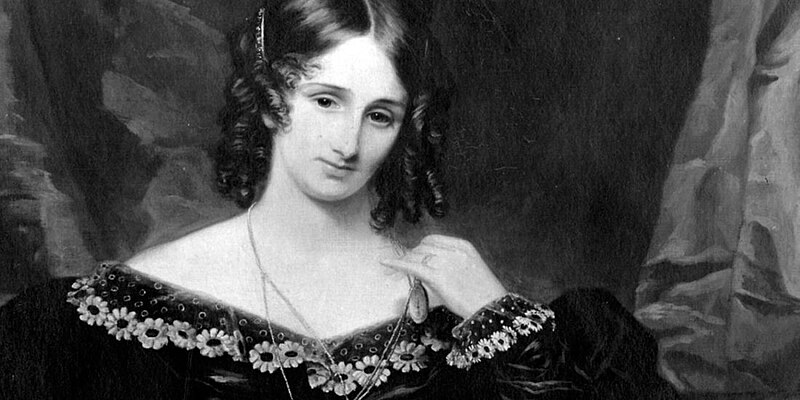
Mary Shelley was born on August 30, 1797. Mary had the idea for Frankenstein—or the Modern Prometheus as it was known at the time—when she was 18, and she finished writing it when she was 19. This teenager, who was excluded from the kind of education her male peers enjoyed, created not one but two of the most enduring characters in fiction: the obsessive scientist and the monster he creates. For 200 years, Frankenstein has generated multiple stage and film adaptations across all genres, and it remains as firmly embedded in our culture as ever.

Mary Shelley was the daughter of two hugely important radicals: feminist icon Mary Wollstonecraft and political philosopher William Godwin. She was the lover and then wife of the revolutionary poet Percy Bysshe Shelley and friend of the infamous rebel Lord Byron. Frankenstein was conceived while Mary, Shelley, and Byron were trapped indoors by bad weather during their stay in a villa by Lake Geneva in 1816. To occupy themselves, they decided to invent ghost stories, and Frankenstein was Mary’s contribution.

As is so often the case with women writers, Mary has been treated as an appendage to her parents’ and her husband’s literary careers… whose primary function was to guard the reputations of the more illustrious minds that framed her own. Mary’s life after Shelley’s death is usually dismissed as uninteresting. Biographer Richard Holmes writes, ‘She was still obsessed by Shelley’s papers, and trapped by memories both idealised and remorseful, her life attained a curious stillness’. But Mary, who was only 25 when Shelley drowned, was active enough to support herself and her surviving son despite being ostracised by society and by Shelley’s aristocratic family. She was a writer, reviewer, essayist, executor of her father’s estate, and architect of Shelley’s poetic reputation—in addition to writing five further novels which explored gender inequality.

It is apparently quite difficult for some to accept that a young woman was capable of writing Frankenstein. Professor Charles Robinson worked through a hand-written copy of Frankenstein counting some 5,000 changes suggested by Percy Shelley. The professor declared that ‘The book should now be credited as “by Mary and Percy Shelley”.’ This is rubbish. Other critics have noted that Shelley did no more than any editor, mainly correcting spelling and punctuation. When Shelley drowned just before his 30th birthday, he left a literary mess behind him. Many of his poems remained unpublished until Mary edited and published them. Another academic argues that Mary Shelley’s ‘magisterial editions of 1824 and 1837’ were vital in securing the poet’s reputation. Susan Wolfson writes that Mary’s editing demonstrated ‘considerable authority, at times co-creation’. Without Mary, Percy Shelley would never have entered the great canon of English literature. But does anyone claim that Shelley’s poems should now be credited to Percy and Mary Shelley’?

Many women writers are subtly undermined by the patronising assumption that they simply and artlessly describe their personal experiences. Mary Wollstonecraft died after giving birth to Mary, and by the summer of 1816, 18-year-old Mary had already had two children, one of which she buried. In 1817 Shelley’s wife Harriet and Mary’s half-sister Fanny both committed suicide. Bingo! The creation and destruction, the parody of giving birth in Frankenstein can be satisfactorily explained away. But again this will not do. Mary was familiar with all the intellectual and scientific developments of her time. She attended lectures given by chemist Humphry Davy and Dr Luigi Galvani who passed electric currents through dead bodies.

Mary was also a profoundly political woman. Her book is best understood as an imaginative engagement with the Industrial Revolution which threatened to reshape man’s relationship with nature and with capitalism which was still in its blood-soaked infancy. In Frankenstein, she created a tale which continues to resonate because it articulates a powerful response to capitalism, to class division, and to exploitation and revolt.

Frankenstein can also be read as a feminist novel. It is Victor Frankenstein’s attempts to supplant women in the process of reproduction that leads to disaster. The story, with its dead mothers and murdered wives, reveals what happens when women are marginalised.

Frankenstein was set in the 1790s, the decade of the French Revolution and the Haitian Revolution which established the first black republic. As capitalism developed, it provoked a violent response from those it impoverished by new methods of manufacturing—some 12,000 troops were sent to Nottingham to quell the Luddite Rebellion of 1812. Lord Byron’s first (and only) speech in the House of Lords opposed the introduction of the death sentence for machine breaking, but hundreds of Luddite rebels were executed before the movement subsided. Frankenstein’s monster was born out of these social convulsions and protests.

Mary’s monster is not the mute, dumb monster portrayed by Boris Karloff in the 1931 film. He learns to speak and to read, to love music and the poetry of John Milton. ‘I was benevolent and good; misery made me a fiend. Make me happy, and I shall again be virtuous’, the monster pleads. Here Mary echoes the pleas of her reforming contemporaries who argued that only improving worker’s lives could prevent violent revolt. But Frankenstein is not just an appeal for worker’s rights—there is a deeper and more fundamental protest going on.

Unlike previous monsters, Mary’s is a dynamic, totalising one. Frankenstein does not stay in the shadows or in the creepy castles like the ghosts in Anne Radcliffe or Lewis Monk’s gothic novels. Frankenstein and his monster chase each other across huge geographical spaces. This reflects how capitalism is also a dynamic system, driven to constantly expand and grow. In addition, the workings of the system are hidden and mysterious and far beyond the control of any individual capitalist, however powerful. From the Communist Manifesto comes this description, ‘Modern bourgeois society with its relations of production, of exchange and property, a society that has conjured up such gigantic means of production of exchange, is like the sorcerer, who is no longer able to control the powers of the nether world whom he has called up by his spells’.

Frankenstein’s monster is a metaphor for the condition of the working classes in the early years of the Industrial Revolution. The monster is not natural, he has been created. Like the men and women being forced into the factories, the monster is stitched together from different elements, and like them, he is deformed and debased.

Through the monster’s naïve eyes, Mary invites us to share his disgust at the degradation of workers. He tells Victor, ‘I heard of the division of property, of immense wealth and squalid poverty, of rank, descent and noble blood. I learned that the possessions most esteemed by your fellow creatures were high and unsullied descent united with riches. A man might be respected with only one of these advantages; but, with either, he was considered, except in very rare instances, as a vagabond and a slave, doomed to waste his power for the profits of the chosen few!’

The Monster warns Frankenstein: ‘Remember that I have my power …You are my creator, but I am your master!’ In the monster, Frankenstein has created his own gravedigger. Two hundred years later, Mary Shelley’s novel is more relevant than ever because capitalism is today more monstrous than even she could have imagined.

Charlotte Gordon’s double biography Romantic Outlaws: The Extraordinary Lives of Mary Wollstonecraft and Mary Shelley is available from Bookmarks bookshop .

The Gisèle Pelicot Case: A Catalyst for Change in Justice and Society

The trial over the decade-long abuse involving numerous men has shaken many, and requires us to demand societal and judicial change


03/01/2025

The case of Gisèle Pelicot, a woman from the small village of Mazan in southern France, has captured attention across France and beyond. Her horrific case made headlines when the court hearings began in September, bringing her harrowing story to light. 

For nearly a decade, her husband Dominique Pelicot had systematically drugged her by lacing her food and drinks with sedatives, leaving her unconscious. Initially, Dominique sexually assaulted his wife alone. However, he soon found that this no longer satisfied him. 

He later admitted to becoming addicted to assaulting his wife and subsequently began seeking other men to participate. He recruited strangers from a website called “against her will” and invited them into their home to rape her. 

Dominique’s abuse extended beyond Gisèle, deeply affecting their entire family. The investigation revealed that Dominique had secretly taken nude photographs of his adult daughter and his sons’ wives without their knowledge, further demonstrating his pattern of abuse and exploitation. 

Gisèle’s daughter, Caroline Darian, testified about the devastating impact on the family, describing how they initially believed Gisèle’s symptoms were caused by illness. The emotional toll on the children has been profound, with their son David Pelicot recounting his horror upon discovering that his wife had been photographed without her consent, including during her pregnancy. 

Dominique Pelicot’s manipulation of Gisèle went beyond the physical. He gaslighted her into believing she had health problems, such as Alzheimer’s, when she began experiencing memory loss and unexplained weight changes due to prolonged drugging. 

What particularly shocked people around the world was that the perpetrators were “ordinary” men. The case broke the stereotype of a rapist. It’s not someone outcast from society, moving in the shadows. It could be your brother, neighbor, or colleague. A trusted member of a community. 

It reveals that “roofying” is not limited to nightlife or bars; it can also happen behind closed doors, committed by someone you trust most. In this case, the perpetrators worked in professions such as firefighter, nurse, soldier, journalist, prison officer, and lorry driver. Ranging from highly respected job to more common ones, the French media appropriately referred to them as “Monsieur Tout-le-Monde” (“Mr. Everyman”). 

I’ve seen the refrain “Not all men” frequently surface in social media discussions about sexual violence against women. This phrase cannot be justified. While it’s true that not all men are rapists, it’s undeniable that, in this case, all the rapists were men. Such arguments diminish the lived experiences of survivors and deflect attention from the systemic issues that enable sexual violence to persist. 

Even more telling is the geographic proximity of these men, all the convicted lived within a 60km radius of the village of Mazan. The case exposes the deeply rooted rape culture in our society that persists through silence, stigma, and complicity. As Gisèle herself said, “Shame must change sides.”

The case was closed on the 19th of December and 51 men were sentenced. 46 men were convicted of rape, two of attempted rape, and two of sexual assault. While Gisèle has become a role model for women worldwide, the lenient sentences for many of the perpetrators have sparked outrage, showing an urgent need for systemic reform. 

While the convictions appear to be a victory, when you look into the sentences, they tell a different story. Dominique Pelicot, the mastermind behind the horrors, received 20 years in prison – significant but arguably insufficient given the gravity of his crimes. Other men also received lighter sentences than the prosecutor requested, with some perpetrators walking free due to medical conditions. 

These inconsistencies send a troubling message: the well-being of a rapist is more important than the trauma of the victim. This lack of harsh penalties undermines public trust in the justice system and raises serious doubts about its ability to deliver true justice for victims of sexual violence. 

Some perpetrators justified their actions by stating they believed Gisèle had consented because Dominique had told them she did – as if a husband could decide over the wife’s body. Or they believed Gisèle’s silence was part of a consensual “sex game.” These justifications reveal their complicity and the dangerous misconceptions surrounding consent. This is further underscored by the existence of over 20,000 recordings, which clearly show that Gisèle was incapable of consenting as she was drugged into a coma.

Gisèle’s case serves as a catalyst for change. It is heart-wrenching that only after someone has suffered profoundly those in power decide to act. This case highlighted the outdated legal framework in France for addressing sexual violence. The absence of a clear legal definition of consent complicates prosecutions and retraumatizes survivors. 

In fact, it wasn’t until a horrific rape trial in 1978, where two women were attacked during a camping trip and brutally beaten and assaulted by three men, that rape was officially recognized in the French Constitution. Even then it came only after intense public debate and pressure.

A rape case in Spain prompted a reform of the laws around consent, leading to the adoption of the “Yes Means Yes” standard, also known as affirmative consent, which has also been implemented in Sweden and Denmark. Briefly explained, this framework requires explicit, mutual, and informed agreement for any sexual activity, marking a significant shift from traditional laws. 

Under this model, silence, passivity, or lack of resistance cannot be interpreted as consent, ensuring that the burden of proof lies with the perpetrator to demonstrate that clear and enthusiastic consent was obtained. 

While Gisèle’s case highlights national failures, it also underscores the need for broader European-level reforms. One could argue that the European Union could standardize this approach across member states, aligning with its commitments to human rights and gender equality under the Istanbul Convention and the EU Charter of Fundamental Rights. 

By implementing “Yes Means Yes” as an EU directive, the bloc could ensure consistent protections for victims and promote a cultural shift toward respect and accountability in all member states.

The case also shows that in addition to judicial reform, we need a societal one too. It shows how rape culture is integrated into our societies and “accepted”. Education plays a critical role. Teaching young people about consent and respect can challenge the attitudes that underpin rape culture. 

Communities must move beyond the passive bystander role, actively demand change, and point out the wrongs to prevent abuse. In this case, many of the perpetrators said they noticed something was “off” but still failed to act. After leaving their house, they thought the situation was wrong but still didn’t report that further. 

Online platforms like the one Dominique used, which normalize sexual violence, must be held accountable. Stricter regulations are needed to prevent the facilitation of such crimes. The fact that pornography categories like “rape” or “sleeping” exist reflects a societal issue that blurs consent and objectifies women. 

Despite the shortcomings of the judicial process, Gisèle’s courage has had a profound and far-reaching impact. By forgoing anonymity and insisting on a public trial, she has shattered the stigma surrounding sexual violence and become a global symbol of resilience and feminist advocacy. 

Her bravery has not only inspired survivors worldwide to speak out but also ignited a movement demanding justice, accountability, and change. Across France, public demonstrations have amplified her message, calling for an end to rape culture and stronger protections for victims. 

Gisèle’s story is more than one of survival –it is one of empowerment. She has shown that even in the face of unimaginable pain and betrayal, it is possible to reclaim your voice and spark change that resonates far beyond your personal experience. Her strength reminds us that change begins with courage, and her advocacy has given hope to countless women around the globe who have faced similar struggles. 

As we reflect on the injustices Gisèle endured, let her bravery inspire us to channel our outrage into action – through judicial reform, education, and grassroots activism. Most importantly, we must listen to survivors. Their voices are invaluable in shaping a society that prioritizes justice, compassion, and equality. Gisèle’s journey is a testament to the transformative power of speaking out, and it is up to all of us to ensure her courage continues to light the way for others.