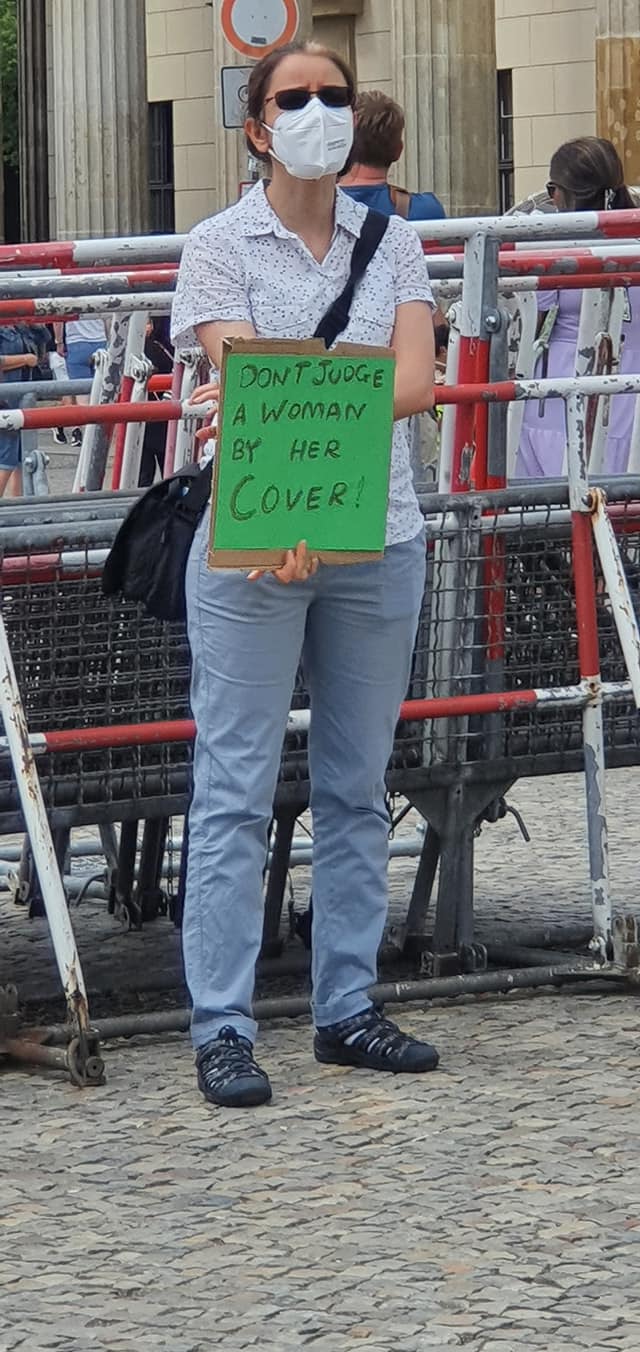
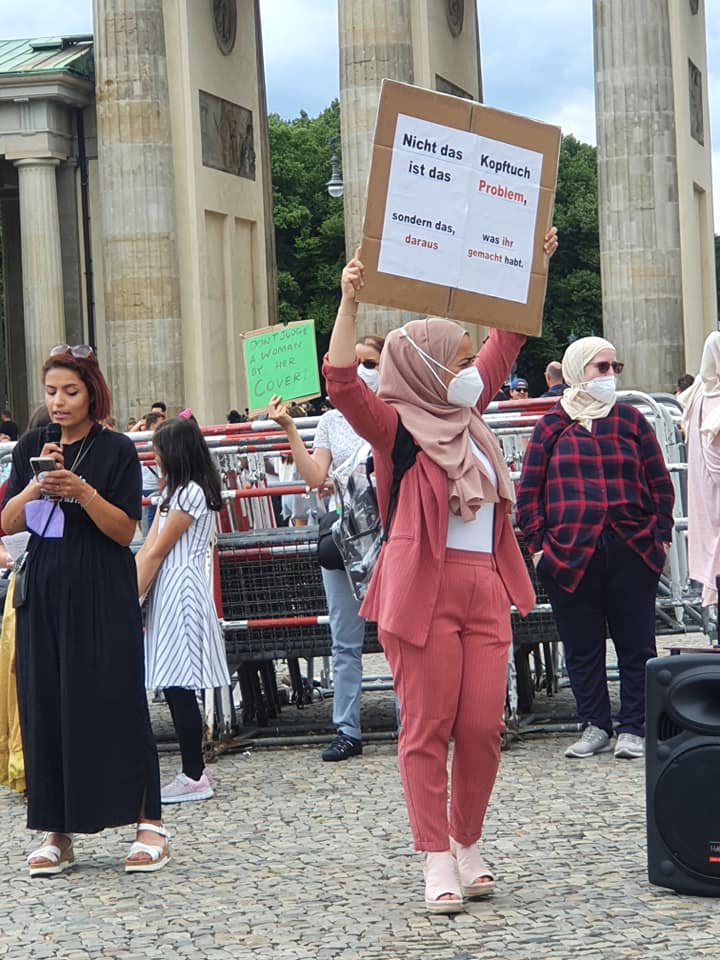
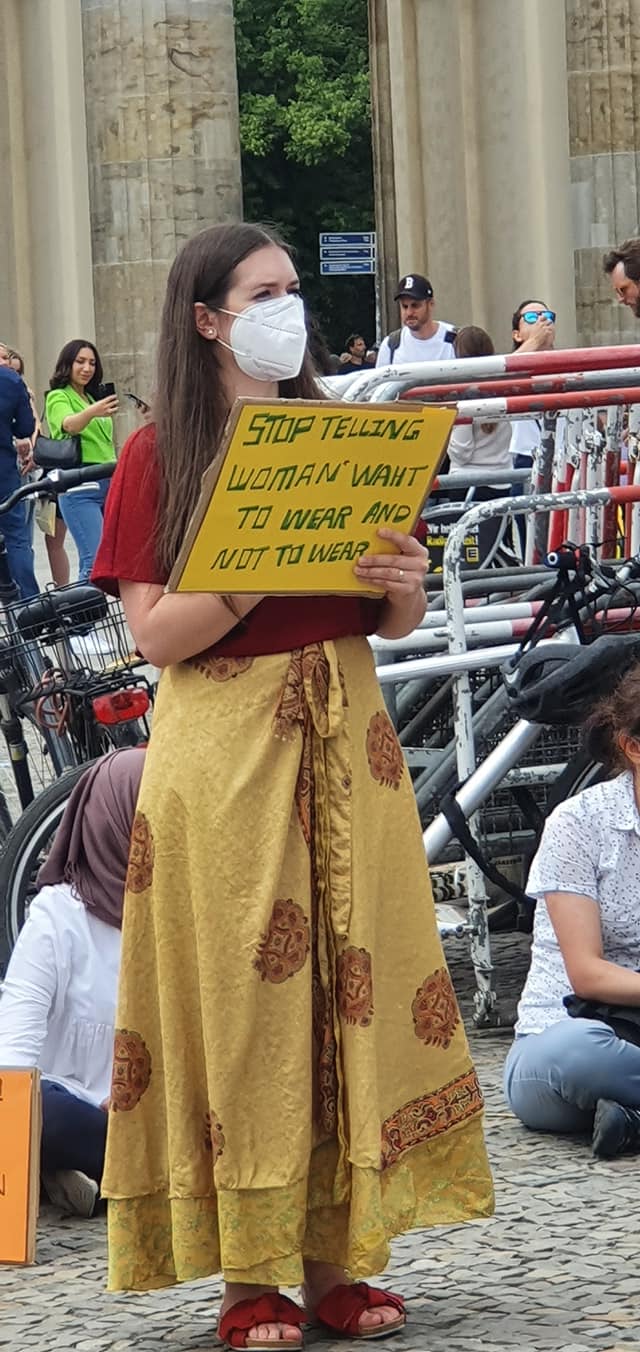
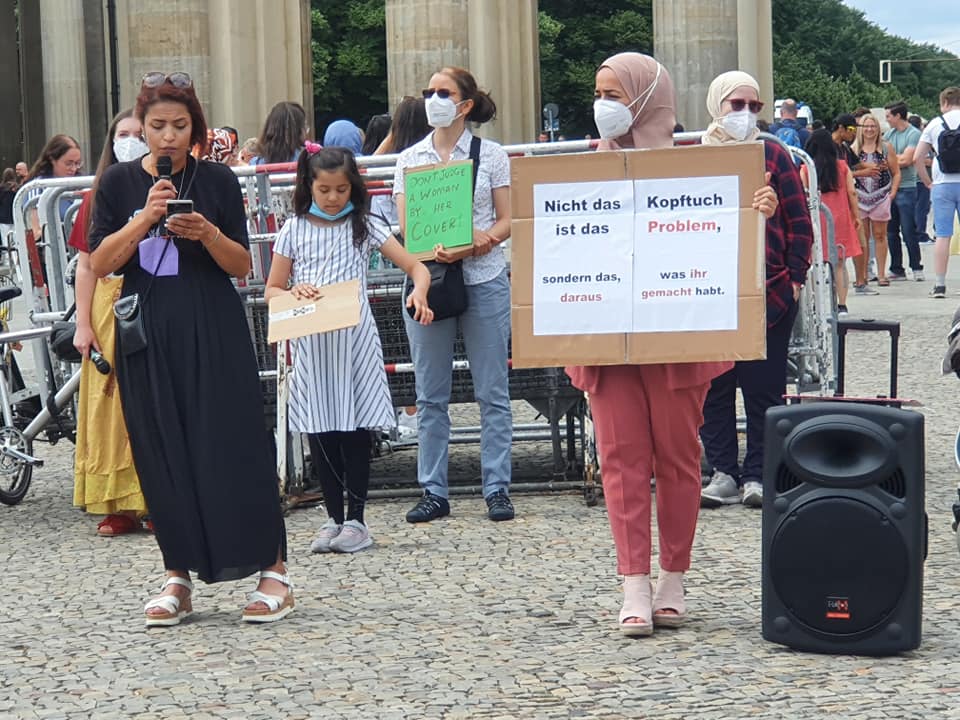
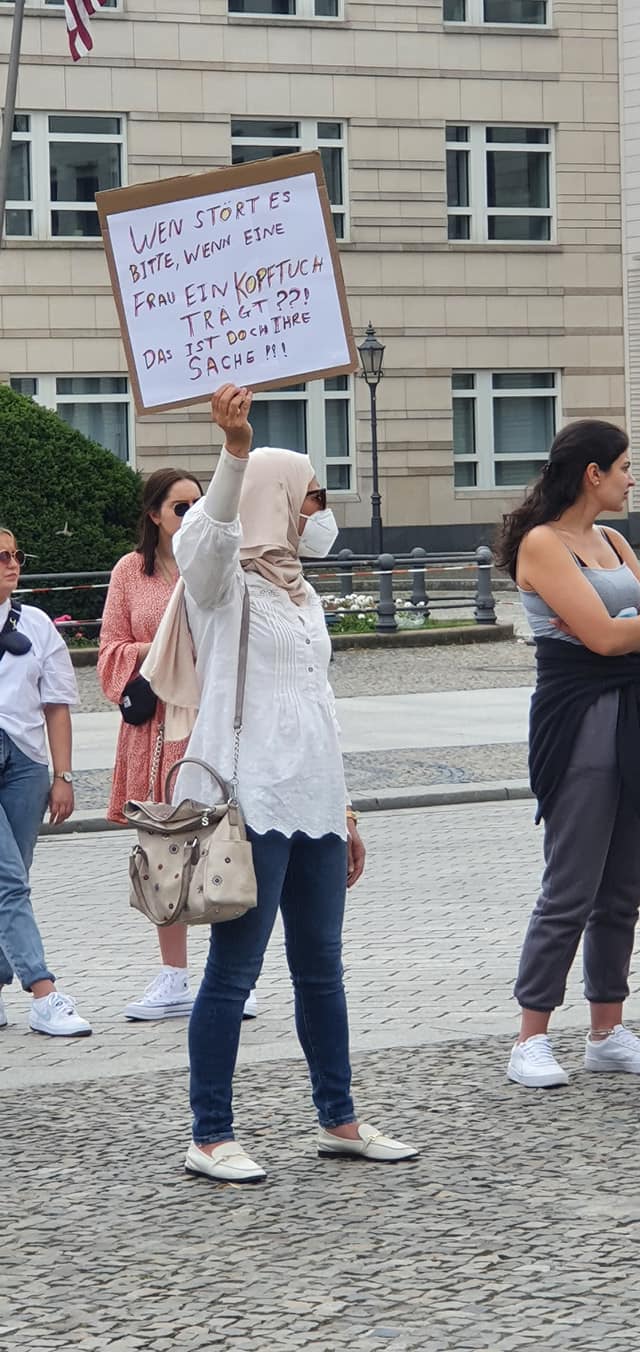
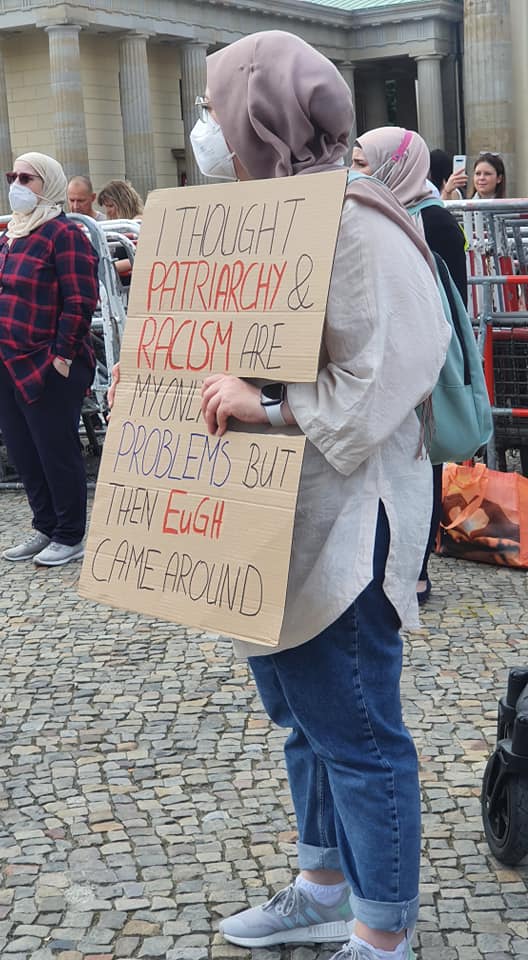
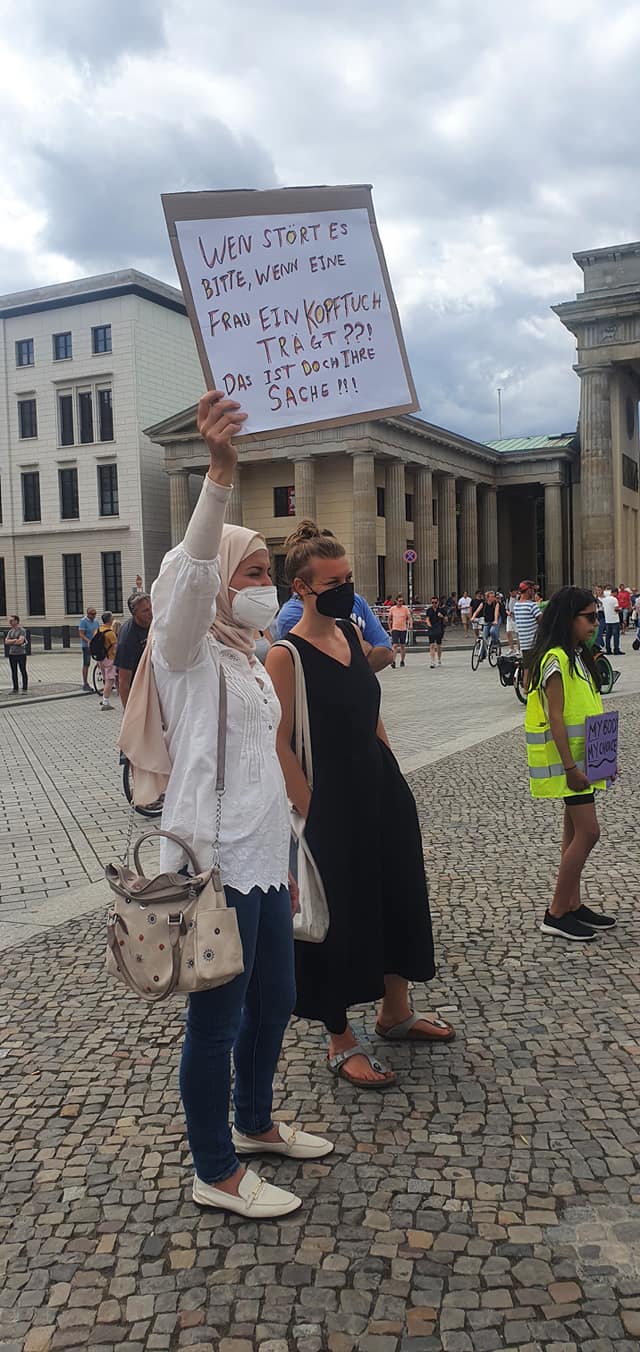
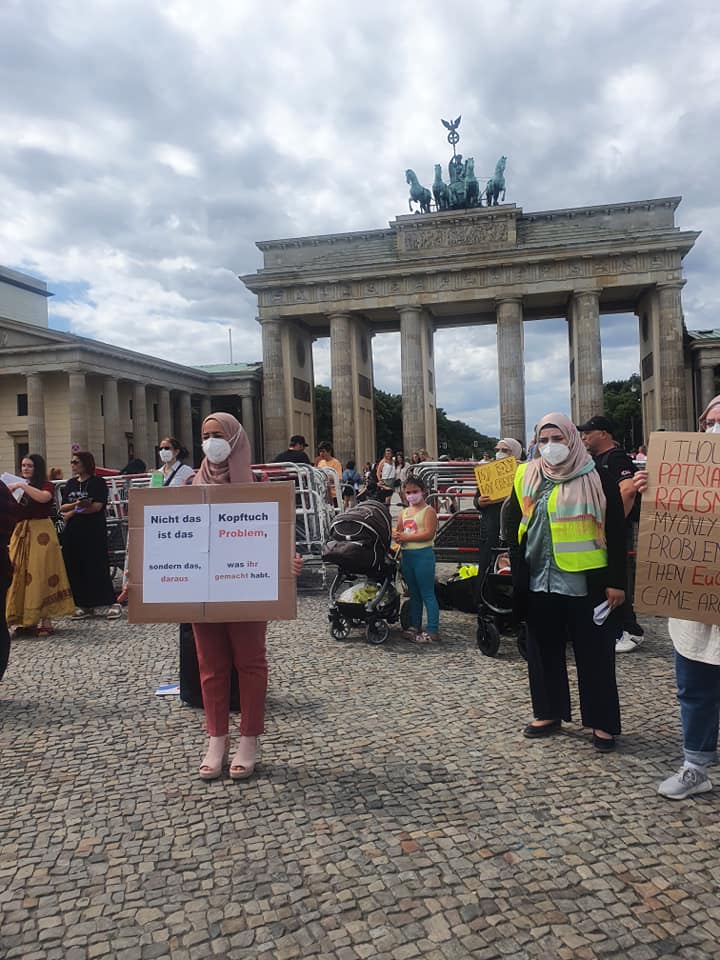
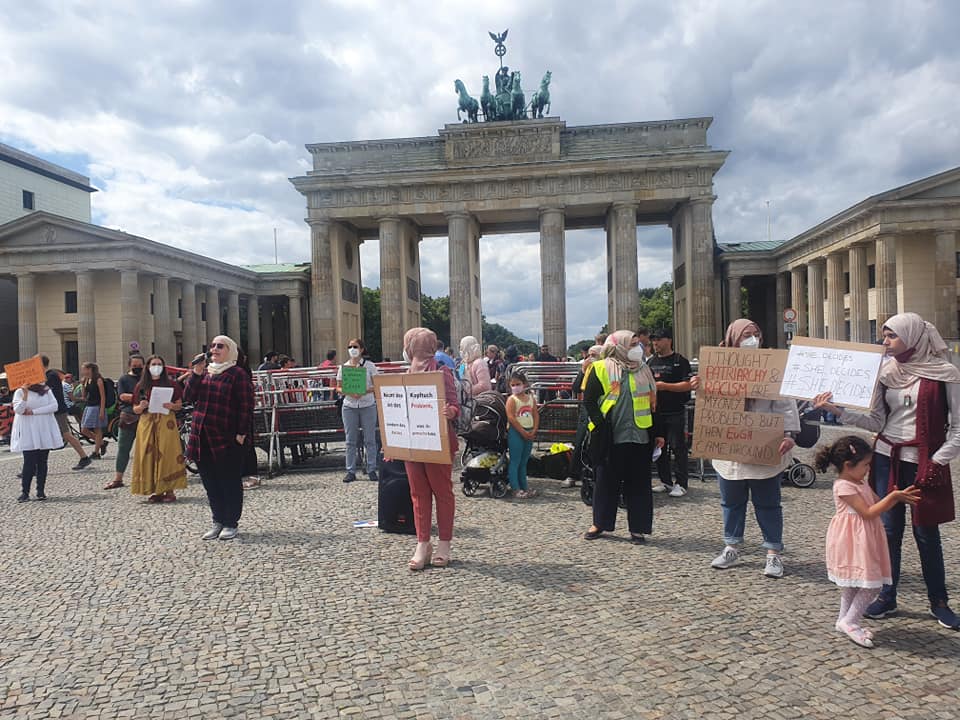
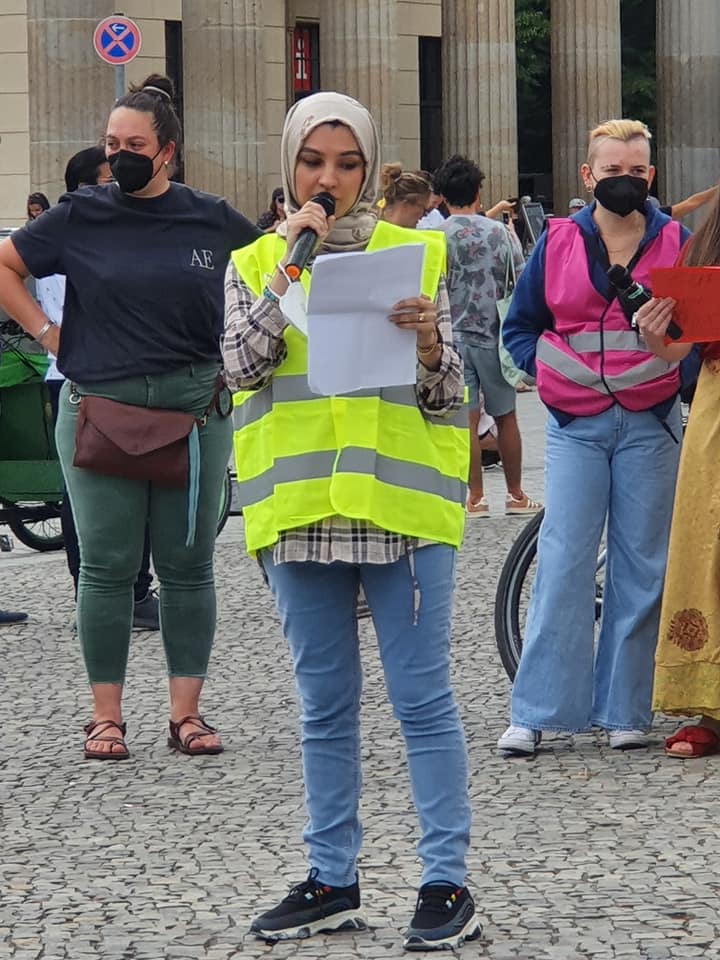
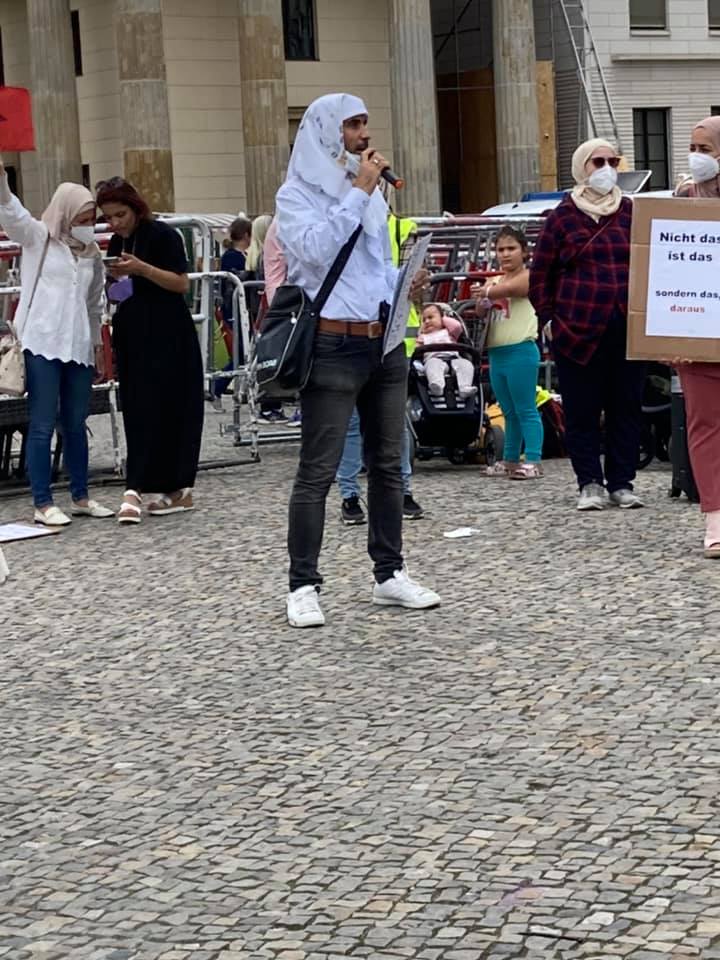
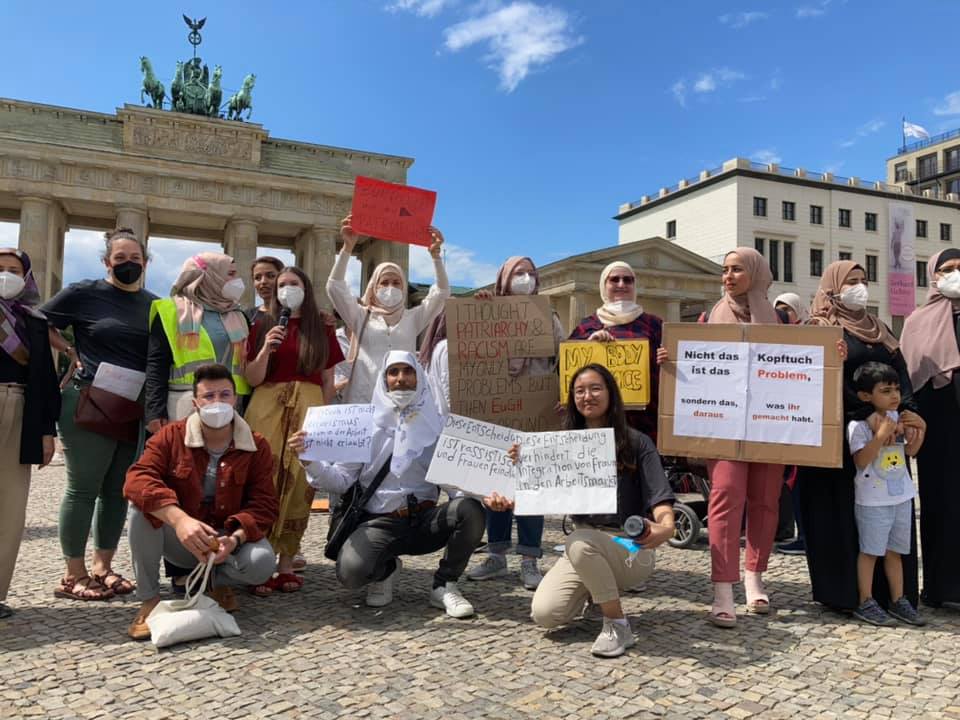
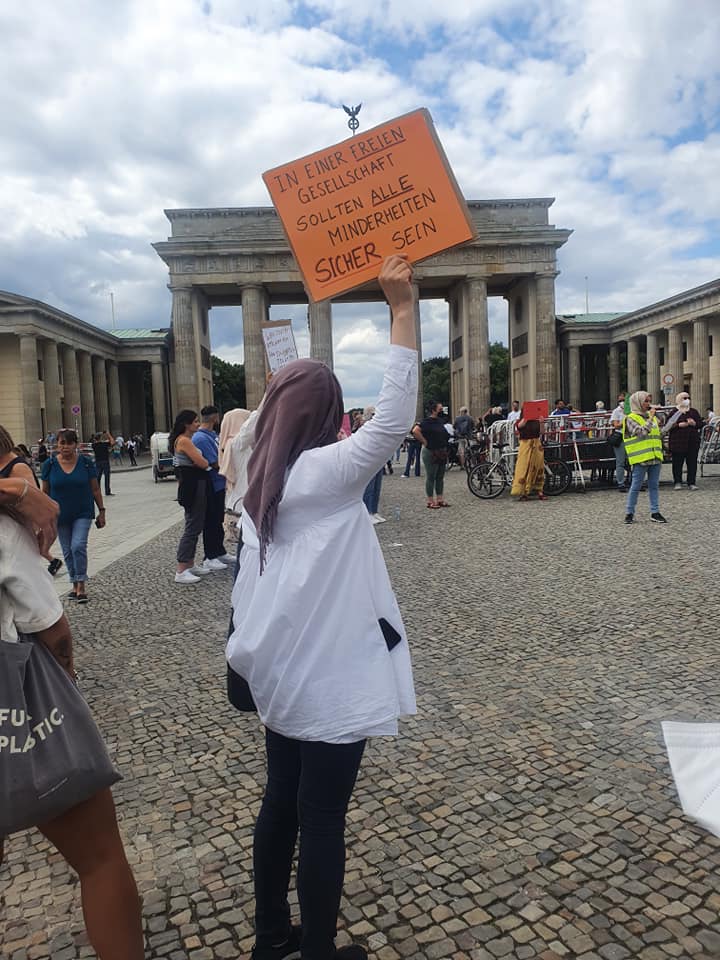
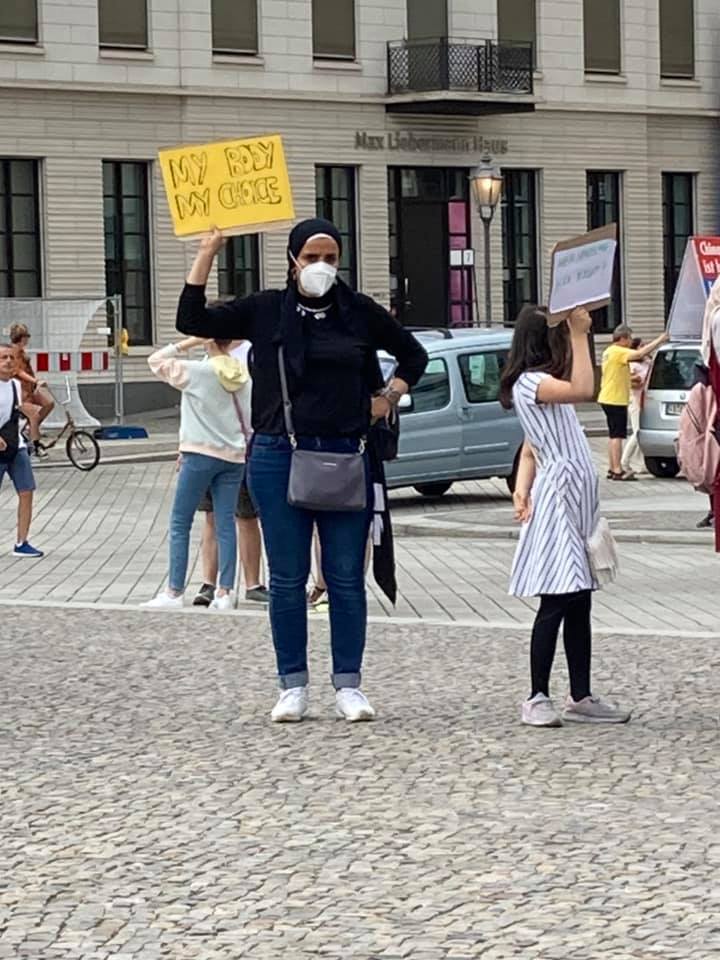
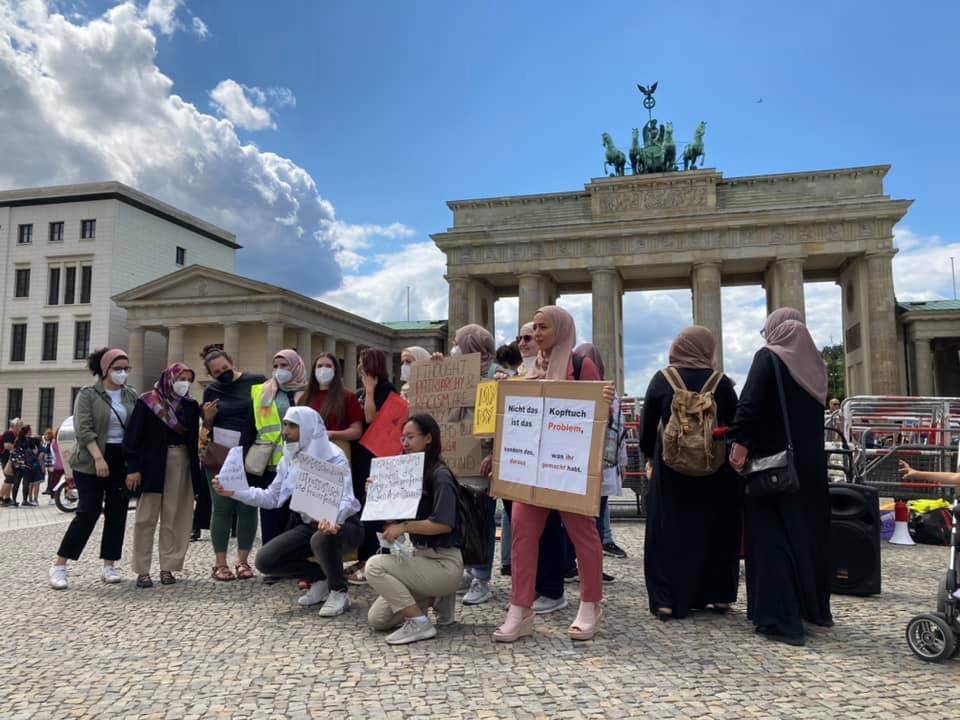
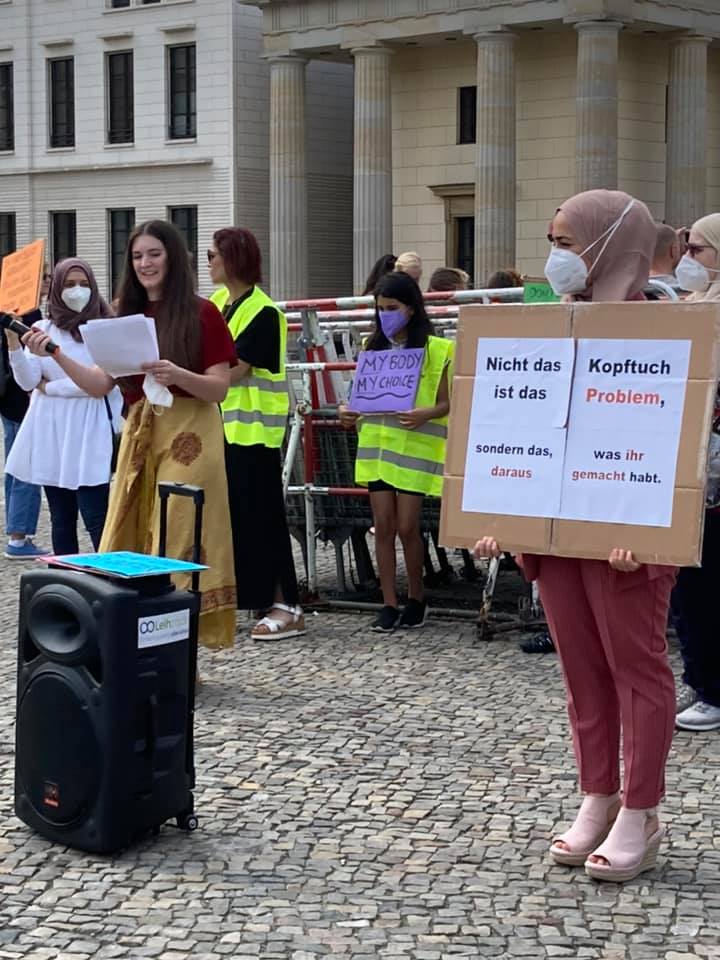
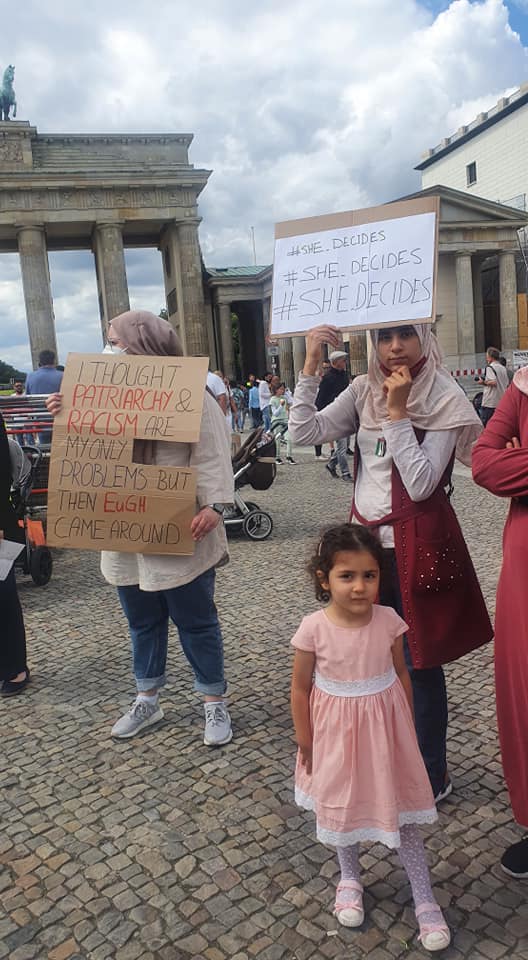
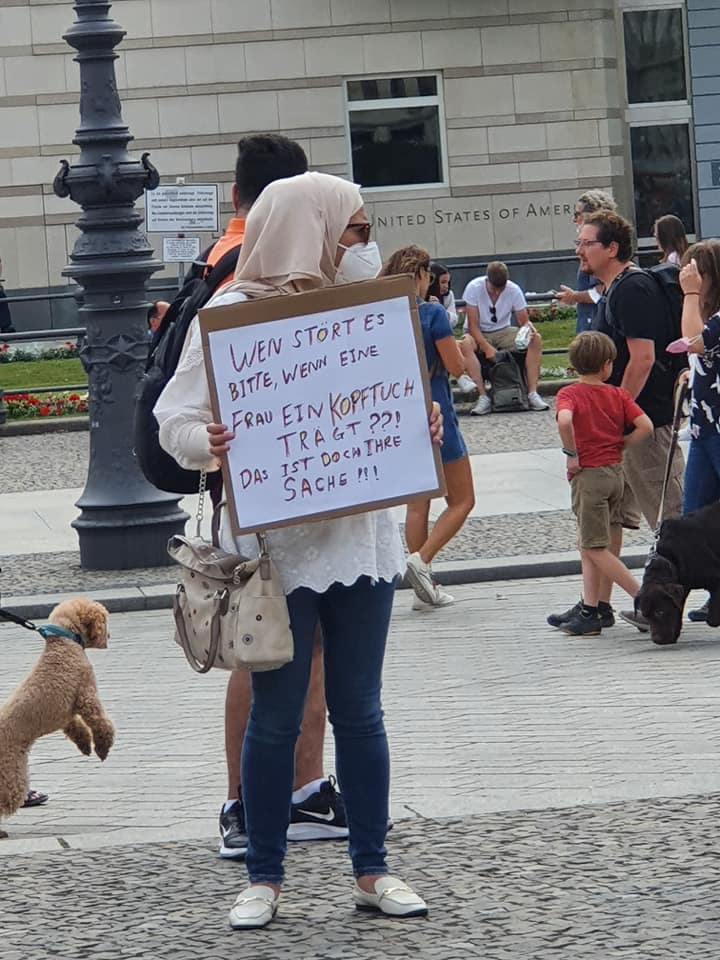
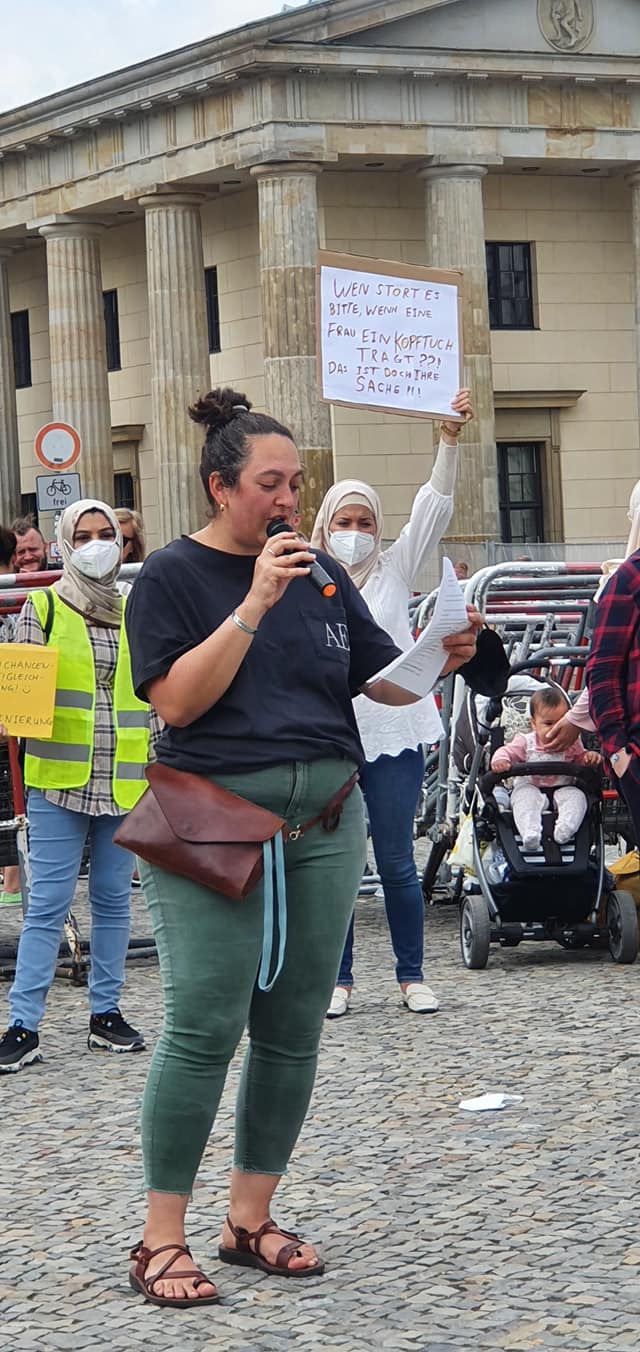
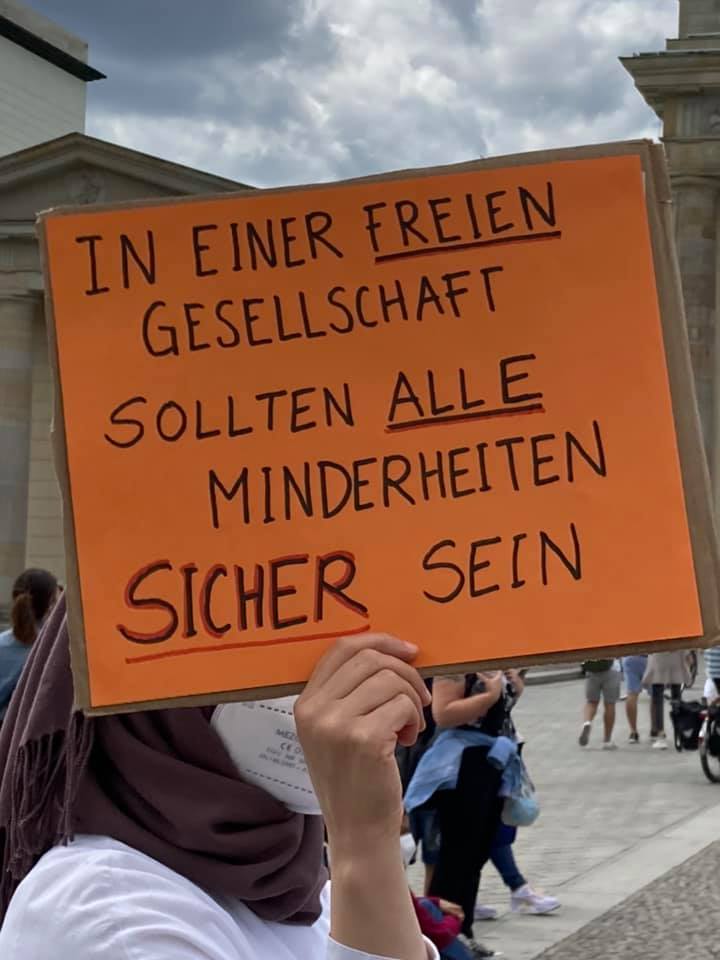
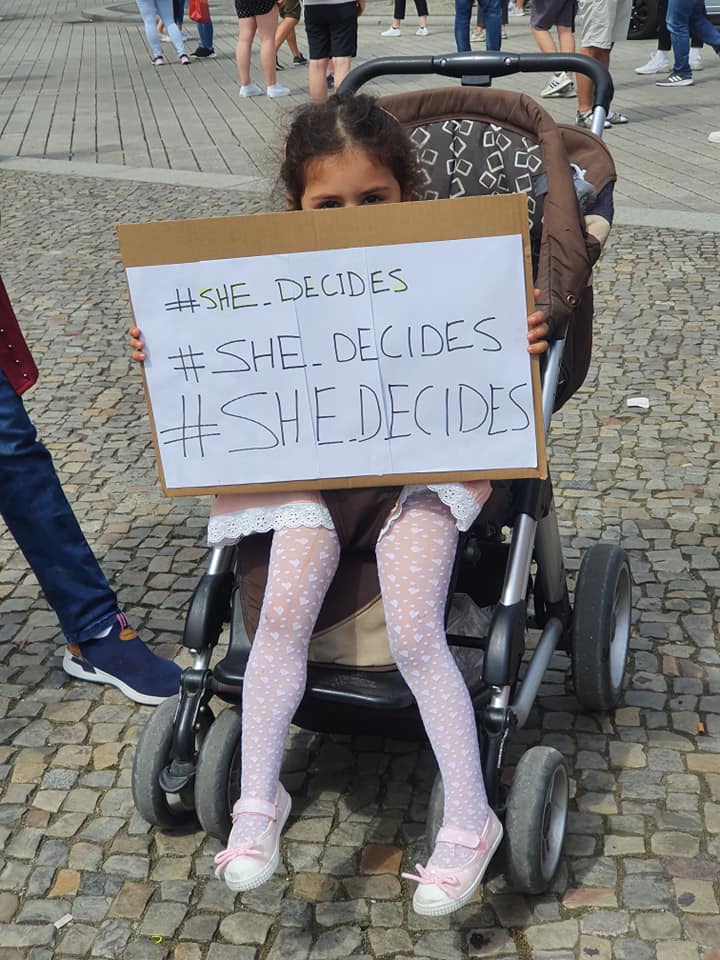
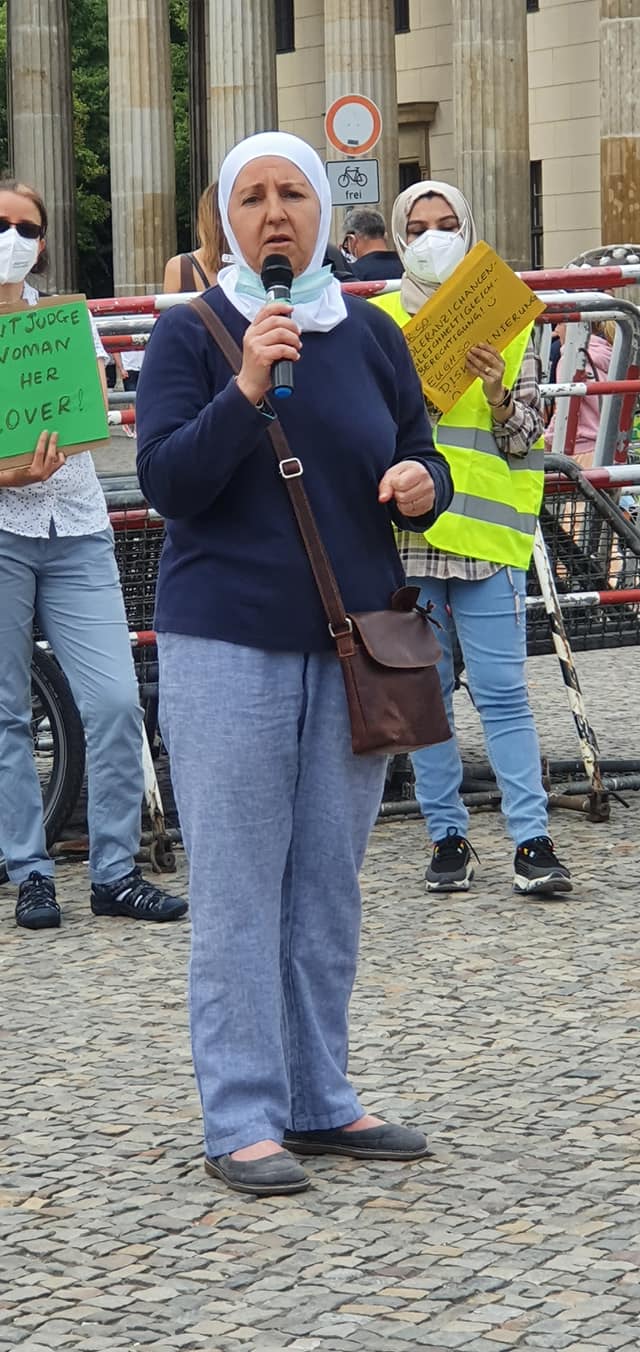
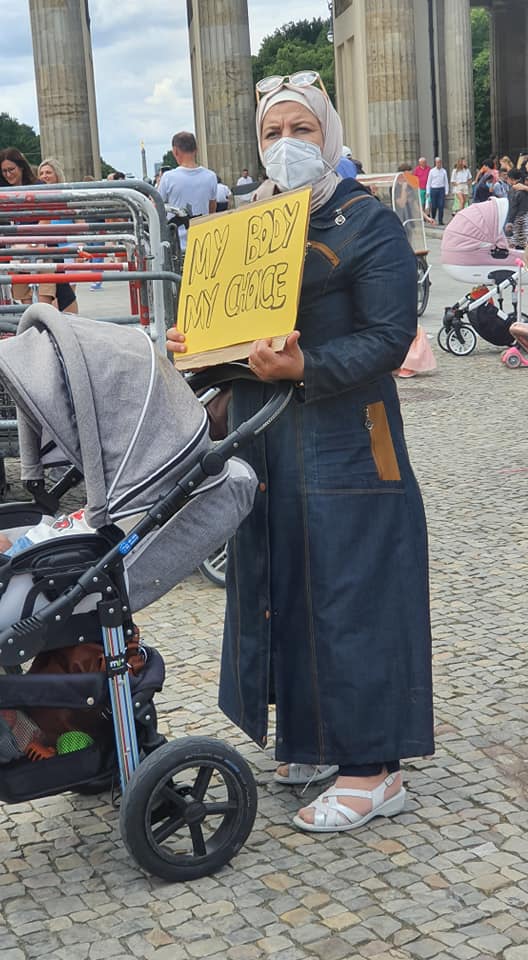
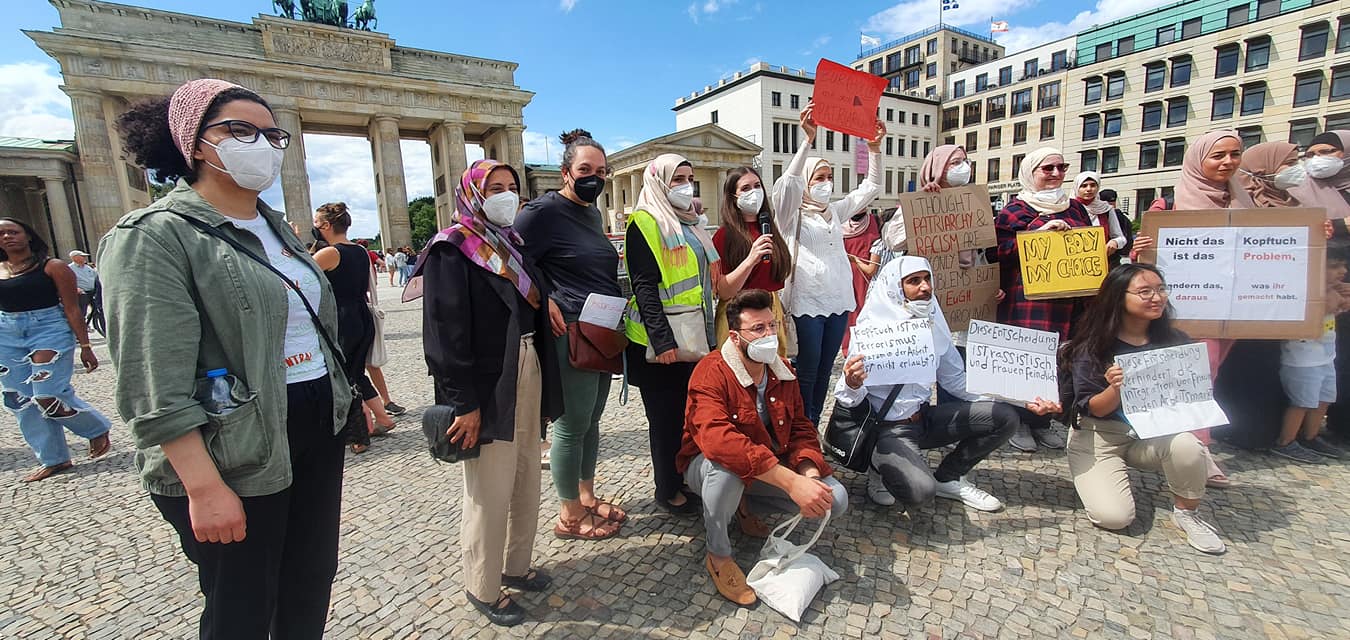
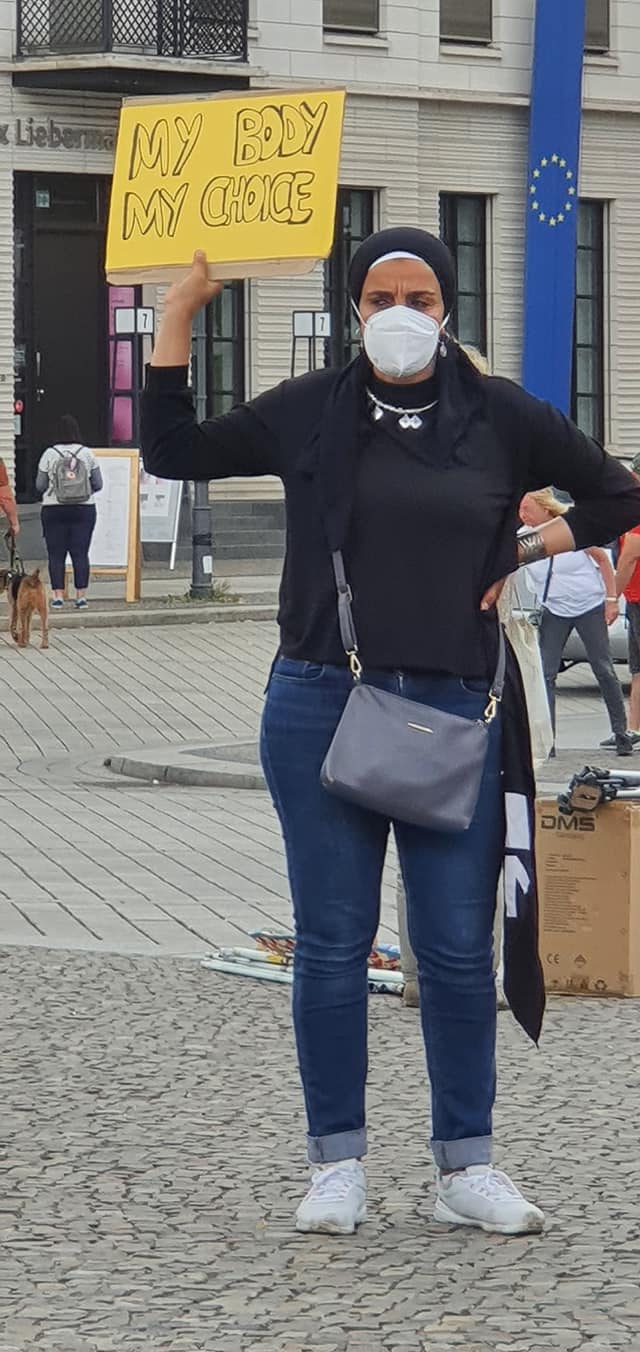
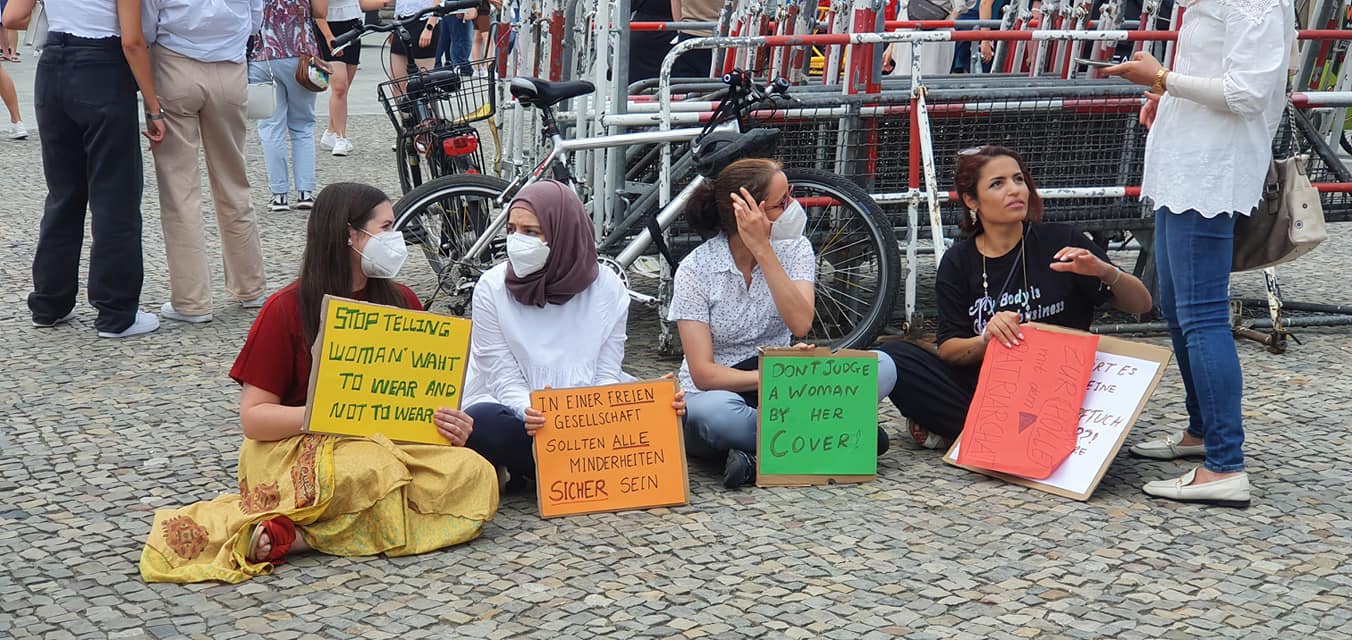
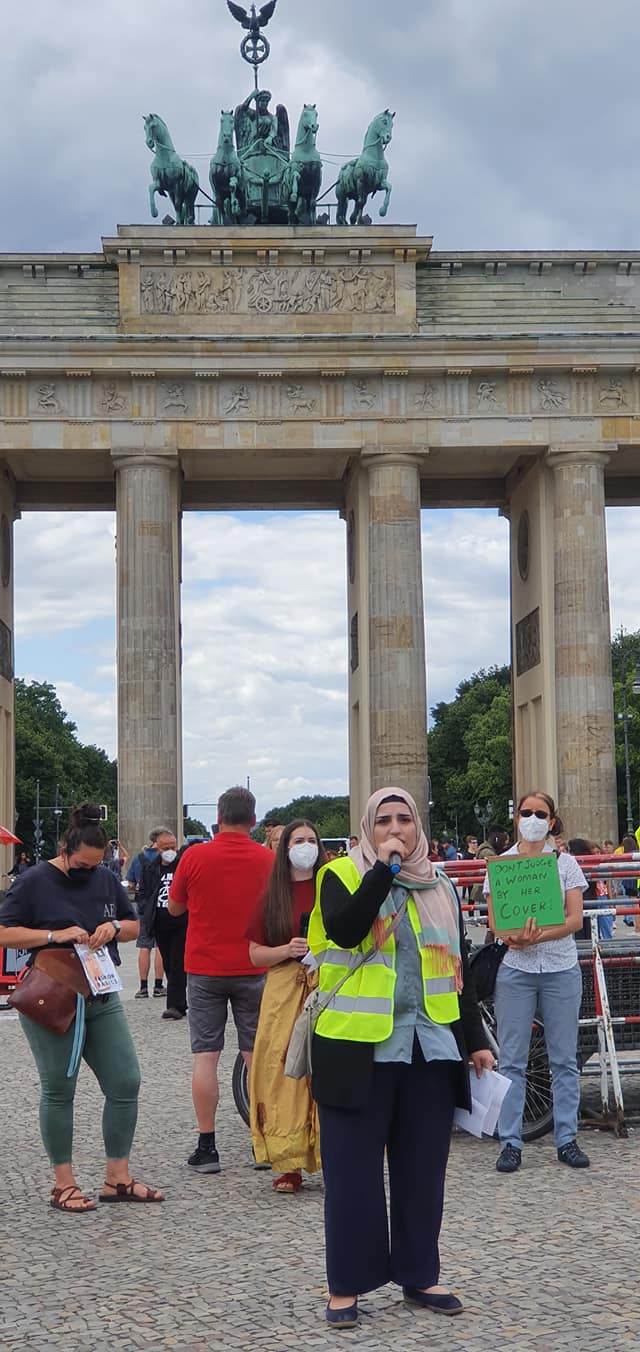
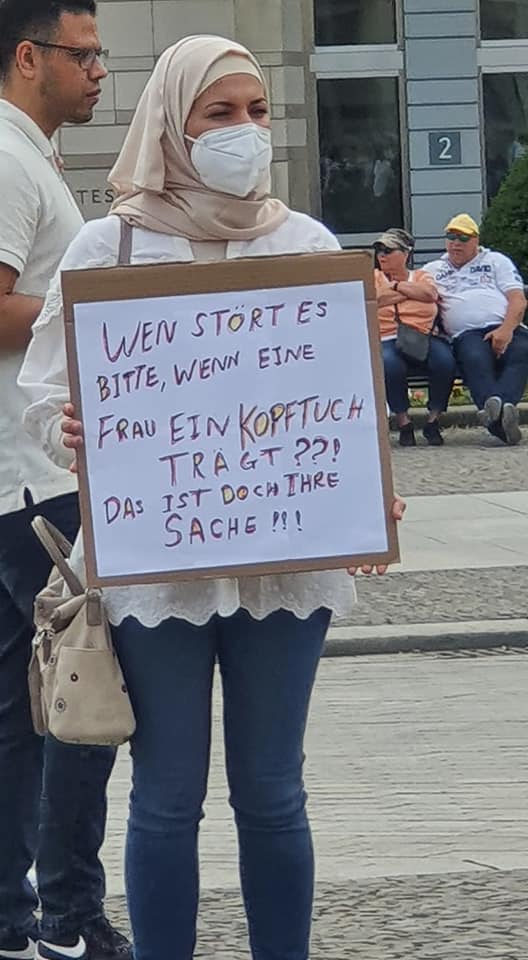
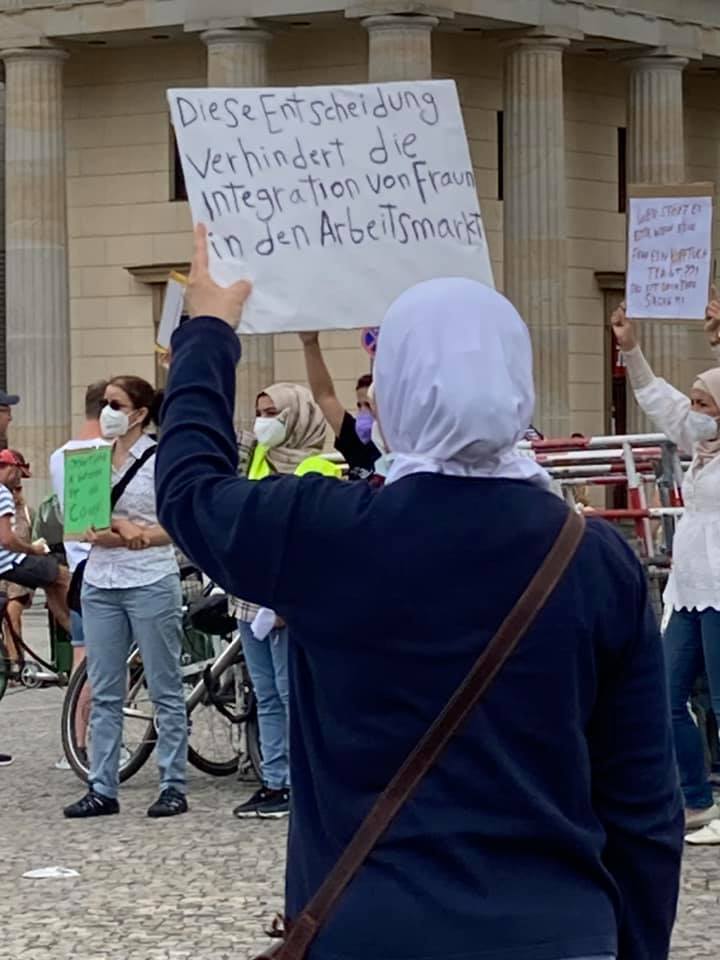
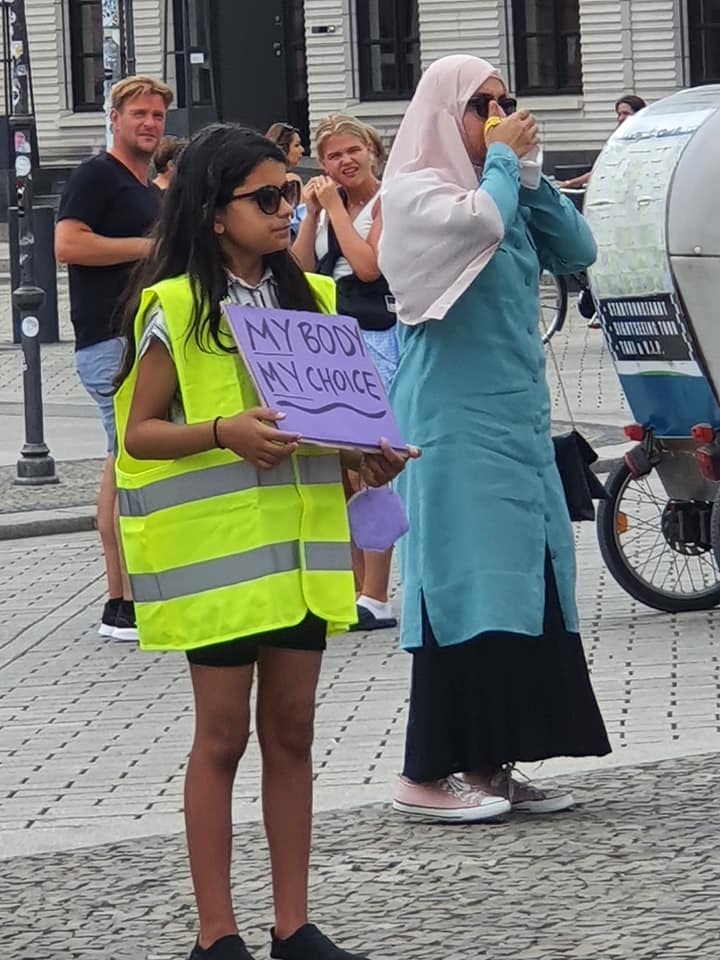
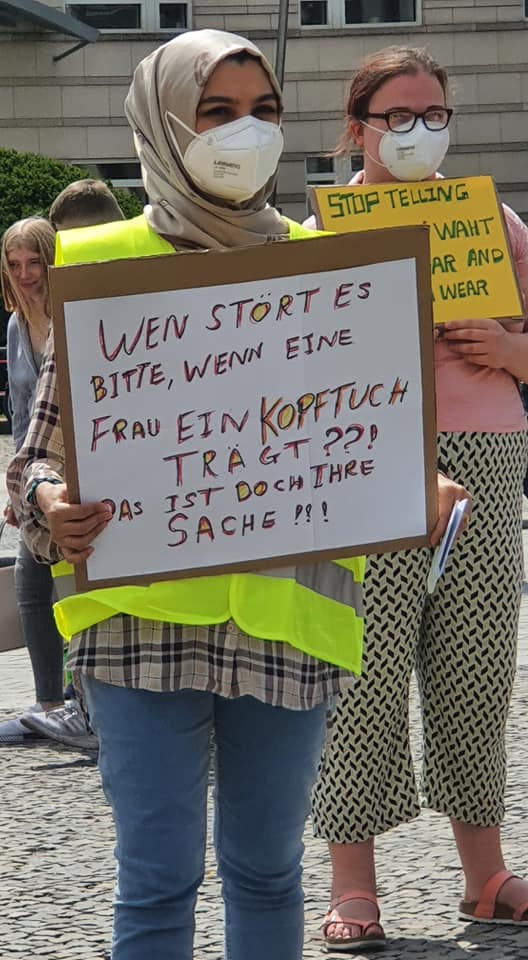
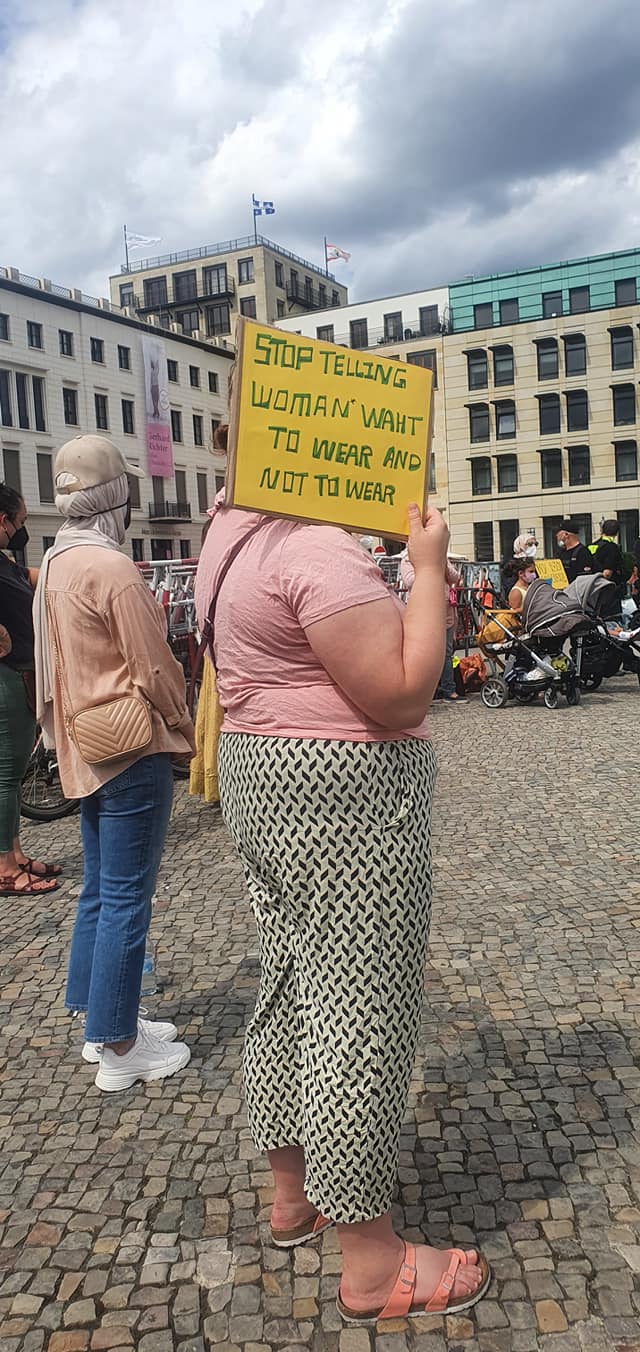
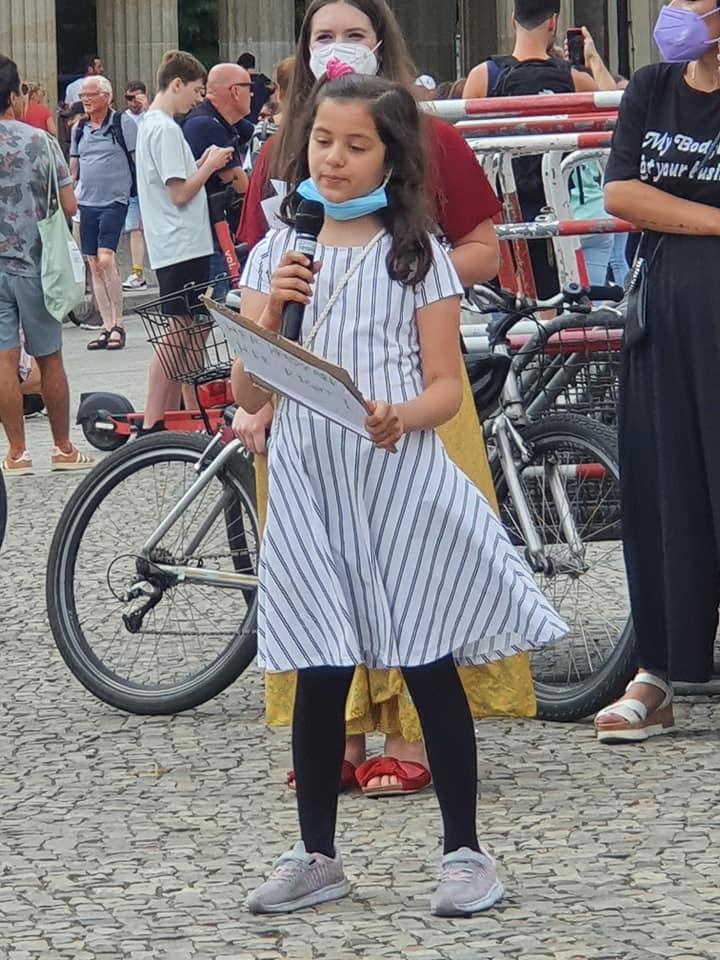
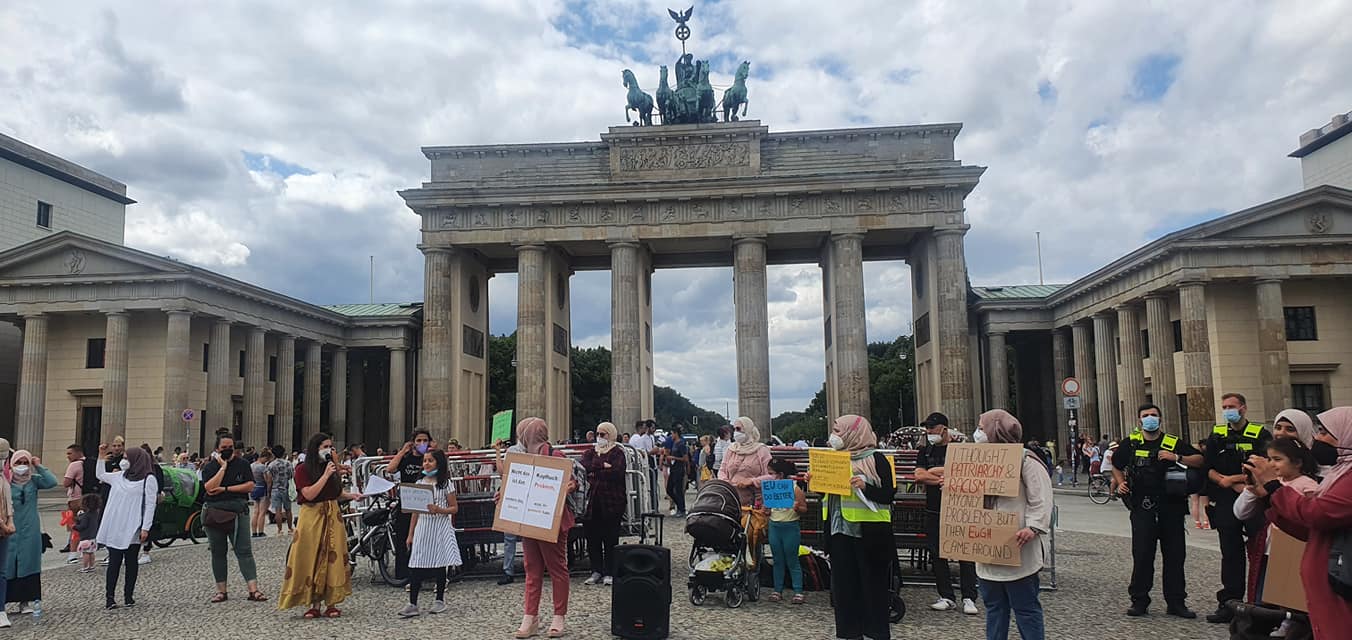
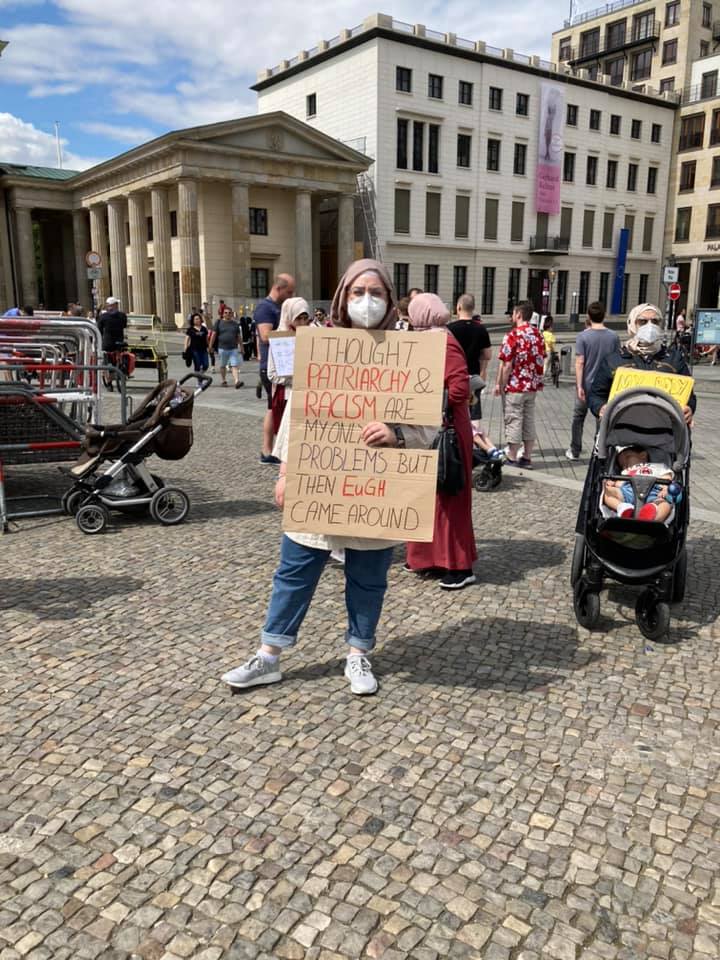
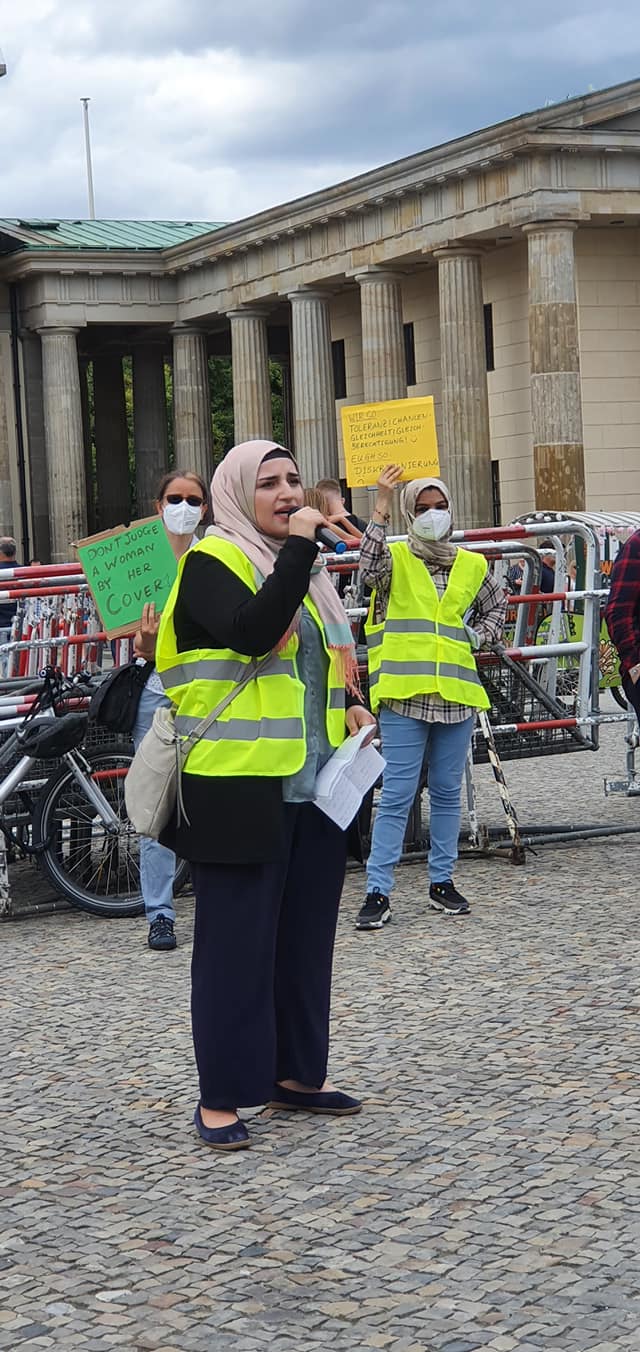
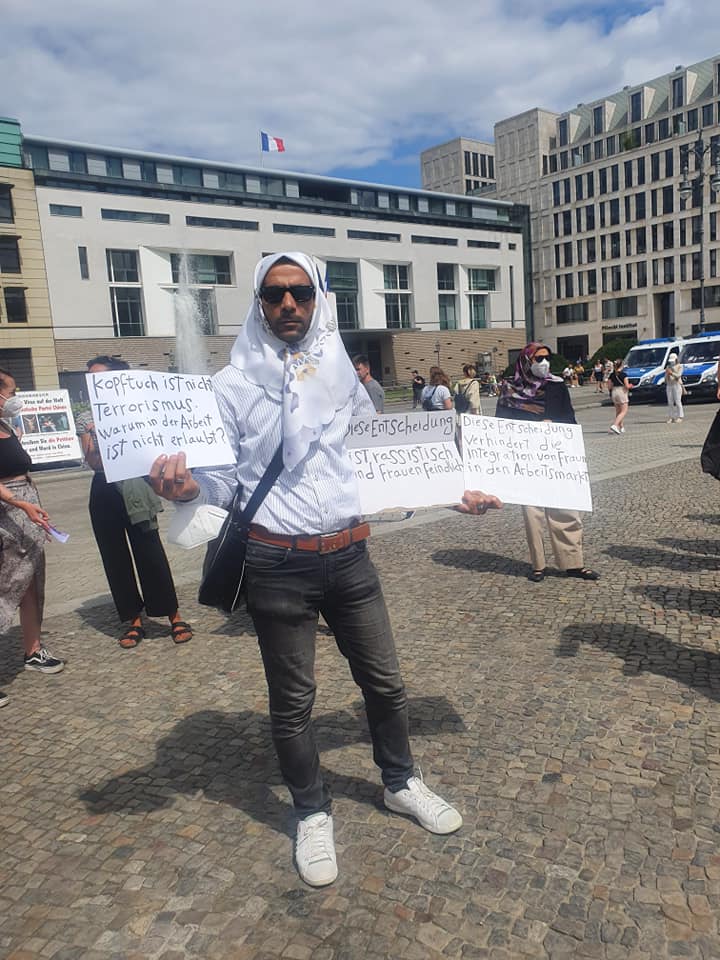
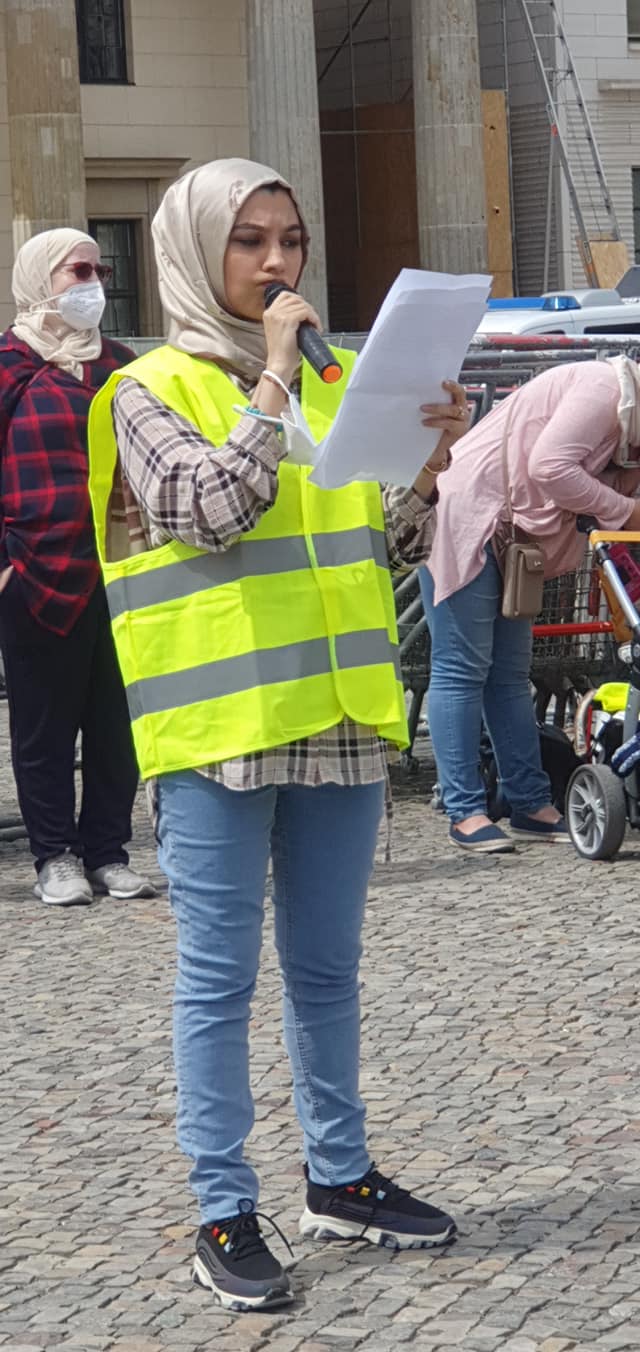
31st July, 2021 Brandenburger Tor.
The Left Berlin
31/07/2021

A new ruling could result in headscarves being banned throughout the EU. This is a serious attack on the rights of Muslim Women. Interview with Asha Faria-Vare
Phil Butland
30/07/2021

Hello Asha, thanks for talking to us. Could we start by you telling us a little about who you are.
Thanks for your interest in the demo! I am a British citizen from the Forest of Dean who has been living in Germany for about five years now. I’ve got a bit of an eclectic background: I’ve gone from being a trapeze artist in the circus, to being a Classical pianist, to running rap workshops in Palestinian refugee camps. Right now I’m studying my Masters in Kulturelle Musikwissenschaft in Göttingen but I also lead the UK team for a flight compensation company based here in Berlin. In terms of activism, I ran a gender equality blog when I was a teenager and also wrote and performed many a protest song (on my gee-tar) for all kinds of causes at all kinds of events. The upcoming demo will actually be my first time on the mic without a musical instrument.
On 15th July, the European Court of Justice passed a “neutrality” law banning certain clothing in the workplace. What exactly does the law say and who is affected?
So the decision passed by the European Court of Justice is not a law in itself, it clarifies questions about the interpretation of the EU Council’s existing framework for equal treatment in employment and occupation (Council Directive 2000/78/EC) and provides preliminary rulings in two cases brought before the court by Germany’s Federal Labour Court.
To summarise briefly, the court found that, while the existing EU framework prohibits both direct and indirect forms of discrimination, indirect religious discrimination may be justified under certain circumstances provided that there is a “genuine need” for the employer to prohibit visible forms of religious expression. Indirect discrimination, according to the court, occurs when all visible forms of religious expression are prohibited and no particular religion(s) are singled out. A genuine need might be “the wishes of customers” or, when it comes to education, the desire of parents to have their children supervised by people “who do not manifest their religion” while in contact with their children.
Regarding the two causes brought before the court, the court found the policy of one employer to prohibit large forms of religious expression impermissible as it targets specific religions and is therefore directly discriminatory. In the other case, the court found that the employer’s neutrality to be permissible insofar as it obliged people of all religions to refrain from wearing visible forms of religious expression. The court emphasised, however, that the employer must demonstrate a genuine need to implement such a policy, and must ensure that the prohibition in question is limited to what is strictly necessary according to the actual scale and severity of any adverse consequences the employer is seeking to avoid.
The decision of the court represents a major step backwards. While the original directive from the European Council talks of “apparently neutral” provisions, criterion or practices, the new decision fails to question whether or not neutrality policies are in fact neutral but rather broadly legitimises such policies provided that they are implemented by employers for “objective reasons”. That the so-called objective reasons named by the ECJ, such as customer complaints, are forms in which religious discrimination and racism is well-known to take, is suggestive of an intentional decision on the ECJ’s part to undermine the original intentions of the existing framework in favour of a distinctly right-wing interpretation.
In terms of who is affected, Muslim women who wear headscarves already bear the brunt of existing neutrality policies in Member States where legislation endorsing such policies already exists. Thus far, such policies have almost exclusively affected Muslim women; however, other religious minorities such as Orthodox Jews, Sikhs, and Hindus stand to be affected, particularly if member states, emboldened by the ECJ’s decision, begin to support such policies having previously taken a more tolerant approach towards religious practice and identity.
We’ve had a similar neutrality law in Berlin for just over 3 years now. How has that been going?
More trouble than it’s worth, I like to think. The State of Berlin first introduced its Neutrality Act in 2006 and has had difficulty implementing it ever since. It has at various times been ruled entirely unconstitutional, to some extent unconstitutional, and has seen multiple states of revision. In its initial stages, the Act, clearly targeted towards Germany’s growing Muslim population, excluded the prohibition of jewellery items such as crucifix pendants worn on necklaces. It was subsequently revised to include prohibitions on any visible form of religious expression and ultimately deemed constitutional under the condition that it is implemented in schools only when there is evidence of a “sufficiently concrete danger” to the school’s peace and state neutrality. In a city as diverse as Berlin, judges have generally taken a sceptical view towards the implementation of neutrality policies in schools as the implementation of such policies appears to pose a greater threat to peace than the absence of them, which makes a strong case for religious discrimination. Less diverse states, such as Nord Rhine-Westphalia, have had more success implementing neutrality acts.
The judgement says that it treats all religions equally. What’s wrong with that?
Of course all religions are not equally affected by the implementation of neutrality policies. For many Christians, the act of wearing a crucifix pendant is symbolic and removing it has no bearing on their religious practice. By contrast, many Muslims believe that covering the hair belongs to a broader concept of Hijab, or modesty, and is an obligatory requirement of the religion. This means that if a Muslim woman were to remove her headscarf, it would actively affect her ability to practice her religion. Muslim women are more likely to be forced out of the workplace as a result, which is extremely disheartening since they face enough difficulties accessing it on account of not only their religion but also their ethnicity and gender.
This is where the recent decision gets interesting: the ECJ acknowledges that religions for which visible forms of expression are religious precepts are more adversely affected by neutrality policies than others, it just doesn’t care. If we go back to the EU Council’s equal treatment framework, we find that it makes the same distinction between “direct” and “indirect” discrimination where discrimination is defined in terms of the action taken by the employer and not by the impact of these actions on employees. The adoption of this definition is less problematic here because both direct and indirect discrimination are ruled impermissible except under the strictest of circumstances. The framework allows member states to determine under which circumstances such discrimination might constitute a legitimate aim but, in light of the other provisions in the framework, it seems fairly obvious than any such circumstances should improve the situation of groups facing discrimination and certainly not legitimise harmful discrimination against them. In its totality, the equal treatment framework could and should be used as a tool for promoting religious tolerance.
What certain Member States (such as Germany) have done is exploit the freedom to define “legitimate aims” under which an employer might impose a policy of neutrality in order to create discriminatory legislation such as Berlin’s Neutrality Act. As we have seen in Berlin, some legislators went overboard and then had to work backwards by making the discriminatory elements less explicit in order to pass the legislation off as constitutional. Of course the original intentions of this legislation, to ban headscarves, has never changed, it has just been repackaged, but the questions surrounding its legitimacy have remained. This is essentially how two German cases ended up being referred to the ECJ for clarification.
What I find sad, or perhaps frightening, is that the ECJ was presented with a major opportunity to make good on the equal treatment framework, and they chose not to. Given the rise in far-right extremism and attacks against Muslims, the ECJ could have decided to take member states in another direction, but they opted instead to lean into it. The equal treatment framework also highlights the intersectional nature of discrimination but the ECJ did not consider gender based discrimination anywhere in their judgement. I cannot help but question their motivation and wonder if the European Union currently feels so unstable that it is scapegoating the increasing population of immigrants from outside the EU to maintain its legitimacy.
So far, neutrality laws have stopped women wearing headscarves from teaching or practising law, but not from cleaning schools and courts. Are double standards at work here?
Oh absolutely, if the position is something that the dominant culture affords a higher status to, a higher value, we feel affronted when we find people who do not look like us in that position and actively oppose it, legislate against it even. That’s when you hear “immigrants are stealing our jobs”. When it comes to menial positions or positions we attribute less value to, we barely pay attention to whether or not the person working is wearing a headscarf or not. The lower position is in keeping with the lower status we afford the person and, since it doesn’t ruffle our feather, we passively accept it.
Many supporters of neutrality laws say that by banning headscarves, they are protecting women as the headscarf is a symbol of women’s oppression. Is it that simple?
I feel like I’m a good person to answer this because I once joined my school’s debate team specifically to argue that the headscarf is oppressive and I remember clearly why I felt that way. I come from a place where we have a history of women being forced to cover up, so showing some skin represented, in my opinion, freedom from oppression. It logically followed that any requirement for women to cover must mean that they are oppressed by men. Simple, right?
Wrong. I tried to ignore the Muslim women telling me that Islam gave rights to women, convinced as I was that they are victims of the patriarchy, but after a while I decided to look into it (moving to a Muslim country helped). Turns out they were right, Islam really did give rights to women, substantial rights too given how women had been treated in the Middle East until that point. It has hardly surprising then, that when the Prophet Muhammed’s (SAW) wives, elevated members of Islamic society, began to wear headscarves, other women followed suit. It was a mark of pride, of prestige even. Within this context, the concept of hijab, when revealed to Prophet Muhammed (SAW), was readily accepted. The headscarf is not only a religious requirement then (a requirement of Allah, not of a man – that’s important), but it might also be regarded as symbolic of a religion that improved the status of women as well as a cultural practice. In Western societies, where women’s bodies are extremely hypersexualised, the headscarf represents for some Muslim women a position in opposition to this form of misogyny, it represents bodily autonomy.
To be honest, the headscarf is so ubiquitous in Muslim countries that at some point it’s like how men tend to have short hair while women tend to grow their hair. Many societies visibly distinguish between genders but you wouldn’t tell a woman she’s oppressed because she’s got long hair. When I visited the West Bank, I discovered that there is a headscarf for every personality type. There’s so much room for expression that even if someone is following a cultural norm, religious or not, it does not necessarily mean they are suffering. On the contrary, it might represent an important part of their identity, it might be the thing that makes them feel good about going out into the world.
I would like to mention that there are certain governments that exploit religious concepts, such as hijab, to oppress women. As a result, some women see that headscarf as symbolic of violence. It is important to understand that it really is complex and there are multiple truths, there are any number of ways in which the headscarf might be perceived. What is important is that we do not assume we know better than the person who chooses to wear it.
Many on the Left are proud atheists. Should religious matters like this concern socialists?
Yes, we should be opposed to all forms of oppression regardless of our personal beliefs. Oppression is a system that will continue to succeed if we allow some groups to be oppressed by the state and not others. In this case, many issues intersect including racism and sexism so if the religious aspect alone is not enough to get you on board, perhaps you can find another reason to support the cause. I believe the ECJ’s decision represents a strategic positioning towards the right and I would urge anyone on the left not to overlook this move on account of any personal religious (or even anti-religious) beliefs.
What actions are you organising and do you have plans for the future? How can people support you?
I expect I’ll do some networking at the demo and maybe some more activities will come out of it, but I have nothing lined up for the moment. I am pretty flat out with work and university so I took a step back from activism… at least I thought I did… but then things like this happen and I just can’t help myself.
Questions by Phil Butland. If you want more information about further activities, you can contact Asha on afariavare01@qub.ac.uk . We will continue to provide coverage on theleftberlin.com.
Protest Against New EU Ruling Which Allows Workplaces to Ban Visible Forms of Religious Expression: Saturday, 31st July, 1pm at Brandenburger Tor
Finally released in Germany, this Black Panther film is well worth watching
Phil Butland
29/07/2021

Chicago, 1968. Martin Luther King has just been assassinated and cities are being burned down by Black activists recognising that non-violence can only take you so far. The war in Vietnam is intensifying and body bags are returning home in increasing numbers – particularly in poor black communities. There is a political vacuum waiting to be filled.
Enter the Black Panthers with a peculiar mixture of Maoism, armed self-defence and community organising. Armed men (and some women) patrolling the racist police may be getting all the news coverage, but it’s the schooling and free meals for kids that are winning the Panthers widespread support in the community. Added to this, under the local leadership of the charismatic Fred Hampton, they are successfully approaching gangs – including gangs of Latinos and Whites – proposing joint action against a common enemy.
Daniel Kaluuya is excellent at giving us a grasp of Hampton’s oratory. Politically radical, but with a strong sense of a liberationist preacher. From the call and response to the background of insistent drumming a la The Last Poets or Gil Scott-Heron, his style is compelling, making the committed feel that they are really part of something and persuading ditherers to get involved.
But the Panthers are up against something more than random arrests and police violence. FBI head J Edgar Hoover is worried about their ability to unite resistance against not just the government but the “American way of Life”, particularly under Hampton’s leadership. He deploys a series of spies to infiltrate the Panthers, and to foster a feeling of mutual distrust.
Just in passing – the main acting credits go elsewhere, and deservedly so – but it was a neat move to cast a highly prostheticized Martin Sheen as Hoover. Sheen is a left-liberal activist and usually cast as one of the nice guys. This gives the foul racism coming out of Hoover’s mouth even more impact. He wasn’t just a right-wing manipulator – he really believed in what he was doing.
Bill O’Neil (LaKeith Standfield) is recruited as one of Hoover’s spies. O’Neil is a petty criminal, who we see in an early scene entering a bar with a fake FBI ID trying to scam one of the drinkers out of his car. He is caught and, with a prison sentence hanging over him, is “encouraged” to infiltrate the Panthers, where he gradually rises to become local head of security while passing on information to his FBI handler.
Much of the film is about the conflict felt by O’Neil towards people for whom he starts to feel affection, and possibly – this is left unclear – empathy for their political ideas. O’Neil is a coward who is proud of his ability to escape detection – a sly smile after he convinces a colleague about his innocence speaks volumes. But at the end of the day, he’s just another Black man who the FBI is using to destroy his own community. And he probably knows this.
There is another article to be written about how this film is leagues better than Aaron Sorkin’s self-indulgent Trial of the Chicago 7, in which Hampton plays a supporting role. And maybe I’ll write that article one day. Let’s just say that it is a rare occasion to see a film which not only shows sympathy for (a strand of) revolutionary socialism, but one that is also well made and acted.
So let me get to the little thing that is slightly perturbing me. I’m not really sure what the film is trying to say about the relationship between radical leaders and organised resistance. It is clear about what Hampton thinks. When he’s about to be put in jail (again), the comrades offer him money to flee to Cuba or Algeria. He rejects the money, saying that its better spent building a hospital in the community. What we do is much more important than specific individuals.
And yet the rest of the film seems to be pleading something different. When Fred is jailed for the first time, membership and support for the Panthers goes down – despite Hoover worrying that jail could turn him into a martyr. There is an interesting discussion about the extent to which the growth of the Panthers in Chicago depended on Chairman Fred’s individual charisma or on what the party structures were able to achieve (I would sit on the fence on this one, mumbling that the relationship is somehow dialectical).
But that’s not what films should be doing anyway – even films as radical as this one. The fact that an Oscar winning Hollywood film could even provoke such a discussion about revolutionary leadership sets this aside from almost all the competition. Judas and the Black Messiah doesn’t solve all the problems of the world, but within 2 hours it has a pretty good go.
This is no time for abstract debate. Unite to fight a serious – and dangerous – right wing attack

by Phil Butland and Anna Southern
Across the world, Trans rights are under attack. Right wing governments are introducing anti-Trans legislation and the religious and fascist right are gleefully adding Trans rights to their campaigns against women’s rights and gay rights. Antisemitic conspiracy theorists have added ‘transgender ideology’ to their hateful conspiracies about Jewish world domination.
Yet in the UK, a strange alliance of radical feminists, conservatives, and a portion of the Left are apparently in agreement. This UK phenomenon is based on the premise that Trans rights undermine or conflict with women’s rights. We will address this point later in this letter, but first a quick summary of the extent of the current offensive.
The Attacks on Trans Rights are worldwide …
In the United States, over 110 anti-Trans bills across 37 states have been proposed by Republican law-makers this year. The Republicans pushing the anti-Trans legislation are also, of course, against abortion rights, which means that they are simultaneously pushing anti-abortion legislation.
In Spain, the ultra-conservative Catholic group Hazte Oír instigated an anti-Trans bus campaign. The far right Vox party backs this campaign, which also has targeted abortion rights and attacked LGBT groups and women’s associations.
In Hungary, Victor Orban’s far-right government passed a law in 2020 ending legal recognition for Trans and intersex people, as part of a wider attack on LGBT rights in the country.
In Poland, attacks on LGBT rights have come hand in hand with attacks on women’s rights. ‘LGBT Ideology Free Zones’ and anti-LGBT ‘Family Charters’ have been set up in nearly 100 Polish regions, towns, and cities.
In Japan, Trans people must be diagnosed with a mental disorder and be operated on and sterilised if they want to have their gender identity recognised. They must also be unmarried and have no children under 18. A Trans woman living in Japan is now suing the Japanese government for the right to be recognised as a woman. If she wins, she and her wife will make history as Japan’s first same sex married couple.
… and in the UK
In the UK, there has also been a recent surge in transphobic hate crimes. Between 2019 and 2020, transphobic hate crimes rose by 16%. Media coverage about Trans people is often toxic, with Trans people often depicted as aggressive, predatory, and unreasonable.
An atmosphere of moral panic has been whipped up. The UK Conservative government has postponed changes to the Gender Recognition Act (GRA) which would allow Trans people to self-identify their gender. There is hope though, as recent polls show that a majority of UK people, especially women, support Trans rights.
Recently, a UK woman named Maya Forstater won an appeal against an employment tribunal. The original tribunal took place after Forstater’s work contract was not renewed due to complaints about her online and workplace bullying, which included her repeatedly misgendering Trans people.
The initial tribunal had found that her anti-Trans beliefs were not protected by the Equality Act 2010, were a threat to the dignity of Trans people, and were not ‘worthy of respect in a democratic society’. The appeal found that her beliefs should have been protected and she will get a new tribunal.
The strange alliance of Trans exclusionary radical feminists, conservatives and ‘gender critical’ minority of UK leftists celebrated this victory. And yet Trans activist Laura Miles explains the real consequences of the ruling:
transphobes and gender critics will see this outcome as a political victory and a license to abuse and harass trans people at work, online and in the streets, as well as a step forward in their strategy of seeking every means possible to undermine trans rights and exclude trans people from social life.
It will undoubtedly make it more likely trans people will be subject to yet more hate speech by those defending their system of transphobic/trans-critical beliefs as being legally legitimate. The tribunal seems to have ignored the proven link between the expression of exclusionary views and exclusionary behaviour. Words have consequences.
So what is the disagreement?
Writing for Counterfire, Lindsey German put the case for what we’ll call the “fence sitting” position. Much of the statement is uncontroversial – the left is split on Trans rights (in Britain at least), and this split must be overcome through respectful discussion and joint activity against oppression. Moreover, oppression does affect working class people disproportionately and cannot be reduced to biology.
Other parts of the statement are less convincing. This is in part because of the nature of the statement. It is a plea for free discussion, which avoids spending too much time outlining what exactly the discussion is about. This is a legitimate method, but it almost inevitably means that some bones of contention are either ignored or misrepresented.
Let’s start with the statement that there is a ‘conflict’ between the rights of women and Trans people, which ‘has to be discussed and debated’. As the statement does not explain what this conflict is, further discussion and debate is somewhat difficult.
So, let us make a couple of assumptions based on what we have experienced from the current debate. Our assumptions are made in good faith. Should the plea for discussion and debate be about something else, then let’s talk about these specific issues rather than engaging in an abstract discussion about free speech.
Is it about toilets?
One of the main arguments used by “trans critical” people is that men could register as Trans in order to enter women’s toilets and harass women. This is an argument that originated with the right wing and is reminiscent of similar arguments used against gay men in the 1980s. It also has little to do with the reality of what is happening at the moment.
In countries such as Ireland which have introduced Self-ID years ago, we cannot find any evidence that men have been registering as Trans to smuggle themselves into toilets. Besides which, the Equality Act 2010, already gives Trans people in the UK the right to not be discriminated against. This explicitly includes access to toilets.
Similarly, the same act already contains the potential for exemptions for spaces such as prisons and women’s shelters, and admissions are already considered on a case-by-case basis.
How split is the Left on the issue?
A second weakness of the article is that the statement that ‘many’ of the left and Trans people ‘take different views’ is misleading. It gives a false impression that the Left and Trans people are split down the middle on the issue. Let’s be clear about this. The ‘gender critical’ faction represents a clear minority of the British Left and is effectively non-existent in most other countries.
None of this means that the Left should not discuss these issues, but nor does it mean that all views are equally valid. This would be a ‘postmodern idealist view’ rightly criticized elsewhere in the statement.
It is not too long ago that a significant proportion of the Left thought that being gay is a ‘bourgeois deviation’ and held some very sexist views on women. Even today, many Leftists support immigration controls on the basis that people born in ‘our’ country deserve more rights than those born elsewhere.
The fact that these ideas are sincerely held by people who take a good position on other issues does not make them right. Nor does it give people who hold these ideas the right to be invited to speak about them on every leftwing panel. While No Platform should indeed be only used against Fascists, this does not mean that our meetings should have to contain speakers telling ‘all sides of the story’, including ideas which we find repellent.
Who is splitting the movement?
This brings us to our final argument (for now). The article is quite correct to point out that ‘the trans debate on the left is in danger of turning people who should be potential supporters and allies into enemies’. But who exactly is splitting the movement?
The statement argues that claiming that ‘those who do not agree on questions of gender are transphobes, TERFs, bigots’ weakens the movement as a whole. This implies that the main splitters are Trans people reacting to Leftists who claim to support them while wilfully misgendering them, accusing Trans women of being potential rapists and insisting that Trans women are not women.
At a time of unprecedented attacks on Trans rights, some sensitivity is required. We could add that the article is also weak on recognising and responding to the reality of oppression against Trans and non-binary people
The attacks of some Leftists on Trans self-identity seems to be at best an academic distraction from the main debate. At worst it involves people who claim to be socialists using the same language and arguments of the oppressor, enabling and providing left cover for what are objectively reactionary positions. Such paternalism is no basis on which we can build a movement of solidarity with victims of oppression.
Solidarity comes first
We stand in solidarity with our Trans sisters, brothers, and siblings around the world in their fight against oppression. We believe that women’s rights and Trans rights are not in conflict, but are under attack from a common oppressor. The framing of the Trans fight for liberation by some feminists and leftists as a fundamental clash with women’s rights has only served to divide us at a time when we need to be united against a serious right-wing threat.
As Laura Miles puts it, ‘Equal rights is not a finite cake where different oppressed groups have to fight each other for bigger slices. Austerity and racism affect all of us: there is a common class enemy. Socialists start from the notion that an injury to one is an injury to all’. Our ‘gender critical’ comrades would do well to remember it.
Anna Southern and Phil Butland are both British socialists based in Berlin. We are very grateful to Laura Miles for giving feedback on an early version of this article, and wholeheartedly recommend her book Transgender Resistance: Socialism and the Fight for Trans Liberation to anyone wanting to know more about the fight for Trans rights.
If Hungary, India and Saudi Arabia passed the human rights test for NSO spyware, just how low was that bar
Tina Lee
28/07/2021
Last week a consortium of journalism outlets and NGOs dropped a bomb of cross-border journalism. According to a leaked list of 50,000 names, at least ten of the world’s authoritarian regimes have been spying on their own citizens, using cutting edge surveillance software developed by an Israeli security firm called NSO Group.
The software, dubbed Pegasus, used malware to give governments practically unlimited access to a surveillance target’s phone, with new hacking techniques that left victims with practically no way of knowing they were being monitored.
Once it has wormed its way on to your phone, without you noticing, it can turn it into a 24-hour surveillance device. It can copy messages you send or receive, harvest your photos and record your calls. It might secretly film you through your phone’s camera, or activate the microphone to record your conversations. It can potentially pinpoint where you are, where you’ve been, and who you’ve met. (Guardian)
The ten countries are known for various degrees of human rights abuses, but the scale of unlawful surveillance was still stunning. (The countries: India, Hungary, Morocco, United Arab Emirates, Dubai, Saudi Arabia, Azerbaijan, Bahrain, Kazakhstan and Mexico.)
The list of numbers belonged to dozens of freelance and legacy news journalists (including a journalist from Mexico who, was murdered under mysterious circumstances), activists, citizen investigators and even a, number of heads of state, including French Prime Minister Emmanuel Macron and the King of Morocco.
India appears to be, one of the most prolific abusers, monitoring opposition party members like former Congress leader Rahul Gandhi, a member of the Supreme Court, a top virologist, journalists, activists and even members of Prime Minister Narendra Modi’s own right-wing Bharatiya Janata Party.
Saudi Arabia’s appearance on the list is not totally surprising, but the, reporting that Jamal Khashoggi’s fiancee was monitored using Pegasus software in the days leading up to his murder is chilling.
Nevertheless, for people living and organizing in Europe, the appearance of Hungary on the list must be the detail that raises the most questions. If Hungary could flagrantly violate the European privacy and human rights laws and get away with it, what does it say for the other countries in the EU? Will Fidesz finally face some consequences?
The consortium of reporters could only confirm Pegasus infection on phones that they could forensically examine themselves- meaning the actual scale of surveillance is still not clear.
Reporting is still coming out daily, but there are a few big questions that are especially relevant for journalists, activists and organizers.
NSO Group has denied that they keep any kind of list like the massive leak that kicked off the Pegasus Project. In fact, they deny that they keep tabs on clients whatsoever, saying that they license software and then have no further insight to how their products are used. These denials make very little sense, for several reasons.
First, NSO claims that each client they license to is thoroughly vetted for human rights violations in cooperation with the Israeli Ministry of Defense. Now, Israel is not exactly the standard bearer for human rights, but even so, the countries on the client list are infamous for harassing, imprisoning, and in one case, dismembering journalists. If Hungary, India and Saudi Arabia passed the human rights test, just how low was that bar?
Even so, they claim that they would stop selling to countries who abuse their software. But if they don’t monitor how their software is used, how exactly would they find out about such abuse? Were they relying on the very journalists being surveilled and harassed to discover abuse of their products?
“The list of 50,000 phone numbers has nothing to do with us.”
Founder and CEO of NSO Group (Haaretz)
NSO has denied making the list, or possessing any list like it. But who else would have had a global overview of each of their clients’ surveillance targets? In some cases, Pegasus Project journalists were able to compare a time-stamp of when people’s numbers were added to list with the attempt to infiltrate the phones, and showed they were within seconds of one another. Who could have access to information like that, other than someone who worked at NSO?
NSO has suggested the list might have been something governments used for “other purposes”, which is maddeningly vague, but again, makes no sense. If you had a surveillance “wish list” for one country, one might assume the leak somehow came from the Security Agency of that country. But having access to hundreds of government surveillance targets spread across the world is incredibly valuable intel.
And if they are lying about whether or not they monitor the use of their software, does that mean they ultimately had access to all the information accessed? And who might they have shared that information with?
NSO employees apparently earn upwards of $30,000 per month, meaning they have strong incentives not to undermine their employer. Could the leak come from someone the data was shared with? Or was someone able spy on the spyware firm?
NSO is ,just one of many such spyware firms, so the fact that certain governments were not on the list does NOT mean they weren’t using similar types of spytech. In addition, the Pegasus Project only revealed ten of NSO’s clients, when there are reported to be around 40. So who else is illegally spying on their citizens, or has the power to do so?
EU Commission head, Ursula Van der Leyen, responded to the reporting with verbal condemnation:
“What we could read so far, and this has to be verified, but if it is the case, it is completely unacceptable. Against any kind of rules we have in the European Union.”
Nevertheless, the government of Hungary has suggested that some of their European Union allies employ similar tactics:
Have you asked the same questions of the governments of the United States of America, the United Kingdom, Germany or France? In the case you have, how long did it take for them to reply and how did they respond? Was there any intelligence service to help you formulate the questions? (WaPo)
It could be a tactic to distract and deflect. But Germany has ,used controversial spyware in the past (albeit, possibly lawfully), and it defies belief that some of the wealthiest and most powerful countries in the world do not have access to such spytech, simply because they weren’t on the Pegasus Project list. How could Hungary possess technology that, say, the UK or Germany would not?
Which leads to our final question: If Germany was not using Israel-based NSO’s brand of spyware, but that of a different country, is it because they knew it was being misused by authoritarian regimes? And if that’s the case, weren’t they basically boycotting Israeli products over human rights concerns?
Inquiring minds and ice cream companies would love to know.