The Left Berlin News & Comment

This is the archive template

Notes from ‘Terf island’

Tories, gender critics and the far right’s war on trans.


07/05/2023

On February 11, 16 year-old Brianna Ghey, a trans school student, was stabbed to death in a Warrington park in the North of England. Two teenagers were arrested for her murder. At first the police claimed there was no transphobic motive but they later suggested that it might indeed have been a hate crime.

Over the following week, dozens of large and angry vigils were organised in towns and cities across the UK. In Manchester three thousand people queued to get into the vigil, there were six hundred in Liverpool, over five hundred in York, over four hundred in Leeds.

Speeches at the vigils expressed rage and sadness at her murder. They clearly tapped a vein of visceral anger that has been building over the accelerating attacks on trans people in the UK and elsewhere. These attacks are driven by the right, even if some feminists and even some on the left allow themselves to be drawn in.

Tories, bigots and whole sections of the media in the UK give free rein to transphobic tropes and gender critical voices. Rarely – vanishingly rarely – do they allow trans people’s voices to be heard. The attacks increase trans people’s fears for the future, but also generate resistance and significant radicalisation among young trans people and their supporters.

Brianna’s murder was shocking but sadly, not such a surprise. Hate words inevitably lead to violence and hateful actions. These grow more serious. In late April there was an arson attack on the home of two trans people and a gay man in Whitechapel, London. Trans people are increasingly a community under attack. Trans health care is being steadily and stealthily undermined; funding for support organisations curtailed and rights challenged by crowd-funded legal assaults which have raised hundreds of thousands of pounds. Many trans people justifiably feel their very existence is under direct threat.

Murders like that of Brianna Ghey may be rare in Britain, but tragic and avoidable suicides of desperate and marginalised trans people are far from rare.

Culture Wars

At the vigils many trans people said it felt like a moment had been reached, in the fightback against the transphobic moral panic. Desires for active resistance to transphobia coincide with a wave of strikes fuelled by high inflation, soaring consumer energy prices and cuts in real pay.

The strikes that began nearly a year ago are immensely popular drew hundreds of thousands of workers into action against a Tory government which trails by 20 points in polls. The Tories just lost hundreds of councillors in the local elections in England. The standard response of governments and regimes in crisis is to ramp up oppression and scapegoat vulnerable groups to divert from their problems.

Resistance to attacks on living standards, transphobia and racist attacks on refugees and migrants has never been so important or so interlinked. ‘Culture wars’ are intended to divide our side, to pit one oppressed group against others and divert anger away from the real culprits, the bosses, the rich and the Tories. Yet there’s a truth that history teaches us – one oppressed group never betters itself by attacking the rights of another or siding with a ruling class against a vulnerable minority. The fortunes of oppressed groups rise together or they fall together.

On the right, the organisations and individuals who attack trans rights also attack women’s rights. Women’s lives don’t improve as the lives of trans people come under attack. In Hungary Viktor Orban’s right wing populist government followed up attacks on trans people by restricting abortion rights, banning gender studies at universities, and declaring LGBT+ rights to be inimical to the nuclear family. In Russia Putin’s government has for years attacked trans and LGBT+ rights. Putin’s tame parliament, the Duma, is now considering a new law to declare feminism an ‘extremist ideology’.

In the US right-wing zealots pushed over 450 anti-trans bills at state level, including genital inspections of children playing school sports if suspected of ‘being trans’, or prosecuting parents of trans children for supporting their child. They also celebrate the Supreme Court overturning Roe v Wade. They also campaign to ban sex and relationship education in schools.

In the UK, the Tory government blocked the vote in the Scottish parliament earlier this year to update and amend the Gender Recognition Act to introduce self-ID. The same government continues to cut funding for domestic violence refuges and refuses to address the gender pay gap. Sunak’s weak and unpopular government plans to force schools and teachers to report LGBT+ children to their parents, directly putting many such children at risk. They drawing from the playbook of anti-trans zealots like governor Ron DeSantis of Florida. De Santis just visited the UK and heaped praise on Tory transphobes like Kemi Badenoch, the Equality Minister.

The fake-feminist gender critical organisations that emerged in the past six or seven years (Fair Play for Women, Women’s Place UK, the LGB Alliance, For Women UK and so on) do not speak for women or even a majority of feminists despite their claims. The vast majority of women’s organisations offering support in areas like domestic violence and rape remain trans inclusive. Indeed, at least one of these organisations was sued by gender critical groups because it employs a trans person.

This in itself gives the lie to the notion that gender critics and transphobes are only interested in protecting women and girls. It comprehensively reveals the hypocrisy of their claims to defend women’s rights. In reality their only purpose is to focus their ideological hostility and political energies on attacking trans people’s legal and human rights, and exclude them from the social spaces they have used for decades.

They ignore the very real threats to women’s rights. They often work with the most reactionary defenders of traditional values and the nuclear family. This includes accepting funding for legal challenges, conferences and so on from the very organisations that work to undermine women’s reproductive rights, bodily autonomy and equal rights.

They bring together people who may claim that they just ‘have concerns’, or just ‘want to debate’ or ‘just want to safeguard women and girls’. But as they become right-radicalised, their resistance to rational argument; their unwillingness to accept credible scientific evidence; and their ideological dogmatism underpinned by sex essentialism and shared hostility to ‘gender ideology’ – tag them as a cult-like hate movement.

Cover for Fascists

Many provide political cover for fascists and antisemites. Their enabling of the far right is the price they pay to promote their shared transphobic aims. Gender critics are notoriously slow to distance themselves from fascists and the right, including their antisemitism. Many legitimise the far right’s transphobia by citing their right to ‘free speech’.

Their shameful political blindness to the far right and fascist organisations constitutes a dangerous entry point for the right’s views. Their ‘anti-woke’, conspiracy theory, anti-working-class agenda, opens the door to fascists – who see trans rights, and anti-migrant agitation, as wedge issues to attract a larger audience.

Since mid-2022 fascist groups like Patriotic Alternative, Hearts of Oak and individuals like Tommy Robinson, often posing as ‘concerned parents’, have been trying to shut down Drag Queen Story Hour events. They and the gender critics have attacked those as examples of ‘grooming’ by ‘gender and sexual perverts’ undermining the nuclear family.

In Australia sieg heiling neo-Nazis supported Posey Parker’s recent ‘Let Women Speak’ tour, was funded by wealthy US organisations like CPAC, the Conservative Political Action Coalition. The protests in Australia and New Zealand were large, angry and successful. Parker (real name Kelley-Jay Keen-Minshull) was forced to cut short her tour and scuttle home.

Yet despite the press and media showcasing of ‘gender critics’, they’ve actually had limited impact on public attitudes towards trans people.  Large UK surveys in 2022 – the ‘More In Common study’ – showed attitudes to trans people remain broadly either supportive or non-committal. A recent Fox News poll in the US found that 57 percent of the population are unhappy with the attacks on trans children.

What’s also been great has been the size of many of the counter-protests in support of Drag Queen Story Hour which have severely blunted the campaigns to shut them down. This is not restricted to the UK. A recent counter-protest in Vienna on April 19 drew over 1000 people to defend the event against around 200 assorted fascists, Catholic bigots and members of the youth wing of the far-right Freedom Party.

Building Resistance

Trans people and their supporters are angry and there’s a growing sense of urgency about building resistance to the onslaught. The minimum waiting time for an appointment at a UK gender clinic is now around 5 years; reported hate crimes against trans people jumped by 56% in one year; gender clinics can’t find staff because applicants fear they’ll attract hate press and social media pile-ons. It’s time to fight back.

Socialists start not from weighing up who’s more oppressed than someone else but from a position of unconditional support for all the oppressed. We aim to be, as Lenin urged over a century ago, tribunes of all the oppressed and exploited. We recognise that oppression in the capitalist system is endemic. It stems from social class, class struggle and the social relations of production and reproduction that arise from this exploitative system. The blind drive to maximise the accumulation of capital spawns one existential threat to humanity after another, encouraging those in power to ‘divide and rule’ and ramp up the oppression of vulnerable sections of society.

The ideology of the nuclear family and the heteronormativity and gender binary assumptions inherent to it are why sexism, misogyny, homophobia and transphobia are so deeply rooted in capitalism. Women’s liberation, gay liberation and trans liberation require the overthrow of the system before they can be achieved.

Building united fronts to defend trans rights is an urgent necessity. These must pull together trans and cisgender people with quite diverse understandings of oppression but who recognise we must stand together against the bigots. For Marxists we go further – we understand the need to see what Marx called the totality of the capitalist system. That requires collective class resistance to fight oppression, and goes hand in hand with fighting the exploitation we face in the workplace.

We argue for building a revolutionary political organisation to unite the most class conscious workers organised to overturn the power of the capitalist ruling class. We need organisations to mobilise the tremendous collective power of workers. Most trans people are also working class and it’s in the interests of not just them but the whole working class to fight transphobia. Just as it is in the class’s interests to fight racism, Islamophobia, antisemitism and sexism.

That’s one reason why it’s so important to fight for trade union involvement in the protests against transphobia, to get banners and delegations from workplaces and unions along to trans pride events, vigils and commemorations. That’s not always a popular position to hold today among trans people. Some activists influenced by identity theory and privilege theory think that trans people should only organise by themselves. But this hardly makes sense when trans people are probably less than one percent of the population. It also relegates cis supporters to the status of ‘allies’, a concept that runs counter to the socialist notion of solidarity.

Some trans activists, especially if influenced by autonomist politics, can be suspicious of trade union and socialist involvement in the fightback. This runs against the need to build the broadest possible working class united fronts against transphobia. We are stronger together, and we need to recognise and involve the potential power of workers in the workplaces. Not least because much trans hostility happens in the workplace and in employment discrimination. Fundamentally a divided working class risks catastrophic defeats.

We socialists say that history is not on the side of the transphobes. We can and will organise to roll back attacks, and we can win. But to permanently stop reactionaries from attacking our gains, we have to pose the big questions. That is how to achieve not just ‘tolerance’ or even ‘acceptance’, but respect and liberation. As capitalism continues to give rise to ever more existential crises for humanity those questions, and the answers that Marxists offer, can no longer be ducked or postponed.


What is Pakistan?

Imagine a military with a state attached to it but is also the 5th most populated country in the world.


06/05/2023

Visiting my “homeland” after 13 years was, among other things, enlightening. For years I hesitated to express any strong opinions on Pakistan because I did not want to become the stereotypical diaspora Pakistani throwing stones at the glass slum from whence I came. I had harboured my suspicions for years about how plainly terrible existence in that country is. Witnessing the prevailing attitudes in person along with Instagram’s algorithm noticing, with Eye-of-Sauron alertness, that I might have some relationship to the country has given some confirmation to my suspicions.

My “for you” page is flush with content from Pakistan that basically falls under three categories: celebrity gossip, politics, and what I would call gristle to the mill of popular libidinal obsessions. The last category obviously needs some explanation. I’ll share an exhibit.

A graphic from a popular Buzzfeed clone in Pakistan

This graphic is the one that nudged me over the edge to write a piece on Pakistan. Notice the framing of a wife “demanding” half of his fortune and the revelatory tone regarding him “dodging the bullet” by putting everything in his mother’s name. The footballer plays for Morocco and Paris Saint-Germain so one wonders why anyone in Pakistan should care in the first instance, but more on that later.

Three essential cultural declarations are being made in this image: fuck women who make any demands on men; never, ever become independent from your mother; a win for any Muslim is a win for Pakistanis. It should be added that the above footballer is also facing charges of raping a woman, but mentioning that may undermine these three declarations.

I can’t overstate the third, implicit declaration. To fully understand it, one has to have a reasonable answer to the question: What is Pakistan?

To begin our inquiry, it helps to know what Pakistan isn’t. Pakistan is 1) not a real country 2) not a republic, and 3) not on the verge of a sudden, fantastic boom of prosperity.

Pakistan is better described as a military with a state glued to it; but the glue is not very good so the military and the state seem to hang on to each other for support, looking like a very uncomfortable, disjointed alternating piggy back ride.

Pakistan is said to be composed of four major provinces. Also untrue. It is composed of half of a province with the remaining half in India (Punjab), a city with a province glued to it (Karachi and the lands of Sindh), and two regions of land that would would much rather secede but are dragged along for a very uncomfortable ride (Balochistan and Khyber-Pakhtunkhwa). The national language of Pakistan is Urdu, a language popularised in the old royal courts of New Delhi (India), Lucknow (India), and Lahore. Nobody speaks it as a primary language, except only to poorly understand people who speak a different regional language than oneself. The language is often referred to as a language of armies — a composite of many regional languages.

Pakistan used to have another “province” called East Pakistan, modern day Bangladesh, which was separated by about 2000 kilometers from the other so-called provinces. How did that work you might ask? Well, it didn’t. The moment East Pakistan exerted some national sovereignty, the Western half invaded the country, carried out a campaign of rape and genocide, and promptly got their asses beat when the military reality of invading a country 2000 km away surrounded by your much bigger arch rival caught up with them.

Pakistan is also the 5th most populated country in the world, behind only China, India, the USA, and Indonesia. If Bangladesh had remained part of this strange contraption masquerading as a state, it would only be behind China and India in the population league. The more I think about Pakistan, the more flabbergasted I am that people refer to it as a country. The closest analogue I can find to this fissiparous construct is Belgium, but Pakistan makes even Belgians look as unified as the Swiss confederation.

Pakistan is also trying to get a bailout from the IMF, its thirteenth (yes 13th!), to help with its dire economic situation. Currently, the total inflation rate is about 35%, annual food inflation is about 50%, and the balance of payments crisis is so severe that the country is living, quite literally, paycheque to paycheque, with many declaring the country effectively bankrupt. Foreign reserves of currency in Pakistan are barely enough to afford import bills for 4 weeks. It is one giant cauldron of misery.

And then my brother went to die there and dragged me to come witness this misery to pay for my sins.

So how is this not-a-country run exactly? Let me present exhibit B.

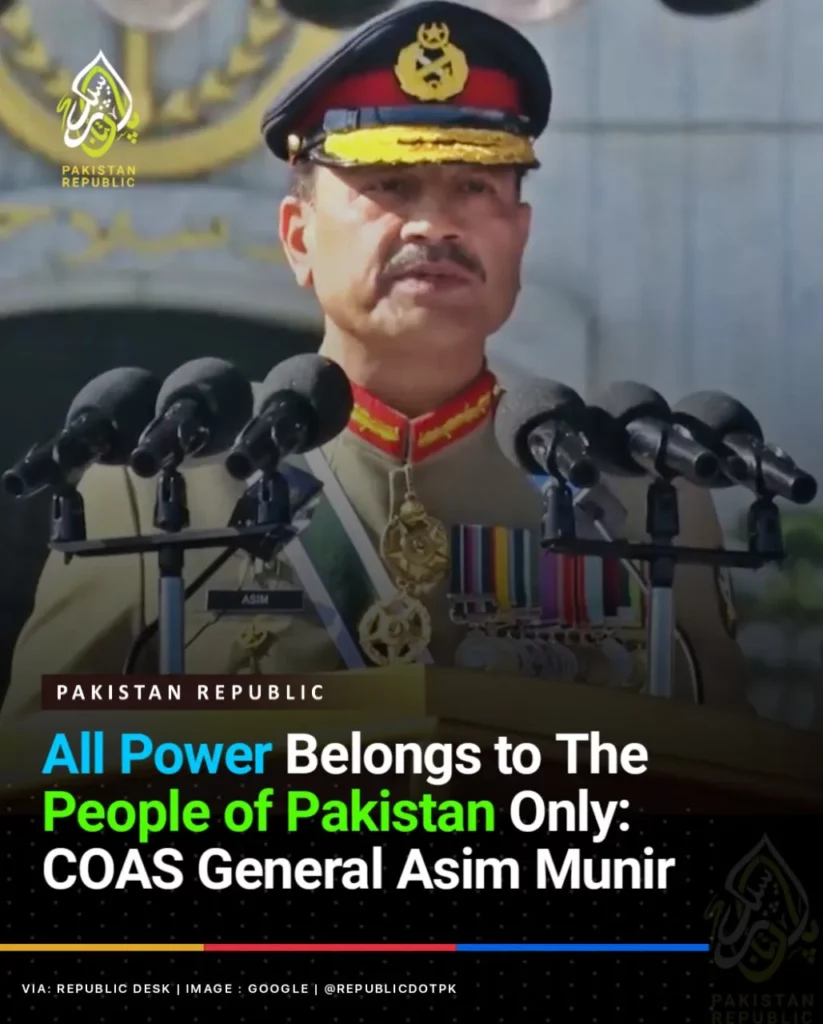
The Chief of Army Staff (COAS) making a statement about democracy or something

Now I don’t know about yourselves dear readers, but when a man in a military uniform gets in front of a mic and tells me how the people, as opposed to him I guess, have all the power, I don’t feel very assured. Even less so when I regularly see the same man in a uniform regularly be the subject of the headlines every day. And I am not joking at all when I say that writing this blog and making this statement might actually get me abducted (or worse) if the wrong person reads this and gets very annoyed.

It is precisely in this confluence of immiserating conditions that Pakistanis must seek out a self-soothing narrative to act as a palliative for their aching souls. Religious institutions with views ranging from extreme to ISIS begin to function as a ‘third sector’, providing food and indoctrination disguised as education. Islamic fundamentalist parties, organised like clerical fiefdoms, lambast the degeneration of Pakistan from a once proud and optimistic nation sinking due to its own abandonment of “true” religious values. Their influence can be exemplified by the evolving image of Imran Khan’s wives.

Former Prime Minister, philanthropist, and cricketing hero Imran Khan was first married to Jemima Goldsmith — daughter of an Anglo-Irish aristocratic mother and an ultra-millionaire father. Khan himself was seen as a modern, cosmopolitan Pakistani who professed a sincere dedication to seeing his country prosper. That got beaten out of him eventually and he is now married to a woman who is regarded as a faith healer — a sort of evangelical Muslim.

Imran Khan is the most popular politician in the country. He was Prime Minister until April of 2022, when conflicts with the military top brass and his own fractious coalition created the conditions to have him ousted, a move that has made him even more popular than before. In any remotely fair election, it is likely he would win an even stronger mandate than before. However, much of his success is built on building a personality cult, demagoguery about imported governments, generous servings of religious conservatism, and, worst of all, alliances with influential defectors from the corrupted ruling class that he spent all of the 90’s and 00’s railing against.

His opponents are two brothers leading an offshoot of the Muslim League, the founding party of Pakistan, who both owe their rise to power to Pakistan’s longest reigning military dictator, General Zia-ul-Haq. Zia-ul-Haq, in his successful 1977 coup backed by Washington, had the founder of the other major opposition party (the Pakistan Peoples Party), Zulfikar Ali Bhutto, judicially executed. The current leader of that party is Ali Bhutto’s grandson Bilawal Bhutto-Zardari, whose mother (and Ali Bhutto’s daughter) Benazir Bhutto was herself the former Prime Minister, and eventually assassinated.

If you are a little confused, you wouldn’t be alone. The ruling class of Pakistan is a politically incestuous mess that takes turns being dominated by the economic and political might of the military. It is ironic that the most organised, wealthy, and popular political party in Pakistan is never on the ballot.

And then the economic question arises. What does the 5th most populated country in the world do to survive economically? How is it that it continually needs to go around begging international creditors every time there is a shock in the world system?

Without going into too much detail, Pakistan’s economy is built on exporting textile products, sports goods, remittances from the diaspora, and land speculation. That’s it really. The country is uncompetitive in the international export markets, suffers from a chronic lack of investment in its industries, and the agrarian sector is plagued with large concentrations of land that are ultimately under-productive. There has never been a comprehensive land reform in the country, barring one abortive attempt during the period of Zulfikar Ali Bhutto.

International aid and loans that the state has frequently resorted to for survival are heavily taxed by its kleptocratic rulers, so that much of the money never gets spent on what it was meant for. Additionally, this corrupt state machinery becomes organised like a pyramid that distributes the fruits of corruption to maintain its internal cohesion, at the expense of the greater national interest. The single exception is investment in the military. As a share of the national budget, Pakistan spends more on its military than the two most belligerent countries on the planet.

These statistics are astounding even to myself. I knew things were bad, but I never thought they were this bad. It’s only after visiting the country, hearing the attitudes of the people, seeing the abject poverty that I began to understand what a mess we had left behind. Or so I thought. My brother was not a product of that world, but he was subject to it’s gravitational pull.

But that’s for another time.

Frequently, you hear people in Pakistan talk about its long unfulfilled potential. About the natural resources littered across the country, about the talent of its people, about the transformative power waiting to be unleashed if only a few select conditions were fulfilled. One or two weird tricks that, if mastered, will make Pakistan a hegemon.

Pakistan has never been invaded by a foreign power, yet it is always rattling its sabre to psyche itself up for an invasion from India, a country many times larger and richer than itself. A country it would have no hope of ever defeating militarily.

Pakistan itself is a country riven by sectarian, ethno-cultural, and economic stratification. Sunni Muslims view Shia Muslims with suspicion, both share a hatred for Ahmedis (best described as Muslim Mormons) and the small pockets of Christian and Hindu minorities that remain in the country. A country that is nearly 97% Muslim yet manifests constantly the uncertainty of its Muslim character. Urban dwellers are divorced from the realities of the agrarian mass of the country. Clan based social organisation still prevails, particularly at the apex of society, jealously guarding its wealth and privileges from dilution.

The absence of a national character creates a vacuum. The state was founded on negating an Other — namely the Hindu majority of India. This was achieved not through some war of national liberation or a collective struggle for political and civil rights, but rather behind closed doors negotiated by a coterie of pseudo-aristocratic landowners in charge of the Muslim League, itself a political formation stitched hastily together to respond to the influence of the Indian National Congress.

As soon as the state was born, it’s raison d’etre vanished. The only remnant being the Muslim-ness of the inhabitants. It is for this reason that the lives of Muslims of every shape, colour, or stripe become fodder for the aspirations of its people. When Pakistanis are not obsessing over the past glories of Muslim empires or peoples they have little relationship to, they are fulfilling their vicarious fantasies through half-baked info-tainment about Muslims abroad. A favourite of the genre is when a white person converts to Islam, as if doing so is a direct benefit to the interests of Pakistanis.

Better days are always on the horizon, and those who do not live long enough to see them, get to feast on the pie in Allah’s sky. Except those unbelieving *insert name of sect or religion you hate*. Unable to accept themselves as wretched victims; unable to accept the historical deceits underpinning their nation; unwilling to embrace secular modernity; suffering from economic woes and cognitive dissonances; Pakistanis are cursed to endure a never ending paralysis that necessitates the palliative relief of many-flavoured opiums.

Acknowledging the harms and the pains of this reality threaten to sink me into depression. No amount of privilege, no amount of distance, no assumed nationality is sufficient to shield me completely from it. I cannot bear to think of what routine sufferings are inflicted on people that are my compatriots. Yet I cannot see any benefits in assiduously ignoring the facts of our national quandaries. Pakistan is functionally a failed state, one that is waiting for fate to deliver its quietus.

This article originally appeared on Ali Khan’s Blog

Who is Entitled to Celebrate May Day Under Israeli Apartheid?

When the Israeli trade unions banned the Palestinians working for them from striking – and the Palestinians struck anyway


03/05/2023

In the seventies (back then in the previous century) I was an activist in a small Trotskyist organization named “The Workers Alliance.” We were absolutely serious about organizing the working class in Palestine, Arab, Jews and everybody else, to lead a socialist revolution and liberate Palestine. Some of our daily activities were to organize workers’ committees and to support workers striking for their rights. One of those strike left a special impression in my mind.

It was in the first days of May when I heard that workers in a big factory on the way north from Haifa to Akka (Acre) were on strike. I went there to see what was going on. The workers were hanging around the factory’s closed doors, so it was easy to speak with them. I sat with members of the workers’ committee, who were happy to express their complaints to me.

The factory was collectively owned by the surrounding Kibbutzim – Jewish-only Zionist community settlements. The workers were coming from the nearby Arab towns (still called “villages,” though they lost their land to Zionist confiscation and became workers’ sleeping neighborhoods). They explained why working in a Kibbutz factory was worse than in many capitalist factories. There is not only one boss, but every manager, engineer, clerk, or worker from one of the Kibbutzim is part of the management. And even the most professional workers have no opportunity for promotion, as all the good jobs are preserved for Kibbutz people.

But they were not on strike trying to improve their conditions. In Arabic, when there is a quarrel, they say: “It didn’t break out because of the pomegranate, but because of the full heart.” The pomegranate in our case came with International Workers Day, which we are used to simply calling the First of May. In those days the Zionist “Histadrut” still pretended to be a “Socialist Trade Union”, and the Kibbutzim were all organized as part of the Histadrut. The Histadrut called for a big May Day demonstration in Tel Aviv, and the Kibbutz people were preparing to participate.

Closing the factory was not a simple thing – it contained industrial facilities that were operated 24 hours, 7 days a week. Closing them and then restarting operations was quite complex and costly, and was done only once a year on Jewish Kippur. So, the Kibbutz managers informed the Arab workers that they are not allowed to take a day off on First of May. When the workers’ committee protested, their managers retorted that, unlike the Kibbutz people who planned to go to the First of May demonstration, the Arab workers have no class consciousness, and they wanted the day off just to go and have a barbecue with their families.

That was too much, and the workers closed the factory on May the First. The strike continued over the next days, as the workers demanded to be paid for their day off.

I do not know who won the strike. The Kibbutzim still control the confiscated lands and the state-subsidized factories. But I think that, since then, they, at least, gave up their attempt to keep a monopoly over class consciousness.

This article first appeared on the FreeHaifa blog. Reproduced with permission

Transforming Welfare Stigma in Germany

Addressing the hidden struggles in the ‘Best Welfare System in The World


28/04/2023

When I first moved to Germany, I remember being initially puzzled by how people could be experiencing financial hardship here. Tapes from my Malaysian-Chinese context were on play — you have a welfare system, a state that actually has a social safety net to catch you when you fall. Do you know how lucky you are?

My initial perception of the EU powerhouse was that it was stableand socialist’ — worlds away in progressiveness from the places I had previously lived. Whether it was unemployment, pension, childcare — you were on your own, especially as an immigrant. But this was slippery slope thinking, according to which simply having a welfare system would mean everyone in a country was able to succeed. The story would then continue predictably: if people dont climb out of poverty or unemployment with social support, especially in a country like Germany, it would definitely be due to a personality problem. People are doing it to themselves.

As someone who considers themselves embodying the values of the political left, I surprised myself as these thoughts came to me. Neoliberal meritocracy is the dominant global value system today. Far from being just a detached political narrative, its deeply embedded in our consciousness and is dominant in the German public and political mind. It finds itself in public debates about Hartz IV (Arbeitslosengeld II) & Bürgergeld reforms, how institutions like the Job Centre run their services, and around whether immigrants are deserving of help.

Evidently, these narratives were also internalized in me. I had spent so long defining my own right to belonging by the economic standards of being a good immigrant. So, I decided to dig past my own resentment of never having lived under a government that felt compassionate – and understand that the reality of why inequality existed was much more nuanced than that. Under the current climate of employment uncertainty, I wanted to see how the best welfare system in the world catches people when they fall, how it fails people, and how our ideas of successcould affect our own psychological beliefs about who truly deserves help.

The Trauma of Welfare Stigma

Germany’s welfare system has long been admired. It was heralded for being the first nation-state social security system. Unlike the US, it is a state-managed system relatively untethered by corporate interests. It ranks as one of the most generous and comprehensive welfare systems in the world. I was a grateful recipient of German welfare during the pandemic when I first moved here, it remained an important lifeline for me on my way towards finding stability. However, it is not something to be unanimously celebrated.

One of the most commonly discussed and controversial welfare policies was Hartz IV, a colloquial term for Germanys former unemployment fund (Arbeitslosengeld II). Hartz IV helped to trim down Germanys unemployment rate by 50%, but also quickly became associated with heavy stigma towards the working class and immigrants.

As a research assistant at the Fraunhofer Institute a few years ago, my colleague asked me a question that I’m always terrified of: “what is your mother doing?” For the first time, I felt confident enough to be vulnerable and told him that she is unemployed and receiving Hartz IV. His response was one that I’ve heard before: “Oh, really? Why?” I explained that my mother was a single parent who came to Germany from Turkey and worked in seven different places before being let go because she had to pick me up from kindergarten. She couldn’t find a job after that, so she decided to be there for me. My colleague proceeded to express concern about his taxes going to people like my mother who he believes are taking advantage of the system. This is a common narrative that I have to deal with, and it hurts every time. The truth is that many people who receive Hartz IV are not taking advantage of the system.

-Sue Sarikaya, Head of Diversity & Inclusion at The Dive

Sue was far from alone. A study found that the levels of shame felt by recipients of German welfare increased with the amount received40% of recipients who didnt work for more than two years reported feeling ‘completely’ or ‘somewhat’ ashamed of receiving benefits.

My German friends told me they had all grown up with reality TV shows like ‘Die Hartz IV Schule’ which voyeuristically followed children of recipients into their schools and homes, creating a tasteless, sensationalized story around poverty, and the laziness that underlies all the unmotivated people who fell through the cracks.

The story of failure due to personal failures is embedded globally. I surprise myself by finding the remnants of the American Dream even in Germany — a story that no matter who you are, you could make it with enough hard work and dedication. However, this narrative relies on a fracturing from our social context. Where we come from, our own histories, how others perceive us, and who is around to help us. And it is this fragmentation from self and identity that casts out discussion around structural violence. It makes it easy to do a mental one plus one equals two — that marginalized communities are failing because theyre not choosing to work hard, or have regressive cultural norms.

Stereotype endorsements are so powerful, because they are not only reinforced by governments and media, but also by regular people onto each other. Another German friend told me she decided to take up welfare as a newly single mother, and was shamed and accused by her own working class parents for not working for her own money. She was only 19.

Was it failure of the individual? Or the system?

How personal and emotional vulnerabilities intersect with structural inequalities is an understudied phenomena. The world of social psychology rarely intersects with the rational-first economic worldview. Underneath so much of what popular media assigns as ‘lazy’ are people with situational constraints and chronic emotional stresses. The laziness narrative also leaves out the care of lone mothers and fathers, pensioners, the social exclusion of disabled people and immigrants, and the vulnerability of those psychologically struggling. These are the people that make up two thirds of those who are long term unemployed, who many German politicians repeatedly attack for being unable to get out of the welfare system.

As of 2022, 14 million people in Germany were living in poverty. I always found this hard to believe. But,you might say, this is the fourth largest economy in the world!Its easier to understand when you delve deeper into the spoken stories of people, particularly East Germans and those with a migration background, or walk into certain areas. Germanys wealth inequality is also hidden beneath its facade — 99.5% of the wealth rests in the hands of the top 50%.

Poverty and inequality are associated with higher likelihood of trauma, whether childhood, historical, racial or intergenerational. Chronic economic stress and trauma are also correlated with higher likelihoods of addiction, adverse childhood experiences such as domestic violence and neglect, as well as racial and social discrimination. These factors play a reinforcing psychological role in our self worth and ability to economically and socially participate.

The German education system is often criticized for perpetuating inequality from an early age, such as through early tracking of students to place them into different school types based on their academic performance. Children with immigrant backgrounds are often overrepresented in lower-performing schools, critically disadvantaging them from being able to be admitted to universities. “My Turkish best friend told me she was in my year in school, but I just never saw her,” my German friend tells me. “It took me years to realize she was there, just segregated from me completely. Racism also remains a significant issue in Germany. Hate crimes, discrimination, and racial profiling are not uncommon. Financial inequality is also associated with a lack of relationships providing connections to opportunities, which is critical to our success.

Whats missing from the story? Commonly cited reasons for inequality include inadequate food or resource distribution, extended periods of unemployment, discrimination or debt. These are well-known and defined, and yet, also contain decades of debates around why so many interventions have failed. Most development initiatives focus on material distribution – just giving people more food, more money, more opportunities. But just as the meritocracy narrative does, the economic tools used in welfare also largely ignores engaging with our multidimensional reality. By engaging less with our social context, it unironically creates less capacity for self and community development, reinforcing the very dependency it criticizes.

Hartz IV vs. Bürgergeld

German bureaucracy has always had a tendency to prioritize managing issues rather than building capacity. The slogan of Hartz IV has long been “Fördern und Fordern” — sure, lets support the unemployed, but lets also make fierce demands on them to get out of their situation as fast as possible. In other words, motivation through fear.

Hartz IV was grossly controversial for barely keeping people above the poverty line. When taken with other government support systems like child allowances and housing benefits, Hartz IV would make percentage cuts on the amount given to recipients. Every additional euro earned would therefore be subtracted, which left some recipients, including my friends and their families, in further precarious situations. Hartz IV would also punish or threaten recipients with sanction cuts on housing, heating and health insurance if they did not comply. It placed no forgiveness onto people who missed meetings, who were overwhelmed with stress and relational obligations, a stark reality for those living in financially scarcity. In 2018, the highest percentage of sanctions were imposed on under 25 year olds.

Hartz IVs harshest critics also blamed it for being the reason for widening inequality, as the Job Centre quickly pushed people back into work, even if it was low paid with poor working conditions, corrupting an individuals opportunity to re-invent themselves into something potentially much more harmful. A 2017 study also found that the level of service that the Job Centre gave towards Turks and Romanians had significantly lower qualityThe same is found towards EU migrants, due to language barriers.

Today, after decades of calls for reform, Hartz IV has been replaced by Bürgergeld. It has reduced its punishments on recipients, preventing the Job Centre from imposing more than 30% sanctions. It has lowered application requirements, made it easier to apply for education certificates, and slightly increasing its allowance to adjust for inflation. However, many argue that the €53 increase does nothing in light of the current cost of living crisis. Those living in Germany will know how little money would be left after the total €502 is spent on basic necessities like groceries and transportation.

Predictably, the policy has been met with resistance. Centrist and conservative political leaders, such as Markus Söder, framed the higher handoutsand reduced sanctions as an impossible way of motivating people to get back to workIn a public debate on Bürgergeld, CDU party member Kai Whittaker stated that “Solidarity is not a one way street. The overwhelming majority in Germany say that we should help those in need. But the return is that you should get work as quickly as possible.These narratives not only frame the structure of Bürgergeld, but also continue to perpetuate the same old story.

Reclaiming our full human experience

Reimagining welfare and the narratives that accompany it requires a profound shift in our beliefs around how people not only survive, but come to thrive.

Financial incentives and sanctions are effective in context, but in the face of something as multidimensional as poverty, can be like dangling a carrot in someones face and hitting them with a stick when they misbehave. It doesnt engage with the depth of what it means for someone to feel strong again after crisis – to be able to go out in the world to pursue the things that empower them. Thankfully, the Bürgergeld debate is not without more holism. Critics advocate for the Job Centre to take a stronger role in supporting individuals with human mediation. What actually helps people get out of poverty? Theres a myriad of proposals that vow to solve the problem, but Ill share my favorite.

In her debut book Radical Help, UK-based welfare reform activist Hilary Cottam proposes the solution of community. After a 10 year experiment with building social infrastructures with marginalized groups in London, Cottam concluded that capacity building through promoting really seeing and being there for each other was the most effective and long lasting means of helping people thrive. ‘Radical Help’ highlights a possibility of collaboration between public service providers and recipients co-producing solutions, based on contextual community needs. By engaging people and what they struggled with directly, choosing to invest in their potential rather than mitigate risk, she states that we can create long-lasting change that not only catches people when they fall, but gives them enough strength to take flight.

Cottam’s proposal reminds me of my own economic struggles and how Ive overcome them — a marriage of progressive social policies and reciprocal relationships that allowed me to find opportunities and retraining when I couldnt find the right work. Meritocracy tells individuals its all up to them to succeed, but it leaves out the fundamental aspect of community. It seems so simple, but good relationships are fundamental. My friend Saskia tells me she wouldnt be where she is today – being able to confidently step into a job with higher pay than her entire family has ever made — without the presence of inspiring women around her“I know that if they can do it, I can do it too.”

Weve been told the wrong stories. Wrong empirically, wrong emotionally. This doesnt mean we should stop helping people with material needs, but we need to put our survivalist assumptions aside and look deeper. One of the greatest evils of neoliberalism is how we come to believe that we are worthless if we cant meet certain economic standards. Beneath most economically-strugglingpeople are stories of attempts, complicated internal and external circumstances, cycles of stress and isolation. Welfare stigma doesnt just hurt individuals, it also pours into further reform efforts. Around the world, attempts to create stronger welfare support receive backlash from the public around the fear of societal laziness. A study reported that European supporters of UBI demand a caveat on the universal by making strict eligibility requirements for immigrantsI dont blame people for these views — our collective participation in the economic still remains an emotional symbol of personal survival. But these stories need to change, if we are to be able to adapt to the uncertain realities ahead of us.

What kind of an alternative would we be offering ourselves if we looked deeper into the experiences of people, and what they really needed? Would we be able to reclaim our inherent altruism, believing that everyone deserved help regardless of perceived laziness? What kind of help would we be giving if we brought the full human experience back into the story?

This article is dedicated to my friends who have touched me with their stories, and inspired me with their strength. I am also grateful to Brett Barndt, who taught me that emotional is how you engage people with money & economics, and my close friend Tarn Rodger Johns for giving me Radical Helpby Hilary Cottam — reminding me that community is always the answer.

The Serbian Ruling Party Can’t Provide Basic Access to Electricity

Why Serbians are protesting


26/04/2023

On April 24th, 2023, about 200 protesters, mostly members of Želimo Struju u 21. Veku (We Want Electricity in the 21st Century) rallied in front of the Serbian National Assembly in Belgrade. For around 5 months, 1,000 families in the capital voiced their concerns over a lack of electricity in their homes.

The protesters chanted slogans like “we want energy” while politicians or staff members entered and exited the parliament or watched from the windows. The rally’s main organizers also gave speeches with megaphones and condemned president Alexander Vucić’s complicity in their lack of connection to the energy grid.

Marko Stevanović, a head organizer of 21st century electricity, said their collective spoke with authorities who promised to solve their energy security issues who took no concrete steps as of yet. Stephanović testified that his activist collective knows there are many more who suffer from a lack of electricity. 

Želimo Struju u 21. Veku describes itself as an apolitical, single-issue collective focused exclusively on trying to solve the material needs of residents of Serbia who struggle with energy needs. Although the collective itself is non-partisan, political activists including Milena Repajić, the secretary general of the Partija Radikalne Levice (Party of the Radical Left) and members of the opposition in the national assembly attended the protest. 

After the break-up of Yugoslavia in the 90s, many settled in new housing or built their own homes. They reside in them but still don’t have electricity after 4 years, according to some reports. Since late 2018, it’s become impossible to connect to the electric grid without a building permit or legal permission. Before then, an application for a permit would suffice.

In late January, the group also protested in front of the parliament with about 100 members in attendance, as Vučić was abroad at the World Economic Forum in Davos.

Local press in Serbia shows that the lack of electricity is not only felt in Belgrade but in other major cities as well. In July 2021, the mayor of Niš, Serbia’s third largest city promised that 35 resident’s would be connected to the electricity grid after more than one decade of waiting for energy utilities. At the time, 4,500 households were still left without electricity. 

Niš’s current mayor belongs to the Serbian Progressive Party (Vučić’s ruling party since 2012). Nine months after his declaration, the municipal opposition “Niš Moj Grad” (Niš is my City) demanded that the city negotiate with the national government and Elektroprivreda Srbije, the largest energy company in Serbia, to bring power to 7,500 households still waiting for power. 

One can assume that the energy crises endured by Serbians in various major cities remains unresolved. This small string of rallies in front of the National Assembly comes months after the Serbian government, faced with massive popular protests in multiple cities, revoked a license from Anglo-Australian mining company Rio Tinto for the multibillion dollar project to exploit a lithium deposit in the Jedar Valley of western Serbia. Rio Tinto still wishes to pursue its operations and spent millions on Serbian land deeds recently. 

While a swathe of average Serbians are suffering from energy precarity – the Serbian government and landowners are still trying to sell off national resources to Western companies like Rio Tinto. So much for Vučić’s “patriotism” and “cunning” negotiation skills. 

One can only hope that the protests for energy access will broaden to reach the scale of those against the negative environmental effects of lithium mining and light the spark to a bigger national movement against the ecocidal and unjust neoliberal system under which Serbia currently finds itself.