The Left Berlin News & Comment

This is the archive template

The Silicon Valley Bank “not-a-bailout” Bailout

Recent bailouts show that capitalism is still an inherently instable system


14/04/2023

The clientele of California’s failed Silicon Valley Bank (SVB) was the high tech start-up industry in Silicon Valley. Banking is a con industry. Without the confidence of depositors, no bank is solvent. This was what SVB faced. Some of its depositors withdrew their deposits to gamble on risky, high-interest rate stocks. The bank did not have enough liquid cash to honour this request. The remaining depositors were left short.

The US government knew if it did support the bank depositor/investors, it could not be publicly called a “bail-out.” Why not? The term bail-out “had become a toxic word in the wake of the 2008 financial crisis. The depositors would be protected, but the bank’s management and its investors would not.”

The March 2023 bailout was for the full amount – not simply the $250,000 normally protected by the Federal Deposit Insurance Corporation (FDIC), the banking regulator. These rich depositors were ‘bailed out’ by the US government in full. This includes Pieter Thiel, the multi-billionaire.

Jamie Dimon, chief executive of J.P. Morgan — when asked for his advice by the Biden administration’s Deputy Secretary of the Treasury — warned of “potential” for the banking crisis to spread to other banks in a “cascading series of bank failures.” And indeed the cryptobank Signature Bank was also at risk of crashing soon after and was taken into receivership by the government (US speak for temporarily nationalised).

What happened? Clients had deposited their cash in SVB to reap profits with the bank’s investment strategy. That was locked into US government fixed, long-term bonds, which yielded stable returns. Profit-seeking capitalists realised however that there was a catch in the post-COVID era as inflation re-emerged.

This resulted from an increase in the money supply following the government pumping money into businesses, but also to the population during the pandemic. Between them, the Trump and Biden administrations put into the economy over $5 trillion (“almost a quarter of GDP”) of which $1.8 trillion went into households.

It is true that in the current inflation phase, other non-monetary causes of inflation operate. These include poor supply chains exacerbating supply and demand mismatches, employers wishing to squeeze wages, and businesses using the situation to gouge prices. But there was an undoubted major increase in the money supply.

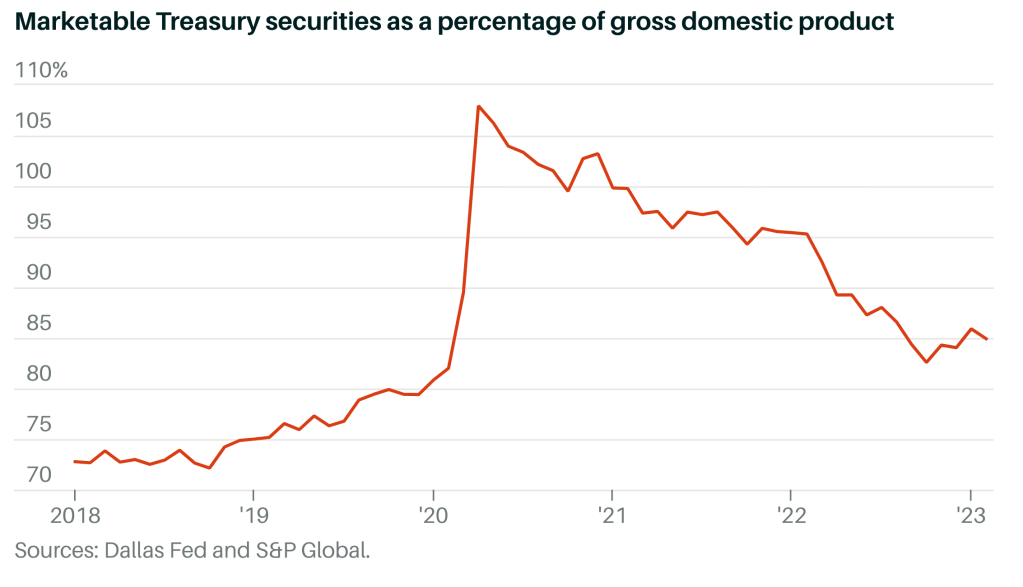
Attempting to control this money supply, the central banks reverted to their traditional “solution” of raising interest rates. This makes the commodity of money more expensive to buy. As rates steadily rose, the profits from fixed, long-term government bonds (or Marketable Treasury Securities) fell below those obtained by shorter-term bonds or pure speculative gambling. That led investor/depositors to start withdrawing their deposits from SVB. They switched that capital into lending money for shorter term but higher interest rate loans. The search for “fictitious money profits” – as Marx put it – once more led investors to shift money around in search of extra profit increments.

The same dynamic for the lowered profits on long-term Treasury bonds applies also to other so called “fixed income” bonds. It appears that in total some $2.2 trillion are “over-valued” currently, a looming threat destabilising the economy and many exposed banks.

“Other fixed-income markets like the $12 trillion mortgage-backed securities market and the $10 trillion corporate bond market also saw big losses in market value. This is a key reason why banks, which hold such securities, are currently under stress. A recent study found that such assets in the U.S. banking system are overvalued by $2.2 trillion due to mark-to-market losses.” See David Beckworth’s analysis:  “The Fed Has Overseen a Remarkable Transfer of Wealth From Bondholders to Taxpayers.”

Actually the amount of holdings by Banks of such “fixed income” markets has soared between 1980 to 2023 from about $0.5 trillion to $6 trillion.

There is another feature of what has happened that we should note: the effect of the rising interest rate has also been to diminish the so-called Debt to GDP Ratio. This is shown below, expressed by the amount of ‘Marketable Treasury Securities’ held as a percentage of GDP.
This is a very new phenomenon as Adam Tooze points out. His depiction from Federal data from the years 1970-2023 makes that case:
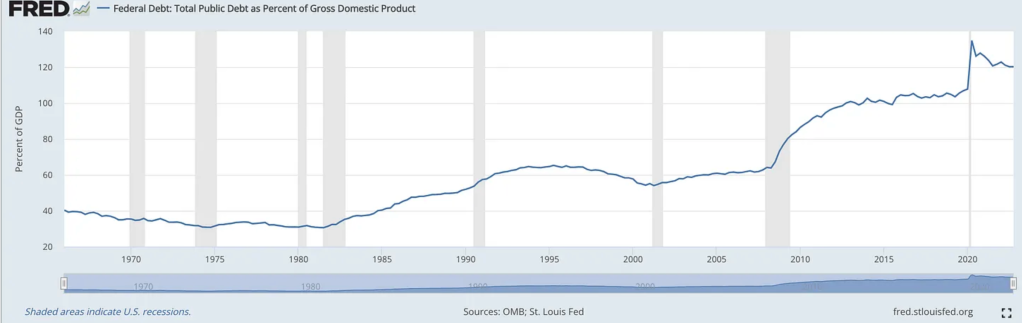
This took hold from the post-pandemic period from 2021. The consequence of this is that government public debt has fallen dramatically. We have discussed previously the divisions of interest between banking and financial capital and industrial capital, which remain intense. At the core is an enthusiasm for high interest rates by finance capital, which gains from the higher rates of borrowing capital. But this is contradictory to the interests of the industrial capitalist who borrows capital for reinvesting in new technology and means of production, therefore preferring a lower interest rate.

Ultimately the contradictions of capital continue to grow immensely. Marxists understand that the whole international banking system under capitalism is – like all other features of capitalism – incredibly fragile. Three points can highlight this.

First in the US, in emergency moves the government established a “Bank Term Funding Program” to underwrite banks. This defends them against depositor withdrawals by using government loans against their original purchase of long-term government bonds, because the government knows that many banks in the US are “underwater.” What this means is they hold large stocks of government bonds that have lost in value as compared to short term “risky” betting investments. That is termed “unrealized losses.” On top, the capital the banks hold frequently cannot cover sudden withdrawals – about 10% of banks have less capital than SVB did. The total unrealized losses at US banks is estimated now at $620bn, or 2.7% of US GDP.

Second, this is not a phenomenon restricted to the United States – it is international. For example, the collapsing confidence in the 167-year old Credit Suisse Bank forced a take-over at basement-low prices by its long time rival, Swiss UBS. But UBS demanded that the Swiss government guaranteed it against potential losses on the books of Credit Suisse, providing $100 bn in liquidity funding to cover deposit withdrawals.

Third, potential solutions such as bank regulations have been weakened, such as the Glass-Steagall Act of 1933. As we pointed out previously, this was weakened by the Democrats and Republicans together — but apparently not enough for financial investor greed. Even the International Monetary Fund (IMF) despairs of meaningful regulations. Its diplomatic language notwithstanding, it concedes “regulations” are not effective: “As the financial system continues to evolve and new threats to financial stability emerge, regulators and supervisors should remain attentive to risks… No regulatory framework can reduce the probability of a crisis to zero, so regulators need to remain humble.”

Normal mechanisms such as lowering real incomes by inflation and removing any vestiges of a “welfare state” are not enough to satisfactorily balance the competing pressures. Meanwhile leading capitalists hope for newer territories and work-forces to exploit. These ambitions are steadily leading to a new world war. Workers and toilers of the world must organize to frustrate this path. Only a workers’ and toilers’ revolution can succeed in this goal. This requires Marxist-Leninist parties, which are being built in many countries.

This article originally appeared in ‘American Party of Labor

“What is a Safe Country?”

Interview with the organisers of a workshop in Berlin about refugees and migration from Senegal


12/04/2023

Hi Fazila and Elettra. Thanks for talking to us. Could you start by briefly introducing yourselves?

Fazila (FB): I’m Fazila Bhimji. I’m in Berlin as a freelancer and independent scholar, I worked for many years in Britain at the University of Central Lancashire.

Elletra (EG): My name is Elettra Griesi. I’m an Italian living in Berlin since 2006 and in Germany for 25 years. I am an architect, but also a social and cultural anthropologist. I’m doing my PhD at Berlin’s Free University in the frame of which I ran an 8 month qualitative ethnographic research in Thiaroye sur Mer (Dakar, Senegal), the community we are engaging with during our event. I’m also spokeswoman at the Institute for Protests and Social Movements at the TU Berlin.

On Monday 17th April, you’re organising a workshop: From Senegal to Europe and Back. What will you be talking about, and why should people go?

FB: We met each other in Berlin at the community-based group, Kiez Kantine, and it turned out that we had both done research in Senegal. We look at migrants coming from Senegal to Europe, but also at the connection between richer countries plundering the seas and displacing lives. Many people in Senegal cannot see a future in fishing and are forced to migrate, both to Europe and to neighbouring states like Mauritania.

Fishermen in Senegal are what’s known as artisanal fishers. The have smaller boats. If they encounter the bigger trawlers, there are accidents and lives are lost. It’s the richer countries including China, Korea, France, and Spain, who are exploiting the seas and the traditional culture of fishing.

EG: This is one side of the story. The other side concerns their displacement and often ends up in deportation centres after their arrival in Europe, where obsolete practices are carried out, like the administering of sedatives to keep people calm, and holding them in cages before the deportation to their “countries of origin”.

Deported people then face several difficulties. They must integrate again into their communities. This is a very difficult step to make, since once you come back from Europe, you are considered as a loser. Going back also means not having anything any more. When you leave your country you give up everything. You have to start again from less than zero.

Now, around 2004-2005, people from Thiaroye sur Mer were starting to migrate to Europe in small fishing boats. There were several accidents, and hundreds of people died. European policies thus started to focus on migration management by running so-called development projects with the aim of creating employment opportunities and “stop migration”. The projects have as their focus groups “potential migrants” and “deporteesand all this contributes to attach this label to these people producing stigmatization within the community and further marginalization.

Normally the discourse about refugees in Europe is about Syria, and more recently Ukraine – it’s about people who are fleeing wars. In contrast, Senegalese refugees are fleeing poverty and the effects of colonialism. They are “bad refugees”. How does this affect the way they are treated?

FB: When Germany received Syrian refugees, Angela Merkel said “wir schaffen das”. There was no such rhetoric for people coming here because of the effects of neo-colonialism.

If you are from Africa or from countries such as Pakistan, the housing situation is really bad, and you’re rarely given refugee status – even in countries which are directly responsible for you being there. Fishers have to flee because there are no fish in the water. This is not just because of environmental reasons, but because countries such as Spain, China, and Korea are stealing fish.

The Senegalese government colludes with European states which are offered waters where the locals used to fish. They have bigger nets and equipment, and are able to fish more easily. This causes migration. When people come to Europe, they are treated very badly. People don’t make the connection that Europe itself is responsible for them. They’re just branded “economic migrants”.

EG: And so, people are usually deported because Senegal is still considered to be a safe country. In the eyes of European governments, there is no need to migrate. Even If you apply for asylum it is very difficult to get the status of refugee.

Plundering the Senegalese waters is one side of the problem. The other side is expropriation of land. At the workshop, we will introduce the community from Thiaroye sur Mer which came from Egypt in the 18th Century and settled in Dakar when it was still not urbanised. They were living from fishing and agriculture.

After Senegalese independence in the 1960s, the government started to take away their lands from them in order to develop the city of Dakar and build industrial buildings. Step by step they were expropriated. They had no land, on one side, and could not get fish from the sea on the other. This led to unemployment, and eventually displacement and migration.

FB: In the villages where I did my research, all the people I spoke to had the same response. They are very dissatisfied with the current government, which is in collusion with European states. They feel neglected.

You each just said something very interesting. Elettra said that national liberation didn’t improve the lives of many farmers and fishers, Fazila that the Senegalese government now colludes with the old colonisers. Does this mean that national liberation wasn’t worth it?

FB: Any kind of liberation is always worth it. But we cannot say that Senegal really got independence from France. It doesn’t have self determination. Even the CFA [Senegalese currency] is linked with the French Franc. They’ve had the same rate of exchange for decades.

People have been fighting against this. There have been some changes, or at least hope for change. There is a fight against neo-colonialism. Even Berlin has seen some solidarity events where West Africans have got together, and demonstrated in front of each other’s embassies. This is an ongoing fight.

My research has a decolonial approach, working with community activists in Senegal or from Nigeria. We were all people of colour working with the fishers. It is important that it wasn’t top down research. We are trying to find out people’s experiences from their own perspective.

EG: I would totally agree with what Fazila is saying, this approach is very important. We must decolonize knowledge and research in order to decolonize the mind and produce equity. As researchers, we should run research that includes the views and standpoints of the people. We must also ensure that no researcher has a higher position, and that research participants are not passive objects. Our research must take their perspectives into account. What do they need? Why should we research there? How can we help them to raise their voices and fight against neo-colonialism? In this way, we take a step towards decolonizing knowledge.

I also agree that Senegal is not really independent. Senegal tries and wants to be independent, but realizes that European powers are too strong to allow liberation. The government is somehow forced to adapt to the European policies in order to get some economic “benefits”, or to be included into development projects.

It is also important not just to talk about helping people, but to support their struggles. What sort of social movements are active in Senegal, fighting colonialism or putting pressure on the government to improve their situation?

EG: There are movements that are moving in this direction, but this is a new development. Until recently, there were almost no social movements fighting against the government. There was a musician group called Yen’a Marre who were activists from the start, but they were really an exception.

Otherwise, in Senegal people were not really used to protests. It was not in the mentality of the people to go on the street. Then, around 20 years ago, people started to become more aware. This process is developing right now. Organizations are also fighting for freedom of movement. This needs to be developed further.

FB: There’s also awareness raising. You can’t say it’s a social movement, but people have realized that this is a long fight and they need to be practical in the short run. There is a lot of work to be done with awareness raising, so people don’t take unnecessary risks trying to get to Europe, and end up drowning in the Atlantic.

There are associations which try to find work for younger people, so that they don’t end up taking the risk. And there is a Women’s Association for women who lost their sons. On the surface, it seems contradictory to the Left idea of free freedom of movement, but people should also have the right to stay. They should not be compelled to move. Their environment should be comfortable enough that they are not forced to take such desperate measures.

What conditions do people fleeing Senegal experience?

EG: There are different routes to reach Europe. Some people move via sea, others by land. It’s not a journey that you can do within one week. Sometimes it takes a month or even years to reach Europe, if at all. During this time, people are stuck in one place and need money to survive or continue their journey. They are forced to work illegally, for example in Moroccan call centres. And the call centres belong to Europeans. So they are working illegally for Europeans before they even reach Europe.

Those who have the luck of reaching Europe end up first in Welcome Centres, then in deportation centres, where they experience administrative detention for not being in possession of staying permits. After a period that differs from European country to European county (up to 6 months) they are either deported or they are released with an expulsion order, so that they mostly end up living on the streets with an illegal status. This forces them to work illegally. As they don’t have documents, they are held in slavery by the land owners for whom they are working. In most of cases, they are caught at some point by the police and put into deportation centres. After a period, they are – again – either deported or they end up on the streets, and the story starts all over. It is a never ending loop.

Let’s talk about your event on 17th April. Who will be there?

FB: Muhammed Lamin Jadama is part of Wearebornfree and helps awareness training in Senegal about the risks of migration. Moustapha Diouf who is the President of the Association of Young Repatriated in Senegal.

EG: There’s also an activist from Italy, Maurizio Tritto, who I’ve know since we were 4 or 5 years old. He’s really engaged in bringing social justice. In 2011, a Welcome Centre in my village was re-adapted into a deportation centre. There were protests which went on for several months, and after one or two years, the deportation centre was closed.

But every time that a new government came into power, the deportation centre was re-opened. Much money flowed in, the centre was closed again, and then a new government was elected. Maurizio never stopped protesting against the deportation centre. He went on hunger strike for two months last year to win attention for what was happening.

But nothing happened. The government would not speak with him or listen to him. This year, he started his hunger strike again, as conditions in the deportation centre were getting worse. People disappeared, people died, people were hold in cages, sometimes without food. He was on hunger strike for 66 days until he collapsed and had to stop. All his efforts went unnoticed, that’s why we invited him. He has very deep insights into this deportation centre.

FB: It’s not limited to Italy. At the old Schönefeld airport in Berlin, a deportation centre is being built, and there will be protests in July. The airport, which used to be a welcoming place for people, is now being used to deport people. The situation just gets worse every day.

One final question. We hope that everything goes well next week, but what happens next? Are you planning further events?

EG: I would really love to organize more events, like seminars in universities and other places which raise awareness among younger people. People just don’t know about the conditions concerning migration and displacement. I hear many times: “Why do they migrate from Senegal? It’s a safe country”. But what is a safe country?

I also heard people say “German agencies are putting so much money into development. So why do people keep on migrating?” We would like to show where this money is going, and what conditions the people in the origin countries are facing.

FB: For me it’s also important to somewhat raise awareness among the Left in Europe, which is mainly focused on freedom of movement. They fail to see the complexities that there are other battles to be fought, like neocolonialism or the plundering of the seas. We should ensure that countries of origin don’t become States which force people to migrate.

The French Left and the Ongoing Workers Revolt

The conflict with Macron is at a plateau and can still go either way. How is the French Left responding? Latest in our reports from Paris


07/04/2023

The 11th day of action to defend pensions and oppose Macron, Thursday the 6th of April, again saw millions on the street, and hundreds of thousands on strike in a joyful festive atmosphere. This is despite police repression, and despite the refusal of national union leaderships either to organize an indefinite general strike or to give any real support to the more radical sections of workers, such as the oil refinery workers blockading oil depots with mass pickets (meanwhile the government sent in riot police and requisitioned some workers in order to force them to go to work).

Conflict at a plateau

Thursday’s day of action attracted fewer protestors, but still millions, in 370 demonstrations across France. Bosses’ representatives were complaining this week that each day of action “costs a billion and a half euros”. In Italy and Belgium there have been some solidarity strikes. Young people are far more in evidence at the demonstrations this week, hundreds of high schools and dozens of universities are regularly being blockaded, and the slogans are more radical than before. Thursday, hundreds of young people in Paris were chanting “we are young, fired up, and revolutionary” while a barricaded high school in the centre of France resounded to the chant “Down with the state, the cops, and the fascists!” In Paris last week, a bemused Norwegian pop singer, Girl in Red, cutely asked her concert audience to teach her a little French. The hall erupted with chants of “Macron, démission!” “Macron, resign!”

There are ongoing strikes in oil, air transport, docks and energy, although refuse collectors and several key rail depots have suspended strike action, feeling isolated after three or four weeks striking. And every day there are local demonstrations or motorways or wholesale centres blockaded. A few days ago over a thousand students at the university of Tolbiac in Paris were debating the way forward together.

The conflict with Macron is at a plateau. Neither side is prepared to give in, and the movement is neither accelerating nor collapsing. As the revolt continues, considering political strategy is essential. How are the Left organizations doing, faced with a huge and very popular revolt, and a national union leadership strategy which is unable to win?

Left organizations put to the test

A historic social explosion is always a test for any Left organization. In this article I want to briefly evaluate the different wings of the French Left in the crisis. This is a delicate exercise. Many thousands of activists in all the Left parties (and many non-party people) have been doing excellent work organizing strikes and protests, leafleting and caucusing, encouraging creativity and rebellion. Most of them have done more than I have, so I do not want to appear as a red professor giving them marks out of ten. But we need to win, this battle and many more, to defend ourselves and eventually to get rid of capitalism, so strategies must be understood and criticized openly.

The political landscape in France today has been formed by decades of neoliberalism and the powerful fight against it. In 1995, in 2006 and in 2019, huge strike movements were successful in winning defensive battles against pension attacks, or against attacks on workers’ labour contract conditions. In 2003, 2010 and 2016, massive movements were defeated by the government and laws implemented to reduce pensions, and to make it much easier to sack workers.

There are two key points here. One is that all these struggles, like the one going on right now, are defensive struggles, to stop the neoliberals taking stuff away from us. They are inspiring, but nevertheless they are defensive. Secondly, they involve a high level of political class consciousness. Millions of older workers went on strike and protested in 2006, when the government threatened a worse work contract for employees under 26. Millions of workers not affected personally by the present Macron attack on pensions are enthusiastically taking part in the movement anyway. The idea that “an injury to one is an injury to all” and the understanding that if they beat us in this battle they will be all the stronger for the next is extremely widespread.

Finally, we need to understand that even when the explosive movements lost on their immediate defensive demands, governments were generally obliged to shelve a whole series of other attacks they had been planning (as this month they shelved a racist immigration law, and also suspended a plan to reintroduce 2 weeks of national military service for all young people).

After the Socialist Party destroyed itself

It is this energetic class struggle which has formed the political landscape today. The Socialist Party was electorally destroyed after the Socialist government introduced new labour laws in 2016, smashing national union agreements, reducing payment for overtime, etc. In the 2022 elections the party got 32 Members of Parliament ten times fewer than in 2012!

But the millions of people involved in the mass movements I have mentioned, sometimes victorious, sometimes defeated, were looking for a political expression to their opposition to neoliberalism. They didn’t become millions of Marxists, because Marxism was still very solidly linked to Stalinism and Soviet imperialism in people’s minds, and because the Marxist organizations were not big enough or smart enough to grow much. But people were looking for a radical Left insurgent option, and that is what made France Insoumise (France in Revolt) possible. If you imagine that, in Britain, Jeremy Corbyn had left the Labour Party and built a radical Left alternative, which then went on to get seven million votes, that is France Insoumise.

France Insoumise calls for “a citizens’ revolution”, which is meant to happen by sweeping away the presidentialist fifth republic and putting a sixth republic in its place, while implementing a very radical programme. Retirement at 60, a turn to 100% renewable energy 100% organic farming, a big rise in the minimum wage, a billion euros for measures to fight violence against women, and so on.

The FI movement and its 74 MPs have been playing a positive role in the present revolt. When Prime Minister Borne announced that the attack on pensions would be forced through by decree, all the FI MPs held up signs for the cameras saying “See you in the streets!”. When the national union leaders called a day of action ten long days after the previous one, the FI called for rallies in front of all the regional government headquarters in the meantime. The FI’s strike fund has raised 900,000 euros. And this week, FI leader Melenchon is being taken to court by the Paris chief of police for “insulting the police”. He had declared that one particularly violent police squad should be dissolved and the “young men should be sent off for psychological help” because “Normal folk don’t volunteer to get on a motorcycle and beat people with batons as they pass by”. These few symbolic examples show the radicalism of the FI.

It is unsurprising that Macron is launching a major campaign against France Insoumise. He accuses it of “wanting to delegitimize our institutions”. His hardline interior minister Gérard Darmanin is denouncing the “intellectual terrrorism” of the radical left. The entire left must be ready to defend the FI against right-wing attacks, whatever other disagreements subsist.

There is still much missing, however, in the FI approach. In many ways a traditional reformist organization, seeing parliament at the centre of its medium-term strategy, the organization accepts a “division of labour” by means of which it is the role of union leaderships to run the strike movement, and political parties should stay out of debates about strategy. This is disastrous when the union leadership’s strategy is so woefully inadequate. In addition, many among the FI leadership are keen to win this battle so that political life gets “back to normal” and politics resumes through traditional channels. We Marxists, in contrast, are hoping that this battle will build up consciousness and organizational capacity which will make our class refuse to go “back to normal” political life, but rather start exploring how capitalism can be overthrown.

The rise of France Insoumise and its successful occupation of the radical Left space has left the French Communist Party squeezed out. It still has 50,000 members, of which nearly a third are elected local or regional councillors, and it has twelve members of parliament. Under its leader Fabien Roussel, it is trying to occupy a space clearly to the right of France Insoumise, to capture some of the people the Parti Socialiste lost but who were not tempted by Macronism, or even some of the far right voters. Roussel has shown this by declaring his support for nuclear power, by attending rallies organized by hard right police trade unions, and, right now, by prioritizing the campaign for a referendum on the pensions law (a process which would take months and require almost five million signatures).

The revolutionary approach

What, then, of the revolutionary Left? In France, there are three revolutionary organizations with a couple of thousand of members each, one with about a thousand, and four with a couple of hundred each. One or two of these latter groups operate inside France Insoumise networks, since the FI is an extremely loose organization. Some of the most radical actions, such as taking busloads of students to join mass pickets at the oil refineries, or organizing regular grassroots inter-union meetings, have been initiated by revolutionaries. And some of the most important questions, such as how to move from a powerful defensive movement to an offensive against neoliberalism and capitalism, are put forward by Marxists.

Yet there is a crucial lack. There is no organization setting up public meetings in every town entitled “General Strike: Why and How?” There is no organization calling rallies in front of the regular meetings of the national union leaderships, pushing them to call a real general strike. Most revolutionaries are following a strategy of “pushing the movement forward as far as possible”. This is obviously essential, but leaves the general strategy in the hands of union leaderships. A clear analysis of the role of trade union leaders as professional negotiators with specific interests (which rapidly conflict with those of workers when struggle rises) is generally absent.

The 11th day of action is on April 13, but the weakness of the weekly day of action as a sole national strategy is ever more visible. Less combative organizations are suggesting the solution is to spend months campaigning for a referendum. But what is needed is an indefinite general strike.

People Make Their Own History

Interview with Rosemary Grennan from AGIT about cultural intervention in Berlin


05/04/2023

We spoke with Rosemary Grennan, one of the founders of AGIT, about cultural intervention in Berlin. Here’s what she had to say:

Hi Rosemary, thank you for agreeing to speak with us. Could you please start by introducing yourself and AGIT?

I’m Rosemary Grennan, one of the founders of AGIT, a new organisation based in Berlin. AGIT is a residency and archiving space that examines historical movement materials to make interventions into contemporary struggles and critical questions today.

The organisation has three different focuses: exploring movement histories and contemporary politics in Berlin and beyond, developing international collaborations focused on building left history, culture, and theory, and finally experimenting with different technologies to develop ways of building and distributing open access archival collections. AGIT is organised around funded residencies where historians, activists, and cultural producers can collaborate on history and collections outside of a formal research setting.

My own background is at an archive in London called the Mayday Rooms, where we have built a substantial archive of social movement histories in London. The other founder is Jan Gerber, based in Berlin and part of an organisation called 0x2620, which builds software for large digital collections. They have worked with video collectives in Turkey and Egypt archiving audio-visual material around Gezi Park and Tahrir Square protests, and have also spent a lot of time in India building the online platforms pad.ma and indiancine.ma.

You’re doing this in Berlin, where there are many cultural and artistic initiatives, as well as lots of academia. What is AGIT aiming to offer that’s not being provided elsewhere?

I don’t know if we’re trying to offer something that’s completely different – more to add to the rich left cultural initiatives already existing in Berlin. AGIT wants to build on the rich history of radical publishing, libraries, and self-archiving on the left by developing new forms of archival dissemination and ways of making things public. We want to create a space for people to work specifically on these histories, to have time to research, translate, read material from past struggles, and create a public context around them. The way the residencies are formed is that people can work with us and other archives to learn how to archive their own histories and build resources and collections around that. We are a young organisation and hope that each residency will build the organisation in some ways and leave something behind.

How much of this work is voluntary, and where do you get funding for what you have to pay for?

The day-to-day organisation is voluntary, but we currently have funding for the residencies and residents can stay in the space. We received a donation to start up and have applied for other cultural funds to keep us going.

On Friday, April 7th, you’re organising your first event – the opening night of a month-long exhibition. Could you tell us a little about it?

Our first resident is Hussein Mitha, an artist and writer from Glasgow. Hussein has created a mural in the space using vinyl cutting and sign-making techniques to incorporate texts and images with vibrant swaths of colour. The idea for the residency was to use political ephemera from different social and political histories of Berlin to create the mural and add to Berlin’s strong tradition of political mural-making (such as those on the Press Cafe and the Haud der Lehrer on Alexanderplatz). The opening of Wir Weben on April 7th is the unveiling of the mural, as well as a small exhibition of historical sources that are either referenced or alluded to in the mural. This includes material from the Silesian weavers all the way up to political print culture in 1970s West Berlin. We will have on display Käthe Kollwitz’s Weavers’ Revolt, John Heartfield’s Five Fingers has the Hand from the Rote Fahne just before the 1928 election, the 1 Million Roses for Angela (Davis) campaign from the DDR and documents surrounding the court case of the Agit-Drucker in 1977.

Let’s talk briefly about the Silesian Weavers. The mural is called Wir Weben (We Weave), which is from a Heinrich Heine poem about the weavers. We also find references to them in Marx. Who are they and why are they so important?

When Hussein first came and stayed in our space, we went on a lot of different walks around Berlin and visited the bronze reliefs on the side of the Neuer Marstall opposite the Humboldt Forum. One relief shows Karl Liebknecht proclaiming the “free socialist republic of Germany” in 1918, and the other commemorates the German Revolution of 1848. Through this, we started to read Heine’s poem about the Silesian Weavers, which strongly influenced the workers’ movement in Germany. Briefly, there was a weavers’ revolt in 1844, where the weavers in the Silesian region of Prussia revolted against increasingly bad conditions and cuts in pay. They were brutally suppressed by the authorities but had a big influence on left intellectuals like Marx and Heine. Heine then published his poem in Vorwärts, which was the newspaper that Marx was editing from Paris. The poem repeats the refrain ‘wir weben, wir weben (we weave, we weave),’ and this became one of the starting points for the mural, weaving together different histories from Berlin and beyond.

What is the connection between the Silesian weavers and the more contemporary issues that are part of the exhibition?

At the top of the mural, there is a spinning wheel and from this a single red thread that goes through the mural, bringing all the material together. I did an interview with Hussein about the making of the mural, and they said that when they came to create the mural, it was interesting how some of these histories don’t really fit together and resonate, and there’s no necessary continuity between the weavers and, say, the squatters in West Berlin, but still the possibility of solidarity.

The exhibition will be held at Nansenstraße 2, which is the location of AGIT, but it is also home to Right2TheCity, the English language branch of Deutsche Wohnen & Co Enteignen. What connections do you, as a cultural organisation, have with political organisations like Right2TheCity?

Nansenstraße 2 is also used by the Western Sahara Solidarity group and other groups that are loosely associated with those in Right2TheCity. There is also a group called the KiezProjekt, which is organising support for tenants of the buildings that would be expropriated if the referendum were to be carried out. In the evenings, people use the space to hold meetings and other events. We thought it was important to confront political history from a place that is not detached from current struggles.

What is the role of art and culture within political movements? Do you believe that art can change the world?

Although our primary focus is on preserving and archiving movement history, we do recognize the role of culture in bringing these histories back into collective memory. Therefore, cultural production has increasingly become a terrain of struggle in a context of “culture war” narratives. However, rather than focusing on that, it may be more important to consider how we can produce culture that reinforces processes of organisation, struggle, and cultural memory of our history. I always think that the workers’ photography movement is a good example of this. There, the question is posed: is photography for the workers or workers’ photography? The photographers were part of a political movement rather than trying to represent it from afar.

For the exhibition, I was examining some of the material from John Heartfield. One of the pieces is an advertisement for an exhibition of Heartfield’s work in 1929 in Arbeiter-Illustrierte-Zeitung. The title of his exhibition was “Use Photography as a Weapon,” and the inscription below read, “Only art that sees and recognizes the moving forces of our society and draws the conclusion from this knowledge has a right to life and validity: taking sides and fighting!”

What are your future plans for after the exhibition in April?

The exhibition Wir Weben, after the opening on Friday, will be open until 30th April and can be viewed Friday-Sunday 2-6pm.

We currently have another residency called Making Fists with Sam Dolbear, who is exploring queer histories and public memorialization in the GDR. We also have an upcoming residency from Bak.ma, a video collective who have created a public video archive of the Gezi Uprisings. They will come and work on their material this summer to mark the ten-year anniversary. In the winter, we will also have an archival exhibition on the Wages for Housework campaigns in Berlin and how they relate to similar international movements. That will bring together archival material from Berlin, London, New York, and Italy.

Why should people come to your opening event on Friday? How can people follow what you’re doing?

We will be unveiling Hussein’s fabulous mural, as well as a small archival exhibition that relates to elements of the mural. The documents on show include solidarity stamps, films of children climbing the statue of Kathe Kollwitz, reproductions of Vorwarts, and more! We will be having drinks together, so please come by for a chat and find out more about the space. Everyone has their own involvement in different historical campaigns or social movement histories, and we would love to hear about them.

Sign up to our mailing list to hear about upcoming residencies and events. We also have a website and a very young Instagram account. Additionally, come to our events and send an email to contact [at] aaagit.org if you have material that you want to work on.

The exhibition Wir Weben opens at Nansenstraße 2 at 7pm on Friday, 7th April. It will continue on Fridays and Sundays until the 30th of April.

The debate about the Easter March, 2023

The anti-war movement must clearly distance itself from the AfD and right wing conspiracy theorists


04/04/2023

The Berlin FRIKO has been organizing the Berlin Easter March for over 40 years. The traditional Easter march is an important action of the peace movement. But this year something is different: The NEA (North East Antifascists) – Berlin published on March 12, 2023 a text with the title: “No peace with rightists! Against ‘Querfront’ [unity with right wing COVID-conspiracy theorists] ambitions within the Berlin FRIKO and collaboration with right-wingers in parts of the peace movement!”

What is the truth of these accusations? Are they justified?

Discussions around these issues within the Left and the anti-war movement have focussed on 3 main questions:

1) Are dieBasis (COVID-conspiracy-based political party) and the ‘Querdenker’ milieu to be classified politically as right-wing adjacent or right-wing?

2) Should Leftists work together with the right wing in alliances?

3) Do we demonstrate together with right-wingers?

This year, the FRIKO is cooperating with the “Alliance for Peace Berlin” who are part of the group organizing of the Berlin Easter March. The call of the NEA to put pressure on the FRIKO to exclude this alliance from the organization of the Berlin Easter March has obviously not been successful so far: the date is still on their website, and in their reply letter to the NEA the FRIKO confirms its cooperation with the current group of organizers.

What is the “Alliance for Peace Berlin”?

As early as 2020, Aufstehen gegen Rassismus (AgR) produced informational and educational material around the Querdenken movement and its connections to the AfD. It was explained in the flyer “Corona Protests: Hand in Hand with Nazis and Racists” why they were talking about collaborating with Nazis and why this is so extremely dangerous for our society.

The protests began in April 2020 and were directed against the protective measures in the Corona pandemic. They resulted from a deep distrust of science, a rejection of scientific knowledge, and an orientation towards romantic notions of nature, etc.

The protests of the ‘Querdenker’ movement often seem harmless, with seemingly Leftist demands like social justice, against war and corporate profiteering, as can be seen in their call to action May 1, 2022 in Wedding. But beware, appearances can deceive.

From the very beginning, esotericists, vaccination opponents, homeopaths, antroposophists, hippies, and evangelicals have met with members of the AfD, Reichsbürger and old and new Nazis, who exploited the protest for their goals. (despite these meetings, Jürgen Elsässer, the founder of the right wing Compact magazine, admitted in an interview that he did not share the conspiracy theories of the ‘Querdenker’ at all). Because Corona was denied or downplayed, the search for other reasons for the protective measures began.

This was the time for conspiracy theories: including antisemitic theories about Rothschild and the East Coast, sharing the abstruse views of QAnon and building a conspiracy theory about the “Great Reset “. The protest is superficially directed against the rich and powerful, the elites. They are supplemented by conspiracy theories about September 11 or parallels with National Socialism, imagining oneself in the resistance (I am Jana and feel like Sophie Scholl…). Some wear “Jewish stars” at the demonstrations.

The Reichsbürger and Nazis tried to hijack this protest, and in many places were able to lead the “Monday walks” against Covid measures. They are united in their rejection of the state and its institutions. Often, known Nazis are significantly involved in the organization of these protests – unchallenged by the other participants. For example, the “Free Saxons” in Saxony mobilized for the protests against the Corona measures and organized the “Monday Walks” in many places. The “Free Saxons” are an extreme right splinter party.

In Köpenick, the far-right Udo Voigt of the NPD regularly walked joined the marches. In Pankow and Prenzlauer Berg, the neo-Nazi party “Der III Weg” and the AfD participated. Their goal is to build a nationwide right-wing street movement.

In the ‘Querdenker’ milieu, old and new Nazis are given public space where they can spread their ideas and gather new forces. Not everyone who protests with this milieu is automatically a Nazi. However, those who do not clearly demarcate themselves from the radical right help them to strengthen the far Right.

TheBasis

One alliance partner of the “Alliance for Peace Berlin” is dieBasis Berlin:

The “Basisdemokratische Partei Deutschland” was founded on July 4, 2020, during the course of the “Corona protests.” In elections, it has so far remained below the five-percent hurdle needed to get into government. ATTAC has issued a statement saying that it cannot work with the dieBasis party and is planning its own actions for the Easter march.

Viviane Fischer has been Chairwoman of dieBasis since 2021. According to Tagesspiegel: “The four lawyers Antonia Fischer, Justus P. Hoffmann, Viviane Fischer and Reiner Fuellmich founded the self-proclaimed “Corona Committee” in 2020, creating a platform for crude conspiracy theories that was celebrated by vaccination opponents and Corona deniers alike”.

The top candidate for the 2021 federal election was Reiner Fuellmich. He spreads lies and disinformation about corona vaccination and trivializes the Holocaust. For example, he claimed that the vaccine would directly kill 25 percent of the German population and that the federal government wanted to establish “a kind of concentration camp” for non-vaccinated people. What the rulers were planning would be worse than the Holocaust.

Fuellmich wanted to sue Christian Drosten and Lothar Wieler by class action: “The two of them, together with the WHO, were the driving forces behind the Corona pandemic. There was no worldwide Corona pandemic, he said, but instead an elite-driven PCR testing pandemic.” But his former clients have now sued him.

DieBasis competes with the AfD in opposing Corona pandemic protections- They see a similar voter potential, and both parties have collaborated in organizing events. DieBasis allows dual membership.

“Die Basis can be described as at the least open to the right” says social scientist Claudia Barth, who has been observing the Corona protests. She concludes. “I see a very close proximity to the AfD and its positions.”

In February 2023, supporters of the party dieBasis, together with the “Free Left”, Michael Bründel (Captain Future, Freedom Parade) and others, demonstrated in front of the Thälmann monument under the motto “Create peace without weapons”. “In the Berlin election campaign, “Die Basis” agitates against the sanctions against Russia, opposes German arms exports and demands the opening of Nordstream 2. Flags of the Russian Federation or with the Russian eagle emblem can be seen at the rally. “

A top candidate for the dieBasis party (Michael Fritsch) in Lower Saxony was arrested in December 2022 during a raid as a suspected member of the right-wing terrorist group “Patriotic Union.” Suspended police officer Michael Fritsch talked to ‘Querdenkers’ in Konstanz about the SA and SS, and the parallels to today’s security apparatus on Oct. 3, 2020.

The call for the Berlin Easter March can still be found on the website of the party dieBasis: “The Alliance for Peace Berlin, to which dieBasis also belongs, is part of the orga of the Easter March for the first time.”

How should we position ourselves in relation to a ‘Querdenker’ movement that is open to the right?

It is legitimate and necessary to criticize government policies. Anger is justified. We are all fed up with war, profiteering and social injustice.

However, we do not march with Nazis and do not offer them a stage. And we do not have any solidarity with the right-wing adjacent ‘Querdenker’ movement.

Because we do not forget: Fascism is not an opinion, but a crime! “Marching with Nazis is not a walk!” These were and are important slogans against the “Querdenker-Processions”.

Our alternative is a solidarity which is borderless and international!

We are in solidarity with all people who flee from war, poverty and need. We demand to open the borders for all people who want to flee from Ukraine, for conscientious objectors from Russia and Ukraine.

And we say no to Putin’s war of aggression! No to arms deliveries by NATO and no to the rearmament package of the German government! The military arms race must come to an end!

We are not ready to pay the bill for this madness. Instead, we demand a redistribution from top to bottom. We need an expansion of schools, daycare centers and the public health system. We need additional support for families and children.

We fight for a just and solidary society.

We have no cause in common with the AfD, conspiracy theory ideologues, Nazis and racists! We are set against them.

How do we want to deal with the Easter march of the Friko?

Fascists from AfD & Co. are presenting themselves as being part of the peace movement with the aim of instrumentalizing and dividing it.

We should not open up a political stage, with speech and performance opportunities, to the right at demonstrations. This would only serve to make fascists and racists “presentable”. Instead, we actively oppose them.