The Left Berlin News & Comment

This is the archive template

What’s Behind the Revolts in France?

Are we experiencing another May 68? A French socialist reports


03/04/2023

There is a deep political crisis in France: in the 2022 presidential election the Socialists and the Right (most recently under the branding of Les Republicains), who had dominated politics the last 60 or so years, totalled between them less than 7%. Both the far-right and the radical-left candidates obtained more than 20% each.

In the 2nd round, Macron’s score of 60% was 6 points down from 2017. 4 voters out of 10 preferred the neo-fascist Le Pen. Macron had promised to break the mould. His slogan in 2017 was “neither left nor right”, though sometimes he would say “both left and right”. Five years later, most left-wing voters have abandoned him. He is 40 MPs short of a majority in parliament and his government only survives because the opposition is divided. Macron claims to have a mandate for his pensions reform, but the main reason people voted for him was to stop Marine Le Pen. 

Prime minister Elisabeth Borne had been close to the Socialist Party. A workaholic and ruthless manager, she worked as boss of the Paris transport authority. As transport minister, she pushed through a neoliberal reform of the national railway company, opening it up to competition and attacking railway workers’ conditions.

Gérald Darmanin, the hardline interior minister, had been a member of Les Républicains. He opposed equal marriage and has led the strategy of demonising so-called Islamist separatists and what he calls the ‘woke’ left. He has been accused of rape and sexual harassment.

The law would also force employees to work 43 years to qualify for a full pension. So for financial reasons many workers will have to go on beyond the nominal retirement age, a crucial detail ignored in international reportage.

A bill on Asylum and Immigration, named Darmanin’s law, is designed to crack down on migrants  It is also tailored to the needs of the labour market. Temporary permits would be granted to migrants to work in industries where wages and conditions are so bad that bosses have difficulty in recruiting. 

Fighting a difficult battle over pensions, Macron has now decided to postpone, but not abandon, the debate on the migrants and asylum bill. The right-wing MPs that Macron depends on for a majority are demanding an even tougher policy. The left needs to take the question of racism, and support for migrants, much more seriously.

Macron’s Pensions “Reform”

So now to the question of pensions. Right-wing president Sarkozy raised the retirement age from 60 to 62 thirteen years ago, despite working class resistance. Now Macron’s new reform would raise the age to 64. Like the left, the unions are often divided, but they have unanimously opposed the reform. The more radical unions want a return to the retirement age of 60. This is also the most popular slogan on the demonstrations. The law would also force employees to work 43 years to qualify for a full pension. So for financial reasons many workers will have to go on beyond the nominal retirement age, a crucial detail ignored in international reportage. Macron has insisted that the age of 64 is not open to negotiation. The leader of the ‘moderate’ CFDT union, who had actually supported Macron’s pre-Covid plan, was furious. 

In previous movements the CFDT has often sold out the more militant sections of the class. The joke is that if slavery still existed the CFDT would try to negotiate the weight of the chains. But it has been able to grow by following a strategy of obtaining small advances through negotiations without strike action. It’s been able to recruit workers in smaller companies with no militant traditions and replace the more radical CGT as France’s biggest union. 

But Macron’s intransigency and arrogance have made it impossible, so far, for the conservative leaders to break ranks. They are prepared to support one-day strikes but are not urging workers to take longer strike action and disapprove of more radical methods. The role of the union leaders has not been entirely negative. The existence of a broad front containing all the national union federations – even the managers’ union and the Christian trade unions – gives people confidence to take on the arguments. 

On each day of action there have been marches in 200 or more locations… On one remote island off the coast of Brittany with a permanent population of 200 there was a march of 80.

Macron has tried to divide workers. He wants to abolish the special pensions schemes of so-called “privileged” groups of workers. The argument that transport or refuse collection workers, for example, are “privileged” because they can retire earlier has worked with the public in the past – but much less so this time. Unions and left-wing parties have instead succeeded in putting other questions on the agenda: difficult working conditions, unsocial hours, low wages, precarity, health and safety and inequality in general. 

The current movement and the Yellow Vests

Nine days after the government announced its plan, the union federations called the first national day of strikes and demonstrations. By last Tuesday there had been 10 – that’s one every 7 days on average, usually involving a million or more people. And hundreds of local demonstrations took place in between. The movement is incredibly inspiring and popular. French workers are very creative. The spontaneous Yellow Vest movement is one example. The use of roadblocks and the occupation of roundabouts destabilised the government and put new questions on the agenda, such as the closure of public services in rural areas and small towns.

Fundamentally, though its politics were confused, the Yellow Vest movement called into question the whole way the country is organised and decisions taken. This time, unlike during the Yellow Vests protests, the unions have played the key role. But there are similarities. For one thing it isn’t limited to the big urban centres. On each day of action there have been marches in 200 or more locations, often towns of a few thousand people in rural areas. On one remote island off the coast of Brittany with a permanent population of 200 there was a march of 80.

These are places where alternative jobs are in short supply, public services have been run down, there is a shortage of GPs, fuel and petrol costs are important etc. Raising the retirement age has been the proverbial straw which broke the camel’s back.

The response to the demos called at a few days or a week’s notice has been terrific. On Tuesday’s 10th day of action, the numbers were down on the previous peak, but people were just as determined. There had always been small groups of high school and college students, but not in massive numbers. 

However, this changed on 23rd March, after the 49.3, the no-confidence vote and Macron’s TV interview. It was the same this Tuesday the 28th. Schools have been blocked and colleges occupied. The government was afraid of a massive revolt of young people like the one in 2006 which forced Chirac to withdraw a law that had already been passed. Its reaction was to send in the cops. I also met older people who were demonstrating for the first time since the movement began.

The strategy of days of action may seem like a dead-end, but it has the advantage of keeping the issue on the boil. So far there is no sign of ‘demonstration fatigue’. French demonstrators have a great deal of humour. One demonstrator had a placard saying she wanted to retire at 49 years and 3 months. French workers also have a great sense of history. So placards called on Macron to retire to Saint-Helena, the island where Napoleon was exiled by the British. The French revolution and the guillotine are an obvious reference, though not to the taste of Macron’s supporters. More obscurely, one demonstrator told Macron to prepare his helicopter, in a reference to the flight of American officials from the embassy in Saigon. And there’s the slogan “You give us 64 (or 49.3) we’ll give you May ’68”. 

People are waging not just a defensive struggle, but a positive one for a better world, one in which we have more leisure and work takes on a new meaning – the very opposite of a society dominated by people like Borne the technocrat, Darmanin the racist and misogynist, and Macron the hypocrite, who told an unemployed protester that he only needed to cross the road to find a job. A common expression is ‘No to Macron and his world’.

The role of trade unions

Union contingents have formed the core of the demonstrations, but they have attracted people in unorganised workplaces and people in precarious jobs. There are many low-paid women workers and immigrants on the demos, including undocumented migrants, many of whom work in terrible conditions under false names. 

If you are a nursery assistant or a part-time supermarket cashier, a hotel cleaner or a delivery worker, a nurse or a waiter, you may not be in a union or be able to strike, but you are motivated to go on the marches, and the sheer numbers help build confidence. Some have been joining unions. 

There has been extended strike action and blockages in some industries and places, though relatively few workers are on indefinite strike. Many are only on strike on national days of action, or for 2 or 3 days. Many can’t afford to strike for longer, though collections have helped in some cases.

Train drivers, refuse collection and incinerator workers, oil refinery and fuel depot workers, gas and electricity workers, dockers, air traffic controllers and some others have taken militant action. There have been a few shortages, but it hasn’t been enough to block the economy, as some top union leaders had promised.

The force of previous movements has been the transport strikes. They have an immediate impact on the economy and on the public. This is a weakness of the present movement. Inter-city trains have been affected the most. Up to 30% of flights have been cancelled at some airports. But in Paris, even on national days of action, most suburban trains are running and the buses are hardly affected.

Refuse collection is another key sector. Rubbish has piled up in the streets in some areas, while others are hardly affected. The unions have now suspended the strike in Paris, but they say it is only on pause. In education, only a minority of teachers have been on strike. There have been no generalised power cuts, though workers have developed the (illegal) tactic of selective cuts targeting, for example, government MPs while restoring power to people who have been cut off for non payment. A little over 10% of petrol stations are currently affected by the strike of refinery workers

Macron’s response

As well as using the police against pickets and roadblocks, the government has now begun to requisition key workers (they face prison and a 10 000 euro fine if they refuse). There’s no doubt that strikes in some sectors have rattled the government, shaping the potential power of the working class to impose its own priorities. This is why they have stepped up the use of the heavily armed police.

Most union leaders are loath to support other than limited strike action, or to encourage workers to organise mass meetings, flying pickets, roadblocks and so on. Most of the current actions are local initiatives, though the top union leaders have not opposed them – publicly at least. The more radical unions, like the CGT and Solidaires, and even local sections of the CFDT, have been in the forefront. The situation is very uneven and it cannot be resolved by a simple call for a general strike.

The revolt is contagious. Only this morning workers threatened with redundancy replied to their bosses with cow dung. In the west of France thousands of protesters at a mega basin were attacked by riot police using military-style weapons. Two demonstrators are currently in a coma.

To conclude, the movement is far from over and the future of the reform is still in doubt. The Constitutional Council, which must ratify the reform, is due to return its verdict on April 14th. Meanwhile union leaders are set to meet the prime minister for the first time. But the government continues to insist that the retirement age is not up for discussion. 

We say ‘No to 64’, ‘Retirement on a full pension at 60’. The next demonstration is next Thursday, 6 April.

This is an edited version of a talk at the recent meeting: French workers in revolt: Lessons for the UK strike movement

Why should we film the police?

A new multi-language guide details how best to film the police. We interview the authors


02/04/2023

The Go Film the Police campaign aims to make racist police violence more visible and demand accountability. The campaign has published a guide in multiple languages on how, where, and when to film the police. We asked FACQ Berlin, a group involved in the guide’s publication, about the motivations behind the campaign.

Where did the idea for the Film the Police guide come from?

The idea started in 2020, and was a combination of many things: The ongoing racial profiling (two of us behind the guide were living at Kotti at the time and were witnesses to many situations of police violence), Covid-related crackdowns on protests, as well as the brutality following the large BLM demonstration in Berlin. All of these intensified the discussions about police violence. There were a lot of discussions on how to best react if witnessing police brutality and racially-motivated police violence.

During those discussions, we noticed a lot of confusion and contradictory information. The little information that was available was all in German, making it especially hard for e.g. non-German speakers or migrant and refugee communities to build on that knowledge. So we thought it would be helpful to compile guidance from people who actually know and make it available more widely. In FACQ Berlin we have a strong commitment to sharing skill and knowledge, and all of this came together to make this guide happen.

And the information in the guide?

We started by compiling existing information from different sources, based in the extensive experiences of structures like ReachOut and KOP Berlin. Some of us are working at the intersection of digital security and activism, so we were able to add that into the guide – as well as our own experiences of being involved on the streets for years.

Berlin has a wealth of knowledge, and there have been various international organisations who have worked on this topic. Our work was to bring all this knowledge (activist booklets, social media posts, legal training handouts..etc) together, update what is needed, develop specific parts to respond to the context and the needs of the streets of our city and our communities, and translate it into what we hope is more accessible language. We also worked with lawyer Maren Burkhardt to review the content from a legal framework.

Who is this guide directed at?

In the world we live in, many of us can be witnesses to police brutality, and many of our BIPoC siblings can be targets of this violence. This guide is meant for everyone, the targets and the witnesses, whether they are activists or not. We hope that this guide acts as a motivation for everyone to intervene when they see police brutality, and to take proactive steps rooted in their knowledge of the risks and of safety and security recommendations.

Who do you think will benefit from it?

This is meant for all of us, and for the benefit of all. Living in a society where there is accountability and consequences for the brutality and abuse of power of the police would benefit us all. Police brutality and abuse of power are linked to a lot of bigger questions in society.

One only has to look at those commonly targeted to understand the bigger connections: Black people, racialized people, people pushed into poverty and homelessness, or those denied access to legal residencies and freedom of movement, sex workers and people who perform gender in less normative ways. This is why we can’t isolate activism against police violence from other political struggles. We also hope that this guide can benefit those who act out of solidarity when they witness racial or class-based violence, and who can also easily become the targets of violent repression.

What do you hope the outcome of publication will be?

As described above, to spread the information people need to make informed decisions and to enable people to take steps against the police by knowing their rights and being able to assess risks better.

The guide also contributes to unresolved legal discussions which are at the core of the campaign: to legalize and decriminalize filming the police! So we hope that the guide helps spark wider debate about this crucial topic, and contributes to understanding the wider complications of police impunity.

How can people get involved in the campaign?

First, inform themselves about their rights and obligations, and what to do when witnessing police violence. Filming is one thing, but it is not the only step one can take. When possible, talk to those who the violence is directed towards, provide support, try to intervene if possible.

Second, people can contact FACQ Berlin if they can help translate the guide into new languages for their communities in Berlin.

Third, help distribute and share the guide and other Go Film the Police publications and posts.

Fourth, they can stay updated on the social media of the GoFilmThePolice alliance and join our actions and events. (KOP Berlin, ISD, Migrantifa…..)

French trade unions and the present revolt against Macron

Why are French workers taking to the streets? One reason is 30 years of mass activity


01/04/2023

The huge movement against Macron’s attack on pensions is still erupting. The tenth day of action, Tuesday 28th March, saw millions on the streets, and numerous strikes continue (in some sectors moving into their 4th week). Blockading of some motorways, ports, universities and high schools also show that the movement is not ready to give up, although the national union leaderships are refusing to call a real general strike and are making worrying noises about “the need for arbitration”. The latest polls show that 63% of the entire French population “want the mobilization to continue” and 40% want it “to get more radical”. We haven’t won yet, but we certainly haven’t lost.

And Macron has sustained serious damage. He has been obliged to shelve some other vicious laws, and  make concessions on other issues (such as student grants). Whatever happens, he will have to abandon most of the other neoliberal reforms he planned, and Macronism as a political force may well be dead in the medium term.

People from afar sometimes assume that all French people are born rebellious, or that we tell bedtime stories about guillotining the rich to infants in order to instill such radicality. But the present combativity, and the political class consciousness of French workers (since millions of those mobilizing right now are not personally directly affected by the attacks on the pension system) have been built up over 30 years, since the first mass revolt to defend pensions, in 1995. This article  is to explain some of the background to the movement, rooted in the specifics of French Trade Union structure.

Trade union membership in France is considerably lower than, say, Britain. In the public sector under 20% of workers are members of a union, and in the private sector less than 10%. However, these figures are misleading, and trade union influence is far wider than membership figures suggest. Millions of non-members nevertheless vote for, and are represented by, union candidates for health committees, company councils, regional wages councils, and other such bodies which negotiate locally,  regionally or nationally on health and safety, bonuses, promotions, transfers and working hours as well as on minimum wages and pay scales. Agreements signed by trade unions on these bodies apply to all workers, union and non-union.  Many workers see union members as activists, organizers and advisors whose job is to support and encourage individual workers and to lead various fightbacks, whether or not the workers involved are themselves union members.

Large numbers of the workers who have taken strike action in the public sector this month are not union members. The right to strike is part of the French constitution, and non-union workers are legally protected by the strike declarations made by unions. Relatively solid legal protection means that it is very common, on days of action, to have minorities in a workplace taking strike action. In one railway depot there might be 20% of strikers, in another 80% and so on.

A key historical weakness of the union movement here is its division into – sometimes competing – confederations, of which the most important are the CGT (Confédération Générale du Travail – 640 000 members), FO (Force ouvrière – 350 000), the CFDT (Confédération française démocratique du travail – 650 000), Solidaires (110 000) and the FSU (Fédération syndicale unitaire 160 000). In some sectors, workers tend to  just join the biggest union in their workplace (the FSU is 80% teachers, for example). In many sectors, though, people will choose the union according to their politics. The CGT (which used to be extremely close to the Communist Party) is generally more combative than the CFDT. Solidaires is the most combative and the most left wing. It is important in the railways and in telecommunications, and will often be at the centre of the most radical actions. But it has the long-term disadvantage that it can separate off the most left-wing workers, and thus have less influence on the mass of less politicized people when class struggle rises.

The separation into different confederations is obviously an advantage for the bosses, as the confederations can sometimes be played against each other. In 1995, in 2003 and in 2019, three of the previous occasions when the pension system was under attack, the government managed to get the CFDT on their side, through minor concessions and institutional favouritism. The CFDT leadership has generally defended the idea of “partnership trade unionism like in Germany”. The situation in 2023, when the attack is angering workers so much that the CFDT leadership has not (yet) dared to break ranks and do a deal with Macron, is an exceptional one. That threat is nevertheless an important brake on the movement, since the national leadership of the CGT and others have toned down their combativity “in the interests of unity”. From January to April, the inter-union national committee (“intersyndicale”) has chosen the dates of the days of action and has refused to call for the obvious option of an indefinite general strike.

There is a large amount of rank and file activity, independent of national leadership, right now. CGT or Solidaires federations, in some regions or industries, or inter-union committees at local, regional, or industrial level, are behind the dozens of ongoing strikes, blockades of energy sites, docks, or wholesale distribution hubs etc.

One of the key traditions of the French trade union movement is the “renewable strike” (grève reconductible). This is a strike where the strikers meet in a mass meeting every day or two, debate and vote on continuing the strike or not. This has been the basis of ongoing strikes at present among refuse workers (each depot voting separately), dockers, air traffic controllers and many more. What is excellent about this tradition is it means decisions are being made by the workers involved, and not by the union bureaucracy nationally. The downside is it has helped allow national union leaders to get away with not campaigning for an indefinite general strike. All the national leaders have called for the days of action, while some (like the CGT) have said that they encourage “renewable strikes wherever possible”.

The present movement is definitely helping recruit people to unions, and the CGT has announced a campaign to get young workers to join. The best boost would of course  be to win the present battle and defend the pension age. An 11th day of action has been called for 6th April, and this week demonstrations against police violence and the shortage of petrol in some regions are keeping the movement on the front pages. Everything is still to play for.

Netherlands: discontent over government once more benefits the extreme right

The right wing Farmers Party is the real winner in the recent Dutch elections. This is a catastrophe for the environment.

As was expected, the governing parties, the right liberal VVD, the liberal D66 and the Christian democrat CDA, suffered defeat in the recent provincial elections as discontent with government policy runs ever deeper. The new right wing farmers party BBB, who participated in the provincial elections for the first time, became the biggest party in all of the twelve provinces on the cusp of a far right rural movement railing against nitrate restrictions on intensive cattle farming. The massive victory for BBB came at the expense of other extreme right parties like Geert Wilders’ PVV and Thierry Baudet’s so-called “Forum for Democracy” (FvD) as well as the governing parties VVD and CDA.

While the vote shifted from other, more extreme right parties to the BBB, the far right camp in general – consisting of the BBB, PVV, FvD and the JA21 – has continued to grow. If one includes the Christian fundamentalist SGP, which has clearly positioned itself in the far right camp over the last years, the right wing fringe has managed to gain 28 out of 75 seats in the Dutch upper chamber of the legislative (which are determined by the provincial councils). In the previous provincial election in 2019, which was marked at the time as a landslide victory for the fascist FvD, the extreme right only managed to obtain 17 senate seats (19 if you include the SGP).

Commentators in the Dutch press gladly join in with the right wing talking point that there is a rural revolt against the big cities. This follows a century old trope masking right wing extremism as “farmer common sense” – a frame used mostly by demagogues in the cities rather than farmers themselves. Most recently it was deployed by the extreme right wing “journalist” and propagandist Wierd Duk in 2018 when he justified the action of fascist “blockading Frisians” who blockaded a highway to prevent anti-racist activists from protesting the racist ‘Zwarte Piet’ figure featured in the Dutch St. Nicholas celebrations.

A superficial glance at the facts will do to show that nothing about this frame fits the reality of the situation. Initially, the rise of the far right was an urban and sub-urban phenomenon. Of all places, the working class city of Rotterdam was the site of the rise of the Islamophobic and far right Pim Fortuyn who broke the taboo on explicitly racist politics in the Netherlands. Even the gains of the farmers party BBB are not limited to rural areas. And the Dutch countryside has seen a gradual shift to the right from the CDA, initially benefitting the right liberal VVD.

The victory for the BBB is a disaster for the climate and for biodiversity. The VVD and CDA have done all they can to shift responsibility for nitrate regulations on cattle farming to the provinces, hoping that the provincial councils would block the national policy. Following last weeks’ election result, they will likely succeed in this, although they have gotten more than they bargained for. Now that the BBB is the biggest party, it is almost certain that nitrate regulations will be stalled and eventually rewritten in the interests of the agricultural and processing companies. The provincial council fractions of VVD and CDA will likely support such a move, undermining the policy of their own national government and shifting the balance of forces in prime minister Rutte’s cabinet to the right.

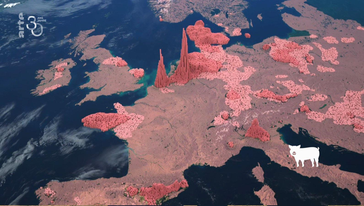
The Netherlands’ concentration of pig farming compared with the rest of Europe. Graphic: Arte

Forum for Democracy”

One silver lining of these elections is the loss of the fascist FvD, even though it doesn’t come as a surprise. After the party split in December 2020 and the neofascist circles around Thierry Baudet and Freek Jansen consolidated their control of the party, the electoral support for the FvD has dwindled compared to the 2019 election. The seats the party won at the time have almost all been lost to internal conflicts over the course of four years. The joy on parts of the left over their loss therefore comes off as exaggerated.

FvD have only lost votes in small amounts to other far right parties. Around 40 per cent of FvD voters in 2021 did not show up this time. Only 10 per cent voted for BBB. The fascists therefore did not so much lose because of another far right party’s success, but rather because a significant part of their own support base have turned their backs on the FvD. It seems like this can be explained by the fact that the FvD leadership overplayed their hand. In the weeks before the election, the FvD increasingly turned against the BBB, accusing them of being a “controlled opposition”. This has led to BBB-chair Caroline van der Plas receiving death threats and a rift in the far right front that was supposed to have mobilised the “biggest demonstration ever” in the Hague on Sunday the 12th of March which ended in a flop for the FvD-fascists.

Although the FvD maintain a frighteningly loyal core support base, who not only vote for them, but are also party members, buy merchandise, consume fascist media and sometimes participate in far right street protests – they are still a small minority compared to the passive electorate of the far right. The latter wider group has up to now not been won over to fully fledged fascism and seems to abhor attacks on other far right parties.

But this situation is far from static. The FvD has a solid base and a real network of fascist media with a serious reach behind them. Furthermore, the fascists show the logical consequences of views that the entire far right share. FvD is focused on raising an extra-parliamentary movement and can continue building it. They might not be a big force electorally, but the danger of fascism is felt in the long term and doesn’t originate from their parliamentary fractions as much as from their influence outside of parliament.

The Left

The left wing parties (the social democrat PvdA, the green party Groenlinks, the socialist SP and the animal rights party PvdD) have done really badly in this election, even if one wouldn’t guess it from the speeches from their leaders. The left has not been able to profit from the blows the government parties incurred. The explanation is simple: the left have not consistently opposed the government and have made no attempt to offer an alternative. The PvdA and Groenlinks together have 15 seats in the Senate and form the second biggest fraction. That also shows that their plans to merge their parties together have not had any substantial positive effect. That is not surprising; the left parties have been losing for decades now because of their neoliberal, rightward turn and their untrustworthy opportunism. One doesn’t solve that problem with different marketing.

Groenlinks and PvdA proved their limited worth in the election debates. While the VVD liberals went on the offensive, the left parties had no fundamental answer. They didn’t dare to wholeheartedly defend the actions of Extinction Rebellion in The Hague on the 12th of March. Neither did they have a left wing answer to the hard capitalist arguments of the right wing – like Rutte’s remark that rents cannot be lowered because that would scare off investors from investing in affordable housing. They even cowed from saying that the right wing government has to go. PvdA’s lead candidate was asked four times in one debate whether Rutte should step down, and she never answered in the affirmative.

Even in direct confrontation with the VVD on the eve of the elections, the “opposition” parties wanted to come across as constructive. They are not opposing the government, they mostly hope that they can continue to help Rutte to maintain his parliamentary majority in exchange for some loose change. Sigrid Kaag of the liberal D66 party described this servile attitude in an unintentionally devastating way: “I know the PvdA and Groenlinks, up till now they’ve voted for almost every cabinet proposal, given some amendments, and I thing they will continue to do so after the 16th of March.” She’s right. The difference now though is that Rutte can make deals with BBB too, which means that the left parties have lost some of their leverage.

One piece of good news is the seat gained by the animal rights party (PvdD), now giving them a total of 4 seats. This party is also quite liberal and petite bourgeois in outlook, but is irrevocably green and principled. They were the only party who dared to directly contradict the BBB. Unfortunately, they needlessly juxtaposed the interests of farmers and nature, for instance with the tactless slogan “no bees, no food”, but nonetheless their courage and principles were rightly rewarded.

Bottom of the barrel

It seems like many left wing voters didn’t vote out of enthusiasm, but mainly out of horror of the right and far right, as was shown in the the Socialist Party’s (SP) fifth consecutive election defeat under the leadership of Lilian Marijnissen. Even in the party’s traditional stronghold of Oss, the SP gained less votes than BBB and VVD.

The party reacted as it usually does – by sticking its head in the sand and explaining the victory of the “protest party” BBB as “a middle finger to the established order”. The fact that this middle finger comes from the far right and not from the left, even from a party that prioritises the interests of agribusiness, apparently doesn’t even make a difference anymore. This latest defeat will not prompt Marijnissen to make way for new leadership, nor will it provoke genuine reflection. The leading clique has practically abolished internal party democracy and don’t have any ideas apart from continuing a failed and increasingly nationalistic strategy.

The SP will reach rock bottom one day, but the party has – in comparison to the other left parties – a surprising capacity to keep losing. Other left parties retain a certain attractiveness to voters who want to prevent things from getting worse. The SP is much less credible in this regard. The party flirts ever more openly with the far right, conducted a racist campaign against labour migration and let their MP Mahir Alkaya make an appearance on the fascist conspricacy channel BLCKBX.

The effect of all this is that the SP is the only left party that substantially lost votes to the far right. Of all SP voters in 2021, 21 per cent voted for the BBB this March. Only a third voted again for the SP. The SP did not manage to gain votes out of the far right camp – those voters have enough parties to choose from anyway.

Media

Many commentators explain the success of BBB by pointing to the way in which the media has continued to offer the farmers party a platform over the last years. Especially talk shows have made a habit of inviting all kinds of uncouth figures. This was the case with Thierry Baudet, but also with leading COVID conspiracy theorist Willem Engel and the fascist commentator Raisa Blommestijn, whom talk show host Eva Jinek kept inviting on to represent a “fresh alternative point of view”.

But it would be too easy to blame the rise of the BBB on the media alone. VVD and CDA have laid the groundwork for the current nitrate crisis by attempting to circumvent EU environmental guidelines and opposing the nitrate regulation plans of their own government when they had no choice but to act. That in turn energised the farmer protests, which gained an ever more distinct far right character at the same time that the BBB became their most prominent political representative. The BBB therefore had a social movement behind them as well as the support of agribusiness.

Another factor was the lack of a credible left opposition. The left parties have done nothing to organise a left wing countermovement. The fact that the farmers movement and the BBB actually did manage to make things difficult for the government, meant that a lot of people mistakenly saw them as an alternative to the neoliberal status quo – even though the farmer protests are precisely meant to maintain this status quo.

Wishful thinking

Just like after the election victory of the FvD four years before, liberals are trying to square the circle in all kinds of ways to reassure themselves. One variant of this is the assumption that BBB will enter into a similar crisis to the one of the FvD after 2019. There is no indication of that at all. Furthermore, this wishful thinking ignores fundamental differences between BBB and FvD.

The FvD crisis stemmed from the fact that the FvD leadership was and still is pursuing a neofascist project, even though a big part of the party neither understood, nor had been won over for such an enterprise. The self-confident fascists in FvD initially amounted to a small group that tried to push the party to the right bit by bit. Before the 2019 provincial elections, the party needed all sorts of candidates that they did not have, and therefore needed to recruit them. Once elected, these representatives were confronted with ever more explicitly fascist outbursts from the party leader Baudet, which put pressure on their relations with other parties. This eventually prompted almost the entire FvD senate fraction to leave the party.

BBB is much different. They also have grown quickly and need new people. But while BBB flirts with all kinds of far right ideas – like the so called great replacement theory and conspiracy theories revolving around the World Economic Forum – and is unmistakably populist and opportunistic, the main party goals are clear to the entire membership. All kinds of former VVD and CDA politicians are now active for BBB. Furthermore, BBB has a powerful and experienced network of agricultural capitalists behind them, that can provide talking points and supply figures to support their arguments – whether those figures are manipulated or not. Despite this, we will surely see all kinds of amateurism from new BBB representatives, but indications for an imminent party crisis are nowhere to be found.

Conclusion

Once more, these latest elections were bad news for the left. The Rutte government can continue to govern and can find senate majorities with the far right as well as with the (centre) left. The VVD strengthened its position in the national government. The fact that the VVD has cleverly managed to put its mark on government policy goes a long way towards explaining their relatively small losses compared to the other government parties (D66 and CDA). It is therefore to be expected that the VVD will continue to strengthen its position. The continued rise of the far right helps them in this regard.

The implementation of nitrate restrictions will be kicked further down the road and probably rewritten in favour of the interests of the big agricultural companies. That will lead to significant conflict, as BBB is determined to force a break with EU guidelines on nitrate and environmental protections, whereas for the governing parties this is probably unnegotiable.

The left opposition will likely play an even more insignificant role. Groenlinks and PvdA are exclusively focused on parliamentary cow towing, which will deliver even less results. This underscores the importance of the extraparliamentary left, especially the climate and the trade union movements, who show that victories for working people are only possible if we fight for them.

This article originally appeared in Dutch in socialisme.nu. Translation: Freek Blauwhof, Die Linke Neukölln

The Imperial ambitions behind Olaf Scholz’s Japan visit

Victor Grossman on the Simmering Conflict with China


28/03/2023

It has become so urgent to rally all those who oppose the most bellicose elements now panting for more weapons, more billions, militarization, even the draft and, basically, more war. German Foreign Minister Baerbock, the new Defense Minister Pistorius, EU boss von der Leyen and NATO-leader Stoltenberg all seem so close to Washington military policy they deserve a Stars-and-Stripes flag sewed on their pants or at least a USA lapel pin. Others, full of talk of “Eastern flank” and “Southern flank” and tactics for 2026 or 2067, dream once again of Prussian glory. They want regime change in Moscow, the opening of vast reaches of Eurasia and a springboard toward China.

Till recently China was Germany’s peaceful trade partner, its biggest. Now, with one provocative visit to Taiwan after the other, with a German warship, fighter planes and soldiers back in old German colonial areas, it is joining in with an encirclement of China like that against Russia.

Olaf Scholz just visited Japan to increase trade and cement common policies. “We are united by democratic principles,” the SPD politician made clear, as he does at virtually all state visits. A leading Japanese journalist noted that “in view of the current world situation, our coordination and cooperation with Germany in dealing with Russia and China are very important.” And Premier Kishida stressed that “Japanese-German relations are stronger and closer than ever before!”

He was not quite correct. They were once even closer. If, like the legendary American long-sleeper Rip van Winkel, I had fallen asleep in 1936, I might have read, before drowsing off:

“… the following November (1936) saw the ratification of the Anti-Comintern Pact, an anti-communist treaty between Germany and Japan; Italy joined the Pact in 1937… It aimed at “formally integrating the military aims of Germany, Italy, Japan, and later followed by other nations… to stand side by side and cooperate in their endeavours in the Greater East Asian region and the European territories, their primary aim being to establish and maintain a new order of affairs capable of promoting prosperity and welfare for the peoples there.“

On awakening today I would have been amazed at some similarities, such as the aspects on Russia and China! To quote Yogi Berra: “It’s like déjà vu all over again.”

There was a major difference from 1936; today’ German-Japanese friendship is under the aegis of that other major power, which also likes to promote prosperity and welfare but is more blatant about its goals – and more frightening. It would have been a rude awakening!

Twentynine Palms, Calif.: “…a half-dozen officers of the Hawaii-based Third Marine Littoral Regiment took a very short break from days of fighting … The war, they said, was going well.

The unit, newly created and innovative in nature, was facing its toughest test yet — a 10-day mock battle across Southern California…developing new tactics to figure out one of the service’s highest priorities: how to fight a war against Chinese forces in their own backyard, and win.

Over the next two years, the new unit will have a relentless schedule, with about four or five times as many exercises as most infantry regiments. Its next big test will be in the Philippines in April.” (NY Times, 3.5.23)

The China-Russia-USA tension recalls another game known to kids in many countries: “Rock, scissors, paper.” Which one wins points? During a visit to a Russian children’s home ten years ago I watched two sweet little 9-year-olds playing it and asked if I could join in. They laughed and nodded. Under their rules, the winner touches the loser‘s forehead with a gentle finger. As I followed this rule they roared at a funny foreigner playing along. Of course they could not know (or care) that I was an American.

I reflected later about another possible finger pushing a special button, not gently, and bringing an end to the girls, now adults, that happy home, all such games – and me if I am still around. People have marched to prevent such an ending in recent weeks, fine people, but far, far too few. Despite all differences, all quarrels, all coalitions. Such protests and demands must quickly increase, everywhere, with countless worried humans, of all colors, preferences and beliefs. My plea is: join in!