The Left Berlin News & Comment

This is the archive template

Neither Putin nor NATO – take the protest against war onto the streets

A discussion with Christine Buchholz about the strengths and weaknesses of the Manifesto for Peace and the role of the Left


23/02/2023

The following interview with Christine Buchholz was conducted by Yaak Pabst, and originally appeared in German on the marx21 website.

Hundreds of thousands of people have signed Sahra Wagenknecht’s and Alice Schwarzer’s “Manifesto for Peace”. The initiators are calling for protest on the streets. How should the Left treat the call for action?

The Manifesto for Peace has received half a million signatures inside just a few days. How do you assess this?

It is absolutely positive that voices in society which oppose the delivery of weapons are getting louder. One year after the Russian invasion, a war is raging in Ukraine which has brought immeasurable misery and death. We need a strong anti-war movement which expresses what many people are thinking; “Stop the war! Stop the escalation! No to the delivery of weapons!”, and thus puts pressure on the German government.

Why now?

The Munich Security Conference begins on Friday [translator’s note: this interview took place before last week’s annual NATO conference in Southern Germany]. As at the meeting of the Ukraine contact group, where the Ukrainian government talks to the defence ministers of the NATO countries and other allied states, at the Security Conference, there will be a call for more heavy weapons, more ammunition, fighter jets and long-range missiles.

The head of the Security Conference Christoph Heusgen has already demanded fighter jets for Ukraine and wants more German “leadership”. We can expect that one year after the start of the war, war propaganda will be ramped up. With this background, it is important that there is a series of calls for local actions on 24th and 25th February. For this reason, I also welcome the “Manifesto for Peace” and the call from Sahra Wagenknecht and Alice Schwarzer to mobilise for a rally on 25th February in Berlin.

But Russia invaded Ukraine? Is it right to speak of an escalation from the West?

Putin is fully responsible for the attack on Ukraine. But the war has a double character. It is a legitimate fight for the right to self-determination for Ukrainians against an imperial occupying force. But it is also a proxy war by NATO, the USA and the EU against their imperial competition Russia. Finally, it has led to a dangerous escalation.

In what way?

The reaction of the Western bloc just throws oil into the fire. That goes from the delivery of weapons and the extensive sanctions régime to that movement of NATO troops to the Eastern border with Russia, up to the massive armament plans of individual countries. These politics are a cul-de-sac, as they further fuel the spiral of escalation and bring no peace and justice to people – neither in Ukraine nor world-wide.

It is fatal to send even more weapons into this war. This is the point where I agree with the call from Wagenknecht and others.

Where do you disagree?

The call has weaknesses, specifically the phrase “damage to the German people”. The German people as such are not suffering. The German armaments industry and other factions of Capital are making tidy profits from this war. We should point out that it is above all workers and poor people in Ukraine, Russia and in other countries who are dying and suffering in this war.

What else bothers you about this call to action?

There is not a single word about the militarisation and massive rearmament of the German army. Given the lack of money for schools, hospitals and the public sector, this is an important concern for the Left.

Why?

Defence minister Boris Pistorius wants to further increase the military budget and is demanding €10 billion more per year for the army. Der Spiegel is using Pistorius’s plans to raise fear that public sector wage increases could reduce the operational readiness of the army.

Some Leftists do not want to go to the rally for these reasons. Is this the right reaction?

Although the call does not refer to the question of militarisation, we must clearly make this point. On the mobilisation for 25th February, the Left has the chance to make public our own position against the war, the delivery of weapons and against the massive militarisation. I find that not going is not an option.

It is really important not to hand over the protest against war and the delivery of weapons over to the AfD. At the moment, the right wing is using this subject to build. Of course they are fully untrustworthy, but unfortunately, they are also enjoying some success.

Chrupalla, the leader of the AfD has signed the call…

It was a problem that Tino Chrupalla signed the call, as you can’t make peace with fascists.

But that is why it is important that Sahra Wagenknecht has clearly said that she does not want any support from the AfD. National flags, AfD flags and right wing symbols have been banned from the demonstrations, and there are stewards to carry this out.

Chrupalla has since tweeted that he has no desire to take part in a left-wing demo, and that the AfD will organise their own peace rallies. Is everything ok now?

Of course part of the right wing scene will try to instrumentalise the demo. But it is decisive that many Leftists mobilise with banners and flags which marginalise the right wing.

At the beginning of the Hartz IV protests, Nazis tried to hijack the demos. It was important that the Left did not stay away, but fought for hegemony of the protests.

Oskar Lafontaine [translator’s note: former leader of die LINKE] has been accused that he softened the distancing from the right wing in a video interview where he said “everyone who has a heart for peace is elected”. Here he is appealing directly to AfD voters. What do you think?

Oskar Lafontaine wants to win back former LINKE or SPD voters who voted AfD as a protest. And sure: Die LINKE has never made a “test of beliefs” to determine who is allowed to attend a demonstration, How would that work? Nonetheless Lafontaine is wrong here.

Why?

He should have clearly said that Nazis who pretend that they are for peace are not welcome. He did say in his interview that Reichsbürger flags are not welcome, and that the protest should not be instrumentalised. But that is too little. AfD politicians and flags will also not be tolerated. His whole approach shows that he underestimates the danger which comes from the Fascist troops organising in the core of the AfD. And he concentrates too much on AfD protest voters.

It would be better to look at the many who do not vote, or who vote LINKE, SPD or Green. Very many of them are against the delivery of weapons. I take Sahra Wagenknecht at her word. The AfD and fascists are not wanted, and a stewards’ committee will make sure that national flags, AfD flags and right wing symbols will not be allowed.

One argument against the call says that the feminist Alice Schwarzer and [co-initiator] Brigadier General Erich Vad are right wingers with whom you should not demonstrate.

There are other people with whom I’d prefer to demonstrate. But we must also see that because of the militaristic role of the SPD and Greens that there are many people in their circle who are not against the delivery of weapons.

People reject the delivery of weapons and the escalation process for many different reasons. I think we must take the divisions in society forward productively, even if we have little in common with some of our partners.

I’m one of the hardest critics of Alice Schwarzer’s position on Islam and the head scarf. She fuels prejudice against Muslims, for example when she demands that only women and children should be allowed as refugees from Afghanistan, but no men.

But just because I demonstrate with her against the delivery of weapons and the danger of escalation, that does not mean that I agree with any of her other positions.

What about Erich Vad?

Erich Vad is not an anti-militarist. Quite the opposite. He stands for a European imperialism under German leadership which is independent from the USA. This brings him partly into conflict with the politics of the German government, which tries to implement the interests of German and European Capital in a different way,

Erich Vad bemoans the insufficient operational readiness of the German army. This leads him to fight “structural pacifism” of Germans since the experiences of the Second World War and the deployment of the German army in Afghanistan.

I reject all this. But it hurts German imperialism when one of their own criticizes the current politics. We can use this if we don’t sweep his position under the carpet. His assessment of the war, which is informed by his militaristic view, is interesting and helps us understand the conflict situation.

By the way, the peace movement always had soldiers in their ranks who were not anti-militarists, but who expressed the contradictions of ruling politics.

In 2003, Vad had an article published in the neo-Right publication “Sezession”

That is right, even if he declared in 2010 that he wouldn’t do it again. But it is clear that Vad belongs to the right wing conservative wing of the German military. Like many in the CDU, he has held culturally racist and anti-migration positions.

But one thing is important: unlike other right-wing soldiers, he has not gone over to the AfD in recent years. This is why I find it defensible to take part in a rally at which Erich Vad is speaking.

If we make the rally large, will Sahra Wagenknecht just use this?

The success of the call is partly because die LINKE and the different parts of the peace movement responded inadequately to the demands brought by war. A vacuum emerged, which Wagenknecht and Schwarzer have filled.

I see it differently to your question. If the Left – inside and outside the party – is not present, and not intervening with our own materials, we don’t just take ourselves out of the debate, we also fail to build an alternative to the established.

Sahra Wagenknecht expresses justified criticisms of the escalation spiral from the delivery of weapons and sanctions. We are in agreement on this point. At the same time, I do not want to adopt her parochial nationalistic positions on the German economy or her concessions to the right wing, for example on the question of migration.

Is it possible, that a new Querfront [translator: German term meaning an alliance of the left and far right] will emerge?

There are right wing forces, like Compact magazine from [Jürgen] Elsässer and others, who want to build the extreme right through such Querfronten. We have the experience of the large demonstration in Prague, at which both Leftists and the extreme right wing took part. And also part of die LINKE is open for alliances with the right.

This excludes other forces from alliances, and leads away from the class politics that we as die LINKE want to develop. Our slogan must be: “Neither Putin nor NATO. Solidarity with the international resistance against the war”.

Left wingers should prevent such alliances because they do not lead to success. But because the militarism of the ruling class is so rampant, and concern in the population is growing, I find it imperative that under the current conditions we do not stand aside but strongly mobilise around the demands against the export of weapons and militarisation. It is enormously important that we combine the fight against war with that against high prices.

In the LINKE party executive, you proposed that the party mobilises for the rally and intervenes with its own profile. Won’t that split Die LINKE?

It is clear that we have very different points of view within the party. But it is no alternative to do nothing in the face of the development of war. I am trying to speak both with comrades who are explicitly for taking part on 25th February, and those who are strongly against.

It is important to make clear that we all want to marginalise the AfD and the right, and to position Die LINKE as an anti-war party. We clearly see different paths to this goal. But we combat divisions through debate.

The biggest current danger is that the AfD emerges as the only partner for peace. Die LINKE must take to the streets with its own placards and banners with our ‘No to war’ and ‘No to the delivery of weapons’ slogans.


Christine Buchholz is a former MP and a member of the LINKE National Executive.

Questions: Yaak Pabst. Translation: Phil Butland. Reproduced with permission.

A weekend with “Care for Calais” supporting asylum seekers

The recent attacks on asylum seekers in Liverpool are the direct consequence of a government which demonizes desperate people. Eye-witness report from Northern France


18/02/2023

‘The Jungle’, was the sprawling refugee camp near Calais. In 2016 it was dismantled. Since then almost no images of refugees in France reaches screens in England. Our media images are dominated by the arrival of refugee ‘small boats’ – unseaworthy inflatables. They discharge exhausted and relieved people onto the south coast beaches. But smaller encampments are still dotted around close to the beaches of Northern France.

Last month with friends, I travelled to France to volunteer with the UK charity Care for Calais. Warehouses are kitted out with floor to ceiling shelves, bodged together from scrap wood and pallets. Van loads of donations are shipped in, sorted and repacked for distribution: warm clothes, sleeping bags, hygiene products and footwear. In the mornings we opened up and checked donated tents salvaged at the end of UK music festivals. Tents, bedding and clothing are needed in abundance because police routinely turn up and bulldoze the camps, trashing the refugees’ fragile nylon homes and meagre belongings. The work is constant. Three paid staff manage a through flow of volunteers, some like us come just for a weekend, others stay for months or years.

In the afternoon we visited bare fields across the road from houses on the outskirts of town. Care for Calais visit a different area every day bringing packs of clothes, hot drinks and snacks, mini generators and power panels. Utility alongside distraction and solidarity. Some of the young men played cricket or football. Lots came to charge their phones or get a haircut. Some wanted to practice chatting in English. I volunteered on the English teaching table giving me the incredible privilege of talking to several people at length about their journeys, their aspirations. What they were running from and to.

The next day, after a morning in the warehouse, we parked up on a patch of concrete in Dunkerque beside a large expanse of treeless scrubland. Dozens of people, including a small number of women and children, appeared shortly after our arrival ducking through a broken corner of the chainlink fence. At this much bigger gathering several other charities turned up. One provided hot food, one bottled water. Organisations from around Europe coordinate to provide medical care, food, supplies and legal advice.

The stories I heard that day were harrowing and awe inspiring by turns.

The young Afghan man of 17 who had reached Dunkerque after walking for 7 months, dodging police bullets at the Turkish border. Life had stopped for him at home when the Taliban took over. He’d lost any sense of safety or hope. With his family’s blessing he left everyone and everything behind.

I met a baby just a few months old peeking out from under her mother’s coat; and a small girl with grubby face and swollen red hands playing on the ground, filling a broken shuttlecock with sand with all the serious intent and curiosity of every toddler. She’d ‘borrowed’ a plastic tipper truck from the Care for Calais toybox and when it was time to go she wouldn’t give it back. Her tenacity, clinging with frozen fingers to the cheap toy seemed to symbolise the extraordinary resilience we saw all around us.

The camps are bleak, windswept wastelands. Since they broke up the jungle there is no on-site infrastructure. No toilets, running water, paths, litter collection, permanent or communal shelters – just scattered clusters of small tents. Everyone is trying to make it to the UK. They are matter of fact about it. There was no acknowledgement of the extreme risks of crossing the busiest shipping lane in the world in freezing conditions. I wondered if they know about the boat full of men women and children who died in the Channel at the end of 2021. Both French and British coastguard agencies took multiple desperate calls from the boat and wrangled for hours about whose waters it was in and whose responsibility it was – meanwhile it sank and 30 people drowned.

Everyone is determined to reach the UK. It was quite hard to hear their hopes and dreams of studying and working, and meeting up with relatives when we know they are likely to end up in detention, or in hotels for years, unable to earn money, work or study. At worst they may even face deportation to Rwanda.

One man asked me a favour. ‘Please’, he said, ‘can you campaign for your government to stop the French police slashing the boats. They get to the beach before us, they break our boats’. Of course the UK Government pays the French police millions of Euros to do just that. To prevent the crossings by any means necessary.

The only real way to stop the crossings, thwart the people traffickers making thousands from each dinghy full of desperate people, and to close the camps in Northern France – would be to create ‘safe routes’ for refugees heading for the UK. They could set up assessment centres in France and allow those with a legitimate claim to cross the channel safely by ferry or train; and allow British consular services around the world to assess claims and provide visas. But safe routes simply won’t happen with the baying hounds in the UK media that daily amplify racist and hateful rhetoric about migrants.

The response to the small boats ‘crisis’ has been brutal. A new Nationality and Borders Act reduces safe routes further, preventing family reunion and creating a hierarchy of entitlement to asylum. An agreement with Rwanda will deport refugees there with no right to make any further claims for asylum in the UK. This a vastly expensive and performative dogwhistle. It signifies to the anti-immigration lobby, a government ‘getting a grip’ on the situation. So far it has been prevented by legal action, but further legislation is planned to smooth the way for this to go ahead. If they have to tear up every international convention to do so and pull out of the European Court of Human Rights, they will.

The opposition Labour party opposes the Rwanda scheme as impractical and expensive. They consistently deflect questions about whether it is ethical, legal or acceptable. Asked for a solution to the immigration ‘crisis’ they have called for more investment in processing applications in order to remove illegal claimants faster. The leader Keir Starmer suggested putting ankle tags on claimants like criminals released from prison so that we can track their movements by GPS.

‘Controlling our borders’ was the rallying cry of the Brexiteers. The propaganda during the referendum deliberately conflated  free movement of EU citizens into the UK, and refugees arriving to seek asylum. Both groups were blamed for the failures of our public services (all at breaking point after years of funding cuts and privatisation), though immigrants of all kinds are as likely to work in those services as to use them. Those who voted for Brexit in the hope it would keep ‘foreigners’ out are disappointed and bitter. Brexit has successfully reduced the flow of, largely skilled, EU workers into the UK leaving us with staffing crises across all sectors: health, transport, construction, agriculture. But the failure of the government to negotiate a ‘returns agreement’ on leaving the EU has actually increased small boat traffic.

Those who do arrive in England – estimated to be 40,000 people in 2022 – have no right to work while their claims for asylum are processed. That can take years in a system that is underfunded and understaffed. Refugees are housed in flats or hotels in communities  suffering from years of austerity. That resulted in yearly real terms wage cuts; spiralling inflation; a housing crisis and unaffordable rents; huge rates of in-work poverty with mass reliance on foodbanks; and families unable to heat their homes, and even their food, for fear of astronomical bills. A demoralised, desperate population are told every day by their political leaders, and newspapers that idle, criminal immigrants have come to claim benefits and be housed for nothing in their neighbourhoods while they work multiple jobs just to keep a roof over their heads.

Immigrant hater-in-chief home Secretary Suella Braverman (herself a second generation immigrant) was recently asked to apologise for her use of hateful, othering language about people seeking asylum. The holocaust survivor who confronted her told her that her words echoed those used by the Nazis to justify the murder of her family. She warned that words have real life consequences. Braverman refused to apologise.

Only three weeks later a protest took place outside a hotel housing asylum seekers in Knowsley North West England – the second most deprived borough in England. It degenerated into a stand-off with police and the burning of a police van. The demo was organised by far right groups on social media around the unproven claim that asylum seekers were predatory paedophiles, preying on young English women. In her late and tepid denunciation of the demonstration, the Home Secretary managed to endorse this atmosphere of suspicion.

I can’t help wondering whether some of those I’d met in France three weeks earlier might be among those peering out in fear from behind curtains of the besieged hotel. People who are looking only for safety and opportunity like Ali, 23, from Darfur. Ali had somehow reached Libya where he’d spent a year at the mercy of traffickers. When I asked him about life in Libya he just pointed to scars across his hands. He finally made it across the Mediterranean to Italy and walked across the Alps and across France. When I asked him what or who he missed about home, his solemn face lit up and he told me about his beloved mum. She always encouraged and supported him in his ambition. After getting to England he hoped to study and become an engineer.

The demonization of people like Ali, to deflect from the economic failures of the most incompetent, damaging and corrupt government in modern British history, demonstrates a fundamental lack of humanity. It is also an enormous failure of imagination that we can’t work out as communities and nations, how to capitalise on the extraordinary energy and grit of people willing to walk across continents for better lives.

You can find out more about Care4Calais here. Donate to their activities here.

The trial of Nakba Day protestors begins with a “Not Guilty” verdict

Now lets ensure that we can protest on the 75th Anniversary

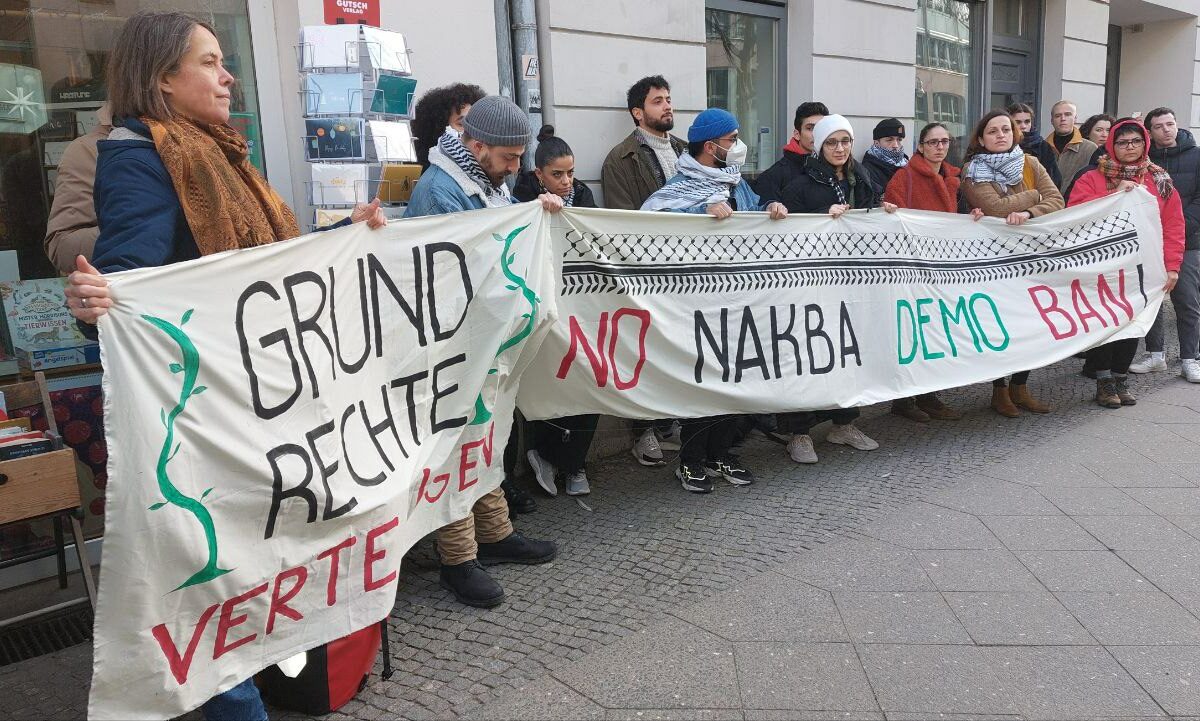
At midday on Thursday, 16th February, 50 people gathered opposite the Tiergarten District Court to protest at the first prosecution of someone arrested on Nakba Day 2022. Protestors held banners that read, “Defend Civil Rights” and “No Nakba Demo ban”. Given the time of day and the difficulty of discussing Palestine in German politics, this was an impressive mobilisation.

A report in the Electronic Intifada, the day before, pointed out that the first person put on trial, who prefers to remain anonymous, was Jewish, and a member of the Jewish Bund. He was facing a fine of over €300 for being in Hermannplatz a few days after the Israeli state murdered Palestinian journalist Shireen Abu Akleh.

One of the people arrested in Hermannplatz last year explained her experience: “Being surrounded by the German police for an hour in the middle of Berlin, under 30 degrees in the sun, without any explanation. This whole thing still feels surreal and I cannot believe that for the first time in my life I got a fine and face a court hearing. Simply because I wanted to use my rights.”

Christine Buchholz, former MP and member of the LINKE national executive, who was attending the trial as a witness told TheLeftBerlin: “We are at the court case to clearly show that we will not accept this limitation on the freedom of opinion. The Berlin Nakba demo ban is primarily aimed at Palestinians, but it affects us all. This is why it is important that we organise solidarity now.”

The protest started with speeches from representatives of Palästina Spricht, the Jewish Bund, Jüdische Stimme (Jewish Voice for Peace), as well as Berlin councillor Ferat Kocak and others. Speakers pointed out that one hour earlier, an environmental activist from Letzte Generation had been tried in the same court. They said we must unite the different struggles against repression.

A first victory

After the speeches, most people attending the protest went to a court room, which was too small to hold everyone, so most of us were forced to wait in the lobby outside. After about 45 minutes, Ahmed Abed, lawyer for the accused, came out to tell us that there wasn’t a case to answer. Witnesses who were present were not called. Instead, proceedings were stopped and the case was dropped.

The good news is that the accused does not have to pay any fine, but this is not necessarily a case which can be used as a precedent. Other protestors are due in court in the coming months, and at least one has already paid their fine. Although the accused are organising and supporting each other, people are under intense pressure, especially those who don’t hold German passports.

Pawel Wargen, who is also facing a fine, said “It’s clearly good that the court recognised the absurdity of the situation and dismissed the case, and we hope this will be true for the others facing trial, but that’s a very low bar. The ultimate goal is an end to the punishment of Palestinian solidarity in Berlin.”

The protests must continue at future court cases, and we must start preparing for May 2023, the 75th anniversary of the Nakba. Last year, while demonstrations took place worldwide, even in Israel and other parts of Germany, several planned demonstrations in Berlin were banned, including one called by the Jüdische Stimme protesting the murder of Shireen Abu Akleh.

Demonising Muslims

The bans were justified by the police on the grounds that “the current situation”, by which they meant the cold-blooded murder of a journalist, “can provoke the anger of Palestinians living here.” They went on: “The Palestinian diaspora here is considerably tense and emotional. As a result, these gatherings often caused considerable disruptions to public safety.” In other words, bans are more likely to take place when people are angry about a recent injustice.

Of course, this only applies to certain communities. The police statement continues: “The majority of participations in the demonstration will be from the Arab diaspora, especially those with a Palestinian background. In addition, other Muslim-inluenced groups of people, preferably from the Lebanese, Turkish and Syrian diasporas, will participate on the march. A large number of youths and young adults are also expected, who will continue to be highly emotional.”

This statement comes in the wake of recent demonstrations by right-wing conspiracy theorists and open Nazis. The German police and legal system can live with this, but is systematically denying a voice to “Muslim-influenced groups”, whoever they may be.

Forward to the 2023 demo

The danger that there will be a similar ban in 2023 is very real. This will be much easier to impose if Palestinians and other groups are left isolated. This is why, although all significant protests have been led by Palestinians, it is significant that recent pro-Palestine demonstrations in Berlin have been attended by an increasing number of white faces. This could be reflected both at Thursday’s demonstrations and in the people who have been fined.

There is some more ground for optimism as Thursday’s demonstrators have made it clear that the fight for justice is not over. Over ten people registered to help the organising team planning #Nakba75, the demonstrations in Berlin that should take place in May. As we can expect further repression, it is important that this group is as strong as possible.

Summing up the day, Ramsis Kilani from Palästina Spricht said: “The first court case has shown: the Nakba demo bans have no legal basis. They are politically motivated. On the 75th anniversary of the Nakba, we must make it clear that we will not be silent about our basic democratic rights of opinion and assembly. We are ready to call and mobilise for demonstrations which are both large and broad.”

We will continue to report on future cases, and on the limitation of the right to protests on TheLeftBerlin.com. We also urge you to support the legal fund for the people who were arrested. If you would like to know how you can get more involved in the campaign, please contact us at team@TheLeftBerlin.com.

“Law, order and cars” win in Berlin

The CDU wins the elections in Berlin, in most of the district elections with a rhetoric very close to that of the far-right.

This Sunday regional elections were held in Berlin (which is a federal city-state) and in its twelve districts, which exercise the administrative function of municipalities. The Christian-Democratic CDU won with 28.2% (+10.2%) of the vote and 52 seats, 10 points ahead of the SPD and Bündnis 90 (Greens), both with 18.4% (-3% and -0.5% respectively) of the vote and 34 seats (only 105 votes gave second place to the Social Democrats). DIE LINKE (The Left) obtained 12.2% (-1.9%) and 22 seats, while the far-right AfD obtained 9.1% (+1.1%) and 17 seats. The liberal FDP fell below the 5& barrier with 4.6% of the vote (-2.5%) and other parties obtained 9% (-3.4%). The turnout dropped from 75.3% to 63%. In addition, the Christian Democrats won in 9 of the 12 Berlin districts, while the Greens won in the other 3.

The victory of the CDU and Kai Wegner was based on several argumentative pillars: on the one hand, law and order, fed by the events of New Year’s Eve, when tens of thousands of people went onto the streets to “celebrate” the new year with firecrackers, rockets and flash guns, in some cases resulting in attacks on public transport, cars and buildings, as well as on the firemen who tried to put them out, and the police. Immediately all right-wing parties accused criminal immigrants. Later, after dozens of arrests, it was noted that most of the people arrested were German, to which the right wing responded by asking for “the German surnames”, to see if they had roots in migrant families. From there, the story of insecurity, the permissiveness of the left with criminality, the lack of order and the need for a strong hand. One of the CDU’s slogans read: “what criminals will soon hear: arrest warrant”. Another argument was the debate on mobility and car use, under the slogans “Berlin is for everyone, also for drivers” and “Berlin: don’t let them ban the car”.

With the first argument, the CDU has managed to attract potential voters from the extreme-right AfD, which has obtained 9%, a minimal increase compared with the national polls, where it is polling between 15% and 17%. With the issue of mobility, the CDU has also found an enormous reservoir in the voters of the FDP (liberals), who have ended up being expelled from parliament, a probably undesired effect, as the CDU has been deprived of one of its natural allies and its seats have been distributed among three parties of the center-left and two of the right.

To all this is added popular discontent about the elections themselves, which are a repetition of those of 2021 following a sentence of the Constitutional Court, which detected massive failures in the previous vote, such as late opening of polling stations, stations closing for hours due to lack of ballots, ballots in the wrong polling stations (each district has its candidates also for the Berlin chamber) and the publication of results while voting was still going on. The CDU took the opportunity to denounce the chaos generated by the ruling left-wing coalition (SPD, Alliance 90, Left) and especially by the then senator for the Interior, Andreas Geisel.

In this context, the CDU presented itself as the party of order and seriousness. It is also worth mentioning that all these 2023 elections could be invalidated and the status quo of 2021 could return if a challenge to the unconstitutionality of the 2021 elections is successful. This should be resolved in the first week of March. It could result in an acceptance of the 2021 results, in the acceptance of the 2023 results, or in the partial acceptance of some of the 2021 results (for example, some districts without incidents) and some of the 2023 results (where the major incidents occurred).

(Editor’s note: it has since been revealed that during the rerun election, around 450 uncounted voting papers were found in Berlin-Lichtenberg. The chaos could run and run).

For their part, all the parties of the center-left alliance have lost, especially the SPD and its candidate Franziska Giffey. Giffey is a very polarizing person, who had the highest degree of satisfaction among the candidacies, but also the highest degree of hatred (unlike with the other candidates, few people showed indifference). The SPD obtained its worst result ever with 18.4%, only 105 votes more than Jarasch’s Bündnis 90 (Greens). Jarasch herself has burdened a party that is generally on the rise in the rest of Germany and has caused it to lose 0.5% of the votes.

For its part, DIE LINKE. has paid for enter inga government that has not satisfied the demands of the people on the street (the party’s anchor point), especially regarding the referendum on the expropriation of the large real estate companies Deutsche Wohnen & Co. Enteignen, which has not been transferred into law due to the blockage of Mayor Giffey and Senator Geisel, together with the lukewarm attitude of Bündnis 90 and Jarasch, who speak of “not knowing whether it could be carried out in the next few years”.

In addition, the internal fights at the national level between the different factions have led to an enormous loss of militants for the party. It was not for nothing that the Berlin federation tried to distance itself with posters that did not say “DIE LINKE”, but Berliner LINKE (Berlin Left). Candidate Klaus Lederer, despite being one of the most loved and least hated, did not manage to prevent the party from losing 1.9% of the votes and, in the district elections, from losing first place in Lichtenberg, possibly the mayor’s office in Pankow, and three municipal groups in the so-called “outer districts” in the West (Reinickendorf, Spandau and Steglitz-Zehlendorf, each with 2 councilors without a group from now on). Nevertheless, the loss of seats is minimal at the Berlin level, as the seats of the liberals who remain outside are distributed, and yesterday the feeling in the central election party was that “it could have been worse”.

And now what?

In less than 24 hours, all kinds of statements have been made: the CDU claims the Berlin government as the undisputed winner; the SPD is fracturing between part of the party, which after the debacle would not see going into opposition as the worst option, and most of the parliamentary group, which wants Giffey to remain the mayor; Bündnis 90 – The Greens distanced itself from a pact with the CDU during the campaign, but is not ruling out co-governing with a racist party which is opposed to any progress on climate issues. Nonetheless, the Green candidate is still saying that they “would prefer to keep the left-wing alliance”.

Finally, the leadership of DIE LINKE in Berlin would not be unhappy about continuing with the “left” coalition, so as not to give the government to the CDU, despite the enormous skepticism of its basis. Only a clear programmatic turn of the coalition and a written commitment to implement the referendum on the expropriation of large real estate companies within a specific period of time could win confidence for this coalition.

Germany is expecting a hot few months: the anti-war and peace movements seem to be gaining new momentum, the strength of which will be seen on February 25th in Berlin; the unions are threatening strikes, if their conditions for wage improvements are not fulfilled, so as not to lose buying power in relation to inflation. Negotiations are still in progress in the public sector., where the Ver. di and GEW unions are demanding 10.5% wage increases. The DWE housing expropriation referendum, won with 59% of the vote in 2021, believes that its hopes of transposition into law may vanish with a CDU government, and has announced the preparation of a binding referendum, in the midst of an unchecked rise in housing prices.

Finally, the environmental movements have also regained muscle after the events in Lutzerath: the reactivation of the largest open-pit coal mine (by a government of the Greens of Bündnis 90). In this context, a left that loses the pulse of the street to hold on only to the institutions, would be a failed left. That is why the debacle for the center-left and the left in Berlin is a great warning.

Jaime Martinez Porro is the Co-speaker of DIE LINKE Steglitz-Zehlendorf and a member of Izquierda Unida Berlin.

Bertolt Brecht (and me)

Veteran socialist Victor Grossman on the importance of the Communist playwright


15/02/2023

For me, Bertolt Brecht and Thomas Mann were the two greatest German authors of the 20th century, and Brecht, a believer in socialism – and a fighter for it – is admittedly closer to my heart than Mann.

In my three different US high schools or first three years at Harvard I had never even heard the name of Bertolt Brecht. A highly-literate comrade in our Communist group at Harvard first told me of this “leading German author,” in 1948, but I did not get to reading any of his writings until after I had landed in the German Democratic Republic (in 1952).

After becoming a student here, however, at the Karl Marx University in Leipzig, I heard a great deal about Brecht! He was the great favorite of many or most young intellectuals at the time, even to the point of copying his short forward-combed hair, his buttoned up, tie-less shirt or even his love for cigars. The ones who admired and sometimes copied him tended to be critical intellectuals – not those pro-Adenauer-West German types who were hardly likely to read him (or perhaps read any books at all) – but those who were more or less critical of the GDR leadership but not of the GDR in general. For Brecht was decidedly opposed to USA-led western capitalism and anti-Sovietism!

Brecht in exile had never happily integrated into the southern California scene as smoothly as Lion Feuchtwanger, Thomas Mann or his frequent composer and close friend Hanns Eisler. Like so many, he was moved or forced to return to Europe when the hysterical anti-Communist McCarthy era and its House Unamerican Activities Committee tried to browbeat him. He found no welcome – nor theater opportunities – in Zürich (where his plays were known), or in Vienna, the homeland of his actress wife Helene Weigel – and least of all in West Germany, riddled in the cultural (and almost every other) field with ex-Nazis.

But the writer-poet Johannes R. Becher, returned from exile in Moscow and head of the new Kulturbund (Culture Association), and later the first GDR Minister of Culture, was able to attract him to East Berlin, like other prominent exiles such as Anna Seghers, Arnold Zweig, John Heartfield and Heinrich Mann (who died before he could leave California).

In 1949 Brecht was able to form the Berliner Ensemble in East Berlin, soon a magnet for wonderful actors, to produce his plays, and after some energetic maneuvering, to obtain in 1954 his own wonderful theater, the scene of his great triumph with “Threepenny Opera” in 1928, and now, like all theaters in the GDR, financially well-supported by the city government.

In 1956 a fellow-student of mine and ardent Brecht admirer, who had worked as a summer volunteer with his theater, organized a special student excursion to Berlin to see a Brecht play and then meet the master. But alas, the project was suddenly canceled; we believed because of the sometimes strained official relationship with Brecht, who was rarely if ever praised in the official press, though not too sharply criticized either, perhaps because of his growing renown in world-wide literary and theater circles, including the “Threepenny Opera” performed in New York in 1954 with great success (especially the song “Mack the Knife”). Unfortunately, the great sold-out triumph of the Berliner Ensemble in London came after Brecht’s early death in 1956 at the age of 58.

But the productions, just as he staged them, continued to thrill many, many theater-goers in East Berlin, and as long as this was possible, West Berlin visitors as well. I was lucky enough to see most of them: the old favorite “Threepenny Opera,” Helene Weigel starring in lead roles in “Mother Courage” and “The Mother” (based on Maxim Gorky’s book), the great singer-actor Ernst Busch – magnificently – in his leading roles in “Galilei” and “The Caucasian Chalk Circle”, “Schweyk in the Second World War” with the fine singer and actress Gisela May, “Arturo Ui” on the rise of fascism, caricatured in the gangster milieu of Chicago – all of them geared to both laughing and thinking as well – against fascism, war, exploitation. Always sold out, even a back seat in the upper balcony was worth it! Those performances were highpoints in my and East Berlin’s rich cultural life – recollections which I still cherish!

Brecht, though grateful for finally getting the fine theater for his plays, with his trained ensemble, was anything but a yes-man. Never a member of the ruling Socialist Unity Party, but vocal as an honored member of the GDR Academy of Arts, he was often critical of narrow-minded dogmatism (or plain stupidity), above all in the field of culture. Obviously, such criticism was not always welcome – especially by those affected; he was therefore looked upon with a degree of suspicion by some leading official lights – probably explaining why that Berlin student excursion had been canceled.

Anti-Communist media repeatedly quotes his very clever words, written after a stupid statement by a second-rate writer shortly after the angry uprising in the GDR in 1953.

“After the uprising of the 17th of June
The Secretary of the Writers’ Union
Had leaflets distributed in the Stalin Allee
Stating that the people
Had forfeited the confidence of the government
And could win it back only
By redoubled efforts. Would it not be easier
In that case for the government
To dissolve the people and elect another?”

Those who today recall only this quotation in their attempts to misuse Brecht – as another brick in their denigration of the GDR and socialism in general – fail to recall the boycott of his plays in West Germany and Austria and the (vain) attempts to prevent Berliner Ensemble tours to London and Paris. They conveniently forget who helped Brecht and who tried to hurt him – and why!

They hardly recall that, regardless of his sometimes sharp but always constructive criticism, Brecht supported the GDR attempt to build a socialist state in Germany with all his heart. During that same uprising in 1953 he offered his services – to speak in radio and tell people that their grievances were often understandable, often justified, and their participation in redressing them necessary, but warning them not to fall into the trap of supporting  “the other side,” that of “western”, and especially West German capitalism and imperialism. He was, indeed, a dedicated Communist.

Three quotations , better-known to old-timers in East Germany, are as relevant today as they ever were. (Please excuse my clumsy or partial translations. )

“A rich man and a poor man, there they stood,
And judged each other as best they could.
The poor man said, his voice at low pitch,
If I were not poor you’d not be rich. “

+++

“There are men who struggle for a day and they are good. There are men who struggle for a year and they are better. There are men who struggle many years, and they are better still. But there are those who struggle all their lives: These are the indispensable ones.”

+++

“The peoples broke him, yet
Let none of us triumph too soon,
The womb is fertile still from which that crept!”

— From “The Resistible Rise of Arturo Ui”, a parable about Hitler’s rise and defeat, in the final lines addressed to the audience:

+++++++

“The great Carthage waged three wars. It was still powerful after the first, still habitable after the second. It was untraceable after the third.”