The Left Berlin News & Comment

This is the archive template

Film Review – Fragile: A Feminist Romcom Portrayed Through Male Experience

Fragile conveys themes of masculinity and feminism with an expanded scope of experience through the romcom genre


05/12/2022

The red curtains part dramatically to reveal a surfer shirt and tight red pants. The person sporting them strikes a pose.

“What a behind!” and “I could go surfing on that!”, ring out from the seats in front of the dressing room, as the onlookers appraise the new outfit of their friend, Az.

Az has just been broken up with, so of course he needs a makeover. His friends Raphaël, Ahmed, Kalidou and Lila are of course there to help. The scene, like many others in Fragile, a film by French-Algerian director Emma Benestan, takes traditional gender roles and turns them on their heads. It’s not uncommon to see a film that confronts gender norms, but it is uncommon to see one that does it this well.

Fragile distances itself from other films dealing with similar themes by incorporating questions of identity and behavior in subtle ways. Too often, movies that attempt to engage with these topics end up relying on stale narratives that seem to scream ‘Men can be sensitive too!’ through the inclusion of a character, or characters, that act more ‘feminine’, while the rest of the cast exhibits more normative behavior. Instead, each character in Fragile is dealing, individually and together, with the meaning of their own fragility. They engage the audience in a unique way that dives into societal issues tackled through believable situations, and portrayed by a group of friends you could meet down your block.

That group dynamic is one aspect that carries the film through the familiar ups and downs of a romantic comedy. In one of the first scenes, Az proposes to his girlfriend Jess by placing a wedding ring in an oyster (which she subsequently chokes on). Everything in the scene is set up so Jess’ answer doesn’t surprise the audience. She was late, seems flustered and distracted, and doesn’t notice how nervous and attentive Az is being.

The issue of class and wealth also adds an additional layer of fragility to the characters… The divide is accepted by the characters and not overstated in the dialogue, but it adds a visible undercurrent to peoples’ interactions with each other.

From the subsequent scenes, it’s clear where the movie is going. It follows a classic romantic comedy plot set in the coastal city of Sète, France; the audience is taken from a breakup all the way through to the realization that true love was right there all along. The film, however, remains anything but boring. Even in the scenes where the audience can sense the betrayals that are about to occur, the spot-on comedic timing in the conversations between the characters turns the narrative into something fresh and new.

Another aspect, naturally, is the title theme of the movie – that of fragility. The character most obviously dealing with it is Az, as he navigates the emotional rollercoaster of love and loss. Throughout, those around him are nearly constantly poking fun at the various trials he’s going through, but doing so in a way that shows that they care deeply about him. This is most obvious in Az’s all-female family, who seem to humor Az, while also telling him that men are the worst.

In fact, most of the male characters are working within the same framework – that of women degrading them for their macho behavior, even when they didn’t do anything. It’s perhaps most interesting in how the dynamic plays out between Raphaël, Ahmed, and Kalidou, the other men in the friend group. They simultaneously all have their, often hilarious, macho moments, but also show their sensitive sides. This is especially apparent when Lila, the only woman amongst them, has something to say.

Lila is also dealing with her own fragility, which the audience never gets a full picture of. She hints at a life in Paris, and a story of heartbreak, but doesn’t go into too many details. Throughout the film she’s clearly still healing from a recent emotional wound, and it gives her character a maturity that the others in the group don’t have. Though she’s not the main character, her story could have been fleshed out further. At times it felt as if her motivations weren’t entirely believable – she puts herself in very vulnerable positions in exchange for some, admittedly delicious-looking, sweets.

Of course that’s not all she was motivated by, but knowing a bit more about her would have added to her dynamic with the friend group, with Az, and with Az’s family. Lila also repeats the mantra that men are the worst throughout the movie, yet still ends up doing the bulk of the emotional labor. It’s a situation immediately recognizable to many womxn*, and it would have been good to see more of that reflected in Lila’s character.

The issue of class and wealth also adds an additional layer of fragility to the characters, as something that nearly everyone is collectively dealing with, but is rarely mentioned. There’s a clear divide in Sète between the life that Az’s friends and family live, and that of the wealthier residents. Jess, Az’s love interest from the beginning of the film, has joined their ranks by landing a role in a (hilariously portrayed) crime TV show. The divide is accepted by the characters and not overstated in the dialogue, but it adds a visible undercurrent to peoples’ interactions with each other. Like with many of the gender themes, the audience is shown, rather than told, how the different societal strata impact the characters’ lives.

These intertwining and interlocking themes make this film one for a wide audience. It’s cheesy, but not lame, complex, but not complicated. It’s also hilarious, and holds space for people of any gender to identify with the characters and their fragility.

Fragile is playing at Filmrauchpalast and b-ware! Ladenkino. But be warned: just because you’re seeing a feminist film doesn’t mean the line for the women’s bathroom will be any shorter.

Free Speech and Class War

Is Elon Musk’s Twitter debacle the end of the techbro cult or the beginning of something worse?


03/12/2022

Twitter users have been fretting over the platform’s imminent collapse for weeks. From posting last goodbyes, to releasing the hottest takes from drafts, and to migrating to a privacy-deficient Mastodon, Twitter’s death bells have been tolling since Elon Musk was forced to follow through with his acquisition of the platform. But Twitter refuses to die. The website has not yet crashed, despite constant warnings to the contrary, and Musk claims “record numbers” of logins.

But this does not mean that Twitter has not changed for the worse since Elon Musk took control. As with everything else that Musk touches, his artificially inflated entrepreneurial ego pushes him to wrestle control and attention away from people who know better. This happened with Tesla, which he claims as his own technological brainchild. But Musk was just an early investor who obtained the right to call himself “co-founder” through a 2009 settled suit. This happened with Hyperloop, Musk’s cartoonishly useless transportation concept, developed out of hatred of public transport and with disdain for urbanists. This famously happened in the case of the Thuam Lang cave rescue, with Musk slinging baseless accusations when the people who actually risked their lives saving the trapped children derided his ridiculous technophile “solutions.” And, of course, this happened in his very public private life, where his desire to be an “alpha” male has translated into misogynism and outright lies.

If Trump’s account has been unbanned, however, leftist users have been systematically taken off the platform. One case is that of the anarchist collective CrimethInc., whose account was suspended at the request of “far-right troll Andy Ngo.”

But there is more to it than that. If Musk were just your average frat boy or the edgy shitposter he tries so hard to be, he would warrant little attention. This is unfortunately not the case. Being one of the richest people in the world comes with certain advantages, including taking over gigantic companies whose services are used by millions and treating them as your private fief. Because, for better or for worse, Twitter has not only been a social media app. Activists are already mourning the platform’s value for organizing and connecting, while communities such as Black Twitter will be difficult to recreate somewhere else.

Musk, of course, ignores such “woke” concerns. “I am neither conventionally right nor left,” he recently tweeted. But, proving that anyone who says this is invariably on the right, he continued by writing that “The woke virus has thoroughly penetrated entertainment and is pushing civilization towards suicide.” The right does not, unfortunately, have a monopoly on anti-wokeness. Leftists often engage in such discourses themselves, even if their impulse might come from a different place. But, insofar as there is a bipartisan convergence on this matter, it is a convergence that leans right more than anything else.

Proof of this are the results of Musk’s anti-woke crusade. His takeover came with a promise of radical freedom of speech (a freedom that, incidentally, is not accorded to whistleblowers or critics against Musk’s companies). Musk used his acquisition of Twitter to join the ranks of conservative elites who attempt to create their own uncensored social media platforms. To those familiar with this discourse, it will be no surprise that free speech is just a thin cover for hate speech. Twitter’s safety and moderation policies have been weakened, while the teams have been reduced to below the bare minimum. The result: a surge in the tweeting of slurs.

Musk has not been content with simply letting this happen. Doubling down on his supposed centrism, he called on his “independent-minded” fellows to vote Republican just before the recent mid-term elections. And while he does not have the power to reinstate Donald Trump as president, he did reinstate his Twitter account a few days after Trump announced that he would run again in 2024. While this may not have been an explicit endorsement, it is a natural consequence of Musk’s own political trajectory. His supposedly bipartisan support in the United States has heavily skewed toward the Republican side, not only ideologically, but also financially.

If Trump’s account has been unbanned, however, leftist users have been systematically taken off the platform. Emboldened by Musk’s reactionary free-speech policies, right-wing activists and journalists have taken to pleading for the suspension of progressive accounts. And they have been successful. One case is that of the anarchist collective CrimethInc., whose account was suspended at the request of “far-right troll Andy Ngo.” These are not isolated events, but part of a coordinated alt-right campaign to ban progressives and accounts documenting right-wing violence and abuse.

This is the natural result of Musk’s class position, CrimethInc. write, as he is in that “part of the ruling class [that] has always aligned with the far right and fascists.” Indeed, it is not the first time that Musk has used social media policing to break down leftist organizing efforts. In 2017, Tesla employed a PR firm to surveil employees and organizers on Facebook amidst unionizing efforts. According to reports, the company monitored discussions about unfair labor practices and about increasing sexual harassment allegations at the company, triggered by a lawsuit. In 2021, Musk was ordered by the US National Labor Relations Board to delete a tweet in which he threatened workers who voted to unionize with taking away their stock options.

As IG Metall is making efforts to unionize Tesla’s Brandenburg base, Musk has been taunting United Autoworkers to try to come after the company in the US

Musk has not behaved any differently in his new playground. After his Twitter takeover, he treated his employees as if they were workers on his own domain. Musk swooped in with toxic demands and little respect for either the boundaries or expertise of the people who were already there. His infamous internal memo announcing an era of “extremely hardcore” performances has led to mass resignations, coming after Musk’s dismissal of half of Twitter’s workforce. But Musk seems untroubled, even proud, as he posts pictures of his now small team doing “code review” at 1:30 AM. This comes from a man who positively compared Chinese workers for “burning the 3am oil” with Americans who “are trying to avoid going to work at all,” leaving out the fact that workers at Tesla’s Shanghai factory are quite literally locked in and forced to sleep on the floor.

At least some of the remaining Twitter employees might also be prisoners, even if in a different way. While Musk’s memo invited those who did not want an extremely hardcore working life to quit, this is not an option available to all. Especially the almost 300 employees on H-1B visas cannot simply change their jobs with 24 hours’ notice, as they only have 60 days after their employment is terminated to find a new sponsor for their visa.

Musk’s disregard for workers’ safety and livelihoods is, of course, not new. Tesla employees are overworked and underpaid. They have to work through injuries, exhaustion, and health concerns, and this not only in the US. Authorities have recently found that the Brandenburg Tesla factory offered insufficient protection against harmful dust. Labor organizers, fortunately, have not left this unchallenged. As IG Metall is making efforts to unionize Tesla’s Brandenburg base, Musk has been taunting United Autoworkers to try to come after the company in the US, a challenge that they will hopefully accept. At SpaceX, another of Musk’s harmful pipedreams, former employees have sued for unlawful termination and age discrimination. And Twitter employees have also filed a class-action suit because of being fired without notice. All of this is happening in a moment where the tech industry seems to be in crisis.

So what happens now? As much as we might wish that the Twitter crisis is the last straw that breaks Musk’s grifting career, the past gives us no reason to be hopeful. Musk has made his money from an overvalued and underperforming car company and a transport system that does not even have a prototype anymore. But as these issues are more and more known to the general public, his hardcore fans are more and more embattled in their dedication to Musk’s genius.

The disastrous Twitter takeover might have given the lie to the myth of this genius. The rogue, smooth, and eccentric Silicon Valley genius, who can save the planet while making billions has been replaced by a bitter, power-hungry man who will abuse his position to soothe a bruised ego. But even staff writers at The Atlantic welcome this as refreshing honesty, “preferable to Silicon Valley hypocrisy” and to fake ambitions of changing the world.

But the ambitions to change the world are still there, only not dressed up as for the benefit of all anymore. As the “empty dreams” he sells become more obviously empty, the illusion wears away and Musk leans into the alt-right radicalization that he and his followers promote. His crackdown against leftist organizers on Twitter joins his anti-union track record to make his class politics obvious to anyone who cares to look. His open collaboration with alt-right agitators lays his final cards on the table. Twitter might collapse, and then this episode might soon be over. But what if it does not? If this is a success for Musk, it is a success for the new, openly reactionary tech capitalist that is being born from the current crisis.

Support Pakistani Workers fighting Climate Change and Crisis

Call for Solidarity from the Haqooq-e-Khalq Party in Pakistan


30/11/2022

Introduction by Ali Khan:

The Haqooq-e-Khalq (rights of creation) party is a growing political movement in the heart of Pakistan’s political and economic hub of Punjab. Their general secretary, the historian Ammar Ali Jan, is a council member of The Progressive International alongside people as Jeremy Corbyn and Colombia’s first leftist president Gustavo Petro. The party operates in a challenging political environment, facing repression from the state and the threat of arrest, abduction, even assassination. 

As part of the work of building a political movement in Pakistan’s fragile democracy, the party is involved in initiatives such as education and medical camps for the poorest Pakistanis, flood and general poverty relief efforts, advocacy against water pollution among others.

Now, the party has launched a campaign to finance a legal advocacy fund for workers facing economic headwinds in the aftermath of the flooding and a global economic slowdown. They are appealing for donations, big and small, and publicity for their efforts to give workers dignity. As a Pakistani emigre, I ask readers of theleftberlin to read their appeal, republished below, and consider donating to it if possible. In addition, I ask to share this appeal with friends, family and acquaintances to whom defense of worker rights is near and dear. 

If successful in its mission, the funds will help transform the legal advocacy operation of Haqooq-e-Khalq by shifting from a voluntary, pro bono project to a more regular and organised centre for worker defense. This can give financial security for dedicated lawyers who wish to more extensively represent workers lacking funds to defend themselves in court, in short those who are most vulnerable to abuse by employers. 

Call for Solidarity

To Whom it May Concern:

Pakistan has been devastated by the convergence of multiple crises: climate disaster, food shortages and inflation as high as 40 percent. The corporate sector, which draws privileges worth $3 billion annually from the state, is shifting the burden of the growing crisis onto the working class through mass layoffs and closure of factories without compensation for workers. In recent weeks, Pakistan’s textile industry has fired thousands of workers without paying their full dues, pushing millions deeper into poverty.

With 40 percent children already malnourished, and accelerating food and fuel inflation, the consequences of mass unemployment will be catastrophic. Moreover, a 2019 Human Rights Watch report details the dangerous environment in which textile workers perform their labor, with weak environmental, health and safety standards that not only damage the workers’ health but also cause immense pollution in working class neighborhoods. Preliminary findings from an in-progress study by the Haqooq e Khalq Party (HKP) reveals that lead content in water supply of key industrial areas exceeds permissible limits by an unfathomable 1000%.

The primary reason workers are unable to effectively push back against this attack on their incomes and health is that less than one percent of the country’s workforce is unionized. Moreover, there is no legal aid center that can fight for workers, who are often denied months of salaries due to lack of legal representation. The real cost of cheap garments from Pakistan is being borne by workers in the form of wage theft, unemployment, police brutality and health problems.

For the past few years, HKP has been leading the fight against labor exploitation. We have organized numerous labor protests for minimum wages and better working conditions. Lastly, considering the close relationship between labor and environmental exploitation, we have been holding sessions with workers on the health and environmental hazards they face and supporting them in their fight against pollution, unsafe working conditions, and other effects of voracious production.

One of the key sites for the implementation of labor laws are the labor courts in Pakistan where lawyers from our party regularly represent textile workers. Despite some important victories for workers’ rights, our work remains limited due to financial constraints. Consequently, HKP has decided to set up a workers’ legal aid center fully dedicated to providing pro bono services to factory workers. Our primary objectives are as follows:

  1. Reinstatement of illegally fired workers

  2. Implementation of labor laws

  3. Formation of trade unions

  4. Implementation of environmental, health and safety regulations

Textile workers from Pakistan not only produce foreign exchange for the Pakistani state through exports, but also fuel the global fast fashion industry that reaps billions of dollars in profits annually. Today, these workers face dire conditions because the system refuses to meet basic labor and environmental rights. We request sympathizers across the world to help raise funds to set up a permanent legal team to aid workers. We aim to raise an initial fund of $30,000 to build a robust infrastructure that can support working class struggles across the country.

Economic, climate and social justice all converge on the question of workers’ rights. We hope you will aid us in affirming the dignity of life amid corporate greed and abandonment from an apathetic state.

Regards,

Dr. Ammar Ali Jan

Haqooq-e-Khalq Party- General Secretary

Links for more information

Promiscuous Profit, Fickle Allyship, and the Qatar World Cup

Elite nations wipe crocodile tears for LGBTQ+ people with the blood money their capitalist class makes in alliance with the Qatari autocracy


29/11/2022

The Roman emperor Vespasian came into the Purple after the fall of the Julio-Claudian dynasty, presiding over a much-depleted treasury. One of his policies was to implement a tax on purchasing urine – a raw material for tanning and textile industries. His son Titus protested this decision, claiming it was a dirty way to rebuild the state finances. Reputedly, Vespasian took a coin, asked his son if it smelled. When he said no, Vespasian replied that it was odourless despite being earned through urine. Hence the saying “pecunia non olet” or “money does not stink”. Fittingly, a public street urinal is called a vespasienne in French.

Vespasian’s notion of odourless money unites the ruling class from Doha to Delaware. But in the 21st Century, the stench of death emanating from Qatar is inescapable. This creates a problem of legitimacy for the ruling class. It simply cannot pretend there is no problem, they tried that briefly and failed. When a venal figure like Sepp Blatter starts saying awarding Qatar the rights of hosting was a mistake, you had best put on the stern visage of an angry headmaster.

Their solution is to stage a convincing Kabuki theatre to show moral outrage to soothe self-righteous aspersions without drawing attention to underlying economic relations. The basic economic relations underpinning Qatar prevail in the elite nations, in many ways much more gruesomely than in Qatar itself.

The sacrifices and agitation of women and LGBTQ+ people in the late 20th Century achieved limited social gains in the elite nations. It became convenient to use identity based political demands to differentiate and not class-based politics. Today, the well of advancing social rights for minorities has run dry. This doesn’t stop a façade being erected to prosecute an Islamophobia-laced campaign of performative condemnation of the Qatar World Cup.

“One love” has become the rallying slogan against the repression of LGBTQ+ people in Qatar. Welsh fans are barred from entering venues wearing shirts with a rainbow flag, Harry Kane is threatened with being yellow-carded if he wears an armband with the slogan. Newscasters perform defiance by wearing the slogan as they broadcast back home to a sympathetic audience. When the pressure gets a bit severe, many wilt revealing the fickleness of their allyship.

Amidst the concerted effort by white people and their minority class-compatriots, the real victims of Qatar become side-lined or outright erased from the picture. There is only one reasonable line of attack against the Qatari state, only one argument that does not kick up the stench of hypocrisy or generalizability. That focuses on the particularly acute abuse of migrant workers on whose backs the World Cup is being prosecuted and profited through.

To centre criticisms of Qatar’s religious and social conservatism in relation to women and LGBTQ+ people centres Western sensibilities over the advocacy needs of this repressed, subaltern class that is the fodder fuelling this vain corporate bonanza. Defenders of the World Cup, not least the FIFA President Gianni Infantino (who made some appeals to identity based “knowing what it’s like” arguments), claim that elite nations are driven by a bigoted, Islamophobic dislike of Qatar – they are not wholly incorrect. Furthermore, those claims counter arguments about exploitation, by saying that the same nations also built their wealth on theft and murder. These moral arguments are put to service for horrible ends.

The truth is that the same pro-migration but anti-immigrant policies that Qatar uses to enable the World Cup are policies that elite nations want to implement but face too much domestic opposition to get away with. The nascent fascism of Europe and the USA, the virtual hegemony of anti-immigration across the nominal political divide are evidence of this.

Infantino himself remarked on the deaths of refugees at sea trying to get into Europe (an estimated 3000) to rebut attacks on Qatar’s treatment of migrant workers, who by and large come to work in the Gulf States using legal means.  Corporations like Budweiser and Brew Dog, and mascots – such as David Beckham – get paid to sportwash the Qatari regime. They participate in the promiscuous polycule of capitalism. They are home grown products of elite nations being sold abroad in this fictive pariah state. Qatar is selling liquified natural gas to Europe to smooth over the supply shock set off by the invasion of Ukraine. Focusing on this set of economic relations – merely a vulgarised reflection of the elite nations’ own realities – only gives its own crisis of legitimacy.

That is why the LGBTQ+ community becomes red meat for the illegitimate stratum of rulers in these nations. Rather than risking any admissions of guilt in the past or the present, sexual minorities become the convenient wedge. They present the only viable instrument of performative protest that can be kept sufficiently isolated from these politico-economic co-dependencies East and West. Eliding this corpulent carapace of capitalist hyper-exploitation becomes the singular task.

But in so doing, sexual minorities become targets for repression in Qatar, and the Arab world in general, since this performative advocacy inspires a counter-reaction. This half-hearted attempt at advocacy is quickly abandoned whenever any material sacrifice is demanded as a solidaristic wage of allyship. Both migrant workers and sexual minorities experience a further oppression in the process, the former by erasure and the latter by performative instrumentalization.

Who benefits? The capitalist class of the world and their lackeys in charge of state governance; from Tokyo to Washington, from Canberra to London.

No progress will be made until the unity of the villains and the protagonists in this media confected theatre play is confronted. Unfortunately, there are no longer any serious organs of information dispersal serving the needs of the working class, or any minority group for that matter. The media commons are enclosed by an oligarchic billionaire class. The free press is mostly engaging in stenography for elites, taking their cues from PR agencies, corporate sponsored think tanks, or governments themselves. This includes the most liberal, fictively “left” institutions like the New York Times or The Guardian. And so, I offer this entreaty as a meagre tribute in defiance.

I ask that the reader reconsider the focus of their own angst, shifting it away from the close to heart commitment to LGBTQ+ people and towards the very particular wrongs of this World Cup. That of the inhumane degradation of immigrants from poor nations, nations whose poverty they themselves are complicit in enjoying, and the unity of their ruling class (despite pretensions to the contrary) with that of Qatar. That ought to be the fulcrum of discontent.

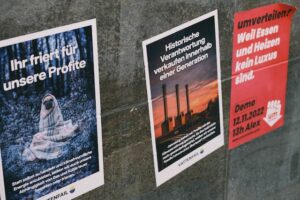
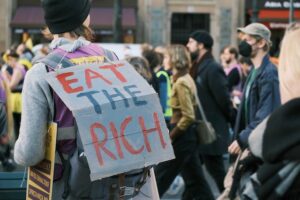
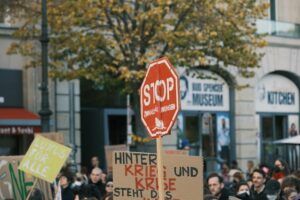
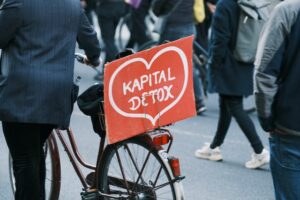
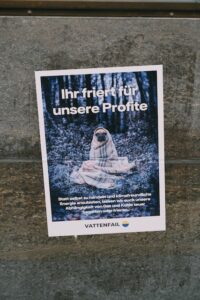
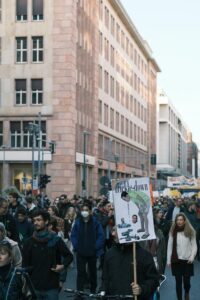
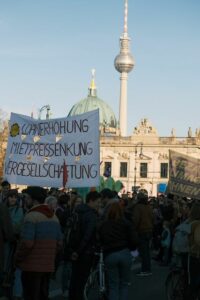
Umverteilen! Redistribute! – Demo impressions

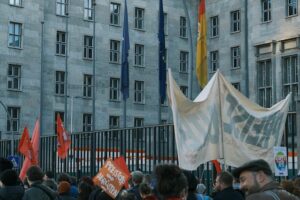
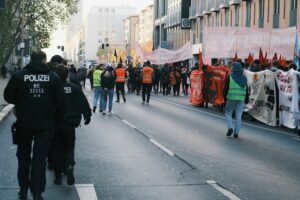
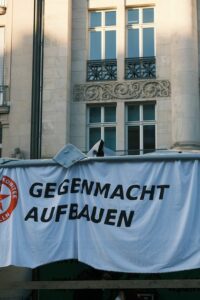
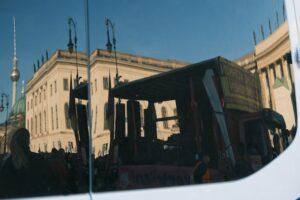
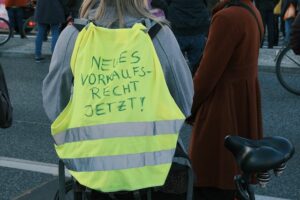
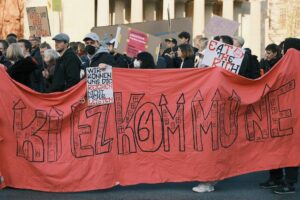
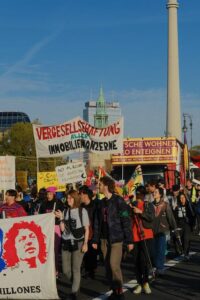
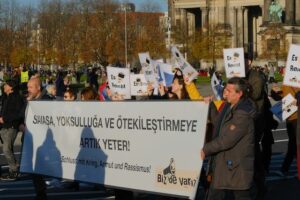
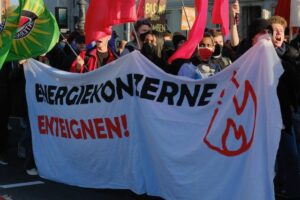
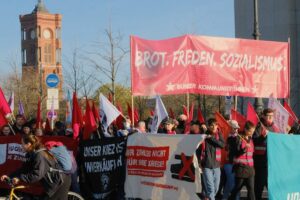
Photographs from the November Umverteilen demo against high prices and low wages.


28/11/2022

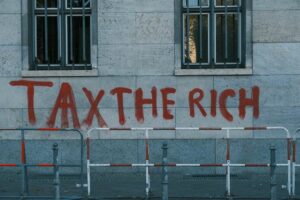
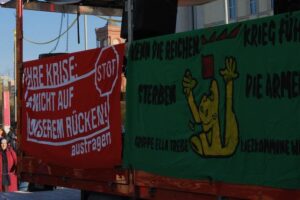
On November 12th, Berliners demonstrated for higher wages and lower prices. Around 7,000 people joined, according to the taz, along with organizations like Deutsche Wohnen und Co. Enteignen, Bizim Kiez, and Klimaneustart. Although the weather was sunny and the atmosphere friendly, the demands stemmed from acute issues facing many in the city. Among them were price caps for electricity, heating costs, and rent, windfall taxes on excess profits, socialization of real estate and energy companies, taxation on the rich, and free public transport.

Although no concrete changes came from the protest, it should be seen as a positive sign for Left movements in Berlin. Taz author Erik Peter wrote, “the number (of protestors) alone is a sign of life for the scene, but more important is the formulation, even rediscovery of what actually should be obvious: There is a connection between almost all emancipatory struggles, which are all too often fought for in isolation.”