The Left Berlin News & Comment

This is the archive template

The Nature of Money

A philosophical reflection on the forces that drive inflation


15/11/2022

Introduction

At some point in our childhoods, we have all wondered why, when things get expensive, our national governments don’t simply print more money to purchase them? The nearest adult, probably a parent, responded with the simple explanation: inflation. If you print more money, the prices will rise with the supply of money.

Alongside familiar pillars of ideological hegemony such as the church, monarchy, and the state, the currency is excluded from inclusion perhaps because of its supranational and, simultaneously, instrumental character. For a non-specialist observer, unfamiliar with the opaque jargon and ideological machinations of the world of finance, the question “what is money?” becomes so daunting to answer that inevitably it is left to “the experts”. I wish to provide an explanation of money that is sufficiently accurate, intellectually accessible, and broad in scope so that we may shake off this fear of politicising money.

The Cross of Gold

What came first: debt or money? Our intuitive response to this question reveals the economic assumptions instilled into us. The correct answer, according to David Graeber, is debt. For coinage to become the medium of commerce, it was necessary to develop sufficiently accurate scales that could be used to denominate metal-based coinage into practical quantities for daily commerce. Even once formal currency began to be used for commodity exchange, its adoption was variable and historically contingent. Throughout much of the feudal era, the vast majority of society did not settle obligations with a currency but rather through goods or services in kind. The widespread adoption of currency was facilitated by the growth of the urban economies of Ancient Greece, Ancient Rome, Byzantium, and during feudalism in the free cities that pocketed the vast agricultural economy. Whenever economic depressions occurred, coinage retreated and payments in kind proliferated further.

Coinage had to be acceptable as a form of payment between societies and civilisations for trade of goods and services that were unavailable internally. This transnational acceptance of a unified metal payment system was facilitated by the spectacular conquests of Alexander the Great. He oversaw the standardisation of Persian royal bullion and injected it into the commercial networks of his vast empire, thus bringing a system of payment common in Athenian realms to much of the known world.

Precious metals maintained a psychological grip on civilisations longer than any religion or system of rule. Discovering easily mined reserves of gold or silver transformed the fates of imperial realms, yet their inevitable exhaustion signalled their imminent fall. Within three decades of the end of the Second World War, at a stroke, gold’s dominance was permanently consigned to history when Richard Nixon broke the dollar’s peg to gold. Had Augustus attempted such a policy at the height of Roman power, it would have caused a cataclysmic implosion of the Roman state. Why should Richard Nixon have been so fortunate?

This is the level at which we should approach the currency question as opposed to the more immediate, impenetrable, technically opaque policy debates conducted by economists, central bankers, and finance ministers. It may be attractive to speak endlessly about financial instruments, flows of capital, interest rates, sovereign debts, and much more for the bookish among us. However, to build mass support for a 21st century ecologically oriented, internationalist socialist project we have to cut across the technical minutiae to elucidate the function of money as an allocative force.

In that sense, currency is an imperfect translator. The convertibility of silver mined in Silesia and Sardinia for silk and ceramics produced in China. What is the essential utility of precious metal, mined with such great effort and at great human cost? What is difference in utility between a cup made of silver versus a cup made of porcelain? In a more modern sense, what is the difference in utility between a cup of gold versus a year of academic research? The inherent impossibility of such tasks in a given time, place, and historical context is thus simplified by the magical, fiat value encoded in money, whether backed by precious metal or pegged to the value of a dollar.

As capitalism became more international in scope, a complex system of confidence wagering developed where all major currencies in circulation had to demonstrate convertibility with precious metal – the gold standard. But this replicated the problems of more primitive times. What happens when everyone simultaneously wants to convert cash to gold? In essence, this meant that the world’s economy was held hostage to the amount of gold that could be mined, purified, and locked in a vault; a truly absurd way to conduct economic affairs when seen this way.

The truly intercontinental political and economic integration forced upon the world by the violent convulsions of the Second World War enabled the technical possibility of fiat currency. But the need for magical belief did not die with gold. Instead the burden of responsibility fell on the most potent symbol of security (in every sense of the word): the US dollar. The material source of this confidence, I would argue, is in the potency of the politico-military infrastructure erected by the United States after World War II.

Modernity

The Church contended with the popular pressures of the Reformation. Absolute monarchs gave way to parliaments of societal elites who in turn succumbed to the demands for universal suffrage. In each case there was a serious clash between values and ideas leading to a transformation in the nature of each of these institutions. Monarchs, even where they exist today, first lost their status as divine appointees and then their political power. Parliaments steadily took the sovereign position of the monarchs they replaced and sought legitimacy through popular elections. But money has escaped unscathed from such drastic reformulations of purpose. Except for William Jennings Bryan’s famous attempt to adopt a bimetallic standard, to the best of my knowledge, changes to the currency system have never been the focus of political agitation.

There is no willingness in economics to centre humanistic aims in the allocation and application of money. The shift towards a system of floating, fiat currencies did not facilitate a shift towards a more agile way of valuing socially productive work and commodities, but rather a hyper-flexible system of leveraging that could expand as far as belief would allow i.e. market confidence. Where previously financial systems traced a tether to a discrete reserve of gold, now they only needed to command confidence, which could be drawn from various sources.

Chasing the “confidence fairy”, a term coined by economist Paul Krugman, was more central to governments following the 2008 crash than the very material needs of human development. But in the aftermath of the crash the bourgeoisie undertook a project to re-allocate resources and remodel power relations in society through the levers of money. In doing so they birthed the demons that haunt us today: the far-right, accelerating ecological collapse, war, and disease.

Inflation

With this philosophical scaffolding we can begin to assess inflation as laypeople. Central banks across the world issued new currency in the trillions and reduced interest rates to near 0% in response to the 2008 Crash. Yet consumer price inflation stayed lamentably low. And so we may ask ourselves, where did the money go? Why is there inflation now, over a decade after the sharpest pulses of money were injected into the arteries of the world economy?

Arguably the most pressing case of inflation in the advanced economies of the Global North today is the unaffordability of housing. More generally, the value of assets – the purchasable entities that themselves are a source of money – have risen at an unprecedented pace over the period after the crash. By contrast, the prices of commodities in our daily lives have until very recently stayed relatively stable. This was not an accident.

Where on the one hand, wealth – in the form of non-liquid assets – became expensive, pulling up the draw bridge of “social mobility”, on the other a passive consent was manufactured through low inflation. Vast sums of currency did not “trickle down” into productive investments that could lead to a breakthrough into a new dynamism but instead entrenched an even more static economic settlement.

As a result, wealth inequality is today worse than inequality recorded in the period leading to the French Revolution of 1789. This alarmism ought to be seen in the right context. The value of wealth, in the form of assets that cannot readily be exchanged for cash, is inflated precisely because the post-Crash money issuing was largely allocated to purchasing the same limited pool of assets. Demand for these assets outstripped the supply of their creation, leading to inflation. But this is a paper tiger in the making, leaving entire financial systems at risk of collapse if the value of these assets is brought back to earth. All the credit that was then issued by central banks, lent out by intermediate institutions, incorporated into incomprehensible leveraging schemes, would evaporate – an economic implosion in the making.

This is one example that demonstrates that inflation is a consequence of varying sets of conditions that at their most immediate level manifest as an acute mismatch between demand and supply. But the mismatch itself is an effect, not a cause. Ultimately, it is not the oversupply of money that causes inflation, it is the choice of what that money is allocated for that is determinant. Similarly, the other hallmark of the post-Crash economy – the reduction in the value of human labour through deregulation and insecurity – is a result of the absolute unwillingness to allocate the liquidity injected into the world economy towards productive labour.

The most acute examples of this are in sectors where gender, race, and class intersect: custodial staff, care workers, nurses, fruit pickers, teachers etc. The inability of these categories of workers to purchase more, often in times of historically low unemployment, explains in part the low consumer price inflation of the post-Crash period. If the post-Crash stimulated had stimulated, for example, a green economic renaissance, workers would have been presented with an opportunity to bargain for better incomes. Furthermore, healthy levels of inflation around the 3% per annum mark may have been achieved with the increasing economic demand. But this did not happen precisely because there were no means of exerting popular sovereignty over the issuers of money.

Conclusions

The prevalence of money as a lubricant of commerce was achieved thousands of years ago in part through the violence of conquest. Though monetary practices have evolved over this period, we are yet to develop a popular understanding and purpose for money. But the nature of money is not nearly so esoteric as we imagine once we see it as an allocative force. It is up to the working class to remake the value system according to its own priorities in a world facing ecological collapse. Reformulating the concept of money under a framework of humanist goals will help us develop a modern eco-socialist political program that transcends the bureaucratic centralist shortcomings of 20th Century socialist planning. We must dare to envision a new money fit for a post-capitalist world.

Why I will not watch this World Cup

I will not be able to enjoy the football, knowing about the abuse of human rights which made it happen


14/11/2022

Diana Ross fluffing her lines. Ballon d’Or Baggio muzzled by McGrath. Nigeria announcing themselves. The solo run of Saeed Owairan. Lalas’ hair. Campos’ kits. Maradona’s maw. Dahlin. Hagi. Stoichkov. Romario. Penalties. When I was 9 years old, USA ‘94 made me fall in love with football. Every FIFA World Cup since has been a must-watch for me.

Until now.

That Qatar was awarded the tournament at all was, of course, ludicrous on its face. Qatari organisers initially insisted that the country could host the event in the summer…when temperatures routinely pass 40℃. Thankfully, the dates were moved, but many issues remained. The country is tiny, it has only one international airport for goodness’ sake. It has no football tradition whatsoever. There is no fan culture.

None of those are reasons why I will not be watching.

No, my objections surround the human rights violations of the Gulf state. LGBTQ+ relationships are banned. punishable by fines, jail sentences and even death…by stoning. Human Rights Watch report that the security services regularly arrest gay, lesbian and transgender citizens, who are sometimes forced to undergo conversion therapy. This makes a mockery of Qatar’s claim that, at the World Cup, “everyone is welcome”.

If that is not reason enough for a boycott, how about labour rights? Thousands of foreign workers travelled from as far afield as Ghana and the Philippines to help construct the stadia and assorted infrastructure needed for the tournament. These workers live in appalling conditions, subject to unimaginable privation, and are paid a pittance for the privilege – the minimum wage in the country is the equivalent of about €1 per hour. Still, it could be worse.

They could be dead.

Qatar say that 37 workers involved in stadium construction have died, and that only 3 of those deaths were work-related. UK newspaper The Guardian, on the other hand, used data supplied by embassies in Doha to come up with a figure of 6,500 deaths among World Cup labourers. Which total do you think is more believable?

Much as Israel paints any criticism of its actions as antisemitic, Qatar seeks to handwave away the highlighting of its egregious violations as Islamophobic. As in the case of the former, in which there are unquestionably those whose anti-Zionism is rooted more in antisemitism than a genuine desire for justice, there are doubtless Islamophobes out there who would object to this World Cup regardless of Qatar’s policies. Yes, previous tournaments have had their issues, which could have earned a boycott; the 2018 edition staged in Putin’s Russia comes to mind. Nonetheless, I contend that no World Cup in the last 30 years has been so brazen in its disregard for basic human dignity.

The Qatari regime wants to use the glitz and glamour of the World Cup to put on a pristine picture of life in the Gulf State and hide the desperate inequality and inhumane conditions in which their own people live. This is called ‘sportswashing’. Apartheid South Africa tried to do the same, as did Hitler’s Germany. Indeed, arguably the most successful example in World Cup history was that of Argentina in 1978, where the fascist Junta staged a tournament in which the home team emerged victorious…drowning out the screams of those ‘enemies of the state’ held prisoner in the notorious Navy Petty-Officers School of Mechanics.

It hurts to miss a World Cup. It really hurts. Football is the longest-lasting love of my life, an obsession that has never burnt out or dulled…and such international tournaments provide so much joy and excitement – not just to me, but to literally millions of people around the globe. It unites us, in a way that no other sporting event can.

Qatar 2022, however, cost too much blood to look past.

Merciless defence against refugees at the Gates of the Empire

Lethal Border Regime. The sealing off of Europe shows its most brutal side in the case of the Spanish exclaves Ceuta und Melilla


13/11/2022

It was the most recent in a long row of incidents, which receive little more attention than the weather report: people die on the border. Again and again this is followed by – nothing. Or, worse, the victims are mocked.

It happened on 24th June: hundreds of victims, of which at least 37 died. According to the Spanish interior ministry, they died as 1,700  attempted to cross the border fence in Melilla.

What does Fernando Grande-Marlaska, the Spanish interior minister from the social democratic PSOE say, three months later? There was a “timely and proportionate use of violence by the Spanish and Moroccan security forces”. He accused the migrants of “trying to enter illegally”, and of showing “extremely violent behaviour”.

Merciless Repression

But an unexpected party said: “470 people were sent back, without observing national and international legislation”. So said the Spanish ombudsman (Defensor del Pueblo) Ángel Gabilondo on 14th October, after reviewing documents of the Spanish ministry of the interior and the ministry for integration, social safety and migration.

Gabilondo is not entirely independent: he was an education minister of the PSOE and also an election candidate for the Madrid region. He was appointed to his post (a constitutional monitor of the Spanish authorities) after his crushing defeat at the local election.

He concluded nevertheless: “The constitutional court has ruled that before people are turned back from the border, every individual must be checked and compliance with international obligations for full judicial control is guaranteed.”

The ombudsman demanded that “the foreign ministry provide the embassies and consulates with material and human resources, so that people who require international protection can visit them and are able to apply for asylum without risking their life or having to enter the country using irregular methods.”

Junge Welt reported that the NGO Spanish Commission for Refugee Help (CEAR) had already described prior statements about the tragedy of 24th June, from the interior minister and prime minister Pedro Sánchez – as “fully unacceptable, when you remember that this joint action caused the death of dozens of people.”

CEAR, founded in 1979, wrote the government tries to particularly emphasize “violence” from the migrants, so that it does not have to speak about the “deep desperation suffered by people like those who tried to cross the fence in order to find protection”.

On 21st September, Enrique Santiago, head of the Spanish Communist Party and Unidas Podemos MP, stated in parliament that Spain must finally enable possible asylum applications, in particular for people from Africa. The justifications by the interior minister reminded him of the discourse of the extreme right.

CEAR also noted that “access to legal assistance and translators” as well as “identifying people who find themselves in a precarious situation and could be advised to apply for asylum” – could not take place.  Since every person was “automatically sent back without having the possibility of identifying themself”.

Estrella Galán, general director of CEAR said: “people from countries South of the Sahara are thus systematically prevented from applying for asylum at the borders.” She asks: “what else can they do but jump over fences or risk their lives on the sea?”

We will see whether the tragedy of 24th June will be atoned. Until now, the Moroccan public prosecutor’s office has simply turned the tables and accused the migrants. This criminalisation again shows the dubious partnership between Morocco one one side, and Spain and the European Union on the other.

Resources flowing from Brussels to Morocco – around 500 million Euros until 2027 – are barely used to integrate asylum seekers, and much more for the ruthless repression of refugees. The relationship between Madrid and Rabat is such that, the weakest party – the migrants – suffer the most.

Strategic Places

Located on the African Mediterranean coast and surrounded by Moroccan territory, Ceuta and Melilla are the only “European” cities with a land border with Africa. Therefore they are a favourite destination for those  fleeing war, dictatorship, famine and climate change, aiming for a better and safer life in Europe.

Since the 17th Century, the Exclave Ceuta has belonged to the kingdom of Spain. The city numbering 85,000 inhabitants, was conquered in the 15th Century by Portugal under John I, following a battle during the Reconquista. In 1668, it was taken over by Spain, after Portugal lost the so called “restoration war”.

Melilla has been owned by Spain since 1497, and numbering 86,500 people, it is a similar size to Ceuta. Neither city are in the Schengen area, posing a big problem for arriving refugees, who find themselves, often for years without a decision on their asylum status. Their legal limbo leaves them neither knowing if they will be deported, or if they will be allowed European entry.

Morocco, a Spanish-French protectorate between 1912 and 1956, considers both cities to be part of its territory. But the Spanish state claims the historic right over the cities for Spain. They are among the poorest places under the Spanish flag. Unemployment has been for decades around 25%. Apart from fishing and shipbuilding, others survive in Melilla through money transfer.

According to Spanish polls, the majority of the population wants to remains in Spain. Not surprising considering the composition of the population. Most people who live in Ceuta were born there, and thus are Spanish citizens. In 2017, this was around 65% of the inhabitants. The remaining 35% includes many Spaniards from other regions.

The second largest ethnic group are people from African countries, in particular from Morocco, which provides 9,500 inhabitants. Melilla’s population distribution is very similar. It remains unclear whether the Spanish government wants to invest part of the EU Reconstruction Fund in both cities because of the conflict with Morocco.

But Morocco uses every opportunity to pursue its claims. In a letter addressed to the UN human rights council, in which Rabat discusses the event on 24th June, the government said that Morocco has “no mutual land border with Spain.” As reported by the news agency Europa Press, you “cannot speak of borders, but merely of a passage” between Melilla and the rest of the country.

Moreover the Moroccan population of both cities has been traditionally disadvantaged. In the early, 1980s, in the course of the Transición after Franco’s death, the Muslim population fought for their rights as Spanish citizens. Until then, the only identification document available to even third generation Muslim inhabitants was a so-called “statistical card” (Tarjeta estadística). Buying a flat was prohibited, neither a general work permit nor health insurance was available. Every journey to the Iberian peninsula, required application for permission. This discrimination was only removed in 1987 after protests.

Both places, in which different cultures have lived together for decades, have a high strategic value for Spain. Sánchez expects that they will be secured by NATO, as he told the summit of the Western war alliance in June in Madrid. This message was unambiguously aimed at Rabat, although Sánchez said, he is eager to pursue a “good partnership” in keeping migrants from reaching Spain, however much it costs.

Shortly after his visit to the Moroccan king Mohammed VI on 7th April this year, the Spanish premier announced a new Western Sahara policy in a letter. This led to a resumption of official diplomatic relations between the two States. With an eye on the autonomy plan for Western Sahara suggested by Morocco, the social democrat spoke in the letter of the “most solid, realistic and credible basis” for a solution of the conflict between Rabat and the Sahrawi independence movement.” This caused great outrage in Spain.

Many including the Spanish Left, regarded these statements as a betrayal of the former Spanish colony Western Sahara. Sánchez’s plans also provoked considerable annoyance from one energy provider. Algeria, which supports the government of Western Sahara in the war against Morocco, suspended relations with Spain.

For decades, Morocco and Western Sahara were at war since Spain withdrew its colonial troops in 1975/76. Morocco, and initially also Mauritania, largely occupied this territory. This was interrupted by a UN-negotiated ceasefire, which offered the Sahrawis a false hope of an independence referendum.

The Spanish press examined events of 17th March 2021 and the following days, when Morocco was not guarding the border to Ceuta. Their judgement Spain was being punished for allowing Brahim Ghali, head of the independence movement Frente Polisario to enter the country, for COVID treatment in a Spanish hospital. Within 48 hours, around 12,000 people crossed the border, mainly young Moroccans looking for work, including quire a few minors.

According to El Periódico de España, Morocco was apparently pursuing a new migration strategy  for Melilla. With the renewed opening of the iron ore mines in the mountains of Uixán/Iksane on the border with Melilla, the caves in which migrants had stayed in the past were cleared out.

The paper affirmed that in September, Moroccan armed forces had burned the tents of migrants. Reports from migrants and NGOs show that this is not a new approach, which includes regular baton attacks.

Fatalities again and again

Spain was shamefully, a European pioneer in the isolation of migrants. Already in the 1990s, Madrid had no other answer to refugees than militarisation. The root causes of this “problem” lie in the West.

In 1996, the Spanish army built an approximately 8 kilometre long wall around Ceuta. One year before, it put up barbed wire, to prevent migrants entering Spain and Europe. Three years later, the enclosure was extended. The Tageszeitung and El Pais reported then, the European Union subsidized the project with three million Euros.

Ten metres high and with three protective walls, the bulwark was equipped with NATO barbed wire. This is furnished with sharp blades, which led to many serious injuries. After persistent protests, the incumbent government dismantled the NATO barbed wire in 2019.

The fence around Melilla was erected by the government of José María Aznar in 1998. The social democratic government under Luis Rodríguez Zapatero augmented the barbed wire with sharp blades. While these were removed in 2003, they were re-fitted in 2017, before they disappeared in 2019. The twelve kilometre long double protective wall has cameras and motion detectors.

In the last quarter century, both facilities experienced “accidents” and “incidents”, euphemistically called. In September 2005, several hundred people in Ceuta tried to cross the fence. Five died, two from gunshots. More than one hundred were injured. At the time, El Mundo reported that an autopsy on Spanish soil revealed that the ammunition used was not officially used by the Spanish police.

In October of the same year, hundreds of people tried to cross the fence – this time in Melilla. Once more, they were shot at, and six died, said El País. The authorities spoke of self-defence, against the migrants carrying sticks and throwing stones at police.

According to victim statements, following this the Moroccan police packed 700 people into buses, and left them in the desert South of the city of Oujda – without food or water. Around 70 people were deported to Morocco, which was previously Spanish territory.

El País wrote: “The first migrants, who after crossing the fence in Melilla, had to return to Morocco, were 70 people from the Sahel state Mali.. afflicted by a plague of locusts in 2004.” An illegal deportation into a third country. One year later, both Amnesty International and Doctors of the World sharply criticized the Moroccan government for this “deportation into the desert”. In 2010 three more people died trying to cross the fence in Melilla.

On 6th February 2014, the man made “tragedy” reached a new peak: at least 15 migrants died and dozens were injured on the El Tarajal beach in Ceuta. They had been  attacked in the water by the paramilitary Guardia Civil with batons, tear gas and rubber bullets. The Guardia Civil denied this.

Around 400 people attempted to swim to Spanish territory. Twenty-three refugees were returned to Morocco without any examination. The human rights organisation European Center for Constitutional and Human Rights (ECCHR) supports the victims of this pushback. “The behaviour of the Guardia civil was unlawful according to both Spanish and European law”, wrote ECCHR.

Nevertheless, investigations were stopped at least three times, and no survivor was called as a witness. Moreover the investigation magistrate ordered “a hearing for the Guardia civil servants about deaths by gross negligence and failure to render assistance.” This hearing still has not taken place.

The construction of the border fortifications in Ceuta and Melilla has substantially increased the number of refugees drowning in the Straits of Gibraltar, and not stopped migration. Until 2017, the Spanish interior ministry has spent 258 million Euros to militarise the border. A further 742 million Euros flowed to Spain from Frontex, the European agency for protecting borders and coasts. Large corporations like Indra and Ferrovial have also been paid to build bulwarks.

But the work of the Guardia Civil has “not been made any easier” by the fence from Ceuta and Melilla, as a worker for the NGO Fundación por Causa wrote  for El Salto. Officials were in a quandary: the lack of legal paths for migrants on the one hand, and the desperation of those trying to cross the fence, led to violent situations. Many were haunted by depression.

Even the former foreign minister José Manuel García-Margallo conceded that ultimately, they are witnesses and actors at one of the most heavily guarded and unjust borders of the world.

Anonymous Graves

The border between Morocco and the European Union is the deadliest border for refugees on the entire planet. The fences were only the first measure, control of the waters followed. This means that those desperately fleeing misery dare the even more dangerous route across the Atlantic.

It is estimated that in every year since 2014, around 4,00 people have drowned during transit. In 2021, according to the NGO Caminando Fronteras, it was 4,404 people. The numbers are so exact because the NGO has set up a telephone for people in distress. Among the dead from 21 different countries, were 205 children last year.

The sheer horror tales place again and again. In May 2021, a boat was on the high seas for up to 22 days, when found 500 kilometres from the island El Hierro. On board were 17 dead, starved and dehydrated. Two children and one woman survived.

The media portal El Diaria reported the funeral. The dead were buried in the cemetery San Francisco de Igueste on Tenerife. On the burial niches were written three-digit numbers, no names. The burial was attended by two graveyard workers and a young man from Senegal who a few months earlier had arrived in a similar boat. The dead were not buried for a month because the local mortuary was overflowing. It is unclear whether family members know their fate. A project by the Red Cross attempts to find the names of the dead since last year.

Caminando Fronteras reports that after the events of 24th June in Melilla, the dead were buried in mass graves on the Moroccan side. Helena Maleno Garzón, the chairwoman of the NGO, who has worked for a long time in Morocco and been harassed by the Spanish and Moroccan authorities, has spent years denouncing the inhumane isolationist policy. Both Spanish officials and Frontex workers handed over a dossier about her to Moroccan judiciary. The helper is criminalized just as much as the refugees.

Until June this year, a verifiable number of 978 people have died trying to reach Spanish territory. It is estimated that around five die every day, including those who try to reach the Canary Islands. In 2017, the NGO Fondación Pro Causa calculated deaths on the flight to Spain via Morocco up until the late 1990s. For a good 20 years since the Transición, this came to less than 200 people.

Most migrants who now die, and whose corpses are found are not identified, their families are not informed, there is no burial ceremony. They are buried anonymously, in the cemeteries of Ceuta and Melilla, or in Andalusia and the Canaries, which contains the largest cemeteries for the Mediterranean and the Atlantic. They are given the reference “immigrant from Morocco” or “died on the run.” The corpses of more than 80 per cent of the dead are not found.

Clearly they count for little. This death toll does not result in a change of course – quite the reverse. The EU continues to adorn itself with its Nobel Peace Prize, transfer more money to its doorman Morocco and militarise the border even more strongly.

Meanwhile, those who are threatened with persecution and poverty do not receive the slightest chance of an asylum procedure. The doors remain shut to all those whose mistake is that they were born in the wrong part of the world.

This article first appeared in German in the junge Welt. Translation: Phil Butland. Reproduced with permission

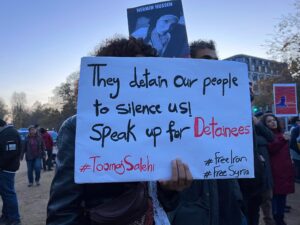
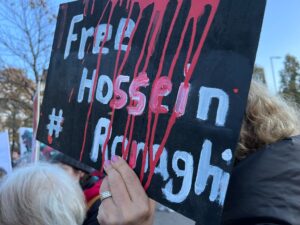
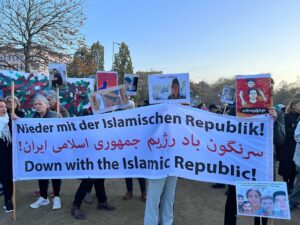
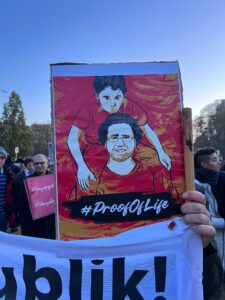
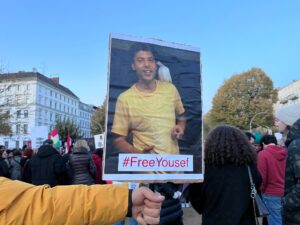
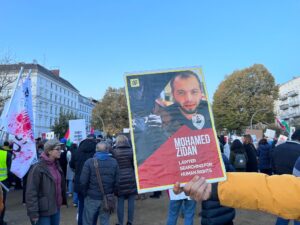
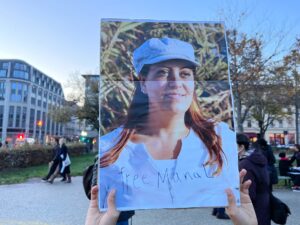
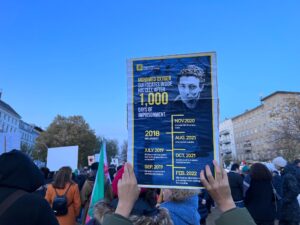
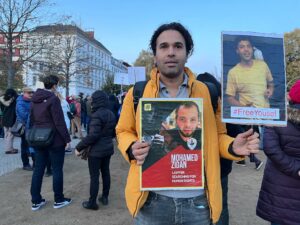
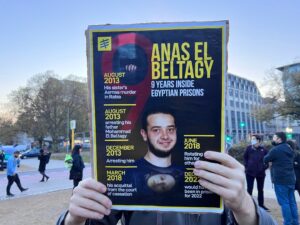
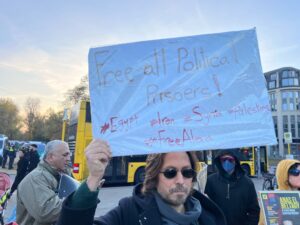
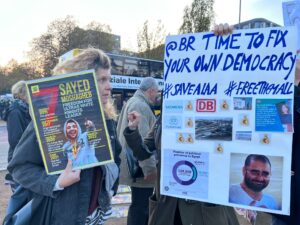
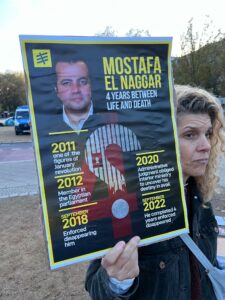
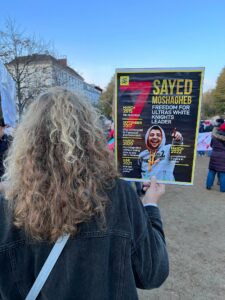
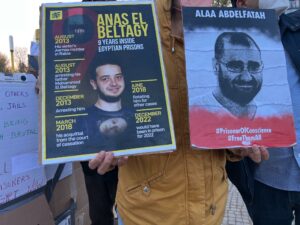
Photo Gallery: Rally for the Release of all Political Prisoners in the Middle East

Saturday, November 12th. Oranienplatz, Berlin

Splits in the German Capitalist Class – Ampel Coalition Members at War

Economic downturn is intensifying competition between German industrialists aligned with China and the US


12/11/2022

Last year in discussing Merkel’s retirement I wrote that: “In the dynamic of 21st century capitalism, under Merkel Germany has tried to ride several horses. But the increasingly tense race between USA and Chinese imperialism, will likely force Merkel’s heirs to be clearer about opposing US imperialism.”

Since the Russian neo-imperialist attack on Ukraine, the confrontation between USA imperialism and the bloc of Chinese-Russian imperialism, has split the German capitalist class. That class which is at the center of the EU is pivotal for the USA to influence, or should we say ‘control’. We can highlight three particular instances where this division became evident below.

The two opposed blocks are quite clear – one led by the Greens (especially Federal Economics minister Robert Habeck and Foreign Minister Annalena Baerbock) and the FDP, favour a more overt partnership with (or subservience to) American imperialism. This means burning bridges with China. This block also aims to tie the EU to the USA’s apron strings. Opposing them is the majority of the SPD led by Chancellor Olaf Scholz, who wishes to maintain economic links with China. This would enable markets for German capital and ultimately to maintain an independence of the demands of US imperialism.

This battle between the two blocks unfolded during the Russian imperialist war against Ukraine. The blocks take according positions on this war. The more bellicose Greens wish to ramp up further arms shipments to Ukraine. In contrast the SPD tries to adopt a more ‘cautious’ policy, while acquiescing in military build-up and verbally condemning Russia. But the war aspects of this needs a separate discussion. Here I focus only discuss specific recent events.

The Nord Stream Affair

On 26 September 2022, a series of explosions hit the Nord Stream pipelines – both 1 and 2 – crossing the Baltic Sea, which led to major leaks of the natural gas. More importantly they blew holes that allowed salt water to enter destroying any potential to be ever used. These pipelines were majority owned by the Russian state company Gazprom. A map of the pipeline course and a blow-by-blow dating is in Der Speigel.

This happened in the territorial waters of Sweden and Denmark – off the island of Bornholm. These countries wrote to the UN that “several hundred kilograms” of explosives had damaged the pipes.” (New York Times; Oct. 25, 2022). All observers accept a deliberate intentional sabotage. However while Denmark, Sweden and Germany have launched investigations, these are fractured and separate. Sweden refused a joint investigation as the matter was “too sensitive”.

Those countries refuse to discuss reports of recent USA and NATO warcraft activity near Bornholm. Yet between August to September 22 a US fleet – “the largest US naval battle group since the cold war ended” – was cruising through the Baltic Sea, and the USS Kearsage reconnoitered around Bornholm.

Three plausible perpetrators are implicated: “Was it the Russians trying to rattle the West, the Americans trying to sever a Russian economic artery or possibly the Ukrainians trying to take revenge on Russia? — what is known remains as cloudy.”

But the ‘Baltic Pipe’ – carrying Norwegian gas to Poland – was unaffected. Had Russia been involved, this was a much more likely target. As for the Ukranian hypothesis, this would only further exacerbate potential European gas shortages, and was unlikely to endear Ukraine to its European allies. It seems far more plausible that the USA was responsible.

The USA had long argued vehemently against the Nordstream pipelines. Under Chancellor Merkel, the German Government enabled the deal with Russia. It was with considerable reluctance the USA appeared to acquiesce. Therefore a natural question, as Der Speigel puts it, is: “Did the USA, as immediately discussed in many voices on Twitter, kill the pipeline project, which has always been unloved?”

The very probable USA ownership of the sabotage is shown by the following. Firstly as reported first by Der Spiegel on 27 September: “The U.S. Central Intelligence Agency (CIA) had weeks ago warned Germany about possible attacks on gas pipelines in the Baltic Sea… The German government received the CIA tip in summer.”

Secondly, three very open statements of US President Joe Biden, his top State Department official Victoria Nuland before the explosions, and those of his Secretary of State Antony Blinken after the explosion – leave little doubt.

In February 8th 2022, Biden threatened to “bring an end to it (the Nord Stream pipelines) if “Russia invades””. Victoria Nuland echoed those remarks.

As Russia launched the formal war, it began limiting energy flow via the older Nordstream 1, forcing immediate energy crunches on Europe. Oil and gas industrialists in the USA exulted as their profits soared (see also Ukraine and the Profits of War).

Immediately after the mysterious explosions, the smug Blinken posed as the savior of Europe, saying: “We’ve significantly increased our production as well as making available to Europe liquefied natural gas.  And we’re now the leading supplier of LNG to Europe … We’ve worked to release oil from our Strategic Petroleum Reserve to make sure as well that there is oil on the markets and to help keep prices down….Ultimately this is also a tremendous opportunity.  It’s a tremendous opportunity to once and for all remove the dependence on Russian energy …That’s very significant and that offers tremendous strategic opportunity for the years to come.”

“The U.S. Secretary of State, Antony Blinken, did not accuse Russia and instead said it was in “no one’s interest” to destroy Nord Stream 1 and 2. “The United States and NATO/EU seem remarkably relaxed about sabotage of a piece of critical infrastructure,” reported an oil and gas reporter for Reuters. Or, as Michael Shellenberger reported: “NS 1 and 2 were not delivering gas. But there is an important precedent/principle. Lack of high-profile response from Washington, London and Brussels itself an important story.”

Finally Europeans in the know are well aware of the real identity of the saboteurs. Radek Sikorski, Polish European MP and former Polish Defense Minister and Deputy Minister of Foregin Affairs blurted out a tweet: “An online debate erupted between senior Polish officials over who is responsible for the destruction… Sikorski, attributed to the United States the sabotage. “Thank you, USA,” Sikorski wrote on Twitter.”

President Putin of Russia recently again dangled the carrot of re-opening the supply of gas through the Nordstream 2 pipeline, finished last year at a cost of $US 11 billion. “Mr. Putin told an energy conference in Russia that delivering natural gas to Europe through the remaining strand of Nord Stream 2 would be a matter of “just turning on the tap.”

But that is unlikely. Warfare now includes the sensitive sea beds of the world, where the “US Senate’s failure to ratify the UN Convention on the Law of the Sea” – gives it free rein.

German Industrial expansions in China versus the USA

There are two separate groups of industrialists in Germany, mirrored by their political representatives. The two opposing directions being pursued are either pro-China or pro-USA. Ultimately, both blocks propose moving production in significant measure to either China or to the USA. For example, the CEO of BASF Germany Martin Brudermuller confirmed:

‘BASF Germany … recently announced that it was intending to “downsize “permanently” in Europe, with high energy costs making the region increasingly uncompetitive. The statement from the world’s largest chemicals group by revenue came after it opened the first part of its new €10bn plastics engineering facility in China a month ago, which it said would support growing demand in the country. “The European chemical market has been growing only weakly for about a decade [and] the significant increase in natural gas and power prices over the course of this year is putting pressure on chemical value chains.”’

Olaf Scholz made his position clear in an opinion piece for “Frankfurter Allgemeine Zeitung” on the eve of leading a major business delegation to China. Scholz rejected any “decoupling” of relations with China. The business trip was continually undermined by loud criticism from the Green-FDP elements of the Traffic-light Coalition. But Scholz’s position reflects a dominant strand in German capital, which wants access to the large market of China. In recent years this has expanded:

“In the first half of 2022, German companies’ direct investment in China hit a record high, surpassing… tens of billions of euros, according to… the German Institute for Economic Research (DIW Berlin)… This is proved by intensive investments by German enterprises in China. … BASF inaugurated the first plant .. on September 6 in South China’s Guangdong Province…. German auto parts manufacturer Hella announced in July that it will expand capacity in China and open a new lighting plant in Changzhou. Robert Bosch Venture Capital GmbH, a subsidiary of Bosch Group, announced in June that it will set up a new fund of 250 million euros for start-ups in China.”

Meanwhile the opposing and thus far smaller, pole of German capital, plans branch plants in the USA, tempted by investment funds and the lure of cheap energy:

“German companies are expanding their presence in the United States – at the growing expense of production sites in Germany… huge investment programs in the USA… economic stimulus measures, some in the triple-digit billions, to induce German companies to set up production sites in the United States…. the Northvolt company is considering suspending its plans to build a battery factory in northern Germany and instead to build a plant in North America. At the same time, the existence of energy-intensive industries is being jeopardized in Germany… The threat of their relocation abroad – particularly to the USA, where energy prices are significantly lower – is tangible.”

US and China Aligned Wings of German Capital

Meanwhile ‘Green’ Habeck tries to obstruct pro-Chinese moves of German capital: “Habeck’s economy ministry refused to extend Volkswagen’s investment guarantees for China, citing the repression of Muslim Uyghurs in the western region of Xinjiang. The ministry is now working on plans to cap the number of such guarantees for China.“

The pro-USA camp tried blocking China’s acquisition of port facilities in Hamburg. This is where Scholz hails from politically: “The Chinese shipping company COSCO’s acquisition of a stake in a terminal in the port of Hamburg, agreed upon last year, was approved last week only with certain restrictions. Federal ministers from the FDP and Greens had done their best to prevent it.”

In the event, Habeck was only able to reduce the acquisition of the stake to a minority position. But this of itself was welcomed by the USA.

Moreover in the strategically important sector of semi-conductors and chips, initially it seemed as if the German firm Elmos, was to be taken over by a Swedish company Silex –owned by Chinese semiconductor group Sai Microelectronics. While apparently approved, now Habeck has vetoed it.

Conclusion

We do not weep for either factional block of German capital. However we do argue that this is the prelude to the coming inter-imperialist war. While this many still be years off, all these manouevres are intensifying. Only a genuine workers party in as many of the countries driving the re-division of the world will help. Parties masquerading as “Green” or “Social-Democrat Socialists” – or indeed parties masquerading as “Marxist-Leninist” as in China – are simply covers for differing sections of imperialists.