The Left Berlin News & Comment

This is the archive template

Verdict announced in the case of Farah Maraqa vs. DW: Victory, but vindication awaits

“The judge asked if Farah understood that she won”, recalled an eyewitness of Maraqa’s trial. Will Farah’s reinstatement be followed by the reputational rehabilitation she deserves?


10/09/2022

This week marked another important milestone in the ongoing case of Farah Maraqa against international German broadcaster Deutsche Welle (DW). Fatah is one of 7 Arab journalists fired by DW based on allegations of antisemitism. Unlike the climate of the previous trial in July, the room was noticeably empty. In Germany, it is not typical for the parties to be physically present for the announcement of the verdict. However, Farah refused to sit at home and passively await news about the case that has consumed her life for months.

When the court adjourned on 20 July, the judge declared his expectation that a joint statement be submitted by Farah and DW before September 2nd. This joint statement was supposed to set the record straight by addressing DW’s accusations of antisemitism head on. Unfortunately, no such statement was produced due to DW’s clear lack of interest in reaching any sort of joint statement.

According to Farah’s lawyer, Dr. Hauke Rinsdorf, DW’s lawyer denied ever having agreed to the joint statement. In recent weeks, Farah’s lawyer submitted a draft of the joint statement, initiating the court sponsored actions in order to begin repairing the reputational damage caused by DW. But DW produced nothing but silence.

Alice Garcia, who serves as the Advocacy and Communications Officer at European Legal Support Center offered a statement: “The absence of response from DW to Farah’s proposed joint statement as a settlement is indicative of their unwillingness to cooperate and to recognize their mistakes, even after being sued. DW’s new Code of Conduct – which urges support for Israel, among other things – is another indication of this direction: they have not questioned their practices or positions.”

Recent summer months have provided several moments of celebration for a group of 7 Arab journalists fired by DW in February based on specious claims of antisemitism. As of this week, two of the journalists, Farah Maraqa and Maram Salem, have secured strong victories related to the politically charged purge. A third case has been settled out of court, while the others are still pending.

Code of Conduct

Amidst their defeats in court, DW recently managed to find time to concoct a conspicuous McCarthyite addition to their compulsory Code of Conduct, to be signed by their 4,000+ employees of more than 140 nationalities. DW’s new and improved Code of Conduct further reveals their undeniable institutional allegiance for the state of Israel, a foreign government widely considered to be practicing apartheid and systematic human rights abuses.

Ali Abunimah writing in The Electronic Intifada expands on this deeply concerning development: “Despite its court defeats, there is little sign that Deutsche Welle is backing down from its institutionalized anti-Palestinian policies.” He continues, “One cannot support ‘freedom, democracy and human rights’ on the one hand, while also supporting Israel’s racist state ideology Zionism on the other.”

As Hebh Jamal outlines in the +972 Magazine, “In many ways, the broadcaster is simply following the example set by the German government. The clampdown on criticism of Israel in Germany has intensified considerably since the Bundestag adopted the controversial definition of antisemitism, which conflates criticism of Israel with antisemitism, which was put forth by the International Holocaust Remembrance Alliance (IHRA) in 2017.”

The updated Code of Conduct declares: “Freedom, democracy and human rights are cornerstones of our journalistic and development message and profile. … We advocate the values of freedom and, wherever we are, take independent and clear positions, especially against any and all kinds of discrimination including sexism, racism and antisemitism.” While pretending to prioritize antiracism, the document also states: “Due to Germany’s history, we have a special obligation towards Israel. … Germany’s historical responsibility for the Holocaust is also a reason for which we support the right of Israel to exist.”

A freelancer working for DW offered an anonymous statement to The Left Berlin regarding DW’s recent updates to the employee Code of Conduct: “I felt immediately that it was an invasion of privacy. As journalists, we are of course supposed to maintain ‘neutrality’ and ‘objectivity’ as far as possible, so I do – to some extent – understand not being very overtly political. Not that I think it actually compromises the work, but it opens you up to critique about being biased. But the way that the Code of Conduct was worded was explicitly to say that we are representatives of DW in our private lives, which is very inappropriate from what I see, especially as the whole reason for the Code of Conduct change (Farah’s trial) is completely obstructed. I find the terms of the new Code of Conduct an invasion of my ability to live a private life away from DW, to be honest.” This document further institutionalizes and makes obligatory support for Israel, not only in a professional setting, but in the privately held views of employees as well. 

Vindication

On Monday, Farah attended her hearing, accompanied by activist companion Phil Butland. Present in the small courtroom were also the assumed representatives: the judge, a legal intern, and a legal notetaker. Notably absent was any representation from DW’s side.

As the judge announced the verdict, he explained that the legal rationale would be released in 6 weeks time. According to Farah, the judge’s verdict was articulated with great respect and sincerity, and she appreciated his efforts to reiterate and elaborate so that she clearly understood the meaning of his decision.

Phil Butland described the event as a “complete victory.” “The judge was sympathetic to Farah and even quoted her lawyer in the summing up. Although he could only rule on the single thing Farah had said when she worked for DW, it seemed clear that he knew that she is not an antisemite and that Deutsche Welle had no reason to sack her.” The judge even went so far as to explicitly ask if she “understood that she had won,” behavior that is against typical protocol in cases like this. 

The judge declared that Farah had won the case against Deutsche Welle based upon several worthy positions that were deemed unlawful in accordance with Germany’s labor law. Firstly, DW failed to adhere to the legal termination terms. Due to the politically heightened nature of this specific termination, it took DW two full months to terminate Farah instead of two weeks mandated by law.

Secondly, regarding the highly contested, allegedly antisemitic writings–the court threw out anything published prior to Farah’s employment at DW, as these were not seen as relevant in the context of her tenure as an employee of DW. What remained was a single statement which Farah has made when she was a freelancer for DW. In this statement she said: “the Israeli experts are putting poison into the history.” The court determined this comment did not constitute justification for the harsh termination Farah experienced.

The court’s stance on the case of Farah Maraqa vs. Deutsche Welle enabled an immediate reinstatement of Farah’s employment at DW, Farah is once again eligible to receive her salary and benefits from DW. The immediate reinstatement of her employment also means that she would be expected to perform her duties at the drop of a hat, should the request be made.

The court ruled that DW must pay all legal fees, which come to over €37,000. Onerous legal fees, like these, typically discourage employees from seeking justice against large institutions like the state-funded media organization Deutsche Welle that can afford drawn out legal proceedings.

A full explanation of the ruling must occur within 3 weeks. After this, DW has 6 weeks to appeal this ruling, which would exempt them from the legal fees. If they win the appeal. But this would require the higher court to overturn a decision that has found Farah innocent on every single count.

What now?

What remains unclear is if DW will choose to appeal this verdict. Farah and her lawyer eagerly await the anticipated release of a lengthy document by the court, due within 3 weeks. This will contain an exhaustive review of the case at hand which outlines the court’s legal position and interpretation of the law in Farah’s case. Based on the release of this information and depending on the specific legal reasoning behind the court’s decision, further opportunities for appeals or other legal actions may present themselves to either Farah and/or DW.

At the time of writing, it remains unclear whether or not the labor court will allow Farah any means of reputational rehabilitation in the form of requiring DW to make a statement disavowing its previous characterizations of Farah as antisemitic. Despite the verdict being cause for celebration, Farah and those who support her still wish to see DW publicly come clean about its slanderous accusations and set the record straight. 


Documenting Gaza in graphic format

Review: Footnotes in Gaza, by Joe Sacco (graphic novel)

“Why are you writing about 1956? It’s so much worse now.” This question, from one of the characters in Joe Sacco’s graphic novel, Footnotes in Gaza (2009), puts the focus on the story that the American journalist pursues between 2002 and 2003 in the Gaza Strip: the indiscriminate killings of the Palestinian population in Khan Younis and Rafah in November 1956.

Someone might believe that a graphic novel cannot contain all the elements that a journalistic investigation requires, but the author warns that he is going to do what many journalists have not done: to relate rigorously, in this case, to some specific events within the framework of the Sinai War. Joe Sacco’s alter ego and his local companion-guide Abed accompany us during the investigation, at a time when the world (including the Gaza Strip) was shocked by the start of the criminal Iraq War.

The story mixes the present and the past. The demolitions of houses in Rafah at the time of Sacco’s visit (2003) with the inquiries about the 1956 assassinations in Khan Younis and Rafah. Interviews with elderly people who remembered those events, along with conversations around tea and honey cakes in which Gazans tell them about the miseries of a conflict that is much talked about, but rarely portrayed truthfully (at least to the West).

In Khan Younis and Rafah, the Israeli army indiscriminately killed dozens of men under the pretext of searching for hidden Egyptian soldiers and Fedayeen. The accounts from the Palestinian population, which Sacco meticulously contrasts, questions and tries to sift through, to draw common conclusions, are clear: there was no resistance on the part of the Palestinian people and the Israeli army killed, wounded and arrested without any kind of humanity hundreds of people (almost all men of “military age”).

Those who enter the story may end up feeling the loss of a loved one, the frustration at the demolition of a house or the despair of those who do not see a future.

The accounts of the victims or relatives of the victims may be blurred by the passage of time, exacerbated, embellished or partially forgotten, but Sacco extracts the common threads they all have, in an impeccable exercise of journalism. He even collects the testimony of a former Israeli soldier, Marek Gefen, which coincides in the main with the other testimonies. Lastly, in some final appendices, he includes letters and reports from UN observers and members of the US army expressing their “concern” about cold-blooded murders against the Gazan population at that time at the end of 1956. The questioning of David Ben-Gurion by Knesset member Esther Vilenska of the Communist Party of Israel, demanding an investigation into the events. Ben-Gurion chose not to respond to such an interpellation and instead justified his actions on the grounds of alleged Palestinian violence and the need to find Egyptian soldiers hiding in Rafah.

The story, which allows us to enter into the life of the investigative journalist, almost manages to make the reader feel in a timeless moment of the conflict in Palestine. Because the situation is not so different in the present of the work (2003) with respect to the events of 1956. The death, fear, colonization and despair to which the Gazan population is subjected knows no dates, because it has been their daily life for decades. Sacco himself comes under the fire of tracer ammunition when he walks through the streets of Rafah in search of testimonies, for the mere fact of walking with a group of men at night.

As for the drawing, Sacco’s exquisite lines contain a restrained severity that tries to avoid being excessively gruesome or morbid. The images, already harsh in themselves, are accompanied by even harsher narratives that penetrate the mind of the reader who, in the combination of text and image, can feel almost present in the story. Those who enter the story may end up feeling the loss of a loved one, the frustration at the demolition of a house or the despair of those who do not see a future.

Tips for Leftist Tourists in Berlin – 2. West Berlin

A beginner’s guide to some of the more obscure monuments in West Berlin


07/09/2022

Last May, I wrote an article about lesser-known Leftist monuments in East Berlin. I promised a similar article on West Berlin very soon. As it happens, I got a little distracted. But, better late than never, here are 10 similar objects worth visiting in West Berlin.

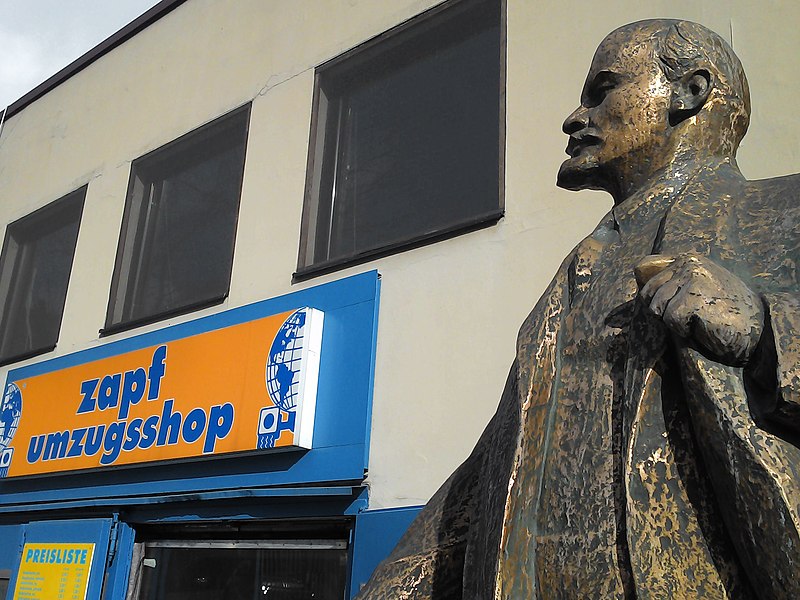
1. Lenin in a car park

Address: Nobelstraße 66

Nearest public transport: Nobelstraße / Bergiusstraße (Bus 246)

Photo: Gerhard Schuhmacher. CC4.0

In a remote industrial estate in the East of Neukölln, you can find a branch of the removal firm Zapf Umzüge. It looks like any other bland office, except there in the forecourt there is a huge metal statue of Vladimir Lenin, leader of the Russian revolution.

Klaus Zapf, owner of the company, is himself an interesting figure. He apparently moved to West Berlin to avoid military service and became involved in the 1968 student movement. He lived a frugal life, saying “There are just so many bloody idiots with money around – you don’t need another one.”

There are different stories about how Zapf acquired the statue. Maybe it was a loan guarantee from a Russian businessman. Perhaps Zapf Umzüge were commissioned to take the statue to be destroyed, and decided to keep it. Or it could be that it originally belonged to an entrepeneur who got rid of it because of complaints by the neighbours. Probably none of these stories is true.

This is not an area of town where most people casually go, but is well worth the visit.

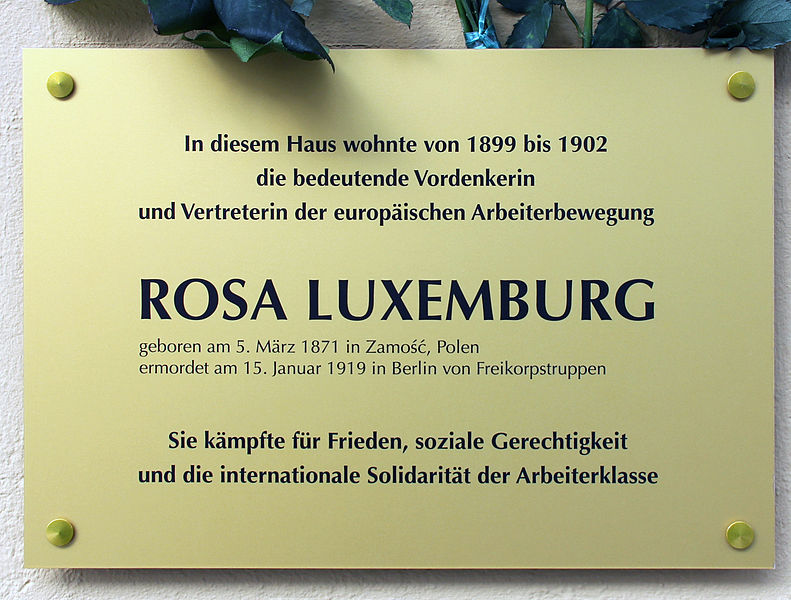
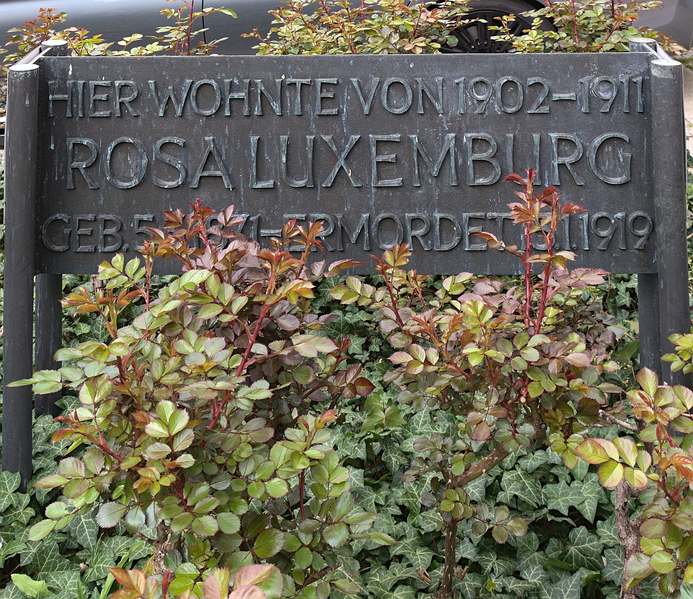
2. Finding Rosa Luxemburg

Address: Wielandstraße 23 and Cranachstraße 58

Nearest public transport: S-Bahn Friedenau

Photo: OTFW, CC3.0
Photo: Babewyn. CC4.0

Berlin has enough statues and plaques to Rosa Luxemburg to warrant an entire article. Some are quite famous, like the one in Tiergarten, others are in East Berlin and are outside the remit of this particular article. West Berlin monuments include a plaque to Luxemburg and Karl Liebknecht in Mannheimer Straße 27, at the final refuge before they were murdered by paramilitaries working on behalf of the SPD government.

Here, I want to talk about plaques outside two of the many places in Berlin that Rosa lived after arriving from Poland, before the devastation of the First World War and the suppression of the German revolution.

The first plaque, in Wielandstraße, says “In this house between 1899 and 1902 lived one of most important pioneers and representatives of the European workers’ movement. She fought for peace, social justice and the international solidarity of the working class. Five minutes walk away, in Cranachstraße, there’s a sign which is now hidden behind vegetation. The simple text reads “Rosa Luxemburg lived here from 1902-1911. Born 5.3.1871. Murdered 15.11.1919”.

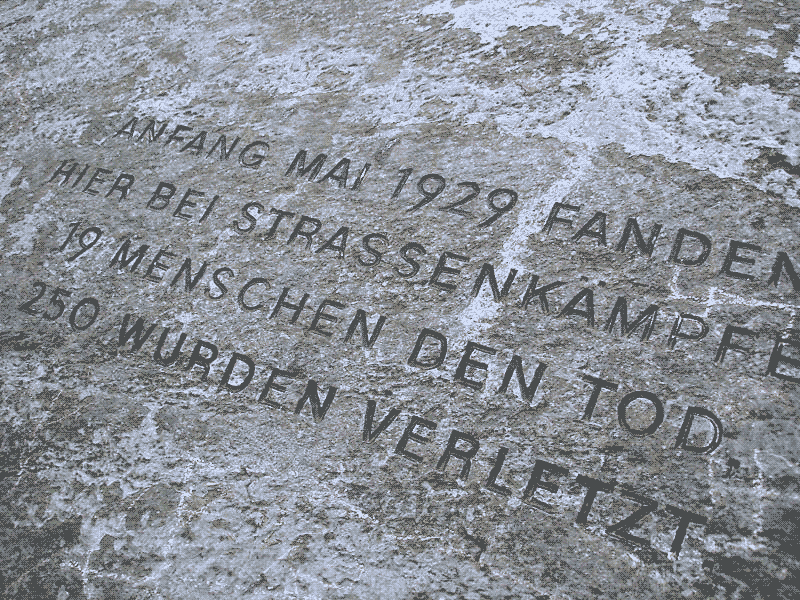
3. Weddinger Blutmai

Address: Walter Rober Brücke

Nearest public transport: U-Bahn Nauener Platz or Pankstraße

Photo: Boonekamp

Resistance continued after the German revolution. In 1929, SPD police president Karl Friedrich Zörgiebel banned all demonstrations planned for 1st May. In response, the Communist Party (KPD) called for “Straße frei für den 1. Mai” (streets free for 1st May). Defying the ban, thousands of workers gathered in Berlin – mainly in Wedding and Neukölln – in groups of 50 to 500 people.

Police fired 11,000 shots at demonstrators and local residents alike. One of the first people killed, Max G, was shot when he looked out of his window to see what was going on. In Wedding, the police deployed machine guns against locals throwing bottles and stones. Sources differ as to how many civilians were killed, but most figures lie between 32 and 38. Around 200 more people were injured. After the demonstration, 1,228 people were arrested, although only 43 were convicted.

This massacre had a fatal consequence. In June, the KPD held its Party Congress in Wedding, where they declared the SPD to be a “social fascist” organisation – just as bad as the Nazis. This, combined with SPD anti-Communism led to the failure of the SPD and KPD to unite to prevent the rise of Hitler. The Nazis never had majority support among the German people before taking power.

A commemeration stone for the victims of the Blutmai stands on the Walter Rober Brücke in Wedding with the following inscription: “Street fights took place here at the beginning of May 1929. 19 people were killed, 250 were injured”.

4. Platform 17 (Gleis 17)

Address: Am Bahnhof Grunewald

Nearest public transport: S-Bahn Grunewald

Photo: Phil Butland

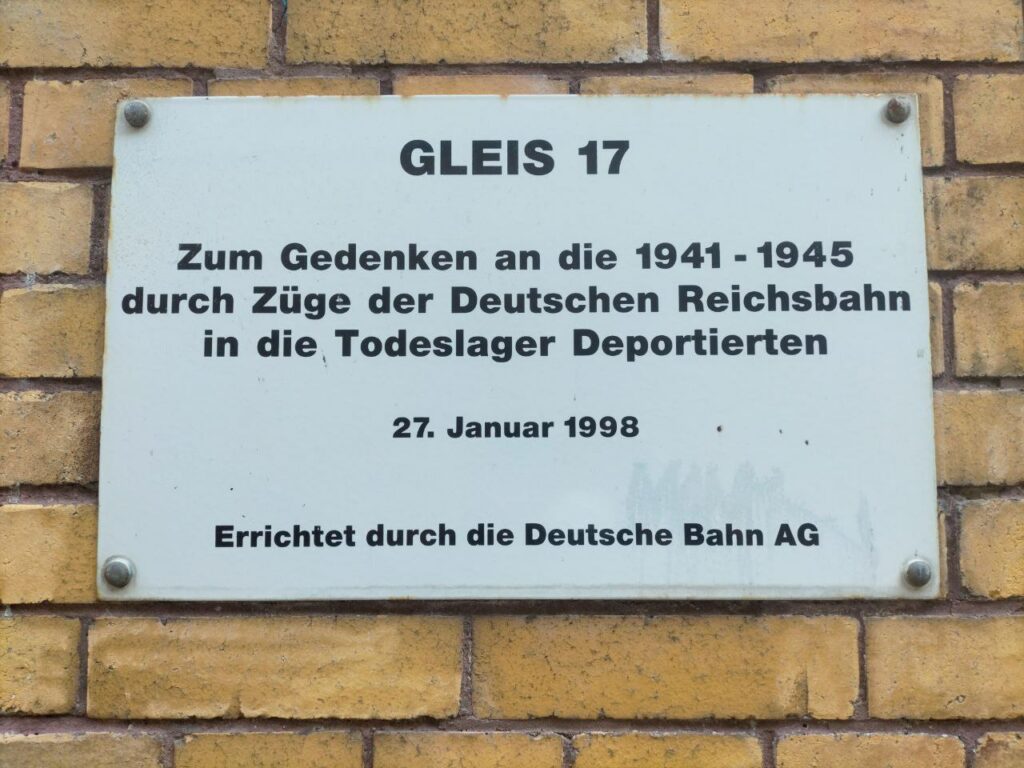
Between 1941 and 1945, more than 50,000 German Jews were deported from Grunewald station to Concentration Camps in the East. Grunewald was chosen because its remote location meant that large numbers could be deported without attracting too much attention. It is also located in a relatively rich area, which was more likely to contain Nazi sympathisers.

On the edge of Grunewald’s Platform 17, next to the train tracks, there are iron grates containing the names of the Concentration Camps to which people were deported, the date of each deportation, and the number of people deported. The first date is 18th October 1941, the last 27th March 1945.

Nearby, there is a monument of a concrete wall, containing the hollows of human bodies, next to a metal panel with the text: “In memory of the more than 50,000 Berlin Jews who were deported between October 1941 and February 1945 mainly from the Grunewald freight station by the National Socialist State to its extermination camps and murdered there”.

5. Deportation Memorials in Moabit

Address: An der Putlitzbrücke, Ellen Epstein Straße, Levetzkowstraße 7-8

Nearest public transport: S-Bahn Westhafen

Photo: Phil Butland
Photo: OTFW CC3.0
Photo: Fridolin freudenfett. CC3.0

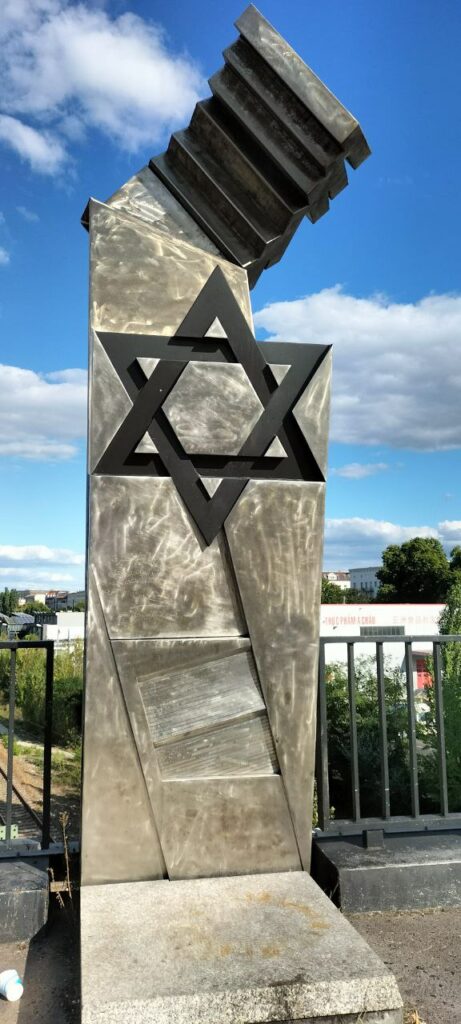
Not all deportation trains went from Grunewald. From January 1942 until 1945, more than 32,000 Jewish people were sent from the synagogue in Levetzowstraße to platforms 69, 81 and 82 of Güterbahnhof Moabit, from which they were deported.

A 2½ metre high statue stands on the bridge above the railway. The front of the statue shows a gravestone carrying a Star of David. The back shows a broken and deformed staircase to heaven. This monument was damaged by a bomb attack in 1992 and has been repeatedly covered with antisemitic graffiti.

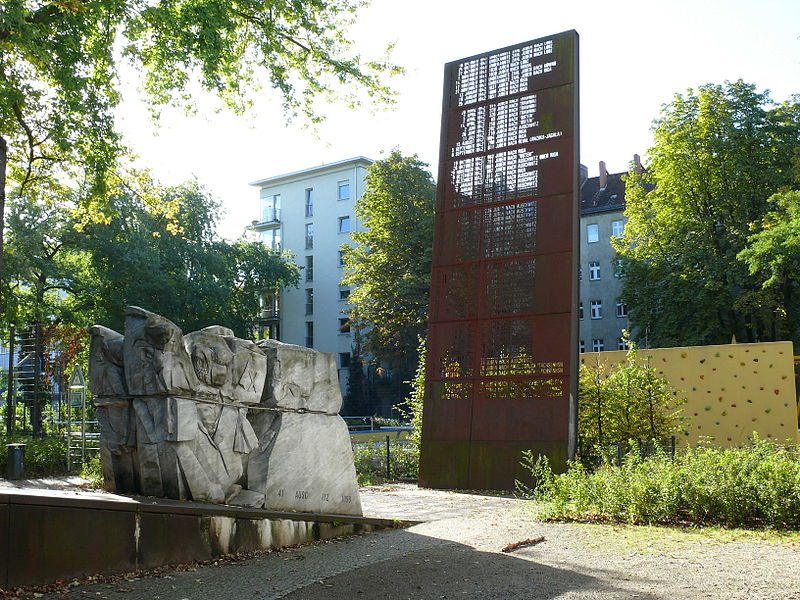
A little further down the tracks, there’s the Gedenkort (memorial site) Güterbahnhof. This contains a monument showing the path taken by deportees from Synagogue Levetzkowstraße. Nearby, part of the train track is still visible. It now leads into a brick wall.

A third monument stands on the site of the Levetzkowstraße synagogue. This shows a goods wagon next to a ramp on which there is an abstract depiction of a group of prisoners. Nearby, there is a huge iron monument on which is written the dates of 63 deportations and their destinations in Eastern Europe. On the ground there are plaques to the synagogues from which they were taken.

6. Commemorating Treblinka

Address: Amtsgerichtsplatz

Nearest public transport: Bus Amtsgerichtplatz (M49, 309, X34), S-Bahn Charlottenburg

Around 900,000 Jews were murdered in the Extermination Camp of Treblinka, East of Warsaw. In 1966, Russian sculptor Vadim Sidur made a memorial to the victims of Treblinka, which was erected in Charlottenburg in 1979.

The sculpture contains four human bodies lying on top of each other, stacked in the form of a cross. The body at the bottom is of a woman who is still alive. Like the Holocaust Memorial near Brandenburger Tor, the statue uses abstract form to depict horror which is virtually indescribable.

Next to the statue, there is the following text in Cyrillic and Latin script: “In the camp Treblinka II, over 750,000 people were murdered between July 1942 and November 1943. If you close your eyes to the past, you will be blind for the present. If you do not want to remember the inhumanity, you’ll be vulnerable to new acts of injustice.”

7. Memorials to the 1953 East Berlin Workers’ Uprising

Address: Berliner Straße 74-76, Seestraße 92-93

Nearest public transport: Straßenbahn Osram Höfe

Photo: Singlespeedfahrer CC1.0
Photo: OTFW. CC3.0

On 17th June 1953, less than 4 years after the foundation of the East German “workers’ state“, workers rose up against their own government. This confused much of the Left, East and West, many of whom thought the uprising was a CIA plot. I have written elsewhere about how Berthold Brecht was similarly conflicted. In East Berlin, no memorial was erected before 1990.

In the West, however, the uprising was used for Cold War propaganda. Less than a week after the uprising, the Berliner Senat decided to rename the street which leads to the Brandenburger Tor Straße des 17 Juni. Western leaders, who did everything they could to put down workers’ struggles in their own country, suddenly became great fans of insurrection.

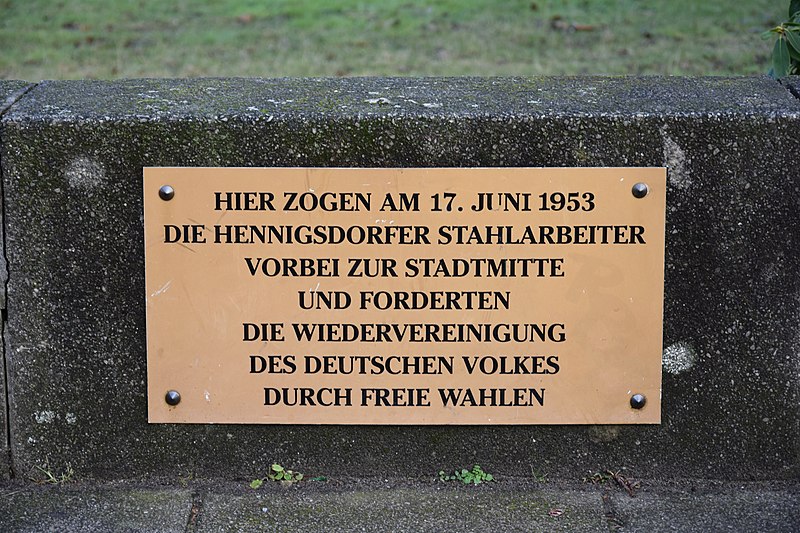
In Berliner Straße 74-76 in Reinickendorf, there’s a small memorial to demonstrating steel workers from Hennigsdorf. Not far away, there the Urnenfriedhof Seestraße in Wedding. At the entrance of the cemetery, you see both commemorations to Germans who died in the Second World War and a larger monument to 295 victims of National Socialist [Nazi] dictatorship.

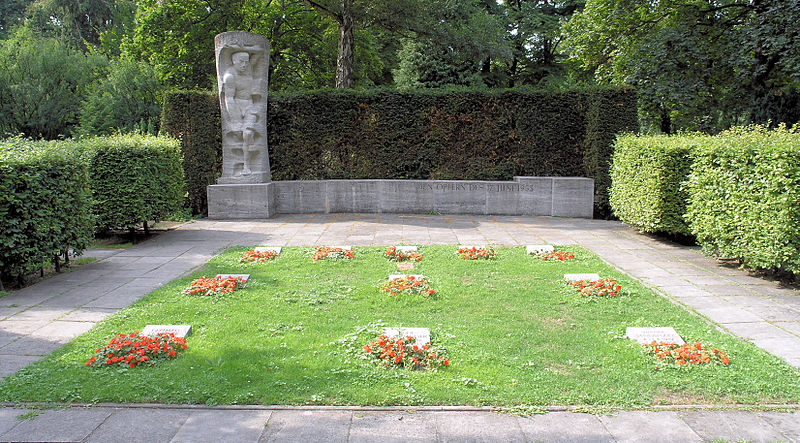
But if you go 100 yards forwards, you see a monument accompanying the graves of the 8 victims of Russian bullets who died in West Berlin hospitals. Like all Western monuments commemorating the 1953 uprising, it is contradictory, but the fight that it remembers was a noble one.

8. Death of a Protestor

Address: Bismarckstraße 35

Nearest public transport: U-Bahn Deutsche Oper

Photo: Lorem ipsum CC2.0

On 2nd June, 1967, Christian pacifist student Benno Ohnesorg attended his first political demonstration. It was outside the Deutsche Oper, where the Shah of Iran, Reza Pahlavi, was attending a performance of the Magic Flute. Demonstrators were attacked by both SAVAK, the Iranian intelligence service, and the German police. Ohnesorg was shot and killed by the police.

10,000 people attended Ohnesorg’s funeral where student leader Rudi Dutschke made the following address: “June was a historic date in the German universities. For the first time since World War Two huge strata of students mobilised against the authoritarian structure of this society. They experienced this irrational authority during the demonstration.” The West German 1968 started in June 1967.

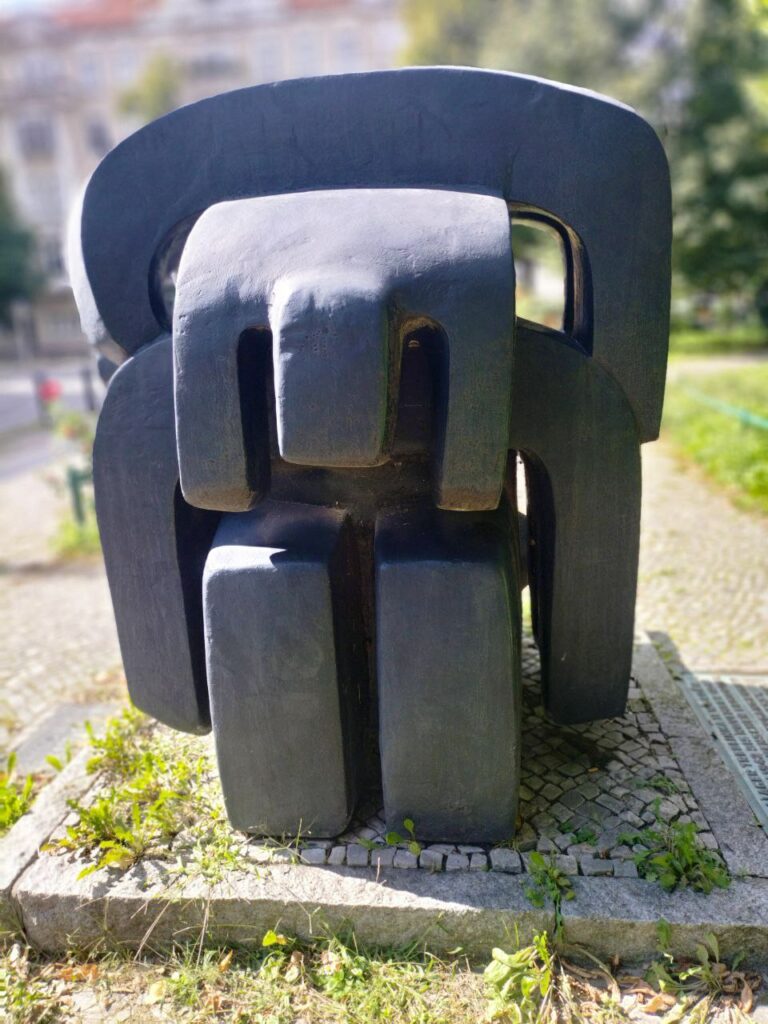
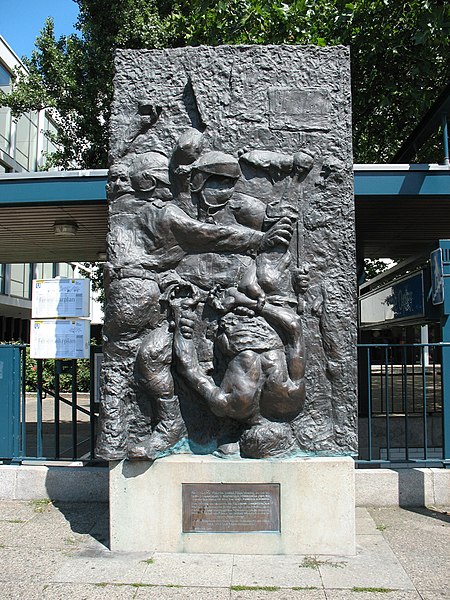
In 1971, Alfred Hrdlicka created the sculpture “Death of a Protestor”, which is currently opposite the Deutsche Opera building. Next to the sculpture there is a plaque which contains the following text about Ohnesorg: “His death was a signal for the nascent student and extra-parliamentary movement, which particularly linked their struggle for radical democratisation in their own country with those against exploitation and oppression with those in the Third World.”

9. Ulrike Meinhof’s grave

Address: Eisenacher Straße 21

Nearest public transport: U-Bahn Westphalweg

Photo: Phil Butland

After the SPD won the 1969 General Election, the 1968 movement started to retreat from the streets. The SDS student organisation had already effectively disintegrated after its conference the previous December, and apart from a few fleeting strikes, resistance dropped.

Frustrated by the decline in militancy, some young activists turned to terrorism, most notably in the Baader-Meinhof Group (aka Red Army Faction, RAF). The RAF understood itself as a communist, anti-imperialist urban guerilla group engaging in resistance against a fascist state. The media named the group after two if its leaders – Andreas Baader and left-wing journalist Ulrike Meinhof.

The RAF was best known for a bombing and kidnapping campaign in the 1970s. Support extended way beyond the radical Left, especially in student circles, including even my German teacher, later a member of the Conservative CDU.

In 1975, the “first generation” RAF leaders were tried in Stammheim prison. Meinhof died of hanging in her cell in 1976, Baader of gunshot wounds in 1977. Other group members also died in jail, all allegedly by suicide, although this was hotly disputed. 7,000 people attended Meinhof’s funeral, and Jean-Paul Sartre and Simone de Beauvoir led the protests against her death.

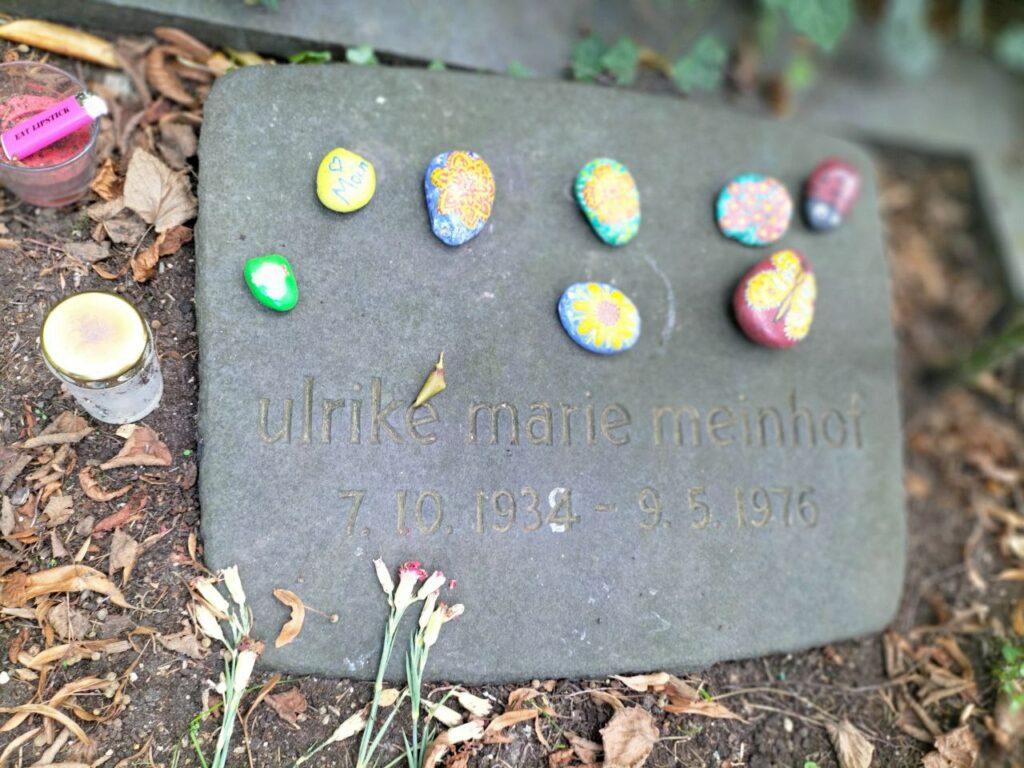
Most Berlin cemeteries contain a plan near the entrance showing where you can find the famous (and some not so famous) people buried there. Not so, the Dreifaltigkeitsfriedhof III in Schoeneberg. In a seldom visited part of the graveyard, with no great ostentation, there is a simple gravestone bearing the words “ulrike marie meinhof 7.10.1934 – 9.5.1976.”

10. Korean Peace Statue

Address: Bremer Straße 41

Nearest public transport: U-Bahn Birkenstraße

Photo: C. Suthorn CC-by-SA 4.0

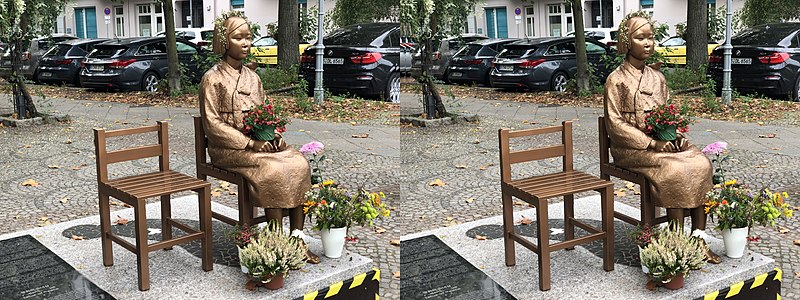
The Peace Statue in Moabit is a memorial to the so-called “Comfort women” – girls and women who were forced to act as prostitutes in Japanese brothels during the Second World War. It is intended as a symbol against all sexual violence. An estimated 200,000 women and girls were raped and forced into sexual slavery during the Asia-Pacific wars of 1931-45.

The bronze statue, by South Korean artists Kim Seo Kyung und Kim Eun Sung, was erected on 28th September 2020. It shows a girl in a Korean dress, sitting next to an empty chair. The girl casts a shadow in the shape of an old woman. The statue also depicts a bird of peace and a white butterfly, symbolising rebirth.

On the day after the statue was erected, the Japanese cabinet secretary and government speaker  Katsunobu Kato called on Germany to remove the statue. Japan’s foreign minister Toshimitsu Motegi made a similar demand to his German counterpart Heiko Mass. The Korea Verband, which is responsible for the statue, was ordered by the district authority in Berlin-Mitte to remove the statue by 14th October 2020. Resistance, including demonstrations in Moabit, have kept the statue in Moabit.

You can read more about the Peace Statue in this interview.

Berlin Court Finds Deutsche Welle Unlawfully Dismissed Journalist Farah Maraqa

Palestinian journalist wins court appeal in Berlin on all counts

Yesterday, Monday 5th September, Palestinian journalist Farah Maraqa won her court case against Deutsche Welle for unfair dismissal. Farah won on all counts – Deutsche Welle must now re-employ her and pay all court costs (nearly €40,000). We hope to publish an article on Farah’s case on theleftberlin.com later this month. Until then, here is a statement by the European Legal Support Centre which has been advising Farah.


Palestinian-Jordanian journalist Farah Maraqa won her lawsuit against German public broadcaster Deutsche Welle (DW), which dismissed her and other 6 journalists in February 2022.

Following a hearing on 20 July 2022, the Berlin Labour Court ruled today in favour of Farah Maraqa, ordering Deutsche Welle to reinstate her and to pay for the costs of the legal dispute. This suggests that the Court recognised that Farah’s termination, based on a controversial investigation and unfounded allegations of antisemitism related to reports published before her employment contract, was illegal.

This comes after the judge had proposed a settlement between the journalist and DW in the form of a joint statement. DW never commented nor replied to Farah Maraqa’s proposal of a statement that includes a public apology, a retraction of their allegations and reputation rehabilitation.

It is the second lawsuit that DW has lost after they terminated the contract of 7 journalists from their Arabic service. On 7 July 2022, the Bonn Labour Court found that DW’s dismissal of Palestinian journalist Maram Salem was unlawful. In another case, DW settled. All the remaining cases are still pending.

The dismissals were presumably based on a controversial investigation report led by Ahmad Mansour, who was criticized by several experts as biased, and used the IHRA working definition of antisemitism (IHRA-WDA) and its problematic examples to assess social media posts and reports as antisemitic. This manifests an anti-Palestinian sentiment and leads to a significant chilling effect on any journalist who would cover Palestine/Israel.

The ELSC is proud to have provided support for Farah Maraqa who stood firm in her convictions and had the courage to take DW to Court.

It is a relief that the judge ruled in Farah’s favour and held Deutsche Welle accountable for this illegal dismissal. We hope this sends a clear message that they should stop their censorship practices. This case illustrates how the institutionalisation of the IHRA-WDA can lead to severe infringements upon freedom of expression and freedom of the press. At the same time, it is another confirmation that pushing back – including through legal action – is effective and is a necessity in order to uphold these rights.

said Giovanni Fassina, Director of the ELSC.

So far, it appears DW management has refused to acknowledge their mistakes and has instead anchored its prejudiced positions in a new Code of Conduct published on 1 September 2022. What is new in this binding Code is that it obliges DW employees to “maintain restraint in the content and form of our social media and other publications in both a professional and private context”. It also mentions Israel twice when referring to commitments against racism and antisemitism, including: “Due to Germany’s history, we have a special obligation towards Israel.”

It is not clear what obligations this statement implies for DW employees, nor whether it means unwavering political support the Israeli government, which would raise important questions related to the independence of the press. The Code also repeatedly warns employees of potential consequences if any violation of the Code is observed, including dismissal.


Additional noteThe motivations of the judgement will be available mid-October.

Federal Gods – Book Review

A new British-German book of prose-poetry is an empathetic response to the 2015 “refugee crisis”,


05/09/2022

Federal Gods is a politically charged work full of poetic prose that conveys the human realities of what is inadequately called the refugee crisis. Clare Saponia has a gimlet ear for weasel words, especially as wielded by states and institutions, but she additionally conveys the depths and emotional intensities involved in the universal longings for security, connection, and a future in desperate and distressing circumstances. The title is a translation of a made-up word, Bundesgott, which Saponia says she created, “to express the exalted, seemingly arbitrary power of the political elite.”

She was a volunteer at Wilmersdorfer Rathaus, Berlin in 2015 when first 500, then 1150 refugees arrived with hopes of starting new lives in Germany. Her first descriptions ache with pain and poignance as children are given instant coffee and there are no beds to sleep on. The contradictions clash against other like brittle waves – the heartfelt frenzy of welcome is perceived by Saponia as a frantic yearning to break free of the unbearable burden of the opposite in German history. This fervent aspiration cannot, however, ameliorate the state apparatus that looms all around the recent arrivals. She represents well both her own revulsion at the ubiquitous, nationalistic iconography against the determination to belong of the refugees: “The symbolism makes me heave. To you it’s a magic cloak.” and “You see eagles everywhere, tattooed to buildings and costumes and paperwork you can’t read. The cult you want to join but have neither keys nor clues.”

As the book goes on (it is written chronologically) Saponia presents individuals she encounters, vividly depicting them with a searing tenderness that pervades the whole work. There is Jayla, Samid, Nikro, Hanin and Zaid, a cancer survivor who shows her his scar and his wife Intesar with “titles and letters after her name”. Here and elsewhere, Saponia portrays the conflicts and tensions within the group, based on either geopolitical animosity or simple, brooding jealousy. This has authenticity and communicates the troubled rage of some asylum seekers alongside the wishes to conform or assimilate. Her capacity to get under the skins of not only those she aims to help but also the xenophobic haters has a novelist’s skill. She writes of an individual aspiring to get to Britain, not being aware of the “faraged gut of my birth isle” and that in the mind of the racist, “Hell is not the others but a dangle of white inferiority.” She is sharply aware of the combined assistance and inadequacy of teaching language skills in this context, “You have histories I cannot heal with haben und sein.”

Federal Gods has a filmic dynamism, full of astutely drawn realities, human compassion and complexity. It added to my understanding and perspective on what people go through and are prepared to face in their efforts to find a life beyond hatred. Although not stinting on the anger and pain, it resounds with our capacity as humans to empathise, to see ourselves in another’s plight, to be literally border defying. Clare Saponia achieves this with her writer’s ability to enter the thoughts and feelings of another and communicate their yearning on the edge of exhaustion.

Federal Gods is published by Palewell Press, ISBN 978-1-911587-60-6 and if you want to avoid the usual online book purchasing sites why not support a local Berlin-Neukölln bookshop and order it here at BuchHafen  to be picked up at Oker Strasse 1, 12049 Berlin. [North Berlin editor’s comment. English books can also be ordered from St. Georges Bookstore, Wörther Straße 27]