The Left Berlin News & Comment

This is the archive template

The Pandemic is Still With Us

178k deaths proclaim that Boris Johnson spectacularly failed to ‘get all the big calls right


16/02/2022

Keep Our NHS Public continues to fight vigorously on a number of different fronts as Covid, austerity and government abandoning all pretence of following the science wreak havoc. Meanwhile, the NHS is further threatened by proposals in the Health and Care Bill. With Health Secretary Sajid Javid declaring that Britain is the freest country in Europe, and the ending of all Plan B restrictions, it might appear that the pandemic is all but over.

The requirement to isolate for those with infection is due to lapse on February 24th. Statistics, however, tell a different story and this is clearly a decision based on political rather than scientific considerations. The Omicron variant has swept the board, and while less likely to cause severe disease, it has a very high rate of transmission.

In early February, there were around 160,000 new symptomatic cases each day, and 14,600 infected hospital inpatients. Daily deaths from Covid have regularly been over 250 (1 every 6 minutes!) with a peak of 276 on the 17th January, the highest daily total since 23rd February 2021. The Office for National Statistics has recorded over 178,000 Covid-related deaths since the start of the pandemic.

To many, the possibility of a new and more lethal variant remains a huge threat, augmented by high levels of circulating infection – a strong argument for ensuring vaccination is rolled out across the world. Recently, 320 academics have pressed the government for support to Low- and Middle-Income Countries to manufacture Covid vaccines, tests and treatments.

In addition, much more must be done to suppress community transmission and reduce the likelihood of a new serious mutation. Low rates of infection would then permit public health measures such as ‘test, trace, isolate, support’ to control further spread of virus. The misleading narrative that we are learning to live (should this be ‘die’?) with Covid is contributing to what the Commons joint committees’ report correctly characterised as among the worst ever public health failures in our history.

One of the highest rates of death in proportion to population gives the lie to the much-parroted phrase that the prime minister got all the big calls right. Such delusional thinking means that the NHS is now on a ‘war footing’, with waiting lists massively increasing and many people being denied the care they need.

The Health and Care Bill

This Bill addresses none of the most pressing problems in the NHS. It has been described succinctly as: “an astonishing attempt to allow the Secretary of State, an enlarged NHS England as ‘rule-maker and regulator’, and new public-private ‘Integrated Care Boards’, to reduce services, limit expenditure, further degrade local accountability and entrench the market.” No wonder legislators are finding it difficult to explain to voters just what benefits patients might expect it to deliver. While this Bill should be rejected outright, parliamentary arithmetic suggests this won’t happen, and campaigners have been lobbying for amendments that could ameliorate some of the worst effects. However, there is no indication that any important revisions will be forthcoming.

The start of Integrated Care Systems (central to the Bill) has been delayed from April until July in recognition that further debate is now unlikely to be completed in time for Royal Assent at the end of March. The committee stage in the Lords is almost over following which the report stage gives a further opportunity for the Lords to discuss and make amendments. The Bill then returns. The Bill then returns to the Commons when key votes will take place on amendments proposed

With the 2012 Health and Social Care Bill, it was noted that many Lords had private interests in insurance companies, private health care and private equity groups, and were in danger of voting on behalf of private and personal interests that stood to gain from the Bill rather than in the public interest. It is likely that situation is not much changed. For example, Lord Hunt of Kings Heath has proposed that 5% of budgets must be ring-fenced for digital transformation. The Parliamentary Register of Interests shows him as the paid Chair of the Advisory Board for Octopus TenX Health, a health technology investment company.

SOS NHS’: building a movement so massive, loud and strong that the government simply cannot ignore

The recent People’s Covid Inquiry organised by Keep Our NHS Public highlighted the effects of austerity in undermining the NHS, weakening its ability to respond to the pandemic. The final report concluded that there may be the basis for criminal proceedings related to charges of misconduct in public office; the Metropolitan police have been asked to investigate. The Inquiry raised the question of what kind of NHS and care system we need in the future.

SOS NHS is an ambitious new campaign supported by around 40 key organisations. It represents a diverse range of people, united in their desire to defend the NHS against neglect, underfunding and privatisation. The central demands are for an immediate £20 billion in extra spending as a down payment to start rebuilding a fully functioning public health and care system; investment in a publicly owned NHS and guarantee of free healthcare for future generations; proper pay for staff.

The recently announced recovery plan falls far short of what is needed. It lacks sufficient investment and fails to address workforce issues without which promised improvements simply can’t happen. Mental health, GP services and urgent and emergency care are not covered, all of which are in dire trouble. The 5,000 beds closed during the pandemic are not being reopened and more cash is being directed to private sector providers.

SOS NHS has called for a national day of action on 26th of February with events being held in many towns and cities. One lesson to be learned from pandemic spending is that money can always be found if there is political will.

This article was written for Chartist no 315, March/April 2022 edition. With thanks to Mike Davis for permission to reproduce.

Norma Waterson Obituary – Her Songs Live On

Reflections on the importance of English folk music and the life of Norma Waterson (1939-2022)


15/02/2022

The great singer Norma Waterson (15 August 1939 – 30 January 2022) was perhaps one of the last of a particular generation of traditional English folk singers. Her recent death deprives us of the great pleasure of hearing her live again. But fortunately, Waterson herself stressed the continuity of the songs that she loved and excelled at. For she said of folk music that it was the working people’s library and history, ‘deserving respect’:

“The official history of people is usually written by historians that are well-lettered and they write it form a different aspect – from ‘oop’ (‘up’ and here she gestures over her head) and they’re looking down on it. But traditional music particularly and protest music and union music – it’s written by the people, it’s our oral history, it’s what made us do things, what made us sing. What made us happy. I feel it deserves as much respect and dignity as any of those history books high on a shelf”.

Other great folk singers agree fully. In the book “Come All Ye Bold Miners – Ballads and Songs of the Coalfields” (London 1978; p.13-18), A.L.Lloyd (Bert), said:

“Songs that are so close to the heart of the common people may have a functional quality that goes far beyond mere diversion. Many of them were made up not so much to decorate life as to make it bearable… these songs arose spontaneously in working-class communities and in the main were transmitted orally.”

One of the great folk singers who is still performing, Peggy Seeger said [in First Time Ever”; London 2017; p.407]:

“Folk songs originally expressed the experience and values of those at the bottom of the social heap; those who take home a weekly wage, not a salary; those who can be dismissed with little or no notice, in short those who walk an economic tightrope insecurely fastened at both ends…. Folk songs were originally hewn in memory. Their pared-down-to-the-bone texts are unpretentious, close to spoken language. Their melodies are so reminiscent of the rise and fall of colloquial speech that they are often regarded as an elemental ingredient – embryonic, therefore belonging to nobody, the property of everybody.”

The definitions of folk-music provided by these three great exponents, reminded me of the songs collected by Georg Weerth (1882-1856). Frederick Engels called him “the German proletariat’s first and most important poet”. While Weerth lived in Bradford during the grounding of the English Industrial Revolution, he collected “Songs of Lancashire”, including “There Was Once a Poor tailor”:

“There was once a poor tailor
Who stitched himself stupid and wry;
He stitched for thirty long years
And did not know why.

And when again Saturday
Saw yet another week go by
He began to weep bitterly
And did not know why….

Then many strong threads
Round his throat he did tie –
Hanged himself from a beam
And did not know why…

The tailor died at half past seven
And no one knew why.”

[Georg Weerth, in ‘“A Young Revolutionary in 19th Century England”; Berlin 1971; p. 171.]

Just as for Weerth, many of the world’s great poets and musicians were fed by the history of the working class as recorded in their songs and poetry. These may lifted them into the realm of ‘high art’, but their origins lie in the people.

Waterson hailed from Hull, Yorkshire, where she was brought up by her maternal grandmother, who had an Irish Traveller background. She and her brother Mike Waterson, and sister Elaine (‘Lal’) Waterson – all learnt that music was a social art early on, in their family:

“[It was a time] most people had a piano in the parlour. We didn’t have a telly, but my grandma knew all the music hall songs and we listened to pop music on Radio Luxembourg”.

The details of Norma Waterson’s career are easily found in two obituaries [Moving on Song and Jim Farber, ‘Norma Waterson, a Key Figure in Britain’s Folk Revival, Dies at 82’; New York Times February 8, 2022.]and a superb long video from the BBC entitled ‘Travelling for a living’ . I do not recapitulate those, and the facts of her life. But in brief, she together with Mike, Lal and a cousin John Harrison; and then with her husband Martin Carthy – all helped revive the English folklore tradition. Their daughter Eliza Carthy ploughs the same soil, but turns up new elements.

Such handing on has been endless, accounting for the words ‘oral tradition’. It ensures that indeed – ‘All things are quite silent’ – remains only the words of one of her most famous songs and not the state of affairs after Norma Waterson’s death. Recent history can attest to the handing down in meticulous detail, of even just one song ‘Scarborough Fair’. The chain in modern times can be traced from Ewan MacColl and Peggy Seeger, through to the real source – an English lead miner called Mark Anderson, collected by Alan Lomax the American folklorist relayed to Martin Carthy – gifted onwards to Simon and Garfunkel, Bob Dylan, and Joan Baez etc. – and the chain goes on.

The last words go to the words that Norma Waterson, Martin Carthy and their daughter sang exposing a heartless world:

“In a horse drawn carriage on the old A5,
You can’t stay here the policeman said,
You better get born someplace else,
Move along, Get along, GO – MOVE – SHIFT.”

Like Eliza Carthy, Norma’s daughter – the working class is not just going to move aside.

Open Letter to Amnesty International Germany

Amnesty International has issued a report calling Israel an Apartheid State. We publish an Open Letter from German Palestinians criticising Amnesty Germany for burying the report


14/02/2022

Translator’s introduction

The Amnesty Report

On 1st February this year, Amnesty International issued a report. Entitled “Israel’s Apartheid Against Palestinians”, one of its major conclusions was that “almost all of Israel’s civilian administration and military authorities, as well as governmental and quasi-governmental institutions, are involved in the enforcement of the system of apartheid against Palestinians and against Palestinian refugees and their descendants outside the territory.”

In declaring Israel to be an Apartheid state, Amnesty was following leading human rights organisations like Human Rights Watch, B’Tselem, Al-Haq and even the British Labour Party, all of whom have issued statements accusing Israel of practising apartheid (though it may be worth noting that the last of these organisation is now declaring itself to be very much “under new management”).

The Middle East Monitor notes that “In its designation of Israel as an apartheid state, Amnesty went further than previous reports, which concluded that occupation state is practising a system of racial segregation but limited the practice as a feature of areas under its control. Amnesty is more expansive in its designation and applies Israel’s practice of apartheid to the state’s international operations.“

As Nasim Ahmed concluded in the Middle East Monitor: “the historical project of creating a “homeland” for European Jews in Palestine was always going to lead to the displacement of the indigenous people who, at the turn of the 20th century, comprised some 95 per cent of the population. Such a venture could not have been possible, nor would it have been sustained without a system of oppression and racism. ”

Although there were some criticisms of the Amnesty report for not going far enough, this was a historic statement. Activists and academics have been calling Israel an Apartheid State for decades, but it has been, until recently, a highly contested position. Despite Books like Uri Davis’s Apartheid Israel (2003), and Ilan Pappé’s anthology: Israel and South Africa: The many faces of Apartheid (2015), even some in the Palestine solidarity movement have been wary of calling Israel an Apartheid state.

Amnesty Germany Responds

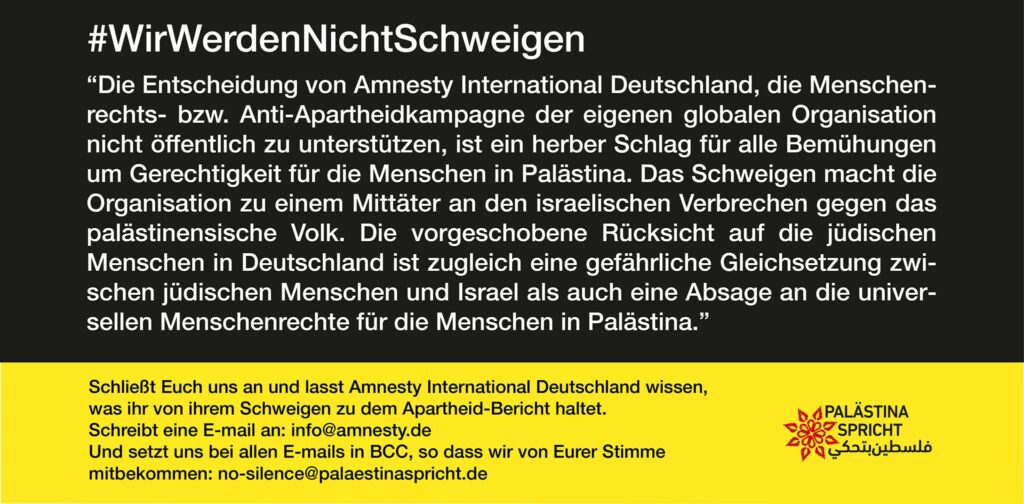
Amnesty Germany was less enthusiastic about the international report, issuing a statement saying saying: “to counteract the danger of instrumentalisation on misinterpretation of the report, the German section of Amnesty will not plan or carry our any activities around this report”. As Israeli-German activist Michael Sappir noted in +972 magazine: “Identifying the need for substantial debate and worrying that the report might be misinterpreted in Germany, the local section resolved to simply stand back and do nothing.”

In their defence, Amnesty Germany say that they have documented the report. Well, yes. Sort of. Michael Sappir noted in his article that: “just one day later, the announcement regarding the report had been deleted from its website, meaning all that remains in German is a separate overview on the Austrian section’s website.”

Eleven days after the report was released, I went to Amnesty’s German Website and searched for Israel. And yes, I did find something. But the first article that I found about the Apartheid report was the 44th article on the search list, well below many articles which are over ten years old.

At the bottom of this article is a link saying “Following the publishing of this report, there was a multitude of reactions, demands and criticism. Here is the reaction of the German section of Amnesty. Click on the link and you find a page headed: “Defend human rights, strengthen antisemistism sensibility”.

Open letter from German Palestinians

Once more German exceptionalism is trying to discuss the oppression of Palestinians without giving Palestinian people a voice. This is why we are pleased to have translated an open letter to Amnesty Germany initiated by Palästina Spricht (Palestine Speaks). You can find the original German text here. Please send the text as an e-mail to info@amnesty.de and presse@amnesty.de with no-silence@palaestinaspricht.de on BCC.

The translated text of the Open Letter follows:

Dear Amnesty International Germany Team

We are writing to you while we are still fighting with the daily bad news from Palestine. The daily expulsion of people, the daily destruction of houses, the daily shooting of civilians on the street and the faces of their grieving families.

We are the parents, the sisters, the brothers, the relatives and the friends of people in Palestine. We are German citizens who are publicly abandoned every day by the German State, and whose basic rights are denied in the media time and again.

While Israeli bombs fell on the heads of our loved ones in Gaza in May 2021, ALL German parties in the Bundestag, from die LINKE to the AfD, held a solidarity rally with Israel, an Apartheid State, at the Brandenburger Tor, and authorized the delivery of weapons to Israel. We were witnesses when an MP in the German parliament wished the Israeli air force “rich spoils”.

In this country, in which over 95% of antisemitic incidents are perpetrated by far-right, white Germans, this attitude is not just fundamentally wrong, it also is a trivialisation of antisemitism…

We are slandered in the German press every day, insulted and pilloried. We are made into a projection screen of German racism and have had to pay for German history with our blood.

We live in a world in which the makers of shoes and ice cream have more political backbone and consciousness, and demonstrate proof more than most German politicians and press platforms.

This conscious silence is not new to all voices who are fighting for the civil rights of Palestinians, and show the extent of the double standards which are applied to Palestinians and their just fight for freedom. But that human rights organisations in Germany have taken this cowardly, passive approach to the overwhelming evidence is a new low point in this country, and a slap in the face.

Amnesty International published a report about the situation and confirmed what Palestinians have known for 73 years. Israel is an Apartheid State. This conclusion which Amnesty drew from their report has already been drawn and clearly labelled by other organisations such as the US-American human rights organisation Human Rights Watch and the largest Israeli human rights organisation, B’tselem.

It is deeply disappointing that Amnesty International Germany has announced that it will not comment on this report, nor will it carry out a campaign, as this would apparently strengthen antisemitism in Germany. In this country, in which over 95% of antisemitic incidents are perpetrated by far-right, white Germans, this attitude is not just fundamentally wrong, it also is a trivialisation of antisemitism and a barrier to the fight against all forms of racism.

Also for us, the Palestinians whose human rights are abused every day, this attitude is not just extremely unjust, but also hypocritical and consciously cowardly. We, the parents, sisters, brothers, relatives and friends of the people in Palestine appeal to your conscience and your obligation as a human rights organisation. End this passive approach to the extreme injustice to which our loved ones are systematically and daily exposed.

We appeal to your humanity – the humanity that unites us all, the most important motif for action and engagement – to actively confront this systematic oppression of our families and loved ones.

Every day that passes is one more day when this injustice continues. We know all to well that you cannot end this injustice on your own, but with active commitment, you would be contributing towards a reduction of the misery and systematic oppression.

Please be on the right side of history.

Best wishes

Families and friends of the people in Palestine.

Translation: Phil Butland. Reproduced with permission

50 Years Cabaret

It is 50 years since the anti-Fascist film Cabaret was first released. It still holds up as a spotlight on the dangers of Fascism, and how we can fight it


13/02/2022

The film Cabaret was released on 13th February, 1972 – 50 years ago today. The musical play on which it was based had its premiere on November 20th 1966, and much had happened in the intervening six and a bit years.

Great Britain had seen laws legalising abortion and decriminalising homosexuality (both passed in 1967). In 1968, France saw the largest general strike in world history, in a mass movement that inspired similar movements throughout the world. After Martin Luther King was assassinated in 1968, US Americans took to the streets.  This dovetailed with growing opposition to the Vietnam war; and movements such as the Gay Liberation Front. After a police attack on the Stonewall Inn, LGBT+ people in New York rioted. In 1973 the Roe vs Wade verdict legalised abortion in the USA.

What has all this to do with a film about the dying days of Weimar Germany? Firstly Cabaret is about much more than just this. As David Hall notes, Cabaret was “one of the first mainstream films that celebrated homosexuality, just as openly as it did heterosexuality”. Brett Campbell adds that “few remember that the original movie version of Cabaret briefly earned an X rating for its implications of bisexuality, abortion, anti-Semitism, and other then-verboten fruits.”

Although it was “just” a musical, Cabaret was a film of its time. It was not just affected by political events outside. It was also intended to be an intervention in these debates.

The Plot

For anyone who hasn’t seen it yet – you really should! But here’s a quick summary. Brian Roberts arrives in Berlin in 1931, looking for work as an English teacher. While looking for lodgings, he meets Sally Bowles, a vivacious but childish singer at the local cabaret. Sally is currently slumming it, her estranged father is “practically an ambassador”. Her real ambition is to be a famous actress.

Brian moves in opposite, and uses Sally’s room as a classroom. His pupils include Natalia Landauer, the repressed daughter of a rich Jewish family, and Fritz, an opportunistic social climber. Fritz tries to woo Natalia for her money. Two problems arise – first, Fritz finds that he’s falling in love with Natalia, second she becomes the victim of Nazi attacks. Fritz then reveals that he is, himself, Jewish, but he registered as Christian when he moved to Berlin.

Sally tries it on with Brian, but he rebuffs her, explaining that he has had three sexual encounters with women, all of them disastrous. But Sally persists and they become a couple. When Sally meets Max, a passing aristocrat, in the laundrette, they become a triple. Max promises to take them to Africa, but suddenly leaves town, leaving a cursory note and some money. Sally discovers she’s pregnant, but she doesn’t know by whom. She has an abortion off screen.

Meanwhile, the Nazis are slowly gaining a foothold. We see the corpses of dead Communists on the street. Max thinks that “Germany” can use the Nazis to get rid of the Communists. When a member of the Hitler Youth gets up in a Biergarten and sings Tomorrow Belongs to Me, a terrifying prophecy of the barbarism ahead, everyone (with one exception) joins in. Brian asks Max if he’s still so sure of himself. Brian later confronts two Nazis and is hospitalized as a result.

The romantic and political developments are interspersed with scenes from the Cabaret, conducted by a creepy MC. At first, the MC invites the audience to “leave your troubles outside”. The cabaret contains some songs, some political satire, but also some female mud wrestling. In an early scene, a Nazi collecting money is ushered out of the cabaret, which leads the manager to be beaten up. By the end of the scene, most of the audience is dressed in Nazi uniforms.

Whose Cabaret?

Cabaret, more than most films, presents a story based on many different perspectives. The opening titles list a series of different sources. This film from the 1970s is based on a musical from the 1960s, which is in turn based on a play from the 1950s – ‘I am a Camera’. The source for all of these was Christopher Isherwood’s Berlin Stories – a collection of 2 novellas published in 1935 and 1939 –  based on Isherwood’s experiences in early-1930s Berlin.

There is a temporal distancing, in which we are privileged to information that the characters lack. As they blithely carry on, we are aware of impending Fascism, war and concentration camps. Similarly, people who watch the film now – in times of the AfD and Charlottesville – have a different perspective to the original 1972 audience. As song writer John Kander remarked: “Every time there is a major production of Cabaret, there’s this horrible feeling of: why is it so pertinent now?”.

The story is also mediated through different characters with a different understanding of what is happening. Ranging from the ambitiously unpolitical Sally to the more socially aware Brian; from the capitalist Maximilian to Natalia who personally suffers from the growth of Nazism. These characters have different, often conflicting, visions of what is happening in Germany. The ambiguity of the film draws on this clash of perceptions.

I think the biggest problem with some interpretations of Cabaret is that they insist on just one point of view. They try and say that Cabaret is saying “X”, rather than understanding that it tells conflicting, and even contradictory, stories. It is more helpful to ask: “Who is trying to say what?” “Why are they saying this?” and “To what extent does their understanding cohere with what is really going on?”

Who Is the MC?

The dissonance between what is said and what is meant, is clearest in the figure of the MC. He has been variously described as a “diabolical presence”, “the all-knowing force behind the action”; as a “counter-aesthetic to the fascist aesthetic”; but also as as someone whose stage performances are “racist and fascist”; as a man with “no conscience, no rules – not unlike Hitler”; and even as “a representation of Hitler himself”.

The implication of some reviews is that the MC is presiding over a club which is propagating Nazi propaganda. I think that this interpretation misunderstands the role of cabaret in Weimar Berlin. In the ‘Kit Kat Klub’, the performers, and especially the MC, do take political stands. They mock Nazi marches, and the MC smears mud on his upper lip to impersonate Hitler. His mocking grin shows that he believes that this is something to be ridiculed.

The Cabaret goes further than just criticizing the Nazis. At first glance, the song “Money, Money” (better known as “ Money makes the world go round”) appears to be a paean to capitalism. But the line “Who’s that knocking on the door? Hunger!”, shows a critical awareness of the reality of poverty in post-Weimar Germany. You might argue that the performers are playing to their audience, but they are not neutral bystanders.

Ultimately, the Cabaret – and the MC – offer the sort of ridicule that we have come to experience from Private Eye and Black Mirror. It is the nihilistic view that basically everything is shit. This is a world view that can very quickly adapt to new political realities. In Marxist terms, the cabaret is part of society’s superstructure, not its’ base. What happens in the cabaret depends on developments in society outside, not the other way round.

The MC is not directly responsible for the increased number of Nazis coming to Cabaret. It is not that he is a fascist, but he is perfectly capable of accommodating to fascism. As the Old Yorker argues, “jokes made at the expense of Hitler’s moustache and stormtrooper goose-stepping are adjusted to accommodate the increasing number of swastika armbands in the audience.”

“If you could See Her”

Let’s now look at the most controversial song in the show. If you could see her, is a languid waltz in which the MC pleads his love for a woman … who is dressed as a gorilla. At the end of the song, after singing “If you could see her through my eyes”, he stops, stares at the audience, and says in a stage whisper “she wouldn’t look Jewish at all.”

The song was in the original stage musical, but provoked complaints, largely from conservative Jewish organisations. A rabbi protested that “the graves of six million Jews were pleading for us not to do this,” [Keith Garebian, ‘The Great Broadway Musicals: The Making of Cabaret’; p.111]. One reviewer called it “Nazi agitprop theater”. In the stage play, the line was briefly replaced by the line “she isn’t a meeskite at all.” but it was restored for the film.

Straight off, it might be worth saying a couple of things. The song was written by two Jewish men, John Kander and Fred Ebb, and sung by a third Jewish man, Joel Grey. Even after the line was withdrawn, Grey later remarked that “I used to sneak it in all the time. I’d say. ‘Oh, I forgot’”. Grey considered the line to be ”anti-anti-Semitic”.

I think we can easily dismiss the charge that the song was intended to incite antisemitism. There are, however, two lesser claims. One claims that although the line was not intended to incite antisemitism, this is, nonetheless, what it did. Another claims that although the author is not antisemitic – the character is – that the line shows that “the MC is a bad person and he’s devolving into being a Nazi”.

I don’t think the claims hold up. First, we need to discuss the dramatic context. The song comes directly after we are introduced to the dilemma of Fritz. That is Fritz wooed Natalia because of her wealth, but has fallen in love with her. More specifically, it comes directly after Nazis have painted Juden in front of Natalia’s house and killed her dog.

The song does not ridicule Fritz’s love for Natalie but highlights the madness of a society that suggests that such a love was somehow immoral. The final line is delivered as an aside, outside the normal song. The MC winks at the audience. He and they, are in on the joke that Nazi racism is something to be laughed at.

This discussion is important to understand what Cabaret is really about. One motivation to write this article was silly online arguments with people who claim that Cabaret is not really an anti-Nazi play; or even that it simply enables Nazis. I think this a great calumny. The film belongs to us and is something of which we should be proud.

What’s it all ‘really’ about?

Cabaret is  above all about the horrors of Nazism. I remember going to an open air screening a couple of years ago with a friend, a Spanish socialist, who was seeing the film for the first time. After the final scene, when we see that the Nazis have taken over the cabaret audience, she was clearly both moved and shocked.

But the film does not ask us to accept the inevitable, or to move into passive inaction. Quite the reverse. The main message is a line from the play which actually doesn’t appear in the film: “If you’re not against all this, you’re for it—or you might as well be.” It is a call for action.

At the same time, there is an implied criticism of certain forms of resistance. To explain what I mean, permit me a little anecdote. In 1961, Peter Cook launched his club “The Establishment” which was about as anti-establishment a venue as Harold Macmillian’s conservative London had seen till then. At the launch Cook said that it was modelled on “those wonderful Berlin cabarets which did so much to stop the rise of Hitler and prevent the outbreak of the Second World War”.

The joke was that despite any media hype, satire is actually a very weak method of fighting establishment repression. Weimar Berlin may have had the reputation of being the hotbed of radical art, but all this was swept away when confronted with real Nazis with real guns and real gas chambers. The point is not that cabarets were reactionary. It is that, after workers’ resistance was crushed, they were ineffective.

But Cabaret does not counterpose rising fascism with an impotent cultural response. It confronts us with the question: “What would you do?” The question is not what Brian, or Sally, or anyone else in the film should have done. It is how we would respond to a situation that is still chillingly relevant.

I am considering writing an extended version of this article, elaborating on some subjects brought up here, and bringing up some new ones. For this reason, I’d welcome any suggestions, criticisms or other feedback. Please mail me at philbutland@yahoo.com.

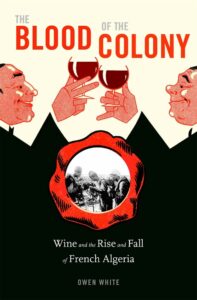
Review – Owen White, The Blood of the Colony: Wine and the Rise and Fall of French Algeria

What should they know of wine, who only wine know? The role of wine in Algerian anticolonialism


12/02/2022

The French colonial project in Algeria (1830-1962) simply reinstated feudalism knowing that the nefarious institution was abolished in France in consequence of the French revolution of 1789. Frances’ prized colony, Algeria, however, provided a second life for feudalism. Hence Owen White’s The Blood of the Colony, which comes at an appropriate time for Algerians, just two years since the popular uprising of February 2019, otherwise known as le Hirak.

Besides being a story of dispossession together with the rise and fall of certain colonial elites, White’s book is a narrative on how postcolonial Algeria was set long before its chronological birth on the highway for dependence. The Blood of the Colony facilitates the reader’s thinking that a cash crop-based economy, much like rentier ones, is a recipe for disaster. But what historians generally fail to seize is how the evil from dependency on one product is not the product itself, but the imposition of the wage labor system where populations are forced to work for this economy or else die.

The book proceeds in the way a song escalates the melody in a slow but eye-opening crescendo. Tracing the story of the wine in the prized French colony of Algeria does not restrict itself into a story of wine only. That reading will not only be flat and unidimensional, but simply erroneous. Instead, and through the rise and fall of wine, readers may capture how primitive accumulation functions.

Substitute oil with wine and the reader is back to square one, White’s colonial account of dispossession, traced through wine.

In other words, the integration of Algeria into the world economy, a policy followed to this day, does not serve the population of Algeria. It facilitates the confiscation of local wealth: its pumping from periphery to the center, that is, from the distant rural districts of the Algerian countryside to Wall Street. That story is brilliantly summarized in the words of the leader of the last armed rebellion of what was back then known indigenous Algerians, Yacoub ben El-Hadj Mohamed, on the occasion of his trial in 1902 and which White quotes. The land appropriations were meant not only as spectacles of brute force. Colonial policies of land appropriation along with the closure of common lands and forests have been capitalistic measures to force Algerians for wage labor.

Karl Marx (1818-1883) specifies that without wage labor capital simply asphyxiates and eventually dies. Indeed, this policy of land appropriation, however anti-emancipatory, have never been reversed, even after regaining political independence in 1962. Shutting off means of independent subsistence is what colonial and postcolonial planners have always excelled in, and executed to the letter. The proletarinization of the people has been the underlying ideology of both colonial and postcolonial Algeria.

The apparent difference, if any, remains an act of spectacle making or what the French brilliantly captures through the expression: faire de cinéma, that is, never of great significance or consequence. How else to explain the country’s endemic dependence on exporting hydrocarbons, and only hydrocarbons, well after sixty years since independence? Substitute oil with wine and the reader is back to square one, White’s colonial account of dispossession, traced through wine.

In addition to an introduction and conclusion, White’s volume makes its argument in seven chapters. Chapter One: “Roots, Antiquity to 1870” discusses how colonists were encouraged less to compete and more to complement the metropole. The early colonial planners sought to diversify farming habits by encouraging the cultivation of cereals. The hunt for profit made this state policy out of touch with reality. The colonial pioneers understood the complementing of the metropole as the strangulation of the colony.

Phylloxera and the Making of the Algerian Vineyard 1870 to 1907” brings to the fore how phylloxera—a disease—that spread in the Midi region in the metropole from the 1850s to 1870s broke the pact between colonial policy makers and large farmers. The disease or the shortage of wine supply it caused made a niche—in fact, not a small market—for Euro-Algerian cultivators. Understandably, the vintners become extremely powerful and instructing them to complement the metropole becomes ever more challenging.

Companies and Cooperatives, Work and Wealth 1907 to 1930” testifies that even when aware that reversing the economic wheel in favor of complementarity cannot be executed, the colonial planners sought to organize the market in the hope of minimizing the nefarious effects from disorganization. What this policy in the end achieved was to help filter big agro-capitalist, vintners, from small-scale farmers.

Algeria and the Midi: the 1930s (I)” illustrates that disputes over access to the French wine market between Euro-Algerian and Metropolitan agricultural capitalists persisted. Through a set of restrictive laws which both knew how to abuse and bypass, the two agro-capitalists resolved problems by enacting policies that shored up their interests and disenfranchised the small wine producers.

Labor Questions: the 1930s (II)” elaborates on how it was only when Algerian indigenous wage laborers’ standards of living entered the picture that the consensus between big wine makers in Algeria revealed its deficiencies. With the activism of members of the French communist party, wine producers started becoming victims of vandalism: large scale uprooting of vine trees at night. In this context, while small owners sought to fix the situation and reform the law in favor of a pay rise, large owners remained manipulative and thought that large-scale mechanization was the way out both to avoid the pay rise and drive the small producers out of the market for good.

Wine in the Wars, 1940 to 1962” shows that WWII brought a standstill to rivalries over labor. Everyone stood behind the metropole in distress. But the end of the war witnessed new challenges in the wine market: heavy mechanization and a drive towards quality wines. Sensing France’s diminishing commitment for maintaining its empire, we read that it is during this period, exactly before War of Independence in 1954 and after its commencement where the big agro-capitalists started relocating to France, Switzerland and even Canada.

Pulling up Roots since 1962” illustrates how the nascent nation-state struggled to cut its umbilical cord with the overall wine culture and industry. The book closes with how the epic story of wine in Algeria ends with a nostalgia. The author follows the fortunes of a chemical engineer in one of the last-functioning colonial winepresses near Oran.

In “Epilogue: The Geometry of Colonization”, White sees the fall of the wine cultivation and industry as ushering in not only the end of colonization as such but its geometry, that is, the ways it claims a second life for the same mode of production bent on fetishizing human beings. For Algeria eventually made it without wine but only through oil, another ‘cash crop’, possibly worse, since oil needs far fewer hands and logistics to handle but itself has far more market value.

Perhaps, White’s fixation on wine makes it harder for readers to trace how oil, ever since independence, has been an existential deterrent and an economic impossibility for whatever project spearheading a truly egalitarian polity in Algeria.

The sources of The Blood of the Colony boasts of audits from banks, French ports entry records, court proceedings, administrative archives. The book comes across as a labor of exceptional dedication and passion. Its reading flies, making it simultaneously an insightful but arduous undertaking. Myself coming from Médéa (south of the Algiers region), large property owners’ names such as the Archbishop Charles Lavigeri, Michel-Louis Pelegri, Saint Germain and Albert Malleval are not uncommon and dominate postcolonial memory.

These agro-capitalists or the powerful vintners literally sucked the blood of my ancestors; their form of primitive accumulation made chattel slavery a blissful experience in comparison. White recalls how Russian convicts serving in Euro-Algerian vineyards around the 1920s observed that wine cultivator’s treatment of indigenous Algerians was worse than “walking cattle”. Still, some of these cultivators were keen enough not to remain stuck for ever in the curse, otherwise known as the wine industry. Soon enough they learnt to adapt and invest elsewhere, and contrary to received wisdom, Algeria’s political independence simply vindicated their plans to go global.

But instead of situating the rise and fall of wine as a class struggle, White goes against his own method and does not crystalize that class dimension. Instead, the uprooting of the vineyards after independence read for him as a nationalist policy spearheaded by the FLN. Similarly, the labor troubles or conflicts he discusses in chapters five and six cannot be reduced into mere labor troubles.

Even if the scale of uprooting vineyards by FLN activists during the war of independence (1954-1962) was limited, its symbolism however specifies that these activists had seized on historical necessity of reversing dispossession through the class dimension, never through identity based politics, be it religious or linguistic. To overlook this class dimension is to perpetuate the conditions of possibility for inequality and dispossession. Unfortunately, this is what happened as the FLN become the shadow of what it used to stand for at its inception. As soon as negotiations for independence became serious, the FLN peeled the insurrectionary rhetoric of the class struggle and wore the nationalistic one.

…the motoring principle that facilitated this equation is wage labor, that is, the proletarinization of large swathes of the Algerian population during the conquest period (1830 to 1880s).

Perhaps, White’s fixation on wine makes it harder for readers to trace how oil, ever since independence, has been an existential deterrent and an economic impossibility for whatever project spearheading a truly egalitarian polity in Algeria. Reading wine, oil, gold or les terres rares (there are estimates that Algeria boasts of solid reserves in the latter) less phenomenologically exacerbates the alienation of the subaltern, their permanent status outside history.

It is true that vine cultures had been behind so much misery, and that is why the duality of rise and fall is never adequate as an analytic matrix (as the author himself testifies in the introduction). Still, the motoring principle that facilitated this equation is wage labor, that is, the proletarinization of large swathes of the Algerian population during the conquest period (1830 to 1880s). Disenfranchised Algerians could not survive without selling their labor, a process which oil and gas has only intensified, never reversed. Hence, the story of wine or oil cannot be a story of wine or oil only.

The Blood of the Colony helps interested readers and today’s democracy activists to see how Algeria was set on the political economy designed to keep it dependent on a single cash product which in the late nineteenth century and the beginning of the twentieth was wine, and which soon after independence become oil. More than serving the root for de-growth and underdevelopment, dependency on one export simply fetishizes man as laborer.

White, Owen. 2021.

The Blood of the Colony: Wine and the Rise and Fall of French Algeria.

Harvard University Press. HARDCOVER: $39.95 • £31.95 • €36.00; ISBN 9780674248441; pp. 336.

Reviewer: Fouad Mami,

Department of English

Université Ahmed Draia, Adrar (Algeria)