The Left Berlin News & Comment

This is the archive template

Election Results and Structural Fraud in Ecuador

We call on social movements and left-wing parties in Germany to denounce the serious disruption of the democratic order in Ecuador

From the Bloque Latinoamericano Berlin, we join the voices denouncing the structural fraud in the electoral process in Ecuador. This is not just a matter of manipulating the vote count in favour of Daniel Noboa, but of an election that took place under an authoritarian regime with anti-democratic practices: from the illegal candidacy of the president to the state of emergency on the eve of the second round. In light of this fraudulent and militarised situation, we demand that legal channels be opened for an independent investigation into the violations of the Code of Democracy that affected the electoral process as a whole, and we support the request for an audit of the National Electoral Council’s computer system.

What happened in the second round?

The 2025 electoral process in Ecuador took place in a context of heightened violence, fear-mongering, and anti-democratic attacks by the government of Daniel Noboa, who did not even request leave from office to run for president. In the first round on February 9th, the gap between Noboa (44.17%) and Luisa González (44%), the candidate of the Citizens’ Revolution (Revolución Ciudadana), was only 0.17%. Leonidas Iza, the Pachakutik candidate, came in third with 5.25% of the vote. Between the first and second rounds on April 13th, the Citizens’ Revolution and Pachakutik, together with left-wing movements, signed a historic agreement with 25 programme points to support González’s candidacy and committed themselves to promoting a process of national unity. All 13 polls, including those conducted by the ruling party, indicated that González was leading the race.

Given these circumstances, the result announced by the National Electoral Council on April 13th came as a surprise to everyone. Noboa was declared the winner with 55.63% of the vote, ahead of González’s 44.37%. The difference of more than 10 points seems implausible in a contest that, although close, never showed such a large gap. González did not accept the result: “The Citizen Revolution has always recognised defeat when the statistics have shown it. (…) We are going to ask for a recount and for the ballot boxes to be opened. (…) The country is facing the biggest and most grotesque fraud that we Ecuadorians have ever witnessed.”

The Citizen Revolution-Challenge alliance filed challenges to nearly 2,000 ballot papers showing numerical and signature inconsistencies. However, at its session on April 24th, the CNE dismissed these challenges and proclaimed the results of the second round, confirming Noboa as the winner. From this date, political organisations have two days to appeal this decision and three more days to file appeals with the Contentious Electoral Tribunal.

As popular movements that raise the banner of truth and justice, we know that the legal battle will be arduous and exhausting, but we must fight with all the tools at our disposal and on all fronts.

An undemocratic, fraudulent and irregular electoral process

The movements that make up the popular camp inside and outside Ecuador have received the CNE’s election results with great concern, alertness, and open questions. We already knew that the playing field was uneven, as the race did not take place under even the most minimal democratic conditions. However, we may have erred in not emphasising even more in our previous analyses the profoundly anti-democratic implications of the electoral and criminal violations, alongside the escalation of persecution, intimidation, and dirty campaigning by Noboa’s extreme right-wing regime. It was a process riddled with irregularities from start to finish, ones that violated both the Constitution and the Code of Democracy. These violations were possible because the authoritarian regime has co-opted all the bodies that, in theory, should be autonomous and independent, mainly the Attorney General’s Office, the Constitutional Court, the Electoral Court and the National Electoral Council.

The American Association of Jurists concludes that “the elections held under these conditions must be considered a structurally fraudulent process” due to the misuse of executive power, violations of constitutional and electoral regulations, the undue concentration of power and violations of international law, irregularities and manipulation during and after the process, as well as statistical anomalies. It is the electoral process as a whole, lacking democratic guarantees, that various organisations and movements, including ours, are denouncing as structural fraud in Ecuador.

Let us name some of the scandalous irregularities: Noboa could never have been a ‘president-candidate’, a legal aberration; he should have requested leave and appointed the elected vice-president, Verónica Abad. Not only did this procedure not take place, but the Electoral Court sanctioned Abad with the suspension of her political rights. This sanction was the culmination of the political persecution against Abad unleashed by Noboa in 2023. During the campaign, Noboa made illegal and illegitimate use of huge amounts of public resources, both to issue bonds for patronage purposes and to hire international artists and mercenaries such as Erik Prince, founder of the US paramilitary company Blackwater (which participates in wars around the world, such as in Iraq and Afghanistan), for his campaign.

The privatisation of the iron fist. Erik Prince in operation with 650 military and police officers to raid homes (Photo: Gerardo Menoscal / AFP)

The regime deliberately obstructed the exercise of political rights by the population in the provinces where the Citizen Revolution won in the first round, slowing down the issuance of identity cards during the election period and escalating the violation of rights on the eve of the second round. On April 12th, Noboa declared the ninth state of emergency of his term across five provinces on the coast (Guayas, Los Ríos, Manabí, Santa Elena and El Oro), two provinces in the Amazon region (Orellana and Sucumbíos), in a canton that is the epicentre of the anti-mining struggle (Camilo Ponce Enríquez in the province of Azuay), in Quito, in two other cantons, and in all prisons. This authoritarian executive order suspends citizens’ constitutional rights and guarantees for 60 days, such as freedom of assembly and movement, as well as the inviolability of the home and correspondence.

In turn, the civil-military regime imposed a curfew in 22 cities between 10 p.m. and 5 a.m. Polling stations were changed at the last minute or closed prematurely. Ecuadorians living in Venezuela were banned from voting. In preparation for the second round, at the request of Noboa, the National Electoral Council implemented a controversial ban on voters photographing their ballots under penalty of a fine, thus restricting individual freedoms. As a result, the personal data of many citizens who used their mobile phones in the voting booth were recorded on lists. There are reports of intimidation by military personnel who threatened those who used their phones for audiovisual recording anywhere on the premises, particularly delegates from accredited political organisations monitoring the election.

Irregularities have been reported in all phases of the counting process, from the counting at the polling stations to the digitisation centres. For example, many counting reports arrived without the signatures of the members of the polling station and the delegates of the political organisations present. In addition, the preliminary report of the Electoral Observation Mission of the Organisation of American States states that “at the time of closing and counting, both in overseas voting and in the national territory, the Mission observed that problems were encountered because the ink used to mark the ballots transferred between political options when they were folded, due to the symmetry of the design. This situation caused confusion in the interpretation of the vote and, in some cases, led to its annulment”. The statistical anomalies in provinces where González not only failed to gain votes but lost large numbers of votes between the first and second rounds are highly suspicious. The list of irregularities continues to grow day by day and has been documented and substantiated by various organisations.

We also denounce the intensification of political persecution following the April 13th elections. The repressive forces of the State and the immigration authorities have received lists with the names and photos of militants of the Citizen Revolution, members of social movements and alternative media outlets. The systematic attacks by the right wing against leaders of the plurinational-popular camp, such as Leonidas Iza, keep us on alert. We call on the international community to be vigilant in the face of the radicalisation of a civil-military regime that is using the most sinister practices derived from the doctrine of the internal enemy.

Fraud that matters, fraud that doesn’t…

All these irregularities during the electoral process are not isolated cases or decisions taken by the executive and other state functions in an accidental and unpremeditated manner, but rather respond to intertwined strategies to destabilise democracy, attack progressive and left-wing forces and violate the political and social rights of the population as a whole.

In the analysis we published prior to the elections, we emphasised the structural reasons and oligarchic interests at stake in the escalation of narco-violence in Ecuador. We also argued why the Agreement for Life between the Citizen Revolution and Pachakutik seemed to us to be the correct response in the run-up to the second round. However, we failed to highlight more explicitly that this was not a normal election between candidates from different political sides, but rather an authoritarian and structurally flawed electoral process. In this sense, the election, beyond being between the candidate of the progressive left and the right-wing drug trafficker-president, was an election between democracy and authoritarianism. What is at stake is the possibility of rebuilding democratic minimums or deepening the free fall towards authoritarianism with fascist practices carried out by Noboa.

The playing field has always been tilted in favour of the economic and political interests of the current regime, and the fraudulent electoral process is a dangerous sign of the consolidation of increasingly authoritarian power in the government. Just as there was no respect for human rights or democratic guarantees for the four Afro-Ecuadorian children murdered by the state in Guayaquil, there are no democratic guarantees for the entire Ecuadorian people to decide who will govern their country for the next four years. We are thus facing a breakdown of the rule of law in Ecuador that has reached a climax with the current structural fraud.

This scandal adds to the worrying setback of the rights fought for and won by workers and the plurinational-popular movements in the countryside, to neoliberal policies of hunger and terror, to the militarisation of impoverished neighbourhoods and to the obscene enrichment of the oligarchy, not despite but thanks to the growing level of violence that it has itself caused in order to profit from drug trafficking and illicit economies.

But since Ecuador is not Venezuela, the international community seems unconcerned about considering Noboa’s government illegitimate and imposing sanctions on Ecuador for electoral fraud. There are allegations of fraud that matter to the international right-wing narrative in order to reaffirm its condemnation of any government not allied with imperialism; and there is fraud that goes unnoticed because it allows Latin America to remain the Yankees’ backyard. Today’s Ecuador is no longer just the backyard, but has been turned into a sacrifice zone where techniques of militarised social control, repression of dissident voices, and annihilation of bodies considered disposable are being experimented with at an unprecedented speed. The necropolitical state murders impoverished children, while the oligarchy sells out the country and the global ruling classes accumulate wealth.

Where are the ‘democrats’ of the world who tore their clothes demanding that the polls be opened in Venezuela? The only leaders who have not recognised the results of the elections in Ecuador have been Gustavo Petro in Colombia, claiming that “there are no free elections under a state of siege”,’ and Claudia Sheinbaum in Mexico, who described the results as “dubious”, reaffirming that she will not resume relations with Ecuador after the unprecedented assault by police and military forces on the Mexican embassy in Quito in April 2024.

Who said all is lost?

As part of the popular forces and the Latin American diaspora in Germany, as internationalists, we denounce the irregularities that occurred during the electoral process in Ecuador, just as we have previously denounced the systematic violation of rights under Noboa’s neoliberal regime of death. We urgently call on social movements and left-wing parties in Germany to denounce the serious disruption of the democratic order in Ecuador.

We call for the continued building of left-wing political organisations and social movements that can respond to the most urgent needs of the Ecuadorian people now and in the future. In the face of Noboa’s narco-state policies, which are tearing apart the social fabric, the response is and will always be popular organisation and compassion, in order to build and dream of an Ecuador where children’s lives are not at risk, where the land, water and dignity are not plundered.

As a migrant organisation in Germany, we are committed to consolidating our political community, which is active in solidarity with what is happening on the other side of the Atlantic. Together with sister collectives such as SoliSur, we have organised a series of political and cultural meetings to collectively analyse the situation in Ecuador and to accompany each other as a community in these difficult times. We invite you to join us in our spaces to continue fighting together for a better future for Ecuador.10

We embrace our Ecuadorian brothers and sisters in this difficult time and stand in solidarity with their pain. Hope is a fire that is difficult to extinguish, but our peoples have known how to resist centuries of horror, dictatorships, genocide and cipayos. Against Noboa and his regime of terror, we will also resist!

Let us fan the flames of hope, of hard-baked clay, of the soul of the green hills, of the light and blood of our people, of the sun of our ancestors.

Sign up for the Latin American Bloc newsletter at this link, and follow SoliSur on YouTube here.

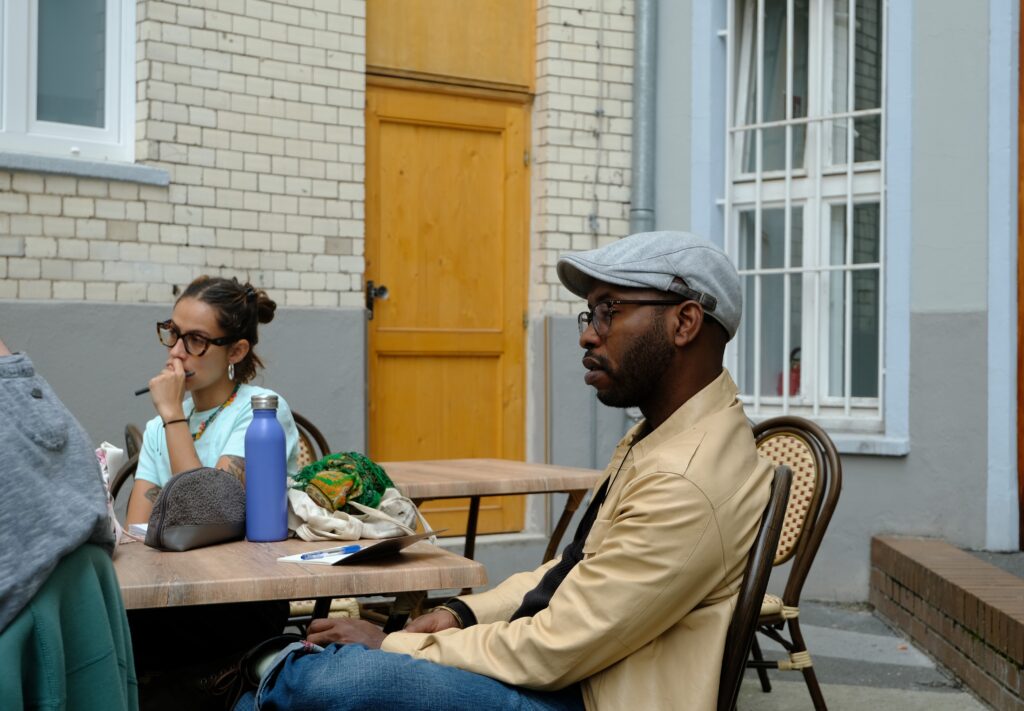
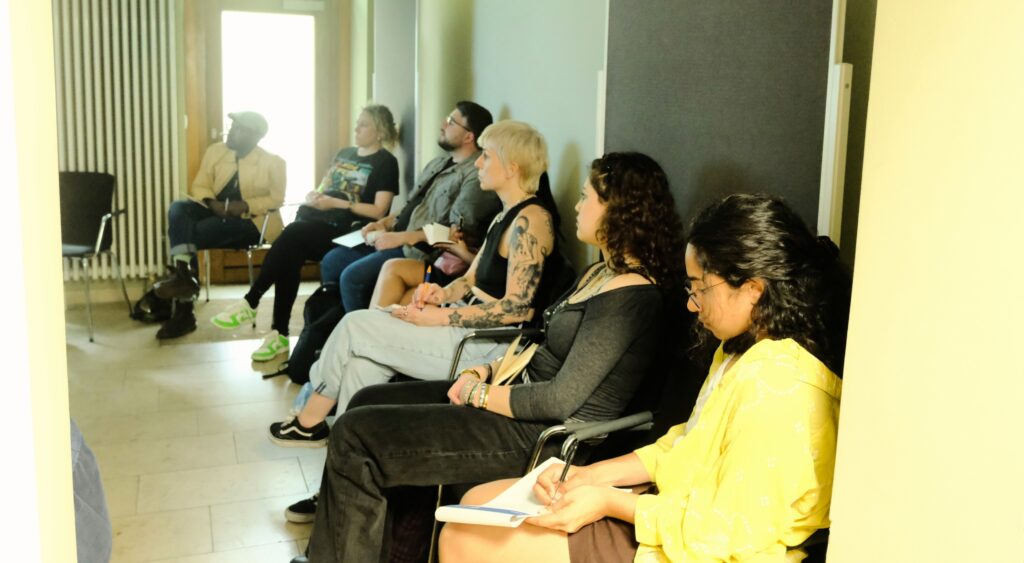
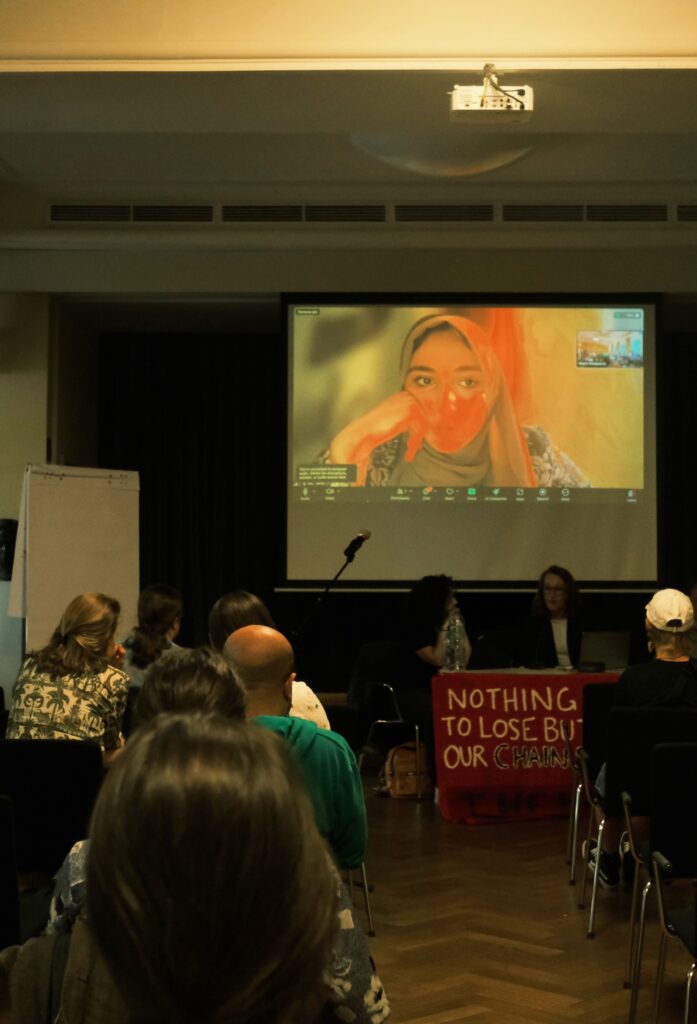
Cultural gathering for hope, Casa Popular Marielle Franco, Berlin (13 April 2025)

This article originally appeared in Spanish on the Bloque Latinoamericano website. Translation: Roser Gari Perez, Reproduced with permission.

Video Gallery – That was Palivision 2

K19, Berlin, May 17th 2025

Photo Gallery – That was Palivision 2

K19, Berlin, May 17th 2025

What’s it Like to be Disabled in Trump’s America and Why We Can’t Stay

Ella and Yarr on surviving disability and dwindling access to affordable healthcare in America.


19/05/2025

What’s it like for my partner and I, as two Autistic/ADHD people in Trump’s America? It’s overwhelming, to say the least. 

We have been forced to witness the rise of MAGA, an administration that we did not vote into office. They claim they want to “Make America Great Again,” but it’s clear they only wish to do that for a certain group of people. They have won on a campaign of hate, and now the quiet parts are being said aloud. U.S. Immigration and Customs Enforcement (ICE) is unleashed. Due process (the constitutional right to fair legal procedures) is now ignored, and US-born citizens are being mistakenly detained. Now there are even threats of sending citizens to camps in El Salvador. The dehumanization is accelerating and it’s terrifying.

It feels like a nightmare we are not waking up from.

We’re watching billionaires such as Elon Musk, who has donated $250 million to MAGA, gain governmental power without being elected. He heads a newly formed department, Department of Government Efficiency (DOGE), with access to our data. The justification? Cutting “wasteful spending”. However, it looks more like they are targeting our lifelines, programs such as Medicaid, to line their own pockets. These aren’t handouts. We have paid into these systems with our taxes and now they want to strip us of those benefits.

Like many disabled folks in America, I rely on Medicaid to survive. Medicaid is a public health program in the United States for people with low income, old age, or disabilities. Without it, I would not be able to afford the care needed for managing my Autism, ADHD, chronic illnesses, and a heart condition that requires regular medication and monitoring. The private healthcare system here is expensive and even if you are insured through the Affordable Care Act (ACA), the out-of-pocket costs can be astronomical. Doctor’s visits, lab work, and specialist care can come with high copays or deductibles, making consistent treatment out of reach for many. A single ER visit can bankrupt a person. It’s very common to find people turning to crowdfunding platforms, such as GoFundMe, just to pay medical bills. The barriers to access affordable healthcare reflect a broken system.

Medicaid is the only reason I can afford the care that keeps me alive, but qualifying for it comes with strings attached. Disabled folks are expected to survive under impossible restrictions such as: strict asset limits, income caps, the crushing costs of healthcare, and rapidly rising costs of living. For example, Medicaid recipients can’t have more than $2,000 in savings or they risk losing their coverage. That means you can’t plan for emergencies or try to build a financial cushion. We’re forced into a poverty wage, choosing between healthcare and financial stability. It’s a system that almost seems intentionally designed to keep folks trapped in poverty. 

To make matters worse, healthcare in the United States is often tied to employment, but not all jobs provide benefits. Many folks, especially disabled people, end up in service jobs, gig work, or part-time roles that don’t offer health insurance at all. Even if you can work, the jobs available are often physically or mentally unsustainable, and still leave you without coverage. It’s a system that feels deliberately hostile towards folks like me.

Now, with Medicaid programs being quietly dismantled in multiple states and right-wing politicians threatening it on a national level, I am left wondering: what happens to us? There is no backup plan. No safety net. If Medicaid is taken away, I’ll likely go without treatment, which could lead to hospitalization, or worse. 

For many disabled folks, losing Medicaid means losing access to vital medication, treatments, and in-home support services. Without it, managing chronic conditions, staying employed, or even handling daily tasks can become increasingly difficult. Some may even be evicted when they can no longer work. Others drain their savings on out-of-pocket medical costs and fall behind on rent, being forced to choose between medication or shelter.

As a result, loss of care can lead directly to homelessness. Many end up in shelters or on the streets. Others are institutionalized or pushed into unsafe and exploitative living situations to survive. Without stable access to healthcare, housing, and basic support, the issue isn’t just about quality of life, it’s about staying alive.

Then there’s Robert F. Kennedy Jr., appointed Secretary of Health and Human Services despite spreading dangerous rhetoric about autistic people. For instance, during an April 2025 press conference, he claimed:

“Autism destroys families, and more importantly, it destroys our greatest resource, which is our children. These are children who should not be suffering like this,” he said. “These are kids who will never pay taxes. They’ll never hold a job. They’ll never play baseball. They’ll never write a poem. They’ll never go out on a date. Many of them will never use a toilet unassisted.”

This statement was widely reported and met with significant backlash from the autistic community and advocates who recognize the diverse capabilities and contributions of individuals on the autism spectrum. Robert’s claims are not only dehumanizing and an echo to a dark history, but one rooted in eugenics. One I never thought I would see repeat itself within my lifetime.

The signs are crystal clear. What we have shared in this article, is but a scratch on the surface to the atrocities happening in America right now. I am truly scared for us.

We’ve reached our breaking point. We’re not fleeing out of weakness. We’re leaving for survival. We are seeking safety, dignity, and a chance to thrive.

As if all that weren’t enough, each day is filled with headlines that make it harder to believe in any future here. One recent incident in particular stood out to me: A white woman named Shiloh Hendrix in Rochester, Minnesota was captured on video in a playground using a racial slur against a 5-year-old Black autistic child. When confronted by bystanders, she not only admitted to using the slur but kept repeating it several times trying to justify her actions by accusing the child of going through her toddler’s diaper bag.

After the video went viral, Hendrix launched a fundraiser on the Christian crowdfunding platform, GiveSendGo, claiming she and her family were receiving threats and needed to relocate. Her campaign has raised more than $750,000. Many of the donations were accompanied by openly racist comments, enough to cause the platform to disable the comment section.

This is a chilling reminder of what marginalized communities face in this country and how hate not only spreads, but is often rewarded. It’s a reflection not just of individuals, but of a society that increasingly shows us who it protects, and who it leaves behind. A reality that seems to be mirrored by our current government.

If someone like her can raise over $750,000 fueled by hate, surely an autistic couple simply asking for a chance at safety and stability can reach our goal too — right?

My partner and I are trying to relocate to a country where we can live with basic dignity. Where the system we contribute to offers us a future. Although we have worked hard and have advanced degrees, in America, they don’t guarantee stability. Our disabilities are invisible, but the barriers we face are not. We have been locked out of opportunities because of ableist systems and lack of accommodations. There is no American Dream left for us here.

From our research, I really believe Germany can offer this to us. Plus, this will be a familiar place to me. I spent my youth in Germany while my dad was stationed overseas. Germany offers national healthcare, protections for disabled residents, and a path for self-employed creatives like me to legally work and contribute. It’s not perfect, but it offers stability and structure we simply can’t find here. We’ve researched Germany’s freelance visa and disability rights laws, and this path is both legally viable and humane. Our country appears to be slipping into authoritarianism, and we’ve given up. In order to survive, we need to leave.

Thank you for reading our story,

Elle and Yarr

Elle and Yarr are trying to relocate to Germany and are raising funds to do so. The amount will cover relocation costs, visa fees, healthcare, start-up housing, and the legal and logistical steps required to move two people and two cats abroad safely. You can donate or share here.

Is This Fascism? For Palestine, Yes

Not all repression is fascism, but this is

Editor’s Note: This article is a response to ‘Is This Fascism? Not Yet’ by Nathaniel Flakin. Read Nathaniel’s side here.

”First they came..”. is one of the most quoted poems expressing the need to fight fascism and injustice. It was written no earlier than 1946, only after Nazi defeat, by German pastor Martin Niemöller who was a Nazi supporter and an antisemite:

First they came for the socialists, and I did not speak out—because I was not a socialist.

Then they came for the trade unionists, and I did not speak out—because I was not a trade unionist.

Then they came for the Jews, and I did not speak out—because I was not a Jew.

Then they came for me—and there was no one left to speak for me.

The poem highlights that fascism doesn’t suddenly arrive—it happens in steps and that those enabling it recognize it after its total success or perhaps only after its crushing failure.

When I read the article entitled “Is This Fascism? Not Yet” by Nathaniel Flakin, I was dumbfounded by the early conclusion, ‘‘Not Yet’’. Many I spoke to who are in constant confrontation with the German state vehemently disagreed as well. The ‘‘Not Yet’’ part of the article’s title seems to apply only to some of the people in the ‘‘Then they came for…” parts of the poem. It is as though we’re midway through the poem but the people at the outset still don’t seem to recognize it.

People use the term fascism because that’s how life feels here in Germany. For many, it comes from their experiences that match the popular imaginary of what fascism is.

It would be a mistake to undermine that popular imaginary. Indeed there can be no doubt, even to an external observer, that Germany is continuing on that path. The word ‘‘fascism’’ has been established as an incontrovertible evil, and people use it to warn about the trajectory of the continued inaction in the face of illiberal performative democracies or the support of ‘‘fascist’’ measures and rhetoric—even in the absence of blatantly fascist parties.

Throughout history, the making of a fascist regime is rarely labeled as fascism. The naming and framing of a regime as fascist becomes recognizable after the success of their policies, which is the same fundamental error in Flakin’s piece.

In Germany today, we may not have the dictatorship and totalitarianism that the term fascism is historically linked to, but we have a great majority of the accompanying symptoms of fascism, which include support for a single view on some topics, demonization of minorities, glorification of violence, weak institutions, and rampant racism. But what’s more, we have a government building more repressive tools. These are conditions not dissimilar to Germany leading up to 1932.

Fascism is not some remote historical narrative. It continues to manifest itself in different ways adapting to the context in which it seeks to rise. Its newer forms have similar effects on people. Indeed, perhaps this reputation of evil is one of the reasons why fascism today isn’t pursued as explicitly as it was before and is shrouded by electoral shams and diversions only to prove that it is not that evil term ‘‘fascism’’.

Fascism for Palestine

Then they came for the trade unionists’’

… but what happens when the Trade Unions come for you?

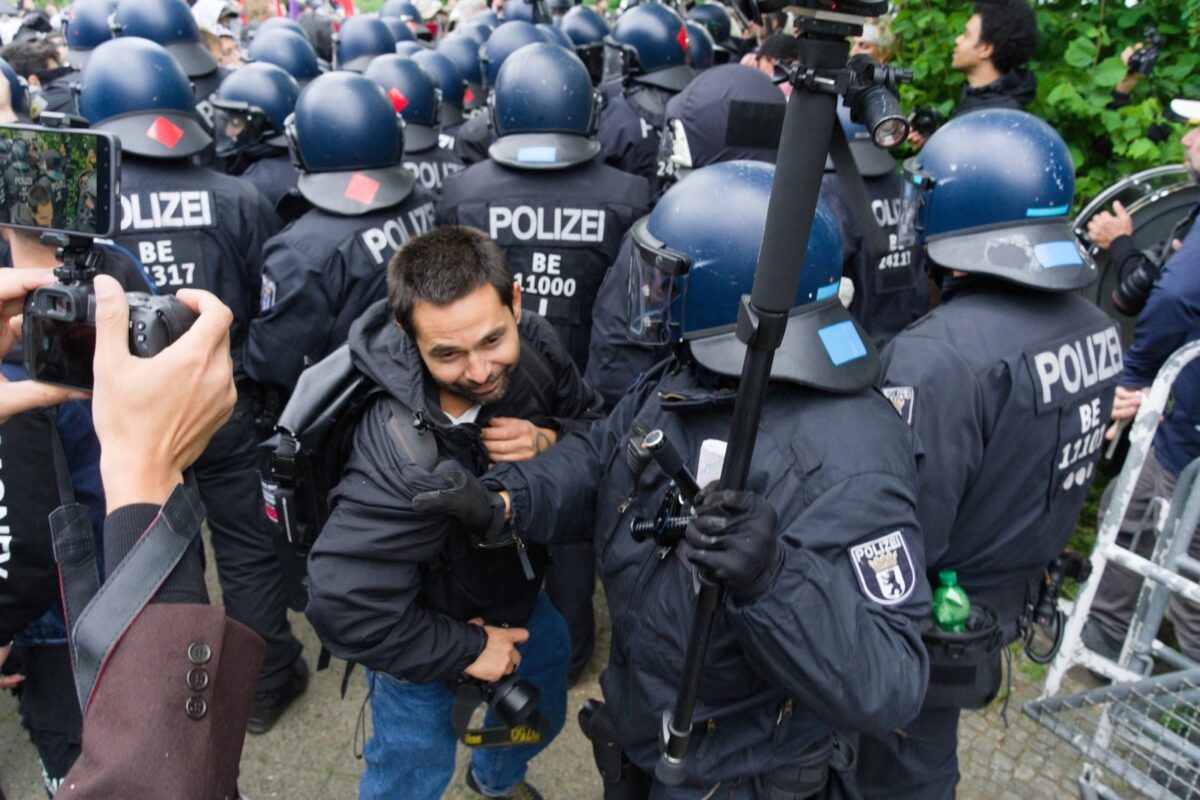
On 22 February 2025, Verdi, one of Germany’s biggest unions, organized a protest called Unkürzbar, aimed at resisting cultural funding cuts. Paradoxically, Verdi banned using the word Widerstand (resist) in chants and speeches. The star speaker, one of the directors of a cultural center called Oyoun, was denied the platform to give their speech midway through the march despite Oyoun being one of the first cultural spaces to bear the brunt ideologically motivated funding cuts. The Palestine block, also protesting the crackdown on cultural spaces, was berated and isolated. Verdi organizers in red and yellow vests, acting as civilian enforcers, kettled protesters till the police stepped in to inflict their repressive measures.

Flakin’s article says, “Yet despite their bureaucratic leaderships, unions still form a foundation of working-class power, and a potential starting point for real struggles.”

Fascism aims to destroy unions by diminishing them as a starting point for real struggles. Hasn’t this already happened concerning Palestine? Isn’t the banning of the word ‘Widerstand’ a worrying sign for any union that would embrace a struggle? This is not the only instance in which Verdi has supported Staatsräson over basic rights. Likewise, many organizations in Germany do not dare to organize for Gaza without being punished by the state’s repressive apparatus.

There have been many definitions of fascism from Mussolini and Trotsky’s to Robert Paxton and Umberto Eco. Within these we see traits relating to the state’s behavior and deviation from democratic norms.

Fascism in today’s reality transcends these definitions. It has become the concerted effort to enforce an exclusive, nationalist state narrative with all of the state’s instruments working in unison, limiting rights and access to justice only to those who subscribe to this narrative, while forcefully subjugating the ability to mobilize for those offering a legitimate counter narrative and framing them as enemies.

Germany’s interpretation of Staatsräson as unconditional solidarity with Israel is an outright expression of German nationalism as a proxy to Israeli ethno-nationalist fascism. It serves to undermine the rule of law and justify the suspension of civil liberties to protect the far Right Israeli government from criticism as they perpetrate a genocide.

Under the auspices of Staatsräson, people advocating for Palestine have experienced the vilification of individuals and groups with smear campaigns that dehumanize them as antisemitic terrorists; deportations of not just Palestinians but those who attempt to stand in solidarity with Palestinian rights; laws for exmatriculation to expel students out of universities; an archive of cancelling and silence to end the livelihood of individuals and organizations; a trade union against Palestinian civil liberties; targeted police violence; unified media propaganda denouncing protests, denouncing events, denouncing artwork without proof; police presence in universities exercising violence and excessive force; political interference in universities overriding university officials; police intimidation of venues that host high profile events on Palestine; crackdown on representing Palestinian voices in public spheres; a crackdown on cultural and academic institutions that would foster debate; lack of due process; house raids; restriction of right to protest; surveillance; device seizure; police carrying orders instead of implementing the law; banning of speaking certain languages; censorship of symbols and slogans; suspension of other civil liberties that include freedom of movement, the right to be free from bodily harm…

…this is not ‘normal’ capitalist repression, this is fascism.

On the foreign front, Germany is adamantly supporting weapons for a genocide in defiance of human rights, international law as well as EU and German law. The German government and their aligned media have offered justifications for breaching international law, bombing schools and hospitals, and the dehumanization of thousands of men, women and children, with implicit and explicit approval of bombing hospitals, killing paramedics, sniping children, forced displacement, starvation and targeting journalists.

But there are many parties and it’s not that violent, so how can it be fascism?

A fascist state traditionally does not allow for plurality of parties, but would we exclude calling a state fascists if the plethora of parties agree on fascist policies? In Germany all the ruling parties are genocide supporters, and the majority of parties that may object to the mass killings are at best genocide deniers. There is no electoral route to change the state’s suspension of civil liberties for Palestine supporters, nor to end the co-perpetration of genocide. There is no possible electoral pathway to end the dehumanization of Palestinians in Germany.

It may be argued that the levels of violence and repression are not as high as they have been historically when fascism emerges, but there are two issues to point out. First, fascism does not need to be very violent if there is not enough resistance, and indeed, there is not enough resistance within German society and institutions to warrant more violence as long as repression is successful. With a high trust in German institutions, their failures are accepted by society, and therefore, there is no need to repress society using violence. Out of European countries, the levels of mistrust of the police in Germany are the lowest. They do not need to exert their ideology with violence, nor justify it when it happens. Any lie they make up will suffice. Having been completely vilified in both state-owned and private media, social media can be seen flooded with the word ‘Deport’ in response to police violence videos against the Palestine solidarity movement.

Second, it’s simply not the intensity of violence as much as the quality of violence. German police are perhaps not as violent as French, Greek, or Italian police, but they are ideologically motivated, selective, and almost consistent in how they apply violence. Police violence alone does not constitute a fascist state, nor a police state for that matter, but the underlying reasons do. People use the term police state to describe Germany, and I don’t contend that. Not because I agree that violence is what makes a police state, but that the description is correct even if the reasoning is not. The practice of making up rules to inflict bodily harm, setting up laws to grant impunity to law enforcement personnel, surveilling and pressuring venues and institutions to cancel events and talks, threatening venues like Kühlhaus, Jungewelt and BUM with permanent closure, raids on activists and notices to forbid them from joining protests—all these are more in line with the police state than the quality of violence, and indeed more aligned with fascist tactics.

Weakened institutions and organizations

The other sign of fascism is the failure of institutions to fight an onslaught of racism. It’s not just Verdi, but many German institutions and organizations charged with fighting authoritarian tendencies that have failed Palestine in the simplest of tests. The Deutsche Presserat has failed to protect journalism and fight the dehumanization of Palestinians and Palestine supporters, the German chapters of Amnesty and Reporters Without Borders (Reporter Ohne Grenzen) have failed to live up to their international mandate. Reporter Ohne Grenzen have echoed the rhetoric and sentiments of the German state when it came to reporting about press freedoms, and Amnesty Deutschland stood by for months and months as protesters’ civil liberties were significantly infringed on systemically and systematically.

Even the courts are starting to fail civilians in terms of acquiring justice or even making sense. We are seeing politicized verdicts such as condemning ‘‘have we not learned anything from the holocaust?’’ as relativizing the holocaust while people chanting Nazi slogans are acquitted.

Is partial fascism not fascism?

Fascism is not a switch, and once it’s turned on, all forms of resistance become futile; it’s a process that is crowned by the success of a fascist regime. If it were true that fascism does not allow any resistance, then what is the point of anti-fascism if fascism doesn’t exist till it becomes totalitarian? We cannot refrain from calling the process of building a fascist state fascism simply because multiple parties exist, judiciary is not yet fully coopted and a cult figure has not yet appeared. Germany is a dormant fascist state that is currently being activated.

The mechanisms used to repress Palestine solidarity such as the resolution on Jewish life (Nie wieder ist jetzt—jüdisches Leben in Deutschland schützen), deportations and exmatriculation will be used to repress whatever opposition comes next, whether it’s climate activists (already bearing the brunt of this), or other minorities not aligned with conservative values.

One of the reasons that upset people I spoke to about Flakin’s piece is that it undermines their experience and resorts to definitions that have an outdated context. The people living through Germany’s policies are experiencing a suspension of their civil liberties and a breakdown of laws, organizations, and institutions in place to help alleviate injustices. To them, there is only one party in Germany: it’s the pro-Israel party. All the papers and media might as well be just one, demonizing and dehumanizing Palestinians and protesters. How can we tell people who have been subjected to immense racism, raided every other month, and deprived of their right to assembly, speech, and believe that this is not fascism?

But perhaps it only becomes fascism when it starts happening to you.

Maybe in hindsight, the success of this trajectory would be called something else by academics and historians, but does it really matter that people call it fascism as it presents all the same symptoms? Calling it fascism now helps us understand what we’re up against. The process of looking into what is not fascist to prove that it is not fascist is not a useful exercise.

Nevertheless, whether we call it fascism or not, there is a need to fight harder in order to prevent fascist success. Perhaps being in the middle of the poem, you may not want to call it fascism yet because of performative electoral politics. But in the process of visiting the experiences of those in the Palestine Solidarity movement one thing is certain: it’s more fascist than most think.