The Left Berlin News & Comment

This is the archive template

Grab your pen, buddy, German socialist culture needs you!

A visit to the Beeskow Art Archive


19/09/2022

In late August I visited the Beeskow Art Archive as part of a €9 day trip organised by Left Berlin. The Beeskow Art Archive preserves an extraordinary range of artistic production from the GDR; from huge mural-like panel paintings, bronze busts, still lives, to student projects, photography and ceramics. Both the collection, and how the archive was created gives us an insight into the role and conception of the culture and art of GDR, as well as bringing up the question of public ownership of material that was produced under a state system of patronage that no longer exists.

So what did cultural policy look like in the GDR? A look back at the Bitterfelder Weg conference of 1959 which introduced a new program of the socialist cultural policy in the GDR, can help reveal the origins of prevalence of public art as well as the role of art in Alltagskultur (everyday life culture). The conference was organised to look at how working people could be given access to art and culture, overcoming the “existing separation of art and life” through getting the working class more involved in the cultural project of socialism. Walter Ulbricht, the head of the SED party, initiated the slogan “Greif zur Feder, Kumpel, die sozialistische deutsche Nationalkultur braucht dich!” or, “Grab your pen, buddy, German socialist culture needs you!” This program attempted to place artists and writers in factories and other sites of mass production, to support workers in artist activity.

This in some ways mirrors the Worker Photography Movement which went against a representative mode of photographing working class movements, instead locating artistic production as part of or in aid of struggle. In the 1970s revival of Worker Photographer in London by photographer Terry Dennett, where he poses the distinction between, ‘workers’ photography, those movements in which Socialists and ordinary people have played an active and formative role, and the various bourgeois controlled practices which we have termed photography for the workers.

However, the Bittefelder Weg was soon abandoned, and in April 1964, cultures were instead given the task of promoting political education in socialist consciousness and key figures in socialism. Much of this was funded by the GDR Kulturfonds, a fund founded by FDGB, the Kulturbund, and the Department of Public Education, which acted as the commissioning body for most of the works that are housed in Beeskow Art Archive. A month before reunification, Herbert Schrimer, the final minister of Culture of the GDR and Walter Patig, the last director of DDR Kulturfonds formed a new foundation whose aim was to continue the public access to works funded by the Kulturfonds.

At this time the artworks were dispersed all over the GDR in the institution that they were commissioned for. After reunification those institutions would no longer exist, so a separate organisation that would continue after reunification was needed. Florentiner Nadolny, the director of the Archive, reminded us that there is no public art collection in West Germany that houses artists from the GDR. This ambivalence of GDR cultural heritage since reunification is only starting to change after a generational gap.

Up until the last five years or so, GDR cultural production was seen as socialist kitsch rather than serious artist work. Two current exhibitions that are helping shift this change in perspective are Kunstraum in Berlin, current exhibition Worin unsere Stärke besteht: Fünfzig Künstlerinnen aus der GDR, showcases the work of fifty women artists from GDR, and Künstlerinnen. Fotografien von Sibylle Fendt, which is housed within the Beeskow Art Archive.

As part of the visit we were given an excellent tour around the collection by Florentiner Nadolny ( which you can book here). Many of the brief insights in this article were inspired by Florentiner’s deep knowledge of the collection and I highly recommend it. I want to highlight a number of pieces from the tour which showed the breadth of aesthetics in GDR commissioned art despite a very much regulated system of state patronage, as well as how art permeated much of public and everyday life in the GDR. We were unable to take pictures in the Archive, so I have managed to source some pictures to give you a glimpse of the works.

There was so much interesting work to write about but I could not include them all, other artists that were of particular note on the tour were: Norbert Wagenbrett, Sibylle Fendt, Kostas Sissis, and Sabina Grzimek.

The fee for the commission was for around twenty-five thousand East German Marks which was the equivalent to around a year’s wages for an artist in the GDR… Although application to the professional organisation was highly controlled, once a member they ensured that cultural workers were properly paid and the art that became part of the state and mass institutions.
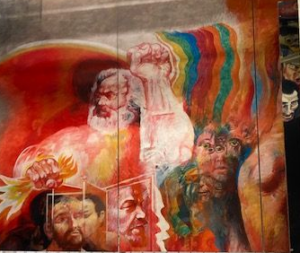
Top right panel of Proletarier aller Länder, vereinigt euch! (Workers of the World, Unite!)

When entering the archive in Beeskow the room is full of grey metal plan chests full of drawings, prints and photographs. Above them hangs a huge painting, Aus dem Leben Ernst Thälmann (From the life of Ernst Thälmann) by Christian Heinze, which was commissioned in the early 1980s to be hung in the mensa of Free German Trade Union Federation (FDGB). A communal table in the centre of the canvas shows people from the GDR living a common life, above them a crowd of people and at the centre Ernst Thälmann, former leader of the Communist Party of Germany (KPD), with his fist raised high. Around the edges of the painting we see the Red Army defeating fascism, the destruction of Berlin and the building of industry in the GDR.

Due to the fact that most works in the Beeskow Art Archive were owned by the Free German Trade Union Confederation (FDGB) and other mass institutions, during the GDR they remained in the public sphere (as opposed to private collections). Art was not just confined to the gallery or museums, but seen as integral to building socialism, so sharing lunch with Ersnt Thälmann in mensa was very much part of the fabric and material culture of life.

The fee for the commission was for around twenty-five thousand East German Marks which was the equivalent to around a year’s wages for an artist in the GDR. These kinds of commissions were only available to artists who were members of the Verband Bildung (Artist’s Union) and were paid for by the GDR Kulturfonds. Although application to the professional organisation was highly controlled, once a member they ensured that cultural workers were properly paid and the art that became part of the state and mass institutions.

Am Strand (On the Beach) by Walter Womacka was painted in 1962… The painting was reproduced more than three million times as an art print, postcard and art calendar, as well as a stamp in 1968 had a circulation of twelve million.
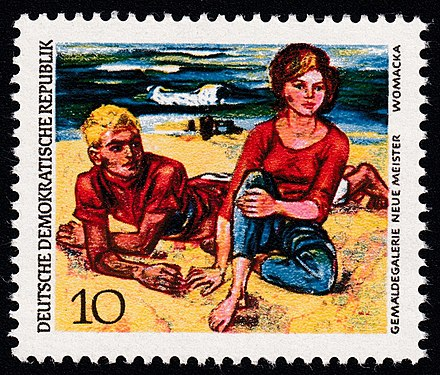
Stamp of Am Strand by Walter Womacka

Hanging on the wall, right next to Aus dem Leben Ernst Thälmanns, were various versions of probably the most famous painting in the GDR. Far from portraits of Thälmann, bronzes of Lenin and or numerous tributes or Rosa Luxemburg and Karl Liebknecht, this intimate everyday picture struck a chord with the population. Am Strand (On the Beach) by Walter Womacka was painted in 1962 and was presented to Walter Ulbricht by the Politburo of the Central Committee of the SED on his 70th birthday. The picture shows two young people, perhaps not yet a couple, sitting on the beach, their middle fingers touching in an uncertain gesture of adolescent love.

Very much in a Socialist Realist style which elevated everyday life under socialism into a “revolutionary romanticism”, the painting through its circulation became a key to the people in GDR’s image of themselves. The painting was reproduced more than three million times as an art print, postcard and art calendar, as well as a stamp in 1968 had a circulation of twelve million. Indeed, one of our tour group remembered the painting from her parent’s sitting room.

Womacka was very much a ‘state artist’ and a member of the SED who was commissioned to do many commission in prominent GDR buildings, such as Unser Leben (Our Life) for the teacher’s house on Berlin’s Alexanderplatz and panel painting Wenn Kommunisten träumen (When Communists Dream) was hung in the Palace of the Republic. The latter was also reproduced as a stamp in 1981 (see below). The dramatic shift in style between Am Strand and Wenn Kommunisten träumen shows that even for ‘party artists’, art was neither uniform or simple functional within socialism.
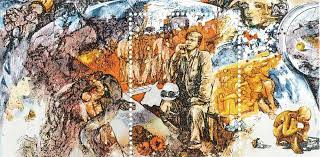
A Stamp of Wenn Kommunisten träumen (When Communists Dream) by Walter Womacka in the GDR Palast der Republik

One of the most spectacular, and mildly grotesque pieces of the archive was a huge multi-canvas piece by renowned GDR artist Willi Sitte, entitled ‘“Proletarier aller Länder, vereinigt euch!’ or ‘ Workers of the World, Unite! Each section, mounted on sliding archival storage, was revealed individually due to the size of the piece. First came Marx; a lightning bolt grasped in one hand and the other lifted high as a fist radiating rainbow colours, below a small refracted side portrait of Lenin.

The next panel brings a sharp contrast between the austere sepia portraits of the figures of communism in Germany (Clara Zetkin, Rosa Luxemburg, Karl Liebknecht, and Ernst Thälmann) adorn the top of the picture, under this a baroque mass of bodies, muscles and guts. The people are tearing themselves down from the cross and heralding a new dawn with golden trumpets. Sitte, who deserted the Wehrmacht in 1944 and briefly went and fought for the Italian Partisans, and this style evidently resembles Italian Baroque.
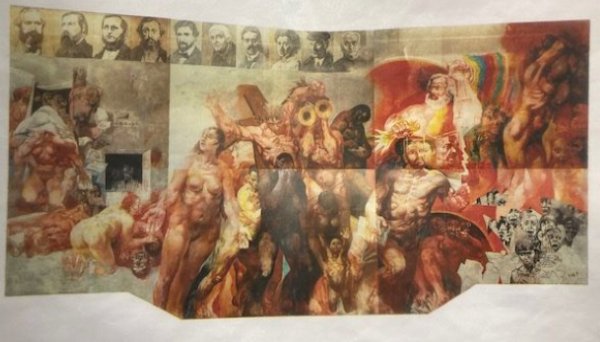
Printout from the tour of all the panels of Proletarier aller Länder, vereinigt euch! together.

The final panel we were shown continued this lineage of communist figures with a young Marx and Engels in the left hand corner all the way through to Kautsky, under the canvas is grey with lumpen naked figures shrouded in cloth, newspapers emerge and fall from the grey background. They both form a revolutionary base, reminiscent of Willi Neubert’s Die Presse als Organisator (The Press as Organiser) mural on the Presse Cafe, in which the communist press takes on an activity and integral part of the revolutionary project.

Pieced together almost triptych-like murals portray the progression of revolutionary consciousness and mass politics from the beginning of the communist movement to what is assumed to imply state- socialism of the GDR. But far from the perhaps drab social realism that one might associate with ‘socialist’ art, the end panel shows a psychedelic mass of colour, power of collective action and the strength of people rising. Interestingly though this was not deemed a fitting piece to be displayed in the Parteihochschule in Köllnischer Platz by SED officials. Due to the prevalence of naked people in the painting the piece was hung at the top of the main staircase in the school and covered by a curtain. Florentiner Nadolny, the director of the Art Archive in Beeskow, said that this was suspected to be due to GDR relations with the Soviet Union. Sitte objected to it being covered up and attempted to buy the painting back through a public campaign, after much conflict the piece was permanently displayed.

This example of the top down sanctioning of even their most prominent artists (from 1974 to 1988 Sitte was President of the Association of Visual Artists of the GDR), showed the rhetoric of the Bitterfelder Weg had become highly institutionalised. However, like many of the contradictions that come out of the GDR, the conditions in which art was produced there can not simply be dismissed. The art in the Beeskow Art Archive emerges, not just as a top down expression of social values, but a site of struggle and negotiation around what it means to create socialist culture. The collections in Beeskow are testament to the huge variety and vibrancy of art that came out of GDR, and their work is key to reasserting it’s artistic and cultural heritage back into public view.

Notre Dame, Eco-colonialism, and The Wretched of Pakistan

The muted altruistic response to Pakistan’s calamitous flooding reveals the persistence of colonial priorities of the Global North.


15/09/2022

I emigrated from Pakistan with my family at the age of 17 in 2010 and I have never returned. I never really felt an emotional connection to the country, the language, or the history. I was always eager to come to the West and assimilate there and my wish was fulfilled. Only after I read Frantz Fanon’s “The Wretched of The Earth” did I begin to feel a sense of patriotism towards the motherland. My sense of righteous anger at the legacy of colonialism-at-large found an expression towards colonialism as it shaped the lives of myself and those whom I perceive as my people.

The Notre Dame Cathedral fire occurred on 15th April, 2019. Within a week, nearly 1 billion Euros were pledged for its restoration. Not a single person died, nobody was displaced from their home. In humanitarian terms, this was a non-event. For a country that can never stop beating its chest about its secular humanism, the eagerness to restore a church to its former glory contrasts starkly with the indifferent response of the, comically named, international community. Laïcité seems like a cruel, taunting insult to the wretched of Pakistan.

The list of donors is worth highlighting. The French energy giant Total pledged 100 m, the chair of Louis Vuitton Moet Hennessy (LVMH) pledged another 100, Francois-Henri Pinault pledged 100, the heirs to L’Oreal pledged 200 more, the city of Paris pledged 50. Half a billion Euros pledged on a whim in a grotesque auction for public self-aggrandisement. Why is it that any entity in the world has the power to allocate such sums to satisfy their own vanity? But perhaps more immediately, how were (and still are) these fortunes generated in the first place? How much did their generation contribute towards the destruction wrought on the biosphere which precipitated the catastrophe in Pakistan?

Even though the lands of Pakistan were colonised by the British, today, in the age of the “Rules Based International Order”, the people and the land can be exploited by capital of any nationality. It is in short, an economic and environmental gang rape facilitated by institutions like the IMF and the World Bank. Greenhouse gas emissions have no nationality. To reiterate, Pakistan is ranked within the top 10 most vulnerable countries to climate change, despite ranking around 158th in the world for emissions. In light of this frightening divergence, I feel comfortable highlighting the French response to the Notre Dame fire and the French state’s barbaric response to the floods. A web search for stories on money or support pledged by the French state or actors yields nothing in terms of money and little in terms of aid that is commensurate with the scale of the crisis.

But if France, with its hypocrisy and wealth built on colonialism, both new and old, is a chief accomplice of this catastrophe and its perpetuation, then the UK and the USA are the primary conspirators.

Colonialism hardly ever exploits the whole of a country. It contents itself with bringing to light the natural resources, which it extracts, and exports to meet the needs of the mother country’s industries, thereby allowing certain sectors of the colony to become relatively rich. But the rest of the colony follows its path of under-development and poverty, or at all events sinks into it more deeply.” – Frantz Fanon, The Wretched of the Earth

Fanon is speaking through the map at the top of this article. Almost the entirety of Balochistan has been affected, even in areas far flung from the Indus River, the primary conduit for flooding. Khyber-Pakhtunkhwa, until 2010 referred to by its colonial name: North West Frontier Province, is similarly affected. The river Indus merges with the flows of the other four rivers of Punjab (Sutlej, Ravi, Chenab, Jhelum) at the border between Sindh and Punjab. Roughly a third of Sindh comprises the Thar desert and is therefore extremely vulnerable to flooding. A catastrophic increase in river volumes would make Sindh difficult to defend as the river swells up downstream. But the damage caused upstream and across in Balochistan are, at least partially, the consequence of the wounds of imperial neglect.

The British government has offered a miserly package of £15 million, or 46p per person displaced. The United States is providing $30 million, 91c per person displaced. Contrast this with the estimates of value extracted from the Indian sub-continent (in the order of trillions in present value) or the money offered to successive Pakistani governments to help prosecute, first the Soviet-Afghan War, and then the War on Terror. The US Congressional Research Service estimates US aid to Pakistan’s military since 2001 to be over $10 billion. The US military is estimated to have emitted 23.4 MTe CO2,eq in 2017. The entirety of Pakistan’s emissions in 2017 were approximately 221 MTe CO2,eq. The confluence of historic economic plunder and present-day environmental vandalism has turned Pakistan into perhaps the first victim of eco-colonialism. The effects of such widespread destruction of homes, crops, and livestock in conjunction with country-scale displacement through a single climate change induced event is without precedent. Countries in the Global South may see what has happened to Pakistan and ask themselves: “Are we next?”.

In light of these facts, the moral outrage of such preventable devastation is already unfathomable to the mind, but it would be remiss not to address one final element to its causality; the role of the IMF and debt. Governments across the Global South are familiar with the dreaded structural adjustment programs that condition any transfer of financial aid from the IMF. In practice, the IMF acts like a loan shark preying on the desperation of the very countries that emerged in the period of decolonisation after the second world war. In Pakistan’s case, this is illustrated by the fact that in 2022-2023 it is expected that 56.4% of tax revenues will service debts.

The demands of the IMF, as a rule, entrench indebtedness and make it impossible for these countries to progress beyond emerging market status. They become centres of unequal value exchange, providing raw materials and cheap labour to perpetuate the wealth and power of the Global North. Work by Jason Hickel and co-authors estimated that in the period 1960-2018, the Global North extracted $62 trillion dollars from the Global South through what they term “unequal exchange” i.e. paying less for something from abroad than what it would cost within the Global North.

Coupled with the entrenchment of economic relations mimicking the period of imperialism, the indebtedness imposed on Global South countries makes it impossible for them to adequately mitigate the impacts of climate change as a last resort. It leaves countries like Pakistan stripped of autonomy, forcing governments to beg at international gatherings like the COP Summit to provide for the harm they have been perpetrating for centuries, and then diligently obstructed through conduits like the IMF. The genealogical links between imperialism, neo-colonialism, and eco-colonialism are thus reified.

Contemporary Pakistani politics is similarly plagued by these legacies. Punjabi elites, the most populous and economically dominant province, coupled with their Sindhi counterparts (home to the largest city in the country) have monopolised political power since its inception. Bangladesh seceded after a brutal war of subjugation led by West Pakistan failed, geography and the intervention of India facilitating Bangladeshi independence. However, efforts to gain autonomy or independence within Balochistan have been brutally suppressed to the present day, with abductions a routine facet of political activism.

Khyber Pakthunkhwa has, owing to the War on Terror, been a similarly militarised region in the country, driven into the grip of religious fundamentalism on account of a war it had little say in participating in. Therefore the scale of devastation caused by these floods and the woefully inadequate response, at home and abroad, is the result of a synergistic function of colonial socio-political legacies, neo-colonial domination, and ecological collapse. The entirety of the Global South must unify to negate these synergies, casting off all old rivalries and apprehensions so that they do not suffer the same fate as Pakistan, one after the other.

You can find some sites where you can donate to Pakistan flood victims here. On Saturday, 17th September there will be a Solidarity Fundraiser for flood victims in Café Karanfil in Berlin Neukölln.

Manufacturing Consent around the Queen’s Death

Socialists must vocally oppose the artificial consensus around mourning the Queen


13/09/2022

Union Jack at half mast

Many years ago I read about a social psychology experiment in which a group of seven people were presented with two cards. On card 1 were three lines of different lengths– A, B and C. On card 2 was one line – D. They were asked to say which line on card 1 matched the length of line D. The answer was fairly obvious but 6 of the group were actors primed to give the wrong answer. What the experiment showed was that in most cases the seventh person (the victim) gave in and agreed with the majority in spite of the evidence of their own ideas.

Such is the social pressure exerted by ‘majorities’. Ruling classes everywhere are well aware of this and exploit it to their advantage. Much of the time they cannot achieve the consensus they desire, especially when there are substantial organised oppositional forces in society (trade unions, left political parties etc.) but there are certain moments when they sense they have the opportunity to really enforce their view of the world on everyone.

This is what the British ruling class is doing at the moment with the aid of centuries of tradition and, very importantly, the leadership of the Labour Party and some trade unions. They declare that the nation is in mourning and that everybody agrees (‘Surely there is one thing we all agree on’ says the short propaganda video repeated endlessly on TV). Then they say that anyone who dares to disagree is not only mistaken but ‘disgusting’, ‘outrageous’, ‘vile’ and so on.

Clearly the media is central to this and the BBC is certainly playing its part to the full. But it is important to understand that in its wall to wall to coverage it is doing the bidding of its master, the British ruling class. It is not reflecting public opinion; it is going into overdrive to manufacture the consent it claims to reflect. More or less all dissenting voices are excluded on the grounds that they would cause ‘offence’. They would cause offence by disagreeing with what everybody agrees with.

They are doing this now over the Queen but the most important occasions on which they do it are when they are going to war. This is what all the belligerent countries did over World War 1, handing out white feathers and the like. In my experience, they did it quite successfully in Britain over the Falklands/Malvinas War but failed spectacularly over the Iraq war. In Ireland it was, until quite recently, simply not allowed in public discourse to criticise the Catholic Church. You couldn’t say that the local priest was a child abuser or that Catholic Industrial schools were sites of systematic violence and cruelty, even though large numbers of people knew this to be true. Why? Because ‘everybody’ knew this couldn’t be so (and because every politician, journalist, TV presenter etc. knew there would be a price to be paid for saying it).

One effect of this is the pressure on the left, on political forces overtly committed to challenging the current order. It is worth remembering that in 1914 the parliamentary deputies of German Socialist Party (SPD) – a party which had always opposed the coming war – voted by 110 to1 in favour of war credits i.e. to support the war (the one was Karl Liebknecht). Inside the left there are always voices who say we know this is bullshit but we must go along with it or we will lose votes.

Another version of this is the slightly less cynical, ‘we have to go along with it because that is what “our members”, “the working class” etc. want, but however it is put the effect is the same; it reinforces precisely the consensus the ruling class is trying to impose. It should be remembered that on these grounds it would have been necessary to accept and collude in overt racism, overt sexism, overt homophobia- all of which were normal and part of the consensus in the not too distant past and on all of which the heavy lifting was done by minorities who were denounced at the time.

Another effect of the pressure is that some people try to get out from under it by saying that feel sorry for the Queen’s family ‘personally’ etc. This was the ‘tactic’ used by Jeremy Corbyn and Zarah Sultana and others but, as Eamonn McCann put it, they didn’t feel obliged to make such comments when his Aunty Maisie died. In other words, this kind of public statement is still a collusion with the propaganda and I think those who do it really know this.

The only decent position for socialists is to state unequivocally that we are republicans who are opposed on principle to monarchy and therefore will not assent to or take part in any of this nonsense manufactured mourning. Given the number of people who now consume their news online and via social media, reflecting critical coverage from outside the UK is an important tasks to puncture efforts to enforce pro-monarchy sentiment internally.

After the Referendum in Chile: The Causes of the Uprising Remain

In Chile, nearly two-thirds of people rejected the new Constitution. Two years ago, three quarters supported a new Constitution, What has happened? Interview with Sam Flewett in Concón


12/09/2022

Why did the convention fail to win support for the new constitution when a solid majority voted for a new constitution?

There are many analyses going around. Some talk of a “silent majority”, others blame fake news, others talk about an image problem of the convention. Personally, I think that by trying to change everything, the convention failed to transmit a clear and believable message that the new constitution was going to deliver improved living standards for the vast majority.

The government has made many social promises, but has so far implemented little of them. The popularity of the centre-left president has fallen dramatically since the beginning of the year. Were the “no” votes also an expression of the deep frustration with the unfulfilled promises of the centre-left government?

Boric does not have a majority in Congress, so any reforms have to first be negotiated. The fact that all relevant social reforms imply government spending, means that the first reform to be implemented must be a tax reform. That is currently in parliament, and will be voted on in the next few weeks. The pension reform is soon to be sent to parliament, however 40 years of neoliberalism means that many people are wary of a pension system that deviates from the orthodoxy of individual savings. Most mistakenly believe that the reason for the poor pensions is due to theft on the part of the administrators, and not the lack of solidarity built into the system.

Another reason is that Boric slammed shut the door on pension fund withdrawals, despite his support for them during his time in opposition. This was an unpopular decision, however a necessary one given the disastrous side effects that these have brought.

What’s the idea behind pension fund withdrawals and why would they have had disastrous side effects?

The pension fund withdrawals came as a response to the lack of support financial from the Piñera administration during the pandemic, and also as a means of supposedly weakening the AFP private pension system. The withdrawals, and especially the political pressure for further withdrawals continued however after the quarantines had been lifted and the economy had begun to normalize.

The side effects came from two sides. Firstly, the release of a large amount of liquidity into the economy with constrained productive capacity further increases inflation, and secondly, liquidating a large amount of nationally held assets has reduced their prices, and pushed credit prices up substantially. Mortgage costs are 50% higher than 18 months ago, and in some places rents have doubled as a consequence of people not being able to buy apartments and being forced to rent. 

Where was the support for the new constitution strongest?

In urban areas, in particular Valparaíso and the southern sectors of Santiago. Also notable that one of the 8 municipalities to vote in favour of the proposal was Ñuñoa, an upper middle class liberal municipality of Santiago. 

And where was it weakest?

In the traditional upper class, and upper-middle class regions of Santiago, and in rural areas. 

Is it possible to draw a conclusion about in which parts of the population the referendum was lost? 

It appears as if was lost in poor and especially rural poor communities. There was no great sensation of working class people “voting for their side” in the urban areas, and in rural areas only 1 in 4 voted in favour of the proposal. It is true that the rich communities also rejected the proposal, but their numbers are irrelevant in a context of compulsory voting.

What was the public political process in the run-up to the referendum like?

Campaigning was much more subdued compared to the run-up to the presidential elections, however there were activities in most cities up and down the country. Supporters of the proposal held a half million strong rally in the centre of Santiago to mark the official end of the campaign, however this was not sufficient to change the result. There was very little technical discussion about the proposal itself, especially with the rejection campaign focusing on other issues such as crime and inflation to sow uncertainty in the minds of voters.

Who organised support for it?

The left wing parties and social movements.

About how many organisations are we talking?

The political fabric in Chile is fragmented. There would have been close to a dozen political parties supporting the proposal, although the Christian Democrats (centrist) were split down the middle. It is hard to put a number on the social movements as such.

Who organised the critics?

Right wing parties and spinoffs from some centre-left parties. Also, the large business organizations.

How much money went into each campaign? 

The rejection side was funded at a far higher level than the approval side, although I am not sure on the exact figures.

How did the supporters of the new constitution react?

Mostly with sadness and disbelief. It is still not understood why the result was so poor for the approval vote.

Some German media explained that Chile is a traditionally conservative country. Do you think that can explain the result? 

More than conservatism, I would say that a complete lack of trust in the political system is more at fault here. Given a long history of broken promises, it is not hard to sow doubts in voters’ minds about some eventual conspiracy to expropriate poor people’s houses, or for the proposed indigenous justice system to allow criminals to walk free. 

Others argue that the government hasn‘t been able to contain the violence in the south. Can you briefly give an outline of the conflicts there?

The conflict has been going on for centuries however it has intensified over the past few years. 

Could you please give a brief outline what it is about?

It is a classic situation of the indigenous Mapuche population seeking to restore their land which was taken from them by force in the second half of the 19th Century. An anti-colonial struggle to put it simply. The Araucanía is one of the few parts of America which was not subject to effective Spanish colonization, rather it was the newly independent Chilean state which finally defeated the Mapuche population. 

Neither this government, nor the previous one has had any success in improving the situation in the south. There are however now indications that organised crime is infiltrating some of the militant groups in the south, further complicating matters.

How would organised crime benefit from infiltrating militant groups? Or militant groups getting involved with organized crime?

In much of the land which is being claimed by the militant groups, large scale industrial forestry operations are in place, and one of the chief crime activities is the theft of the timber – valued at almost $100 million USD per year. It is difficult to know what is really happening down there.

The indigenous Mapuche have been fighting against their oppression for decades. Has the Boric government really changed anything for the people? 

In the 6 months since Boric took office, nothing of note has changed in the south.

Was President Gabriel Boric criticised for continuing military presence, state of emergency, and military the violence in the south even though he had a lot of support from indigenous groups during the elections? 

He was criticized, however in practice he had no choice. It was either a state of emergency, or have the truck drivers shutting down the country, as they did during the summer holidays in February and again in March/April. 

What’s the relation of the truck drivers to the conflict in Araucania?

Truck drivers, and especially the owners have a long history of (far) right agitation in Chile, dating back to 1972 when they accepted CIA money to shut down the country, paving the way for Pinochet. Being associated with the (far) right, they are also close the settler community in the South, who are one of the main targets of the militant groups. Truck drivers have also been target of attacks from militant groups, so they have gone on strike demanding more police presence on the highways. Due to its unique geography and lack of a modern rail system, Chile is especially vulnerable to truck strikes. With just 4 trucks parked across both directions of the main highway, Chile stops. There was also truck strike in the North earlier this year against Venezuelan refugees. 

Will there be a new proposal now to fulfill the decision in favour of a new constitution? 

I will believe it when I see it. It does appear however that there is a real change of tone from the right in favour of a new constitution.

Isn’t the current constitution exactly what the right wants?

The current constitution is what they want, but on the other hand, it is no longer politically viable to maintain it. The right (and everyone else) also needs stability, which the old constitution can no longer guarantee. 

How does the government react to the result of the referendum? 

There was a change of cabinet, however the right is pushing hard for a further weakening of their plans to introduce important changes in economic material. Unfortunately, the result has weakened their negotiating position substantially.

What is the reaction of the radical Left, the Unions and extra-parliamentary movements to that? 

Mostly one of despair. I have not read anything of note from important union groups such as the Teachers’ Federation.

Have the roots of the uprising in 2019 been addressed by the new government? 

No. The constitution, pensions, inequality etc are still all to be addressed. Not having a majority in parliament makes things more difficult, especially in the context of a global economic crisis with the local inflation at 14%.

The government in Chile is not the first left-wing government to dash hopes. What are the lessons? 

I personally think they are doing all they can in what are very adverse conditions. 

Chile is not the only country in Latin America where social upheaval led to a process for a new constitution. Venezuela and Bolivia are cases in point. However, these countries are also far from overcoming poverty, exploitation and oppression. What does that tell us about the prospects of channeling a social process involving millions into a constitutional process?

I am unfamiliar with the details of both of those processes unfortunately. In the case of Chile, the theme of the Constitution has been especially pertinent because it has been one of the cornerstones of the how the dictatorship has maintained a presence despite an appearance of democracy on the surface.

This article first appeared in German on the marx21 Website


The Queen is Dead. Republic Now!

A symbol of privilege and colonialism has just died. The Royals are no friends of ours


11/09/2022

On 8th September, 2022, a 96-year old woman died. Nothing unusual there. On average, 1,679 people die in the UK every day. But this time round, everyone from the British Kebab Awards to The Prodigy made gushing sycophantic statements. Britain’s idiot prime minister Liz Truss, called the deceased “among the world’s greatest ever leaders”.

As Britain was sent into 10 days of enforced commemoration, the madness also spread to Germany Chancellor Olaf Scholz called her a “role model and inspiration for millions”, while Berlin mayor Franziska Giffey said that the “power of her great personality has always fascinated us Berliners.” Brandenburger Tor was lit up in the colours of the Union Flag in her honour.

Even John Lydon, who as Johnny Rotten once wrote; “God save the queen. She ain’t no human being. There is no future in England’s dreaming” got involved. He posted the following message on social media: “Rest in peace Queen Elizabeth II. Send her victorious From all at johnlydon.com”.

Extinction Rebellion had been planning a so-called Festival of Resistance in London. They issued a statement, saying “Due to today’s news about the passing of Queen Elizabeth, the Rebellion Planning team, and other groups involved, have made the difficult decision to postpone the Festival of Resistance this weekend in London until further notice.” So, there is no time to waste in resisting climate change – unless a privileged old woman dies?

The Trade Union Confederation (TUC) postponed its conference. The post and rail unions called off planned strikes, although interestingly, barristers will continue to strike. The leader of the RMT rail union Mick Lynch said “RMT joins the whole nation in paying its respects to Queen Elizabeth.”

This is the same Mick Lynch who a few days before had proudly declared his love of James Connolly. In a television appearance, he asked his interviewer: “Do you know who James Connolly is? He was an Irish socialist republican and he educated himself and started non-sectarian trade unionism in Ireland. And he was a hero of the Irish revolution.”

James Connolly was indeed an Irish revolutionary who wrote the following: “A people mentally poisoned by the adulation of royalty can never attain to that spirit of self-reliant democracy necessary for the attainment of social freedom.” Unfortunately Connolly’s most famous supporter is showing exactly this sort of adulation.

Just like Us?

Labour leader Keir Starmer tweeted “Above the clashes of politics, she stood not for what the nation fought over, but what it agreed upon” (you can read the full, sickening statement by the Labour Party here). But just how much did the life of this privately educated woman with 30 castles resemble that of a normal pensioner?

One of the last acts of Elizabeth Windsor was to pay £12 million to cover the court fees of her son Andrew. Andrew is accused of sexually abusing Virginia Giuffre when she was a teenager, and the evidence against him looks compelling. It is not even a matter of dispute that he regularly partied with known paedophiles and sex traffickers.

Andrew is not the first sexual predator to visit royal palaces. Serial rapist Jimmy Savile used palace visits to seize young women and lick their arms. When Prince Charles and Princess Diana had marital difficulties, they employed Savile as a counsellor. Charles asked him to help improve the image of his brother’s soon to be ex-wife Sarah Ferguson.

How Much?

While many British pensioners die of hypothermia each Winter, the Royals have an annual gas bill of £2.5 million. This is not something they find difficult to pay. Forbes magazine estimated last year that the royal family is worth $28 billion. Last year, the Sovereign Grant, which replaced the Civil List, allocated them £86.3 million, compared to £42.8 five years previously. This money is paid by the British tax payer.

As Bailey Schulz reported in USA Today, the queen’s “personal assets from investments, real estate, jewels and more have an estimated worth of $500 million”. Prince Charles’s Duchy of Cornwall inherits all the wealth of people who die in Cornwall without making a will. His estate, worth £1billion now passes to Prince William.

The Royals own 1.4% of all land in England, including nearly all of Regent Street and most of the UK seabed. They have their own train costing at least £800,000 a year and a helicopter costing nearly £1 million. A new royal yacht is being built at a cost of £250 million. Even Elizabeth’s funeral will cost British taxpayers £6 billion.

Ten million pounds of the queen’s private money was invested in offshore tax havens like the Cayman Islands and Bermuda. It is a step forward that she feels the need to hide her tax. She only agreed to pay any income tax at all in 1992, when the popularity of the Royals was at rock bottom.

During the Corona pandemic, the queen gained an exemption from the ongoing eviction ban and evicted a couple from one of her many properties. The reason? They had used a communal plug socket to charge their electric car. In 2004, the queen asked a state poverty fund used to help low income families to pay for heating Buckingham Palace.

Notwithstanding their vast wealth, the Royals were not prepared to look after their own family. In 1941, Nerissa and Katherine Bowes-Lyon, Elizabeth’s first cousins were sent to the “Royal Earlswood Asylum for Mental Defectives”. They each had a mental age of around 3 and never learned to talk.

In 1961, they were recorded as deceased, although Nerissa actually died in 1986 and was buried in a pauper’s grave. Katherine died in 2014. There is no record of anyone visiting them. A nurse reported: “They never received anything at Christmas either, not a sausage.” The Royals sent the hospital £125 a year for their care, but never publicly acknowledged their existence.

The Legacy of Colonialism

The British monarchy has always had a close relationship with colonialism and imperialism. Elizabeth’s great-great-grandmother Victoria styled herself the Empress of India and presided over the expansion of the British empire.

Princess Elizabeth learned that she was going to be queen when she was representing Britain’s colonial interests in Kenya. Later that year, British troops brutally suppressed the Mau Mau rebellion in the same country. As the New York Times reported: “The clampdown on Kenyans, which began just months after the queen ascended the throne, led to the establishment of a vast system of detention camps and the torture, rape, castration and killing of tens of thousands of people.”

The monarch is the head of the British army, and has the right to recruit, appoint commissioned officers and negotiate the stationing of British troops on foreign soil. Under Elizabeth’s watch, British troops invaded Egypt after President Nasser nationalised the Suez Canal, shot dead 14 unarmed civilians in Derry, and acted as bag carriers on countless US imperial adventures.

The royal family continues to benefit from the plunder of the colonial years. The new queen Camilla will inherit the crown which contains the Koh-i-Noor diamond, valued at $400 million but considered to be priceless. Indian economist Utsa Patnaik estimates that goods stolen by the British between 1765 and 1938 from the Indian subcontinent alone were worth $45 trillion

The royal family continues to aid imperialism. When BAE systems sold 72 Typhoon fighter jets to the Saudi Arabian dictatorship, Prince Charles was in Riyadh dancing with Saudi princes on the evening before the deal was signed. According to Andrew Smith from the Campaign Against the Arms Trade: “It is clear that Prince Charles has been used by the UK government and BAE Systems as an arms dealer”.

In 1975, when a majority of Australians had the temerity to voted for the Labor politician Gough Whitlam, it was the queen’s representative who sacked Whitlam and ushered in a Conservative government. So much for the Royals being above politics.

Racism

Elizabeth’s husband Philip was famed for his racism, which the media quaintly reported as “gaffes”. On a state visit to China in 1986, he told British students that if they stayed in the country they would go “slitty eyed”. In 1998 he asked a British student in Papua New Guinea “You managed not to get eaten, then?”. Four years later, in Australia, he asked an Aboriginal man, “Still throwing spears?” Philip’s brother-in-law was a close aide of SS chief Heinrich Himmler.

Philip was not the only racist in the family. Elizabeth’s mother was fond of calling black people “nig nogs”. When Stephen Fry told the queen’s sister Margaret that he was Jewish, she “expressed her horror by shouting to everybody else at her table: ‘He’s a Jew. He’s a Jew.”’ Margaret once told the Mayor of Chicago that “the Irish are pigs, all pigs”.

We are often told the “tragic story” of Elizabeth’s uncle Edward who had to abdicate because he wanted to marry a divorcee. The truth is that the establishment were more worried that both Edward and his fiancée were open Nazis who regularly visited Hitler in the run up to the Second World War. In 2015, the Sun released exclusive photos of Edward teaching a young Princess Elizabeth and her sister to make a Nazi salute under the headline “Their Royal Heilnesses”.

Until at least the 1960s, Buckingham Palace banned “coloured immigrants or foreigners” from work. Even now, the monarch is exempt from several laws, including those concerning racial, ethnic or sexual equality

The racism continues to the present. When Meghan Markle was expecting the queen’s grandson,  members of the British royal family expressed “concerns and conversations” about how dark her son’s skin would be. Her husband Harry said that racism was a “large part” of the reason for the couple leaving the UK.

Do we need a Figurehead?

Shortly after Elizabeth’s death, the Blairite journalist Polly Toynbee wrote an egregious piece in the Guardian in which she stated: “Every nation needs a figurehead; and, however perverse the sheer randomness of being born into that role, she did it with remarkable skill and dignity.” In other words, know your place, plebs.

But do British people really need a figurehead to unite behind? Working class Britons have more in common with other working class people in Berlin and Kolkata than with a Tory government that claims that we’re all in this together while attacking living standards and handing over the profits to their friends in the City. We don’t need a fake unity with the people responsible for keeping our wages low and our rents high

We are asked to lay off the queen because she was an old woman, just a symbol. But what she symbolises is exactly the problem – Empire, colonialism, and the fact that if you’re born into the right family, you’re guaranteed a well paying job.

The monarchy cannot survive without the racist belief in birth privilege. As John Mullen says: “the existence of a king or queen represents the principle that one family is born superior to another – more deserving of privilege, purer, more virtuous, because of their blood line. This is the idea that plagued humanity from ancient slavery to Nazis.”

It is not just that Royals get their jobs because of birth, rather than merit. It is much worse than that. They are all born into privilege, are privately educated, and do not understand how most of us live. It is not a coincidence that so many of them end up as far right racists. Even the “progressive” one who married a Black woman went to a fancy dress party in a Nazi uniform “for a laugh”.

The Royals are not representative of the country as a whole. They are representatives of their class. When Paris Hilton tweeted that the queen was the “original girl boss”, she was right, even though she didn’t understand the implications of what she was saying.

People say that the monarchy is above politics, that the role is purely symbolic. If this is true, why must the British people pay them so much? Why are Elizabeth’s relatives allowed to keep the expensive booty of colonial expropriation? When the victims of colonialism rightly claim the reparations they are owed, their first stop after the British Museum should be Buckingham Palace.

What happens Now?

So what happens now that Britain is being ruled by a man who is much less popular than his mother, employs someone to iron his shoelaces and once fantasized about being his mistress’s tampon?

There’s a shift going on in British society which we shouldn’t overstate but which is not insignificant. A statista poll in 2022 said that “younger age groups are progressively more likely to oppose the monarchy, with 31 percent of 18-24 year olds opting instead for an elected head of state.” This was under the relatively popular Elizabeth. Another poll in 2022 showed that two-thirds of Britons did not want Charles to succeed his mother.

The British Royals have been declining in support for several decades. This is why my friend Jacinta Nandi is trying to popularise the hashtag #THETIMEISNOW. Although I think that the time was 1,000 years ago, rising prices and a growing discrepancy between poor and rich means that Britons can no longer afford the Royals. It’s time for them to go.