What is objective journalism?
Presentation at the Left Journalism Day School, 21 February 2026
Tina Lee
25/02/2026
Presentation at the Left Journalism Day School, 21 February 2026
Tina Lee
25/02/2026
Weekly news round-up from Berlin and Germany

“Shocking, but not surprising,” says Alina Voinea, commenting on the findings of the new Berlin Monitor. The study finds that 24.4% of Berliners express chauvinistic attitudes. The monitor also examines a broader range of social and political attitudes, including discrimination and democratic stability. Voinea is the Berlin state government’s contact person for antigypsyism. Commissioned by the Senate Department for Anti-Discrimination, the monitor examines racism against Sinti and Roma alongside antisemitism. The results of the study, which surveyed more than 2,000 Berliners, were presented on February 23. While 70% of respondents agreed in 2021 that they were generally satisfied with the democracy as it exists in Germany, this figure dropped to 62% by 2025. And 40% of Berliners were classified as “fragile democrats”—the highest percentage since the study began in 2019. Source: nd-aktuell
Excitement surrounding a speech at the Berlinale: the Federal Environment Minister Carsten Schneider (SPD) left the hall on February 21 in protest. That happened because the Syrian-Palestinian director Abdallah Alkhatib, who won the award for best feature film debut with “Chronicles from the Siege”, had accused the federal government of “being a partner in the genocide in Gaza.”. The Gaza war was also discussed when Lebanese director Marie-Rose Osta (“Yawman ma walad” – “Someday a Child”), said that the ceasefire was not being observed. Festival director Tricia Tuttle affirmed that a festival like Berlinale cannot solve the world’s conflicts. “But it can create space for complexity, for listening and for humanizing one another.” Source: spiegel
The Berlin ticket office KOKA36 has filed for insolvency. This was revealed in a filing dated February 11 at the Charlottenburg District Court. The shop, a fixture for concertgoers on Oranienstraße in Berlin’s Kreuzberg district for over 30 years, has been closed since last week. Although insolvency proceedings are initially just a court-ordered process to determine how debts can be settled or the company restructured, it is currently unclear whether regular operations will resume. The SO36 concert venue is also affected by the insolvency. A crowdfunding campaign (at https://www.startnext.com/so36-cool/mehr-infos) is now underway to minimize the losses. Source: groove.de
It is another setback for a ban on the AfD: Germany’s domestic intelligence agency, the Federal Office for the Protection of the Constitution, is skeptical about a ban on the party. The intelligence officers fear being “blind and deaf” in the event of a ban, with informants and undercover investigators being deactivated or withdrawn. There is actually no unanimous opinion among intelligence officials if informants are necessary to keep an eye on the AfD. Source: nd-aktuell
The wave of bankruptcies in Germany continues to persist: in January, 1,391 partnerships and corporations officially filed for insolvency. While this was fewer than in December, it was 4% higher than in 2025. Steffen Müller, head of insolvency research at the Leibniz Institute for Economic Research Halle, believes that “easing of the situation” is possible no earlier than April. Furthermore, job losses in the industrial sector were almost twice as high as in 2024, according to data from the Federal Statistical Office and an analysis which covers companies with at least 50 employees. This means the actual decline is greater. Source: jungewelt
The Greens have signaled their willingness to discuss constitutional amendments with Chancellor Friedrich Merz (CDU). At the same time, the party is presenting its own reform package entitled “Immediate Action Program for the Future,” which proposes far-reaching changes to the pension and healthcare systems. The authors are Katharina Dröge and Britta Haßelmann, the two co-chairs of the Greens’ parliamentary group in the Bundestag. The document is largely very general, and the Greens only provide specifics on two points. On the one hand, they advocate for net immigration of 400,000 workers per year. On the other hand, they want to replace the Riester pension scheme with a state-run citizens’ fund. Source: berliner Zeitung
According to figures from the Federal Criminal Police Office (BKA), there was in 2025 1,521 cases of politically motivated violence from the right-wing spectrum in Germany. In 2024, there were 1,488 of those crimes in the country. Such figures are part of a response from the Federal Government to the Left Party. The Government also pointed out that the number of crimes may still change due to late reports. Ferat Kocak, domestic policy expert for the Left Party, observes that “Right-wing violence continues to escalate, and the federal government is looking the other way.” Source: tagesspiel
The AfD wants to meet in Erfurt at the beginning of July – exactly a century after the NSDAP party conference in Weimar. Historians and politicians see this as a deliberate provocation. “The deliberately chosen parallel shows once again who the brainchild of the AfD is,” said Foreign Office State Minister Serap Güler (CDU) to the “Kölner Stadt-Anzeiger”. ” It disgusts me how little decency and respect this party has for our history,” Güler added. The historian and totalitarianism researcher Jörg Ganzenmüller, director of the Hannah Arendt Institute for Research on Totalitarianism at the TU Dresden, spoke of “a conscious symbolic act that works on several levels”. Source: tagesspiel
A 13-year-old boy allegedly attacked a Muslim schoolmate with a knife at a school in Bretten, near Karlsruhe, inflicting minor injuries. According to the Baden-Württemberg State Criminal Police Office, the suspected perpetrator had recently come to their attention for making far-right extremist statements. In Germany, children under 14 are not criminally responsible in Germany, and therefore they do not face criminal charges. “Nevertheless, it is our goal to clarify the background of the incident and to support the responsible youth welfare office in providing the boy and his family with the necessary assistance,” the State Criminal Police Office further stated. Source: islamiq
The world is changing, mostly for the worse: autocracies are on the rise, and democratic societies are under pressure. The “Germany Monitor 2025” concludes nevertheless that 98% of all Germans have a positive attitude toward the idea of democracy. However, only 68% say that democracy means the government must adhere to parliamentary decisions and the separation of powers. The focus of such study, with the participation of 4,000 representative individuals across Germany, were also asked in which areas of politics they most perceive these changes. The strongest change is in defense policy. Source: dw
Since the beginning of February, we have been publishing weekly court reports in our Newsletter. We recently decided to put these reports onto the website to make the more accessible. This is the third report in the series. Subsequent reports will be published on a weekly basis. You can read all the Repression in Berlin articles here.
This week’s column features the case of the Ulm 5, a group of activists accused of taking action against Israeli weapons company Elbit Systems in Ulm last fall. Here is the activists’ crowdfunding campaign, created to help finance various prison and court costs.
In the early morning of September 8, 2025, five Palestine solidarity activists allegedly broke into and disrupted the Elbit Systems weapons factory in the German city of Ulm. The action took place amid sustained protest against the factory, to which the activists are accused of causing an estimated damage of one million euros.
The Zionist entity’s primary weapons manufacturer, Elbit Systems produces over 85% of the Israeli forces’ land-based equipment and surveillance technology, used to brutally occupy and genocide the Palestinian people. Beyond arming the Zionist occupation, Elbit also supplies weapons to oppressive regimes around the world, improving its profit margins off of genocide and mass colonial violence.
The Ulm 5 are being held until this day in pre-trial detention as the State looks to prosecute them for trespassing, destruction of property and membership of a criminal organisation (§129), a charge added in a politically motivated attempt to criminalize solidarity with Palestine. They have faced harsh conditions over the past six months in jail, enduring various repressive measures such as: “strict monitoring of phone calls, visits, and correspondence, confinement in their cells for up to 23 hours a day, and restricted access to books and group activities.”
Within the same scope, last week, the first six of the British ‘Filton 24’ won in court as the jury concluded in their favor. The Filton 24 refers to a group of activists detained for targeting an Elbit factory in Filton, England, in August 2024. Following the first acquittal, prosecutors then elected to drop the aggravated burglary charges, allowing for all but one of the remaining activists to be released on bail. This news came on the heels of the British High Court ruling that the ban on Palestine Action is “disproportionate and unlawful.”
This week in working class history
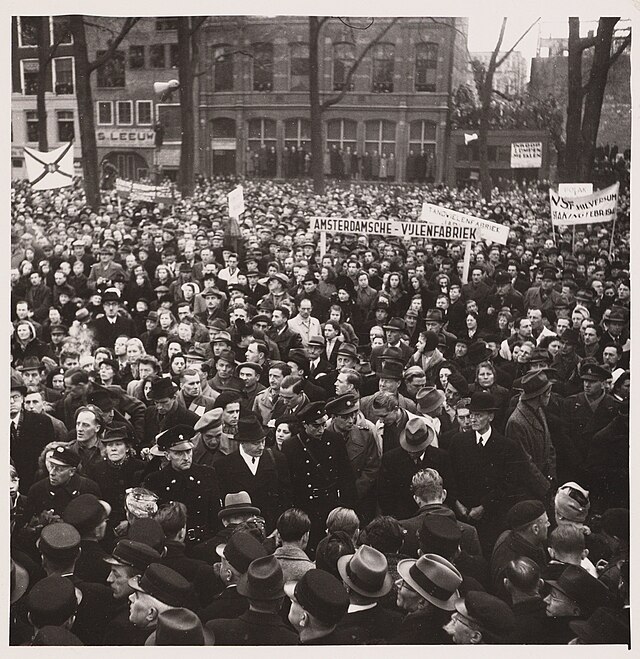
On May 10, 1940, Nazi Germany invaded the Netherlands despite its declaration of neutrality. The unprepared Dutch army fought for four days before the government surrendered on May 15, following the bombing of Rotterdam.
The new leader, Austrian-born Arthur Seyss-Inquart, recognized that National Socialism had little support in the Netherlands. The Dutch National Socialist Party (NSB), led by Anton Mussert, was widely despised, and the population rejected Nazi ideology. Seyss-Inquart’s initial strategy relied on a softer occupation: he pursued gradual Nazification through collaboration with local authorities and avoided antagonizing the Dutch people, hoping to convince them that a new Nazi-led Europe represented their future.
Yet despite this gentler political approach, the persecution of Jewish people remained a priority. The Nazis quickly imposed signs banning Jews from public spaces, and NSB members regularly harassed and assaulted residents in Amsterdam’s Jewish neighborhoods. This escalated in February 1941 when an NSB gang clashed with Communist resistance fighters, resulting in an NSB member’s death. The Nazis exploited this incident to launch mass arrests: on February 22 and 23, they arrested 400 Jewish men in Amsterdam and deported them to camps in Eastern Europe. The raids shocked many non-Jewish Amsterdam citizen and sparked the February Strike.
The February Strike occurred on February 25 and 26, the same week as the arrests. Called by the then-banned Dutch Communist Party (CPN) with the motto “STRIKE!!! STRIKE!!! STRIKE!!!,” the action began in Amsterdam when tram workers stopped work, followed by citywide participation. It quickly spread to Haarlem, Velsen, Zaandam, Hilversum, Bussum, Weesp, Muiden, and Utrecht.
Lasting two days, the strike was the only open mass protest against Jewish persecution in occupied Europe. The German response was swift and violent: nine people were killed and many imprisoned. The broader consequences proved even more severe. The Nazis swiftly cracked down on the CPN, executing four communist strikers and fifteen resistance members within days. Twenty-two men who organized the strike were deported to forced labor in Germany, where two died. The strike demonstrated that the soft occupation strategy would not succeed, forcing the Germans to quickly change course.
Though the strike represented Dutch resistance to Jewish persecution, collaboration with Nazi Germany remained widespread. Of the 140,000 Jews living in the Netherlands before the war, 107,000 were deported to camps. Approximately 25,000 Dutch people joined the SS. While the strike highlighted the Communist Party’s role in the resistance movement, this legacy was largely forgotten after the war. Communist organizers were barred from annual memorials for years, and Dutch police and military disrupted tributes to Communist resistance fighter Hannie Schaft. Only after the Cold War’s end did the Dutch Communists receive proper recognition for their fight against Nazi occupation.
The Games in Milan and Cortina have again shown that geopolitics and capitalism are inherent parts of global sports
As filmmakers and actors were facing a barrage of questions in Berlin about the politics of art and cinematography, a similar debate was taking place about the politics of sports. The 25th edition of the Winter Olympic Games in Milan and Cortina ended on Sunday, on the same day as the Berlinale. As always, the International Olympic Committee (IOC) claimed to toe the line of neutrality and to keep politics out of athletics.
To some extent, it succeeded: no huge scandal broke out in the sporting world over the last few weeks, despite the promising start of a penis-enlargement investigation revealed the day before the games began. Still, as one of the world’s largest events, the Winter Olympics inevitably became a staging ground for geopolitics. Heated discussions about war, identity, and colonialism show that a spectacle with nationalism and capitalist profit motives at its core can never be apolitical.
Ukrainian president Volodymyr Zelenskyy agrees: “Sport shouldn’t mean amnesia,” he wrote on X/Twitter, after the IOC disqualified Ukrainian skeleton athlete Vladyslav Heraskevych over his use of political symbolism. In 2022, Heraskevych had unfolded a “No War in Ukraine” sign at the Beijing Winter Olympics, less than two weeks before the start of the full-scale Russian invasion. In Milan, he chose to honor 24 athletes who had since been killed by Russian forces with a “helmet of remembrance” featuring their photographs.
Heraskevych was allowed to wear the helmet in the training runs, but was barred from wearing it during the actual event. This waffling is not new, but only the latest in a long series of conflicting and unclear decisions from the IOC. The Committee sometimes allows and sometimes bans political symbols with no discernible logic or transparent criteria.
The IOC also chose to put its foot down in the case of Haiti. The Caribbean state sent two athletes to Milan, an achievement hailed by its ambassador to Italy as “a symbol” and “a statement” against “the most dangerous form of erasing.” Erasing, however, is exactly what the IOC forced the Haitian delegation to do.
Their uniforms, designed by Stella Jean, featured a portrait of Toussaint Louverture, painted by Edouard Duval-Carrié. The image of the man who led Haiti’s revolution against French colonialism and enslavement was too much for the IOC, who banned it as a political symbol. Jean chose to have the figure painted over, leaving a potent symbol on the uniforms: a riderless horse.
The IOC’s decision to censor Haiti’s anticolonial heritage comes shortly after the celebration of a diversity win. The 2026 Winter Olympics are organized by the IOC’s first woman president and first African president: Kirsty Coventry, a white swimmer from Zimbabwe. Beyond the politics of representation, her election was, as with all other leadership decisions involving this degree of money and power, a spectacle of politicking and wealth that has little to do with the Committee’s purported lofty goals.
Coventry began her tenure by diving right into one of the thorniest issues of today’s global sports. Shortly before the beginning of the Winter Olympics, she restated the IOC’s commitment to “sport as a neutral ground.” The stage so set, she then sent a clear signal that Russia would soon be readmitted to IOC competitions, echoing Gianni Infantino’s explicit promise to do so in the case of the International Federation of Association Football (FIFA).
Russia has been banned from the Olympics since 2023, following a previous ban due to a major doping scandal. The measure, however, comes with embedded workarounds, workarounds that had not been available in the case of the ban on apartheid South Africa. Both in Paris in 2024 and at this year’s Winter Olympics, Russians and Belarusians can compete as so-called Individual Neutral Athletes (AIN).
AINs do not run under their country’s flag and are individually vetted by the IOC to confirm their political correctness in relation to the invasion of Ukraine. Still, while the fig leaf stood more solid in 2024, it barely covered anything in 2026. Russia openly supported the AINs it sent to Milan, despite some high-level sporting figures in the country condemning them as “traitors.” TV commentators, in their turn, referred to AINs as Russians with few qualms about geopolitics.
One commentator who did take a political stance was Swiss RTS correspondent Stefan Renna. Covering a bobsleigh event, he chose not to provide any sporting commentary during the Israeli team’s turn. Instead, he offered a rundown of athlete Adam Edelman’s support for the Gaza genocide, questioning the fairness of his being allowed to participate. Although the moment went viral, RTS pulled the recording from its website.
Renna is far from the only one wondering why Israel is allowed at the Olympics. Milan saw numerous protests against the country’s participation, from booing to banners. Still, the IOC holds fast to its double standards. Although Israel killed over 800 Palestinian athletes and sporting officials in Gaza, the IOC claims that it has not yet crossed the same red line as Russia: it has not unilaterally absorbed any foreign sporting organizational bodies.
Save a few administrative hurdles, soon not even this will matter anymore, as both the Olympics and the FIFA World Cup will likely feature Russia and Belarus. The IOC and FIFA form a common front with regard to Israel and Gaza, as well. Israel has encountered no issues participating in football competitions, and FIFA president Gianni Infantino made a proud showing of support at the opening of Donald Trump’s “Board of Peace.”
Coventry claimed that she was not aware of Infantino’s participation in the farcical plan to “rebuild” Gaza, but lauded FIFA for its “comprehensive sport recovery investment programme.” As for the IOC, it will not lag behind: Coventry claims that its own “development vehicle,” named “Olympic Solidarity,” will be oriented toward Gaza.
It was the United States, and not Russia or Israel, that took up most of the political bandwidth at the Winter Olympics. Across the Atlantic, the Immigration and Customs Enforcement agency (ICE) has been militarily occupying US cities, kidnapping people on the streets, and murdering protesters. The announcement that ICE would provide some sort of security support to the team of the Milan Olympics caused outrage in Italy and internationally, and led to a new round of boos against US Vice President JD Vance.
Athletes also did not keep quiet. Many members of the US delegation used the global platform of the Games to express political opinions and admittedly mild critiques of the American Government. Still, some of them caught flak from the highest levels. Freestyle skier Hunter Hess, who made public his “mixed feelings” caused by representing the United States, was called a “real loser” by Donald Trump himself.
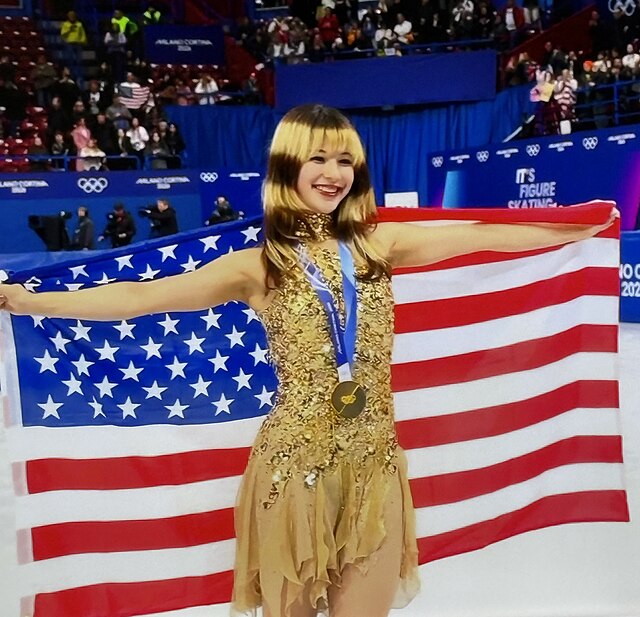
The most intense discussions surrounded figure skater Alysa Liu and freestyle skier Eileen Gu (or Gu Ailing). The two have quite a lot in common: they were both born in California to one white American parent and one Chinese parent. They are both extremely accomplished athletes and 2026 gold medallists. They are both internet sweethearts. Yet, while Liu competes under the US flag, Gu has chosen to represent China.
The 2022 Winter Olympics, which took place in Beijing, already brought the geopolitics of China’s global rise to the fore. In 2026, Americans dealt with this rise by minutely analyzing and criticizing the identities and behaviors of these two young athletes. The biographies and choices of Liu and Gu quickly became two diverging models for Chinese Americans’ choices in a world marked by geopolitical rivalry.
Liu’s success made her a model of the good immigrant in the eyes of the US right. It did help that her father was a 1989 dissident who was allegedly approached by (and who rebuffed) Chinese spies before his daughter’s first trip to China for the 2022 Olympics. Even the House Republicans posted on Twitter/X celebrating her gold medal.
The fact that Liu is one of the US athletes who criticized ICE and the US administration did not faze them. Her politics, her alternative looks, and her rather individual approach to the demands of elite athleticism will not stop Republicans from claiming her as their own. As the conservative magazine National Review writes, Americans should look beyond the culture wars and embrace a good old story of hard work and success. Despite her “typical woke Gen Z girl” persona, Liu embodies “the American spirit of both self-determination and creativity.”
Gu, on the other hand, is a traitor. So says JD Vance himself, who singled her out as the ungrateful type of minority. Having benefited from American education and training, her choice to represent China comes as a defection to the enemy. Even those who do not accuse her of treason always make sure to throw in caveats. Gu has criticized US politics, but never the human rights abuses in China. Gu’s family does not have the same dissident credentials as Liu. Gu has never made it clear how she can compete for China, which does not allow double citizenship.
The first comment on the National Review article about Liu starts with a confession: “I have to Google them to know Alysa Liu from Eileen Gu.” Still, this one internet user unapologetically takes sides: “I’ll root for Alysa to win, and I’ll root for Eileen to lose….to anyone.” This is the perfect distillation of the crass identity politics playing out in these discussions. Liu and Gu are erased as individuals with complex life stories by people who see migrants or non-white Americans as interchangeable vessels for their political grievances and geopolitical anxieties.
The two Chinese-American athletes were not the only sign of much larger issues at the Milan-Cortina Olympics. As with every edition of the game, in summer or in winter, the Olympics went way over the initial estimated budget. Milan spent money that it did not have on an infrastructure that disturbed its city fabric, and that will become obsolete as soon as the Paralympic Games end in March.
Jules Boykoff, who has studied the politics and economics of the Olympics, calls this “celebration capitalism.” The money that goes into events such as the one in Italy comes from the workers and the impoverished in the events’ locations and goes into the pockets of corrupt officials and multinational corporations. Even athletes do not financially benefit from the Games, as they receive much less than in other international competitions. As the bill for the Olympics gets higher, the organizers are looking more and more toward financial markets.
The next editions do not look promising, either geopolitically or economically. After the FIFA World Cup this year, the 2028 Summer Olympics will also take place in the US, in Los Angeles. Both events raise concerns about the safety of fans and athletes travelling to what becomes more of a police state every day, and about the legitimacy and reputation that this will offer the US. And, of course, Los Angeles will have to spend money that it does not have on a project that will lead to the displacement and repression of its infamously high homeless population.
The 2034 Winter Olympics will also take place in the US, in Salt Lake City, for a cost that is already estimated at $200 billion. If Kai Wegner has his way, Berlin might also have to foot a similarly high bill, as CDU pushes for the German capital to host the Games in 2036, 2040, or 2044. As campaigners against the application have pointed out, this is money that Berlin does not have in a time of budget cuts in education, social services, and culture. But it is also a huge political symbol that should raise more eyebrows than an athlete choosing to compete for China, as 2036 would be the hundredth anniversary of the Games organized by Adolf Hitler.
The prospect of a ridiculously expensive, Nazi-reminiscent edition of the Games in Berlin makes it clear that the Olympics intersect money with the politics of nationalism. This is nowhere more visible than in the organization of the Olympics, and of similar global and regional sporting events, along the lines of nation-states. Exceptions exist, some dubious, like the AINs, some more laudable, like the Refugee Olympic Team. But the vast majority of athletes have to compete under a flag.
Nationality in sports is, of course, flexible, sometimes to the extent of revealing the sham. At the 2026 Winter Games, no sport made this more obvious than figure skating. One choreographer went viral for being caught on camera hurriedly changing jackets of different national teams to keep up with all of the athletes he works with. The task was not easy, as the choreographer was on the staff of 16 athletes from 13 countries.
The skaters themselves seem to be similarly little bound by loyalty to their countries. The sport is infamous for Russian-born athletes who participate as representatives of other national teams, but also for skaters simply shopping around for partners and funding. One athlete born in Michigan represented Lithuania in Milan, after competing under the Georgian and Israeli flags in the past. It is natural then to wonder not only whether nationalities matter, but simply why we still pretend that they do.
The political discussions about the Winter Olympics show both how the nation-state continues to structure sport, but also how it restricts events and athletes’ actions. US athletes make statements against ICE and then win medals that add to the States’ tally and celebrate with the American flag. Choices about what nationality to compete under are either accepted as normal or become the subject of geopolitical scandals. Aggressor states participate or not in the Games based on powerplays and financial interests.
The Olympics try to walk a thin line of “nationalism without politics.” Insofar as many of us still tune in to the Games and feel some joy when athletes from our country win, they succeed. But the arbitrariness of their decisions and the impact that they have on political discourses and national economies give the lie to the IOC’s ambitions. As long as nations and governments continue to be an inherent part of sport, so will politics.