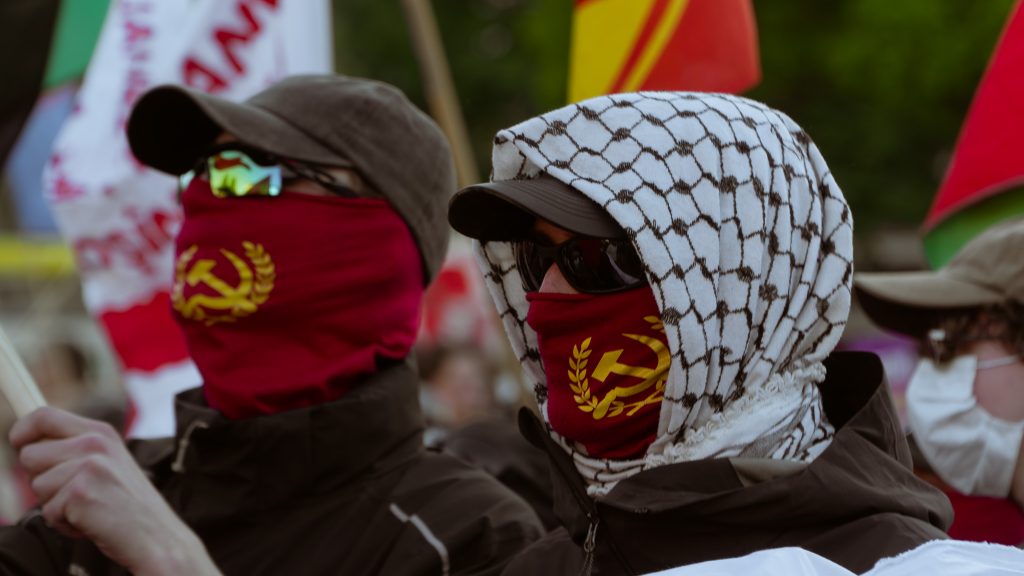


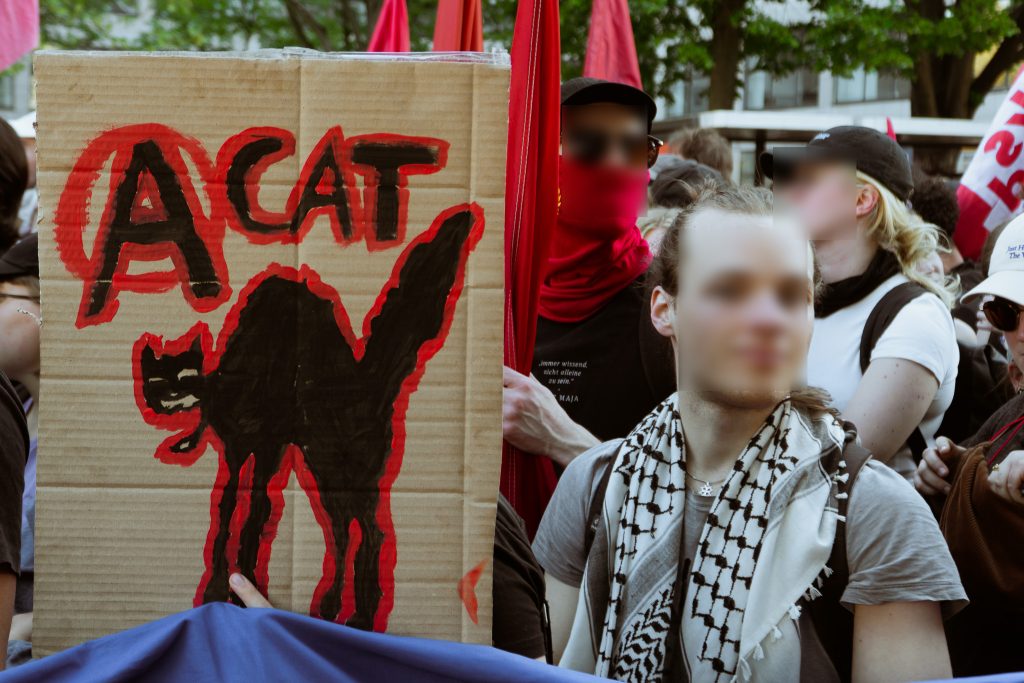
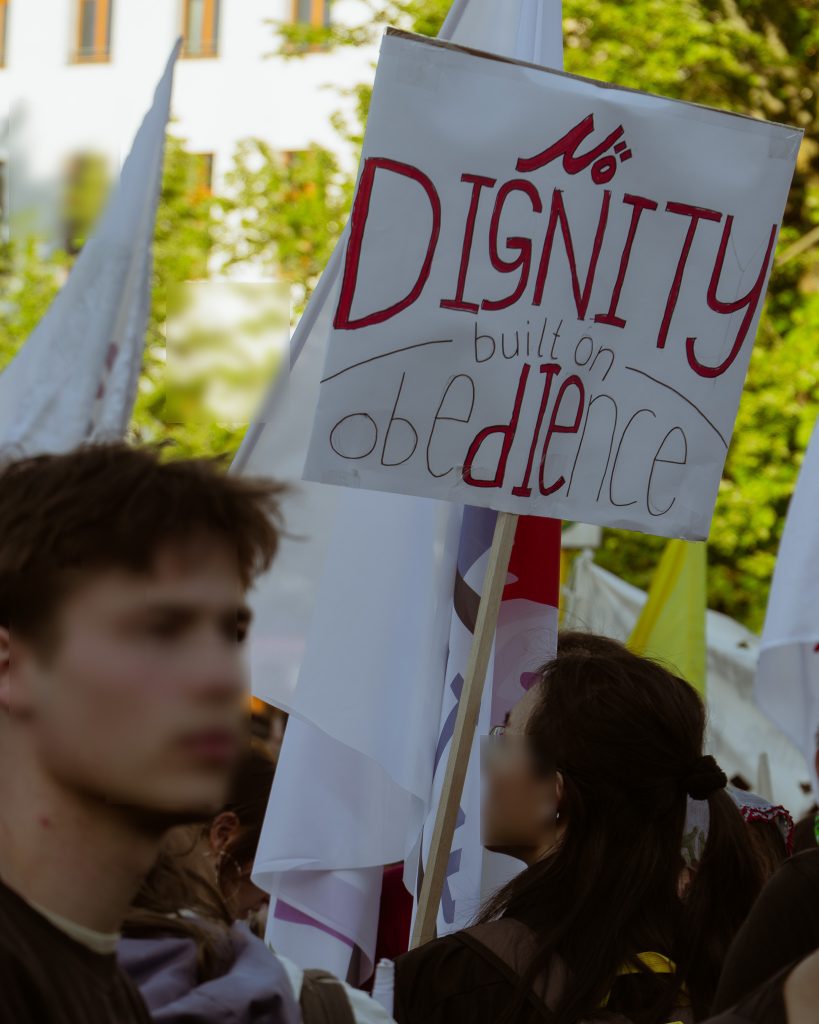
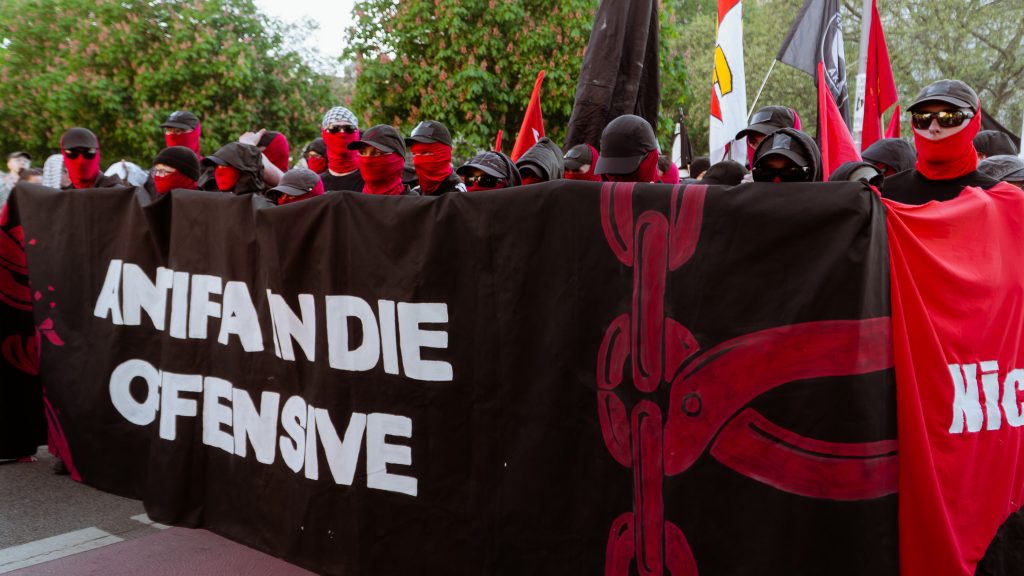
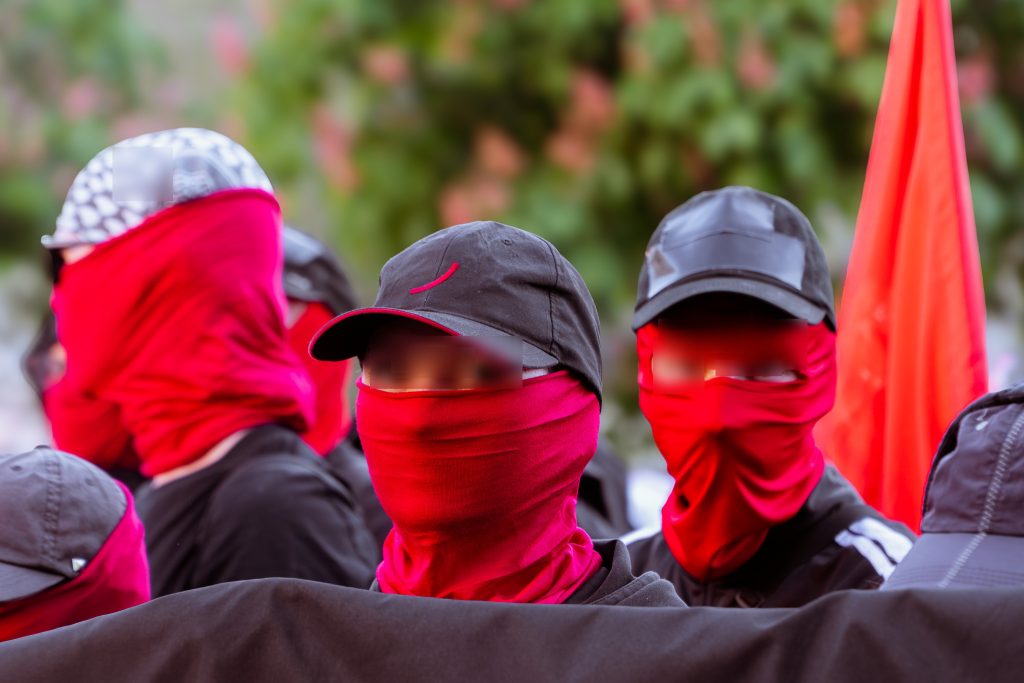
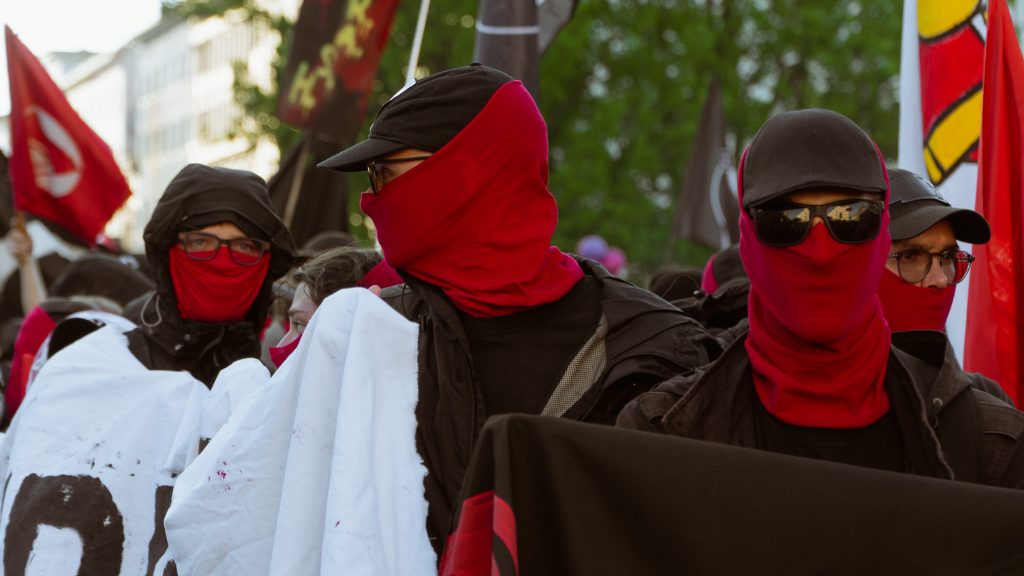
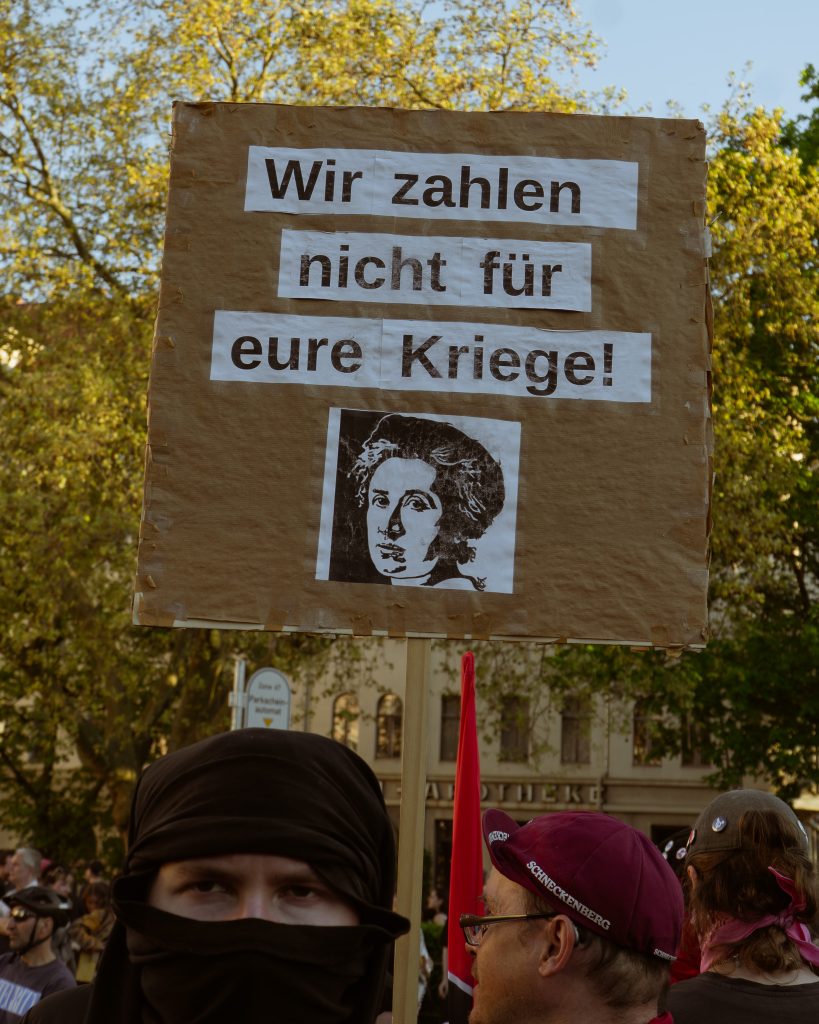
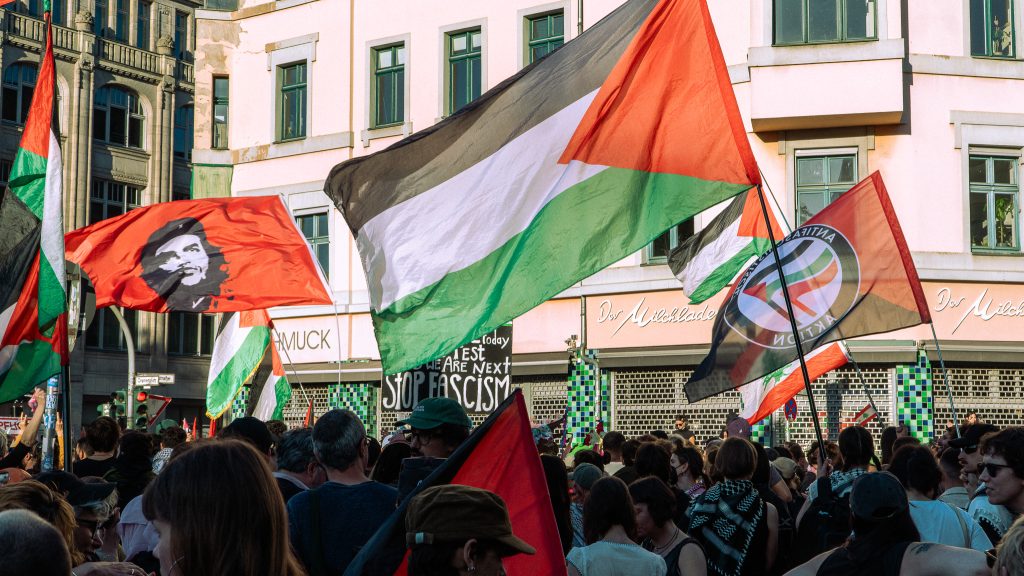
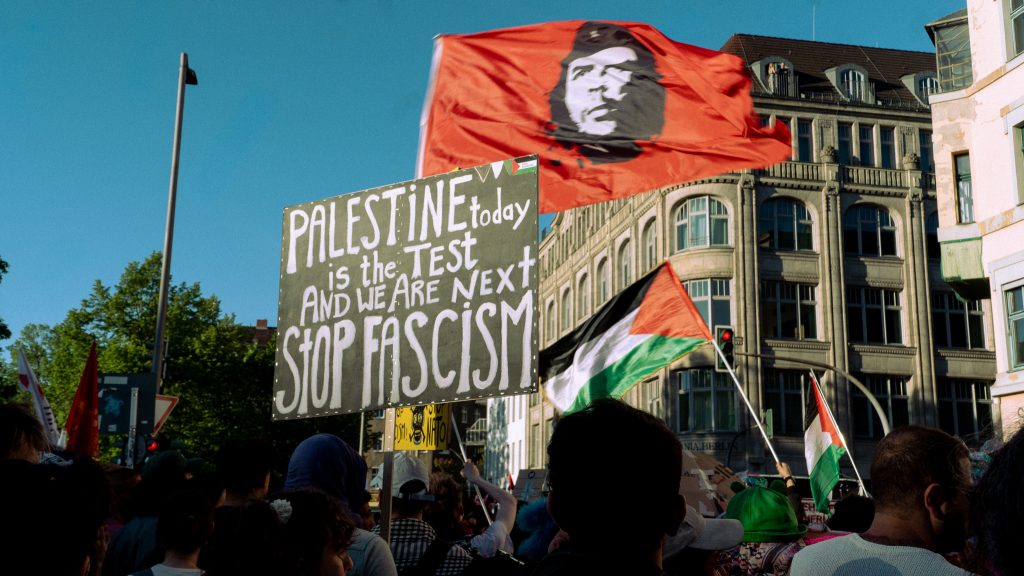
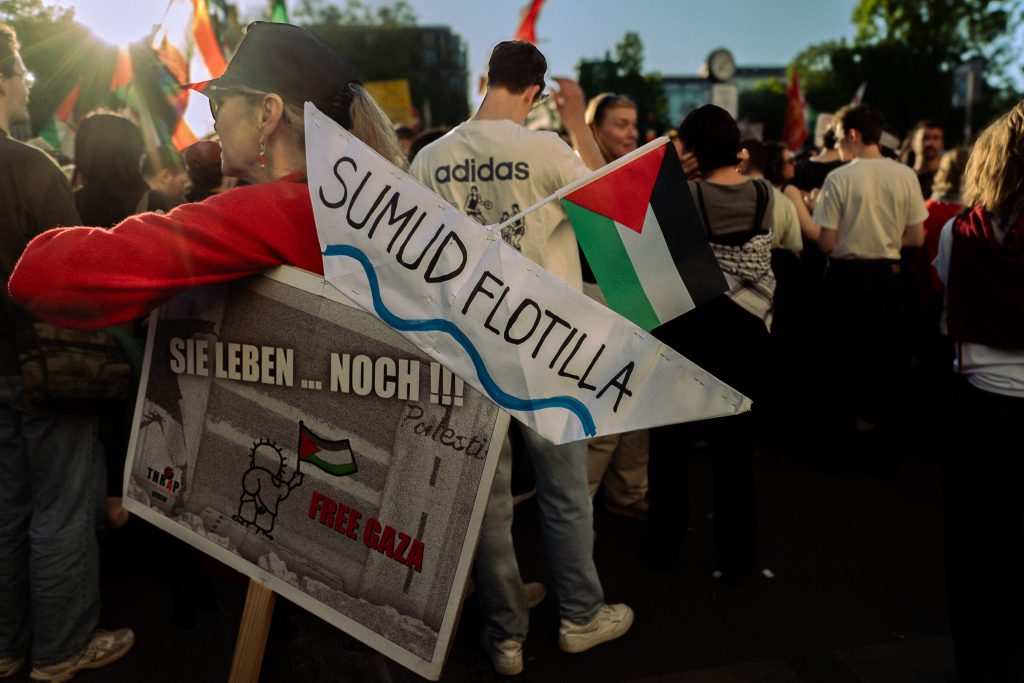
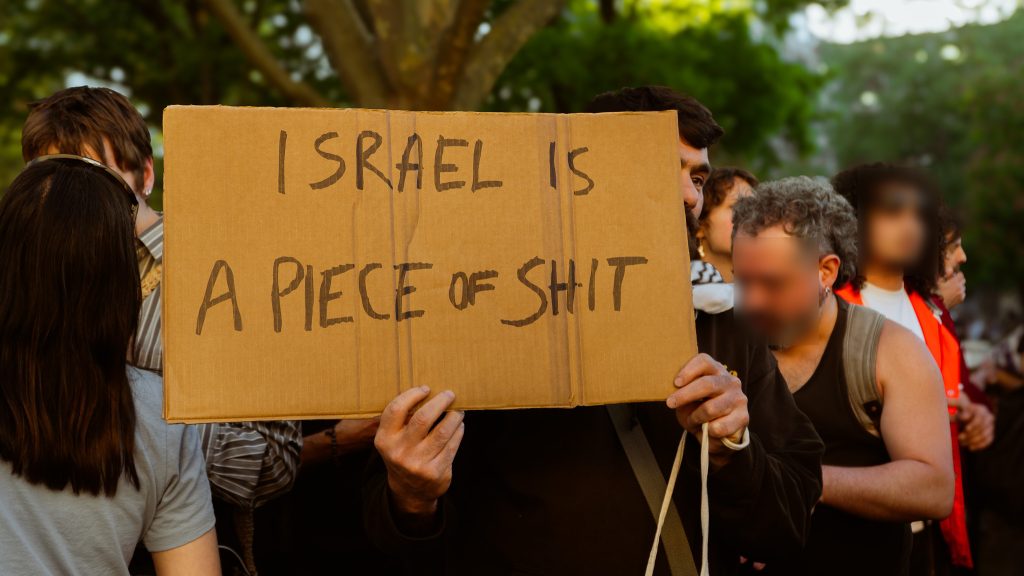
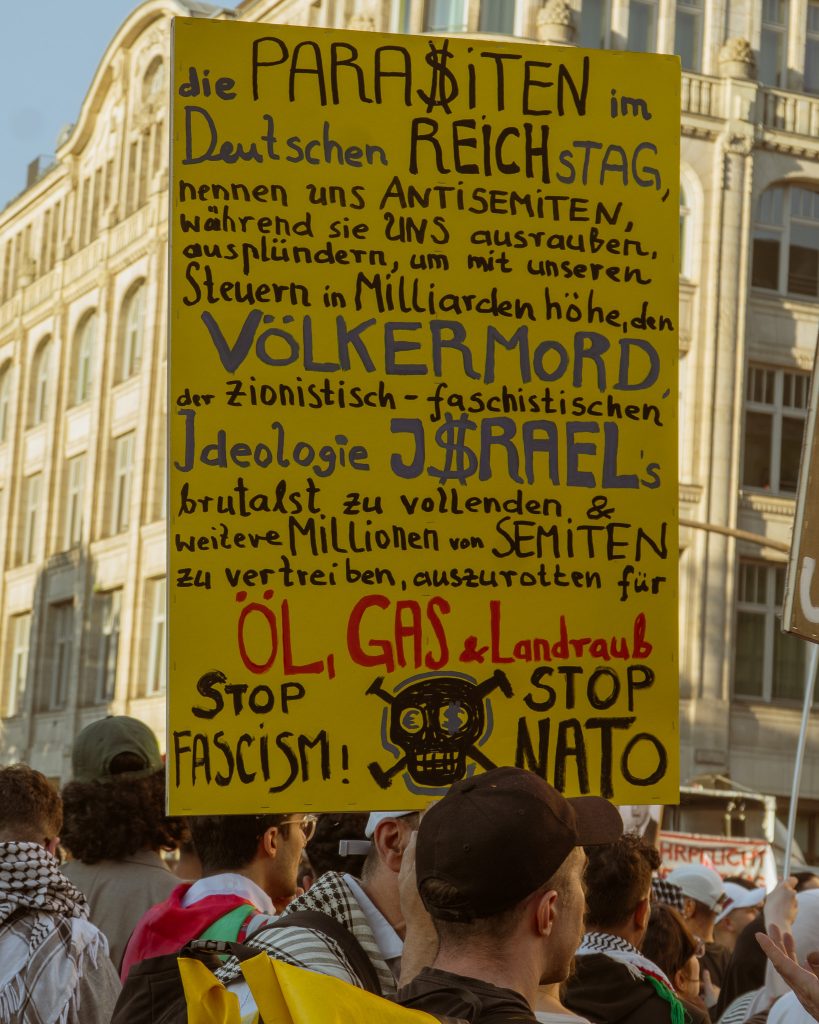
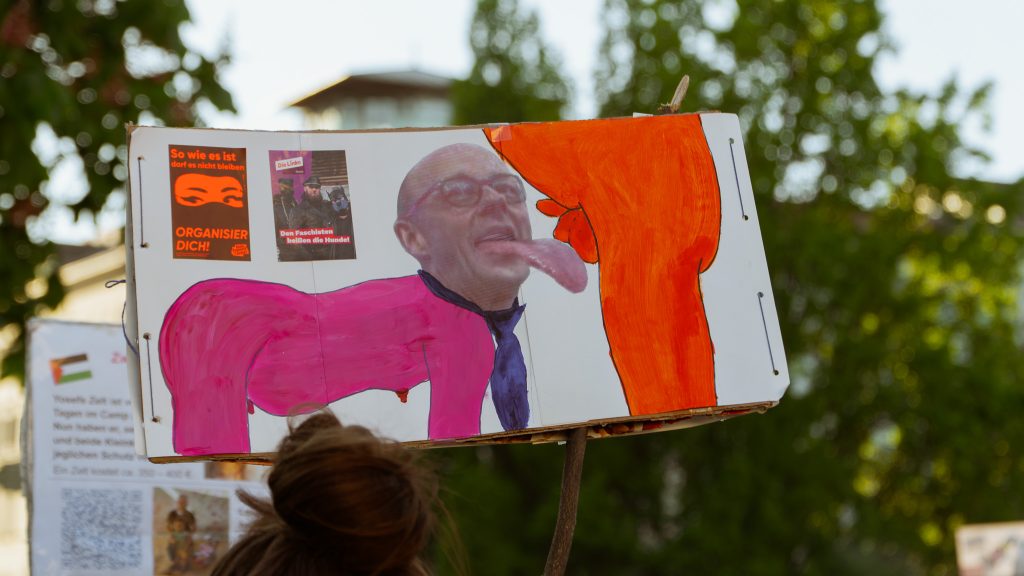
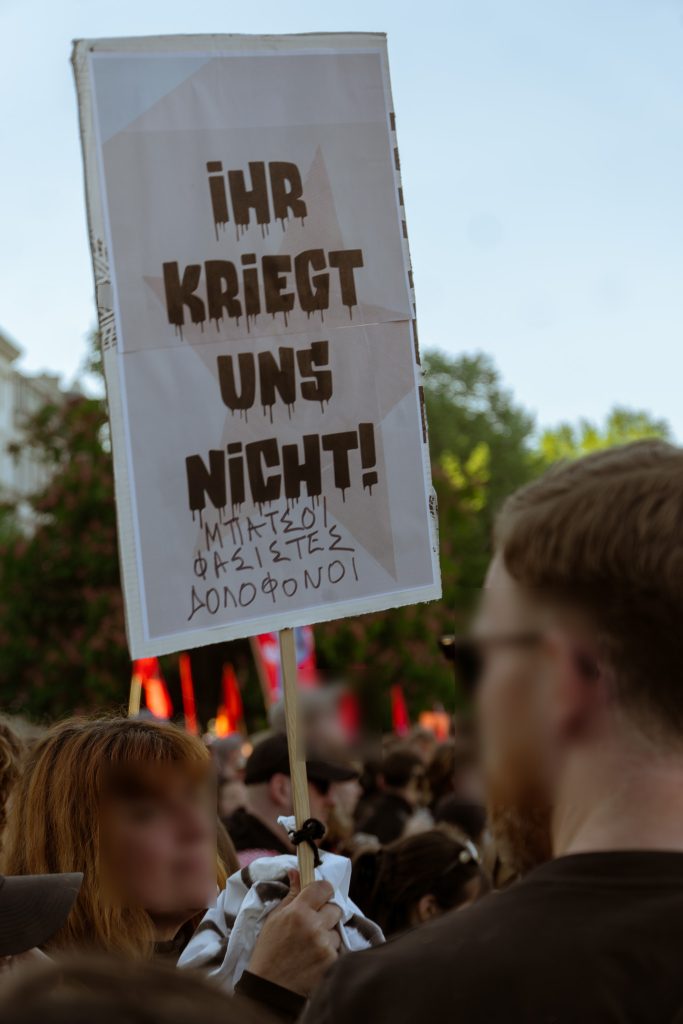

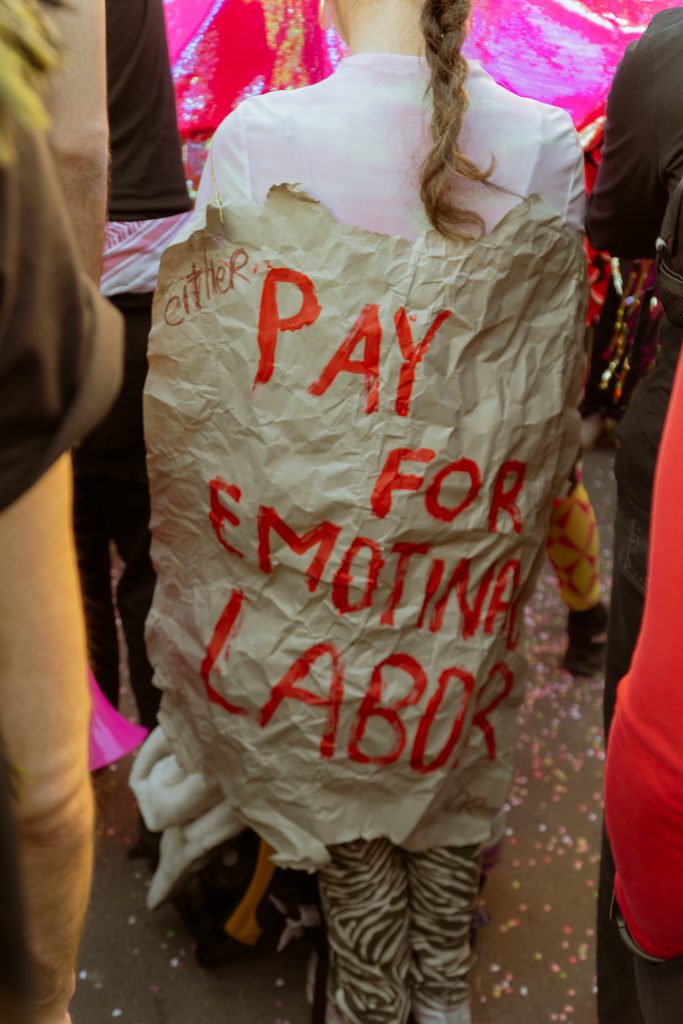
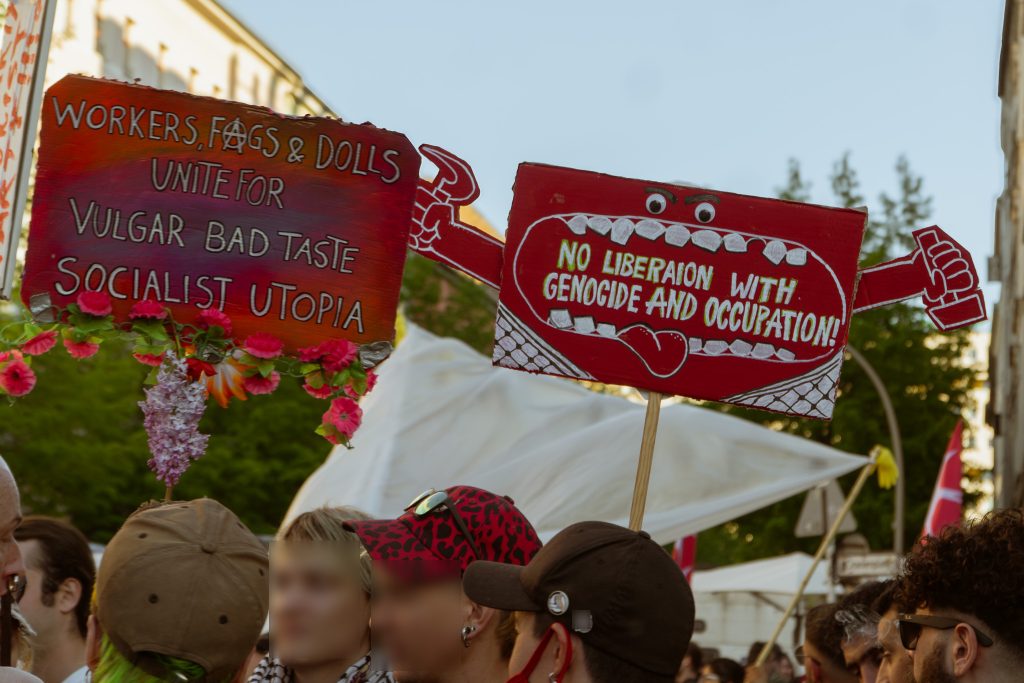
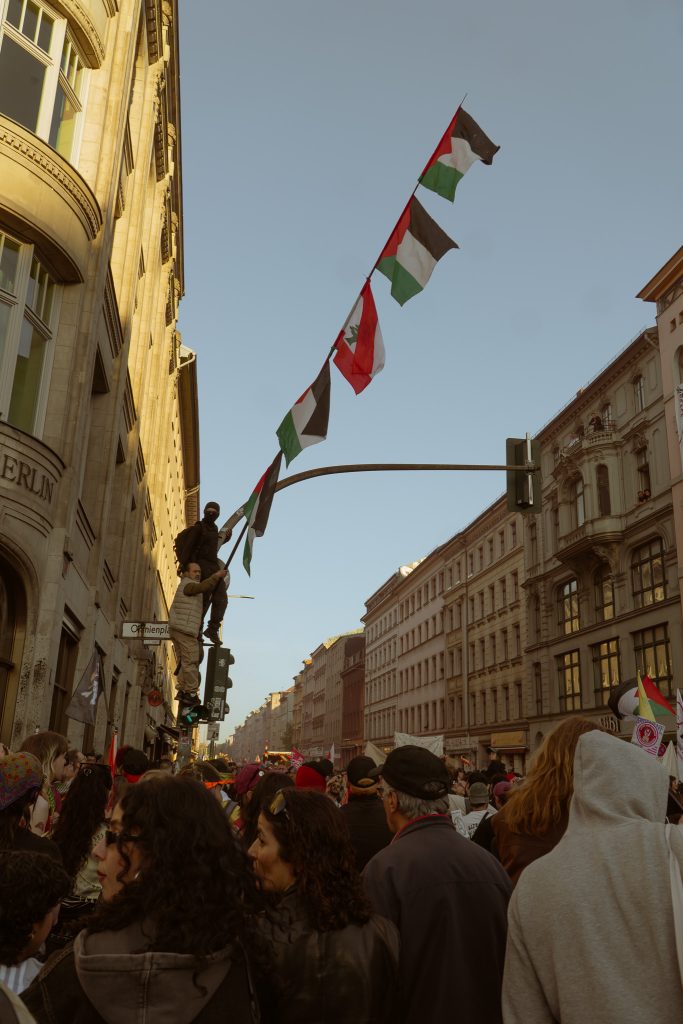
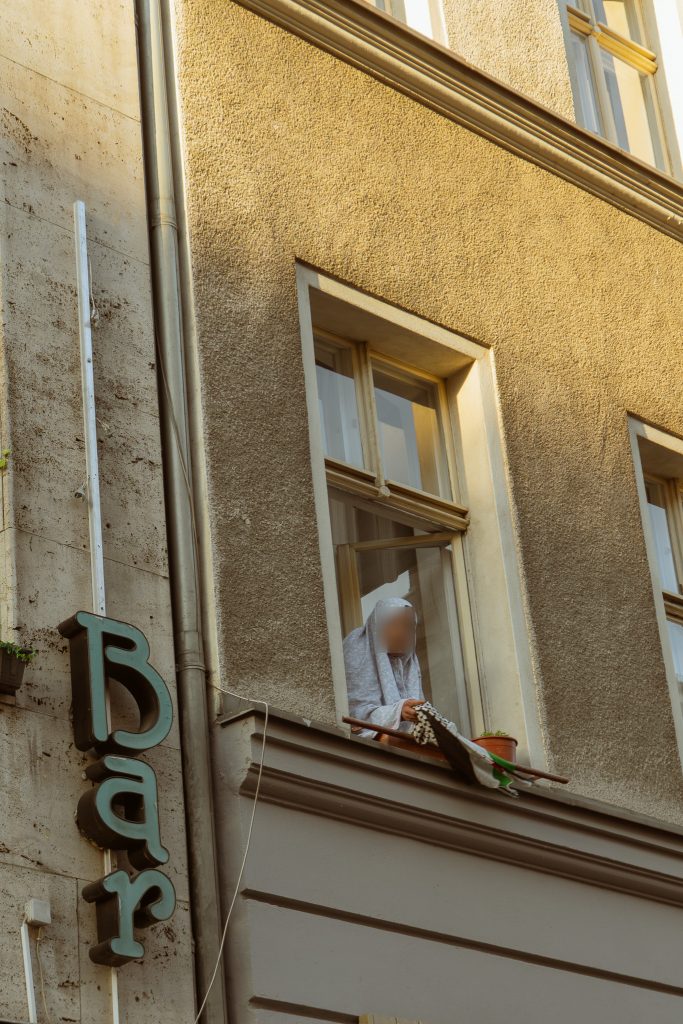
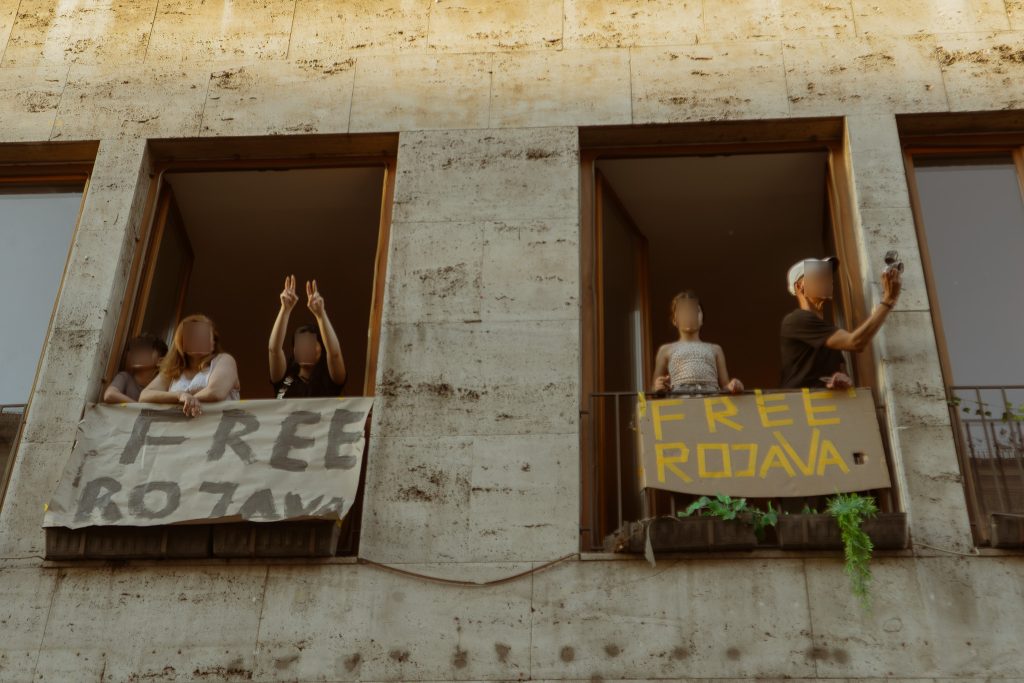

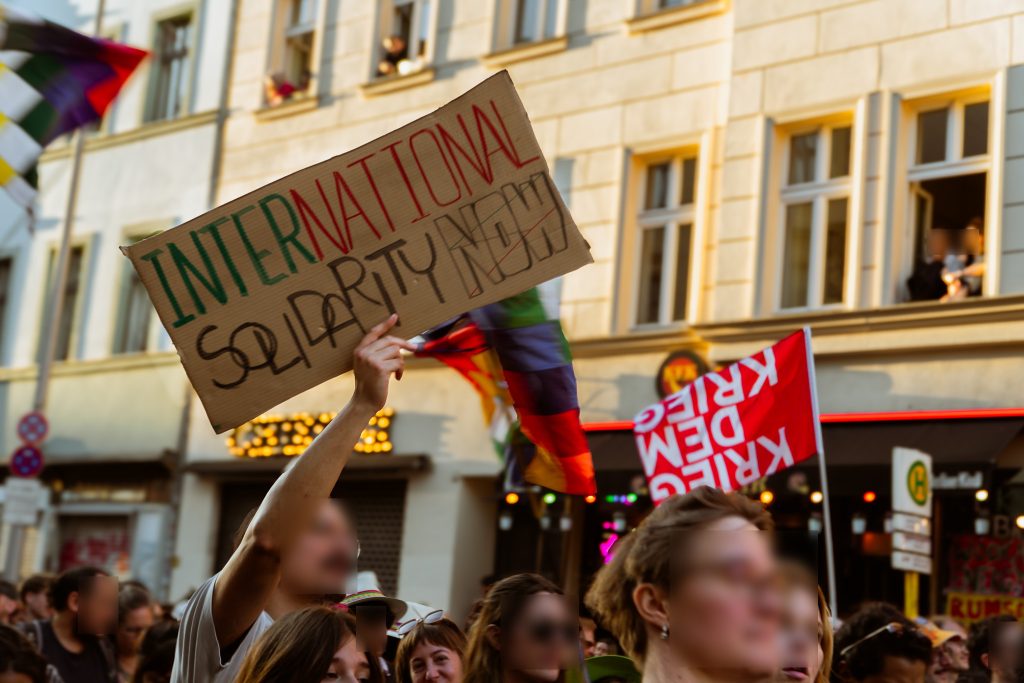
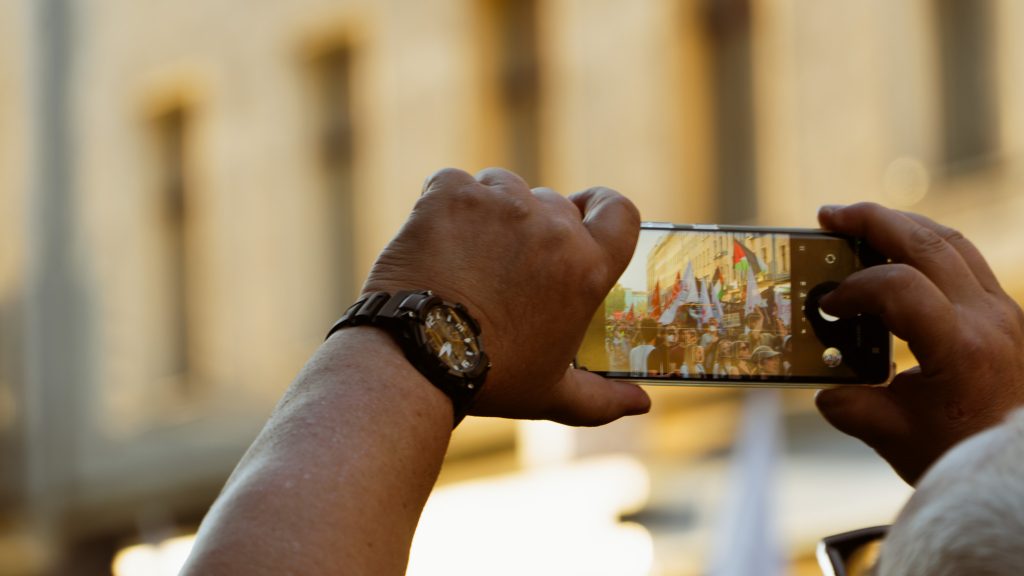
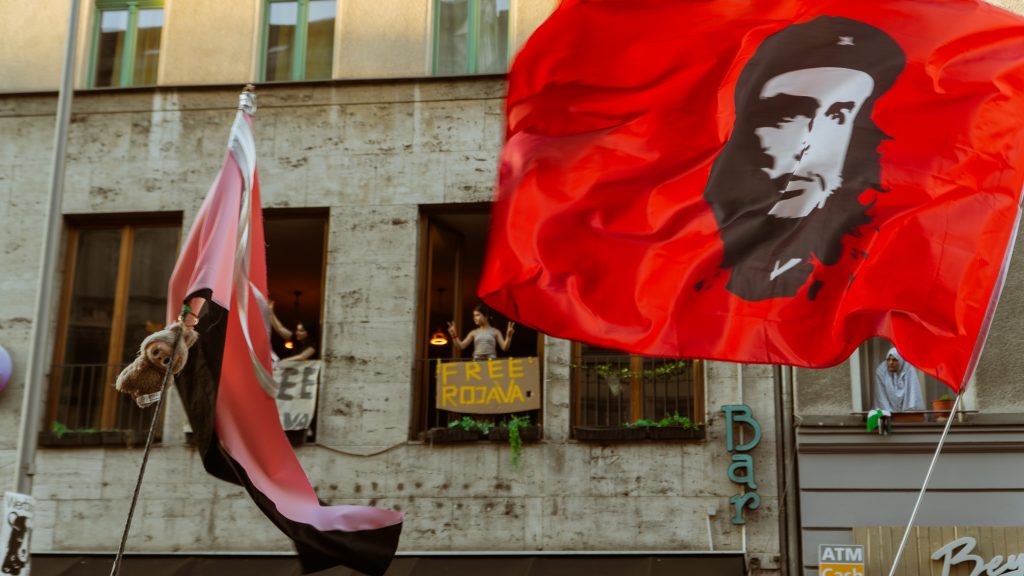
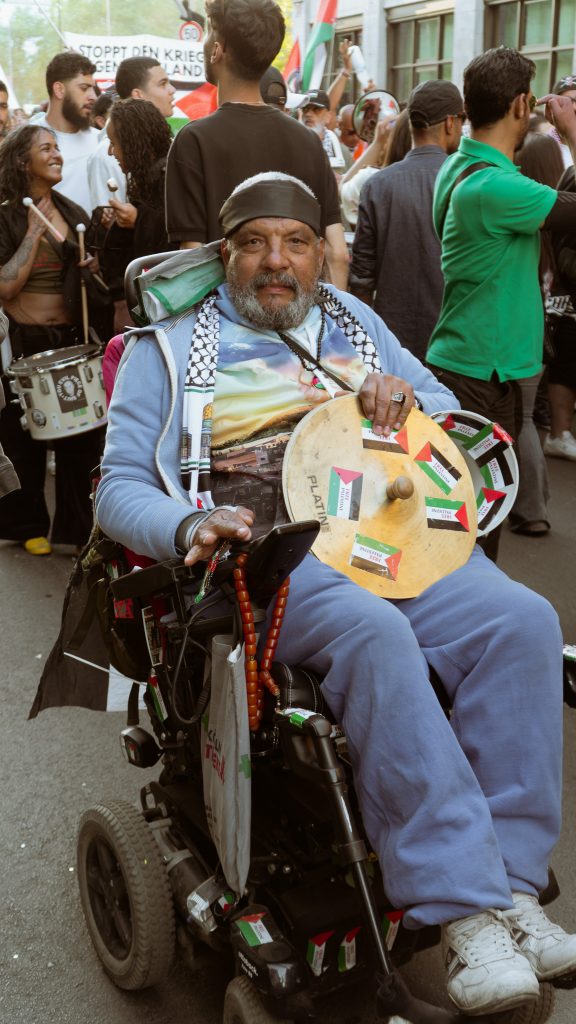
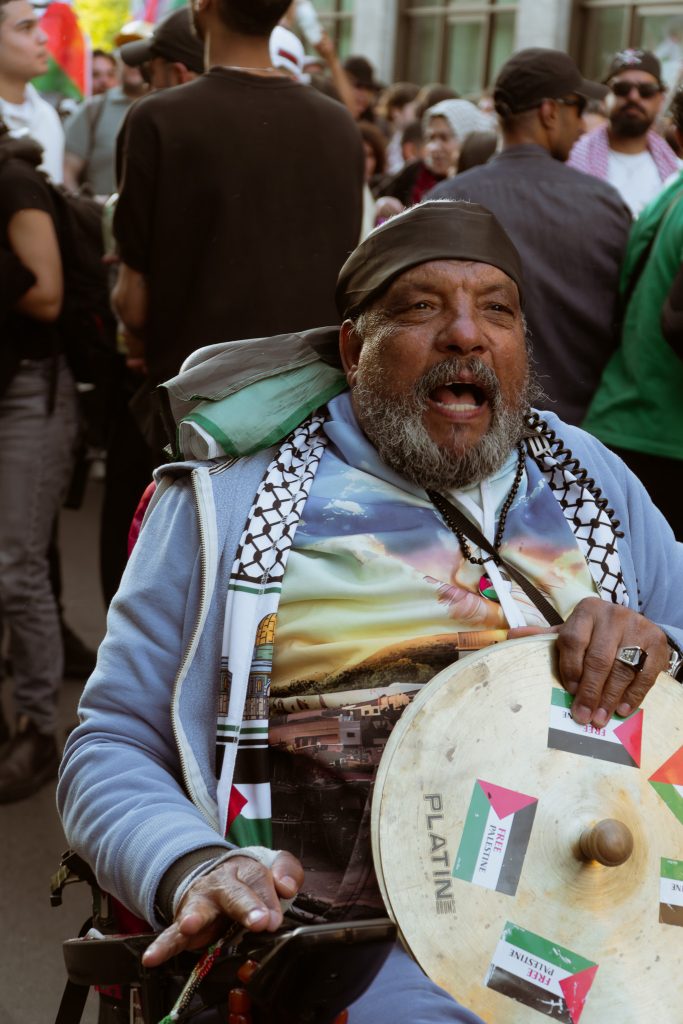
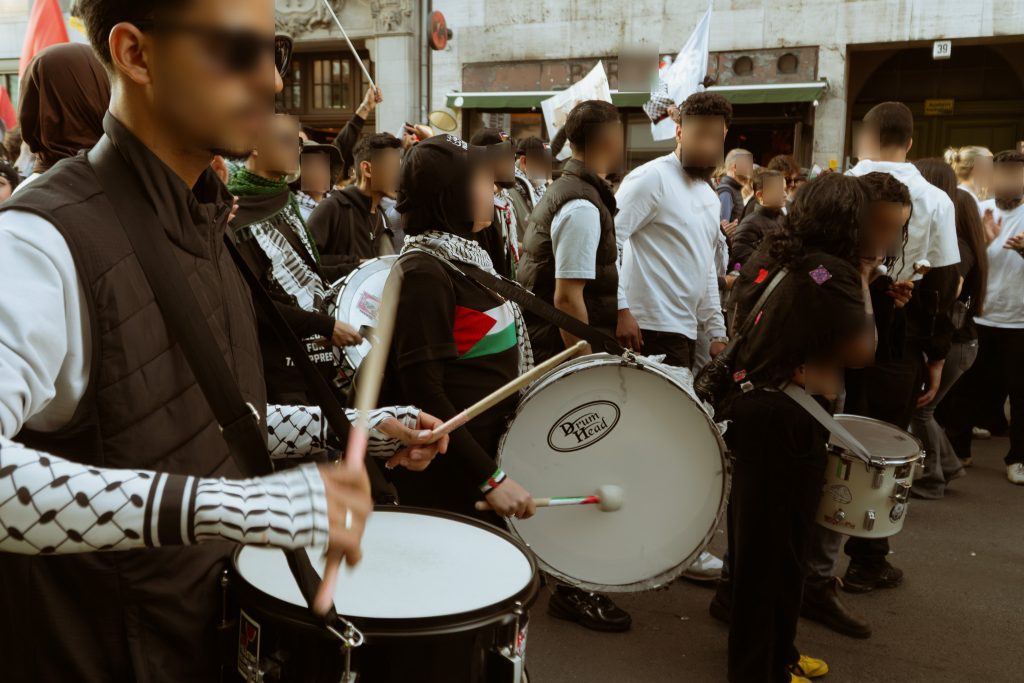
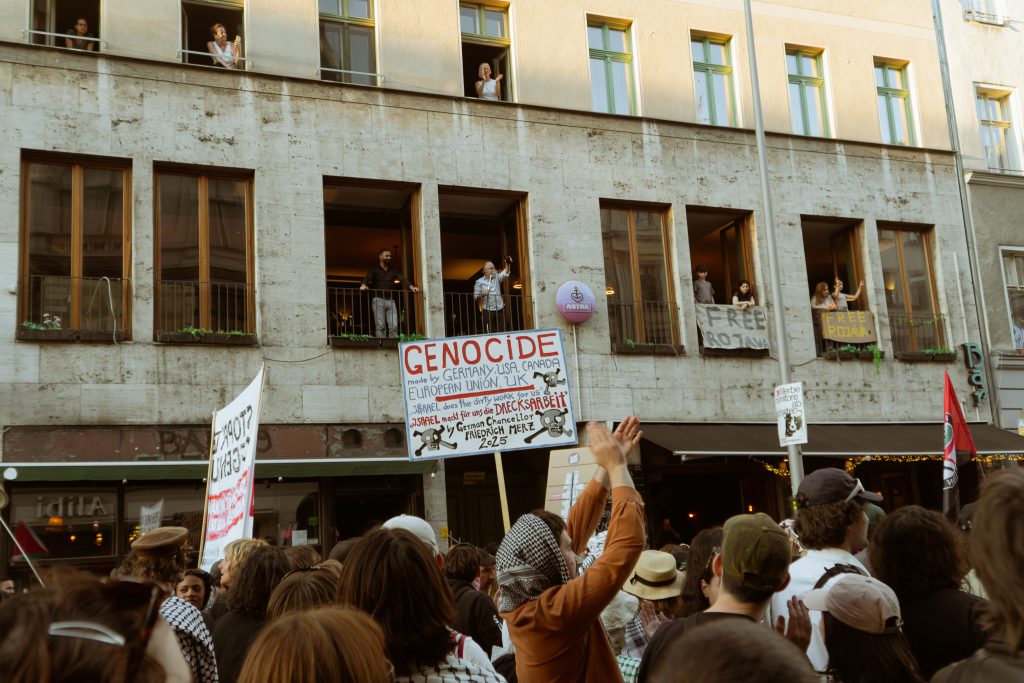
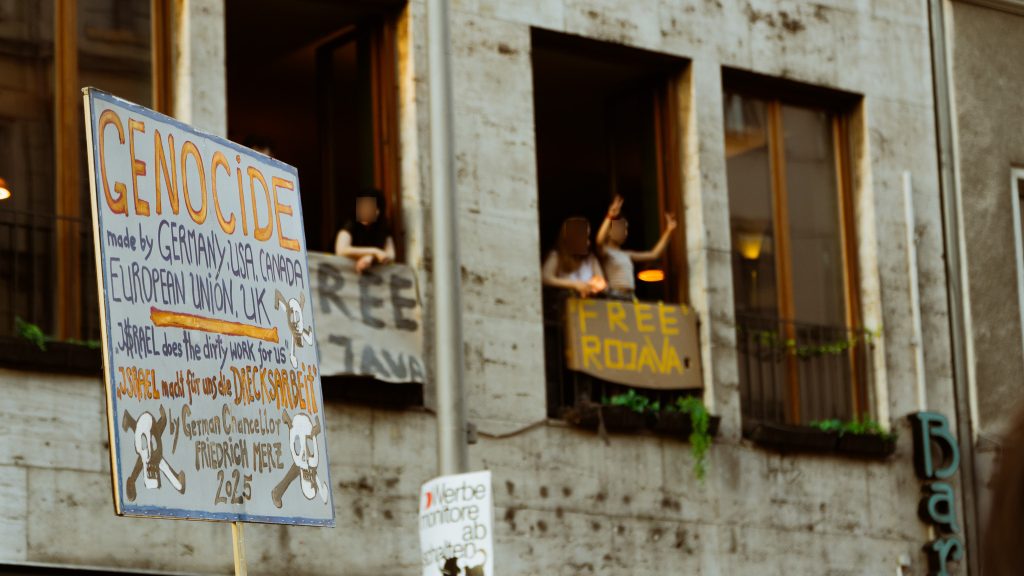
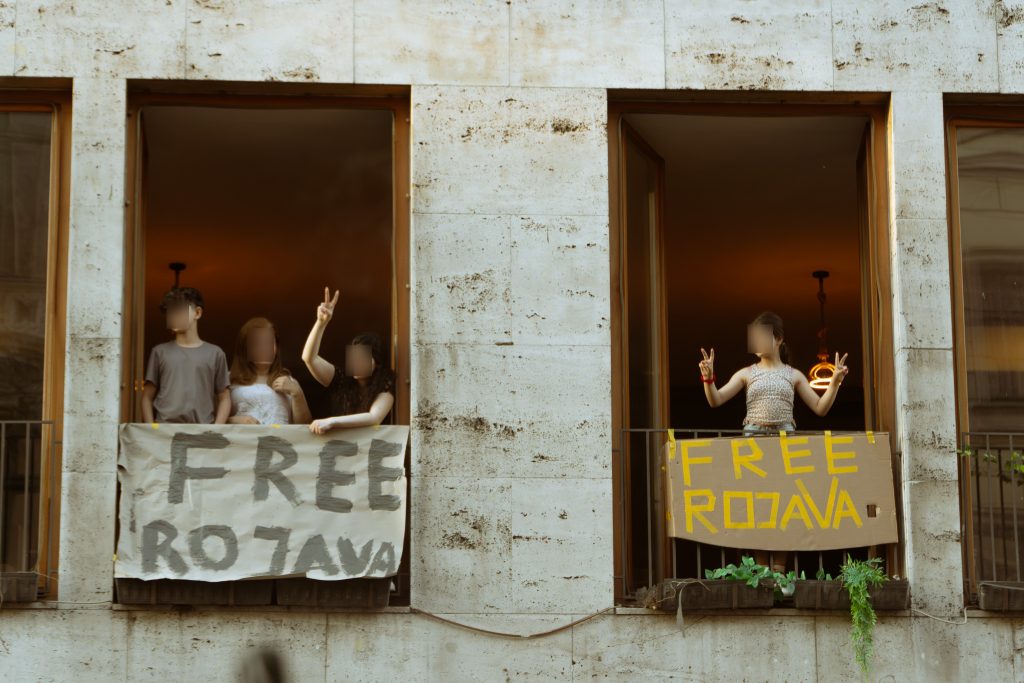
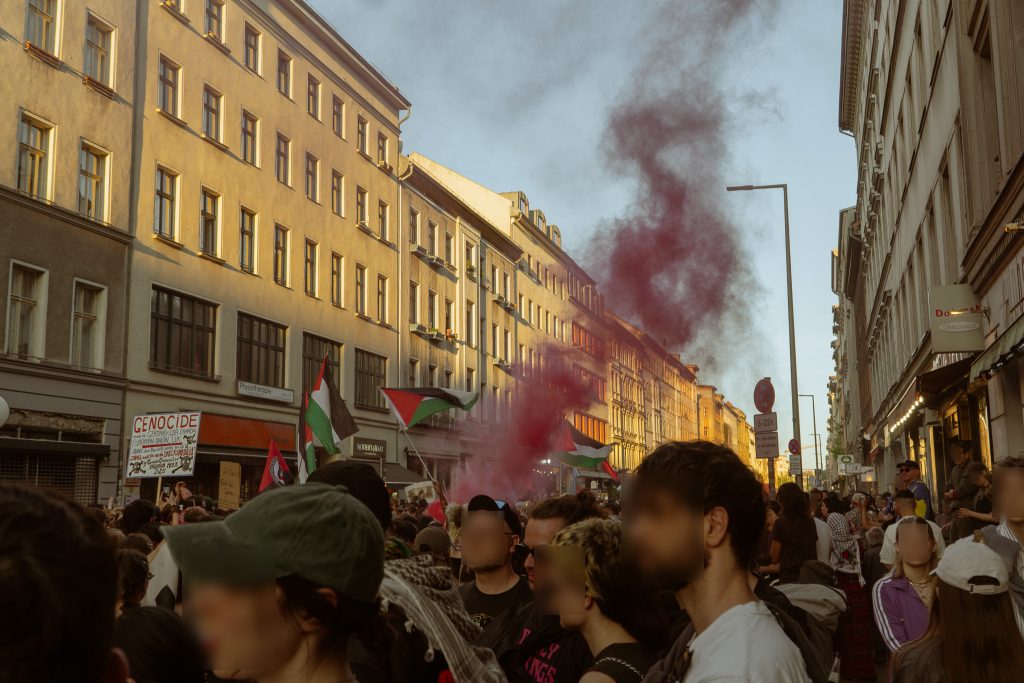
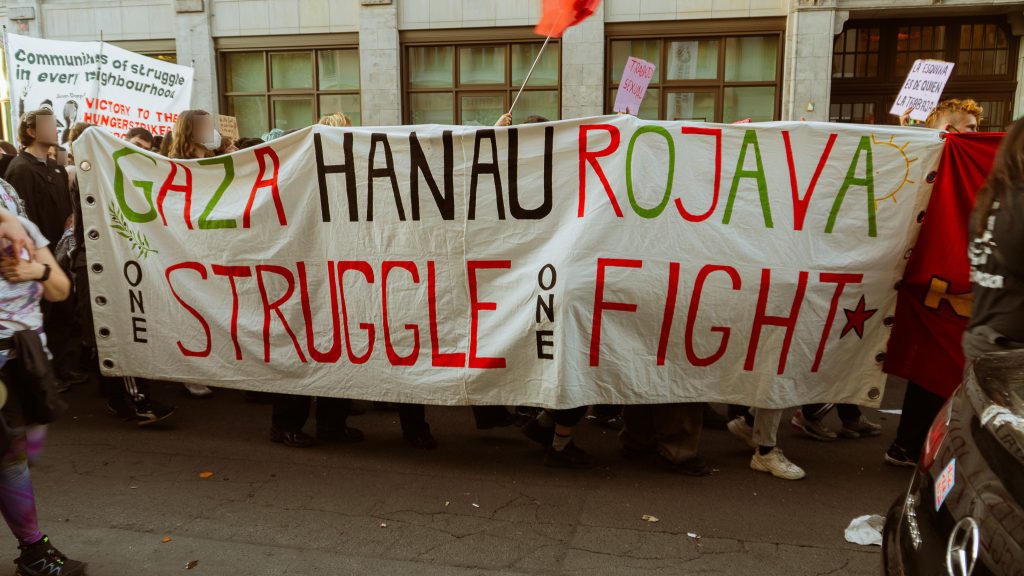
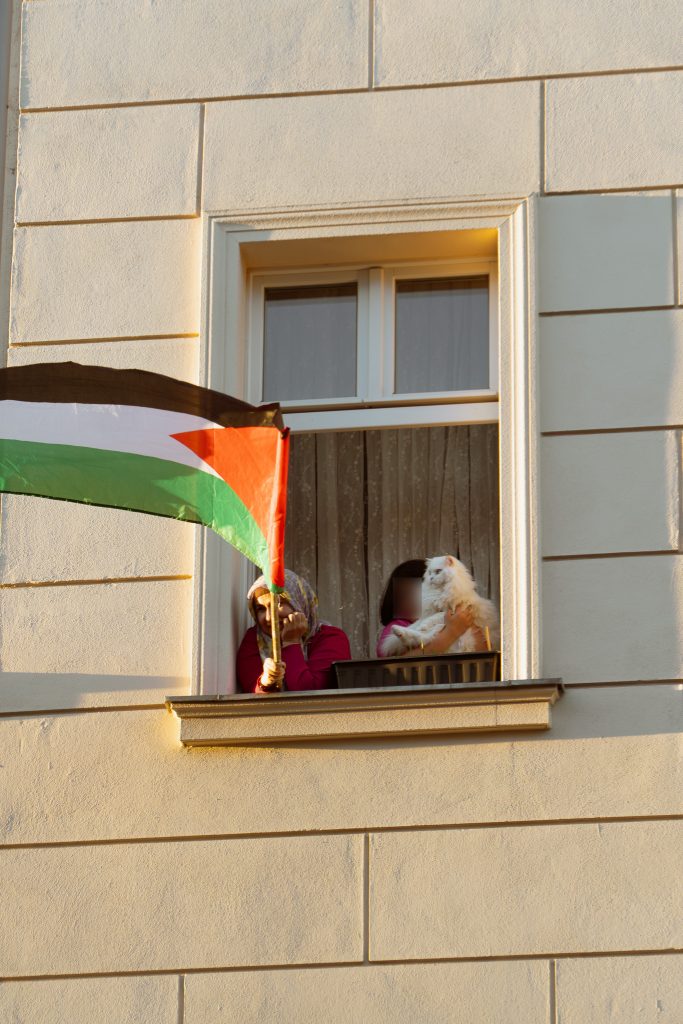
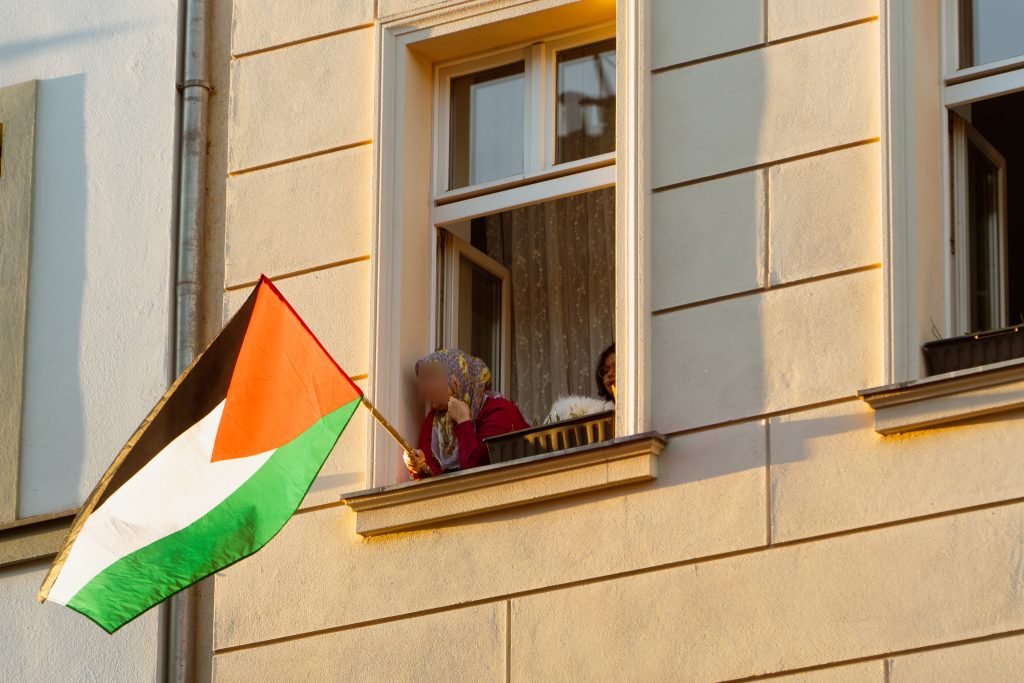
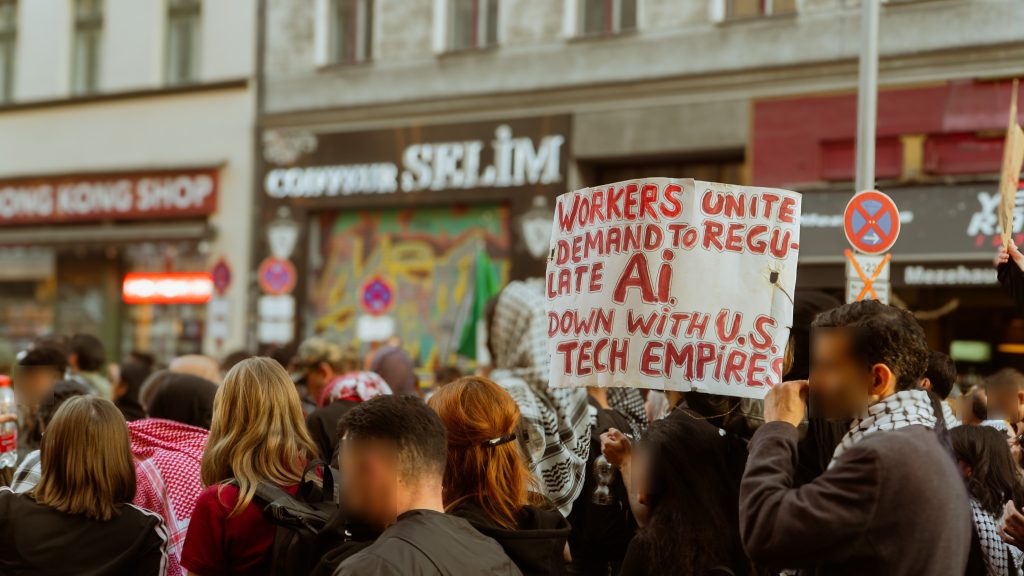
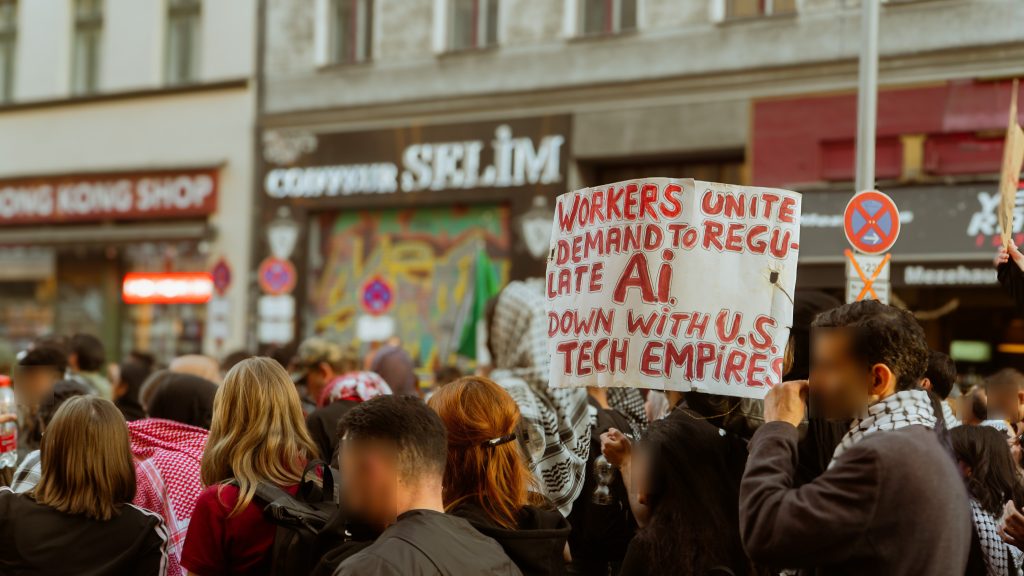
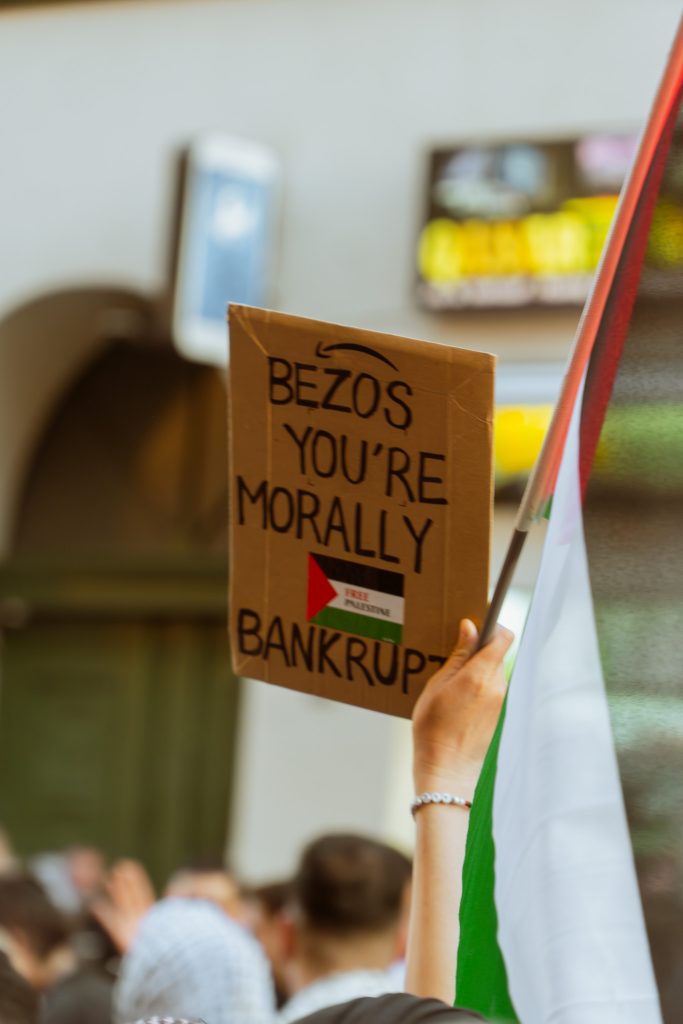

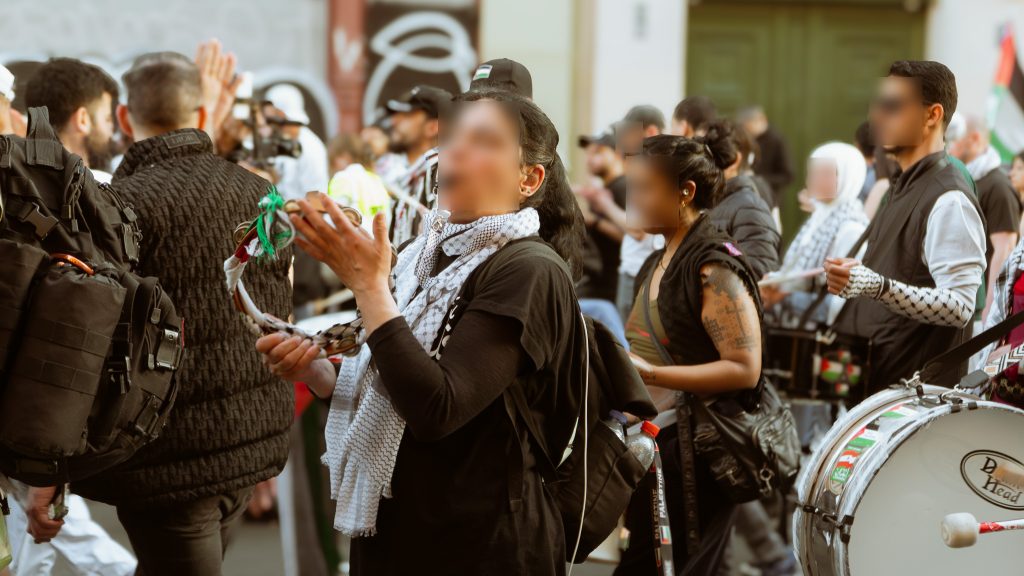
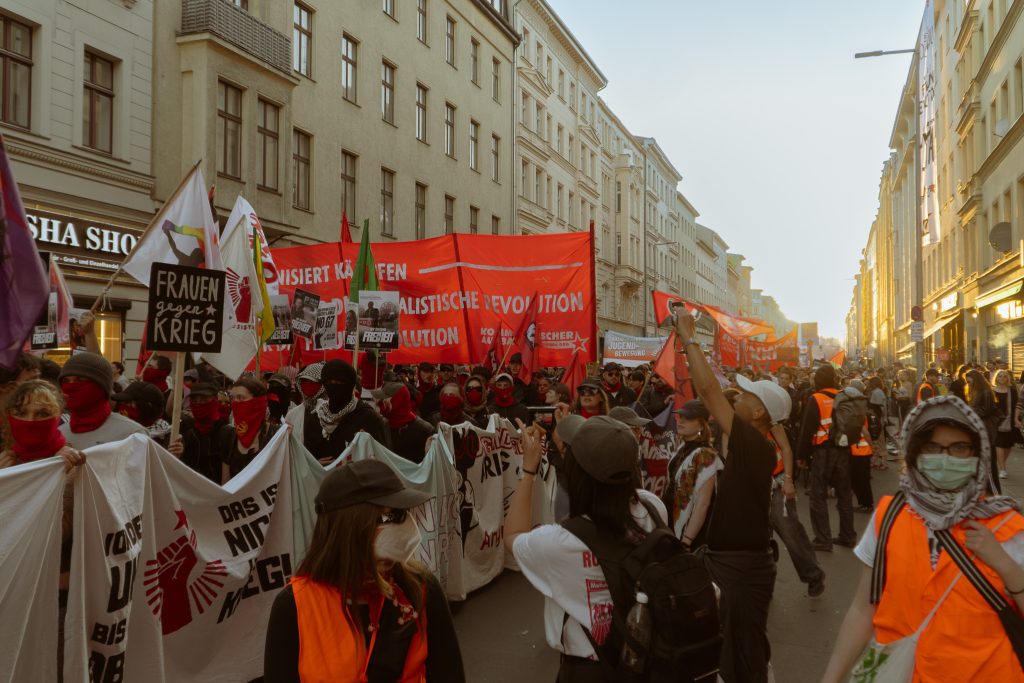
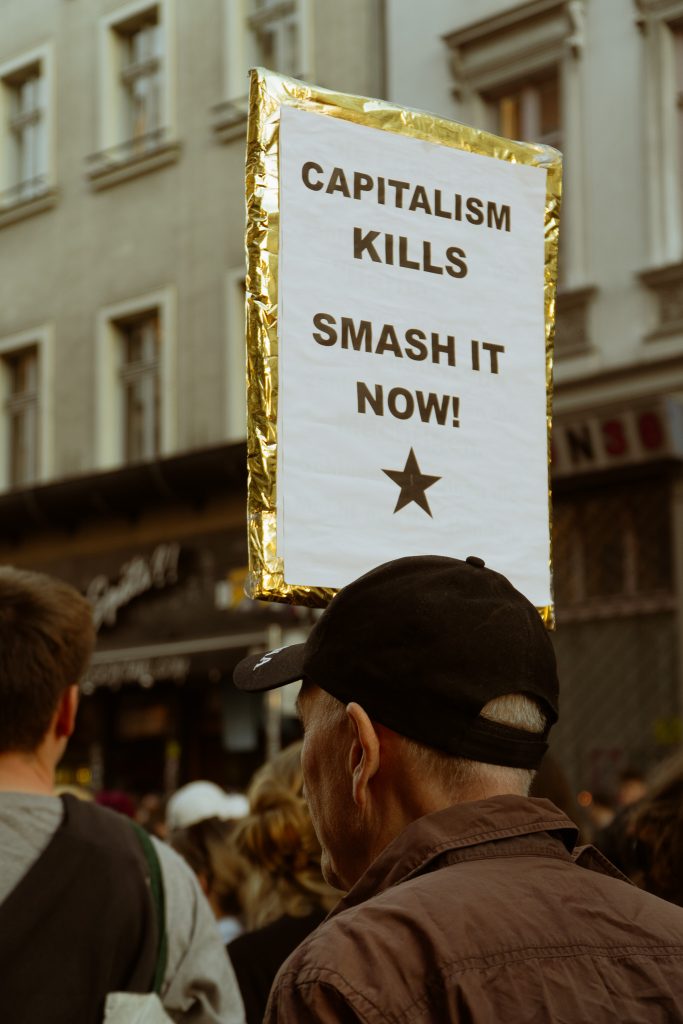

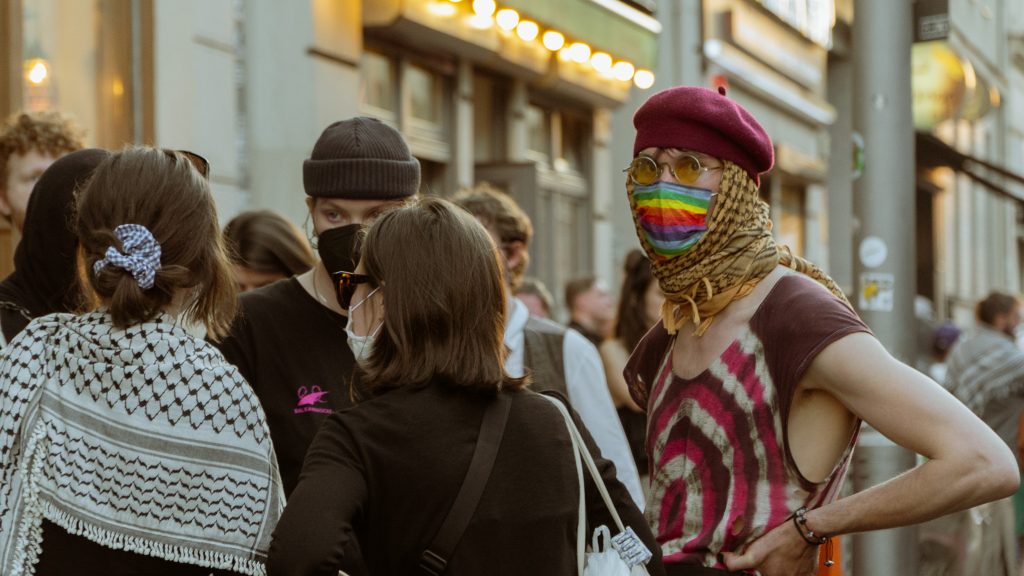
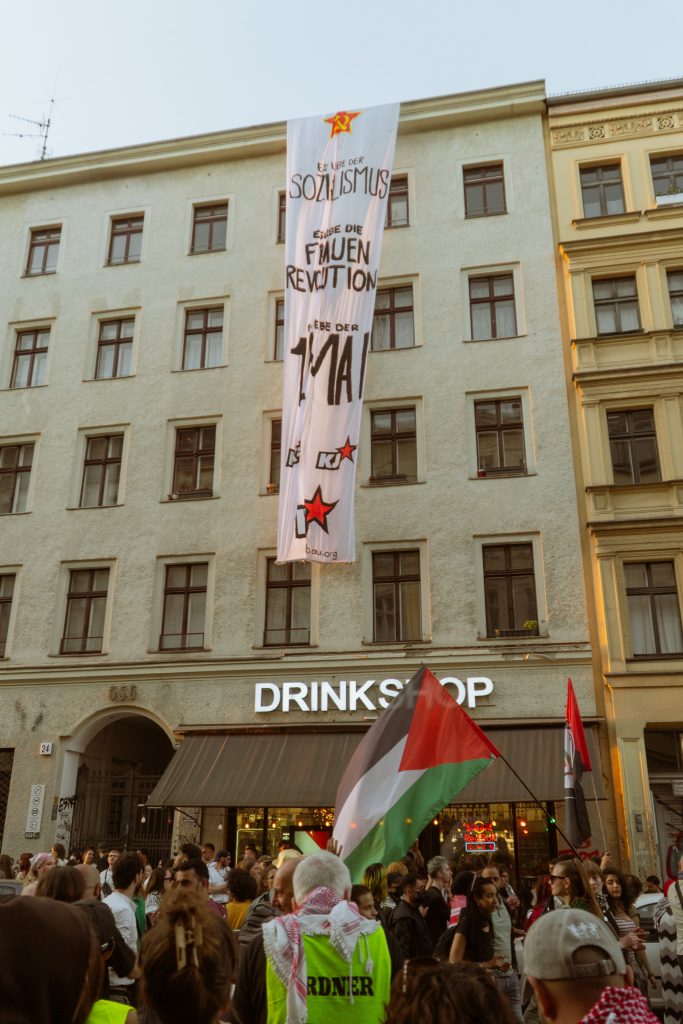
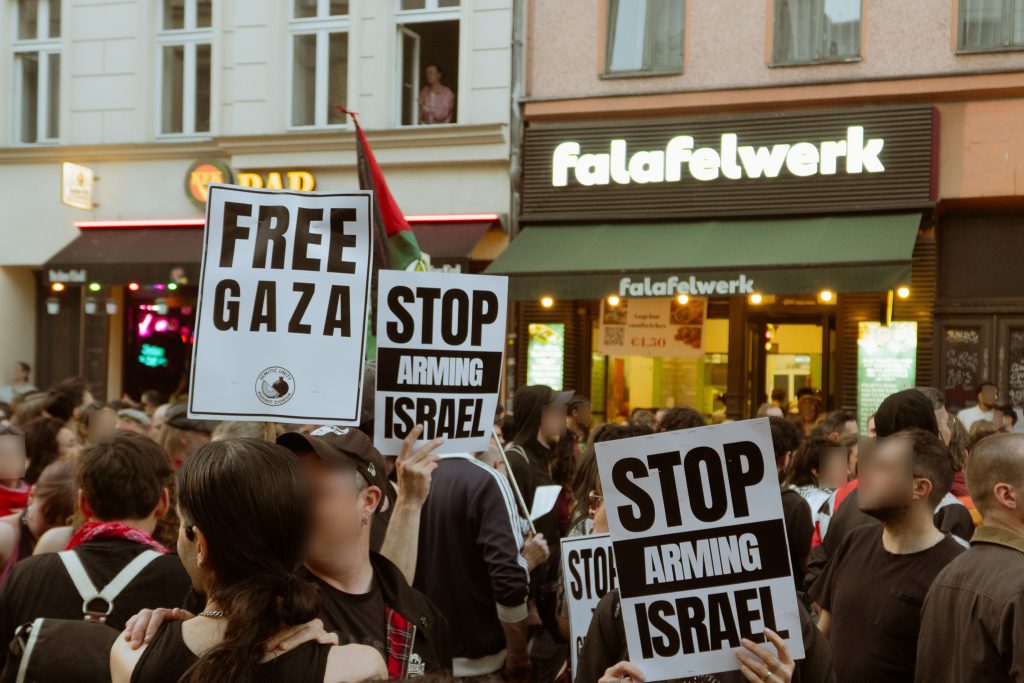
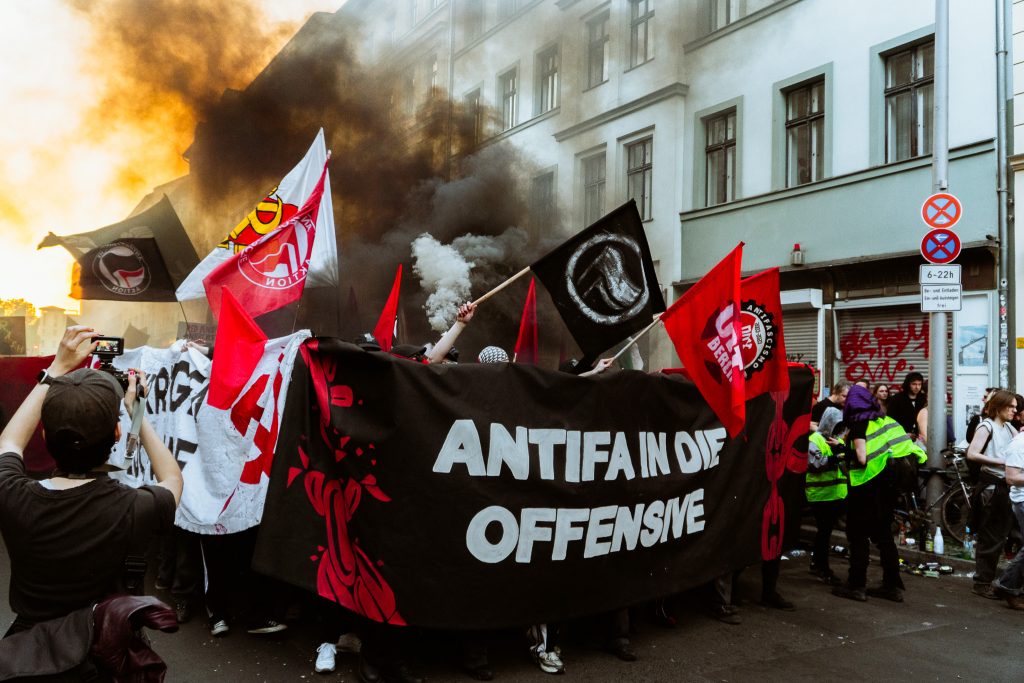
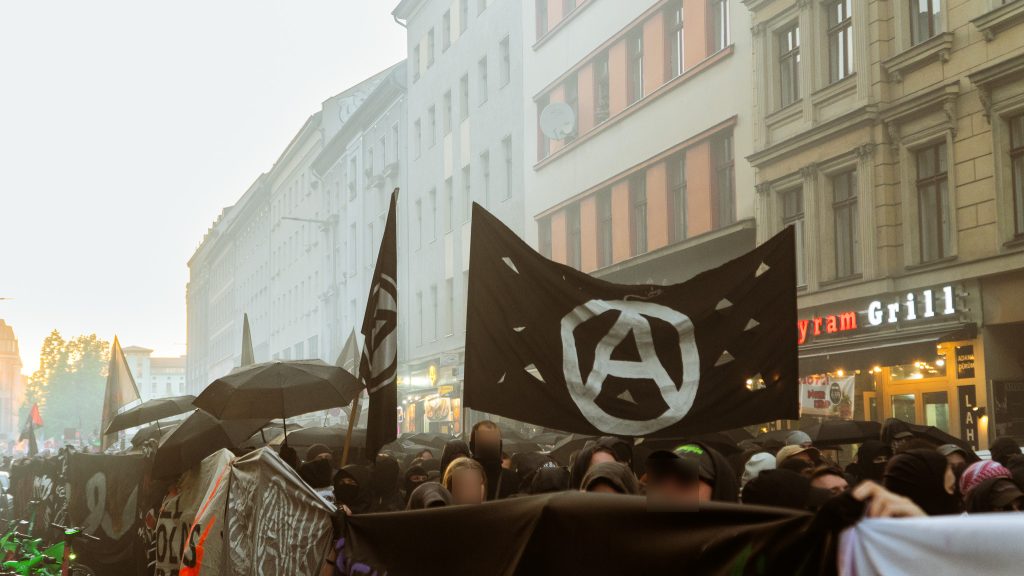
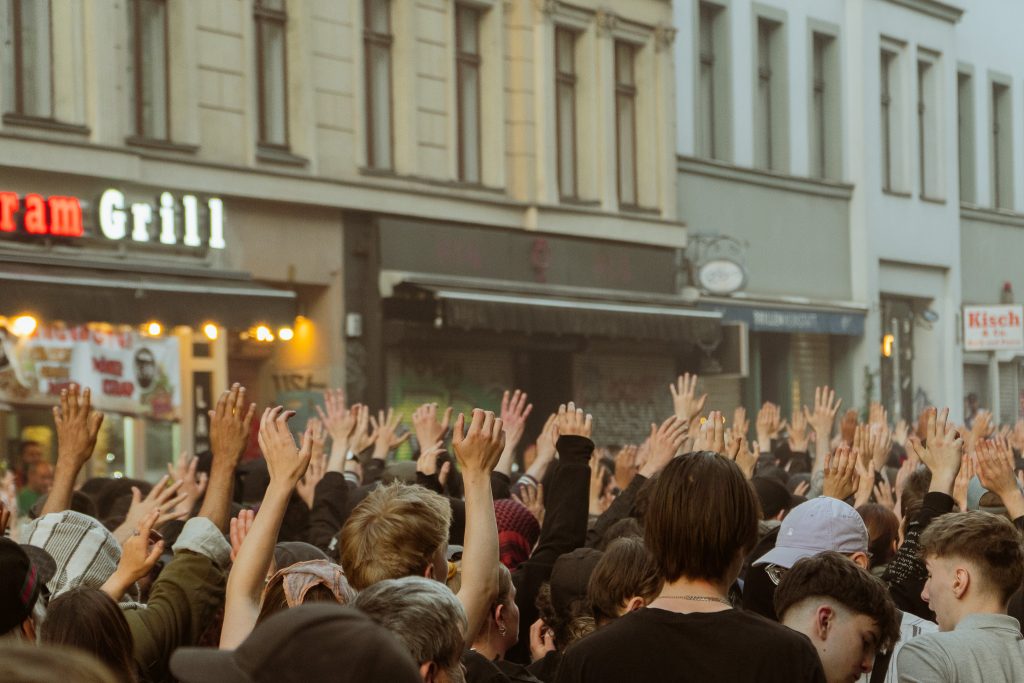
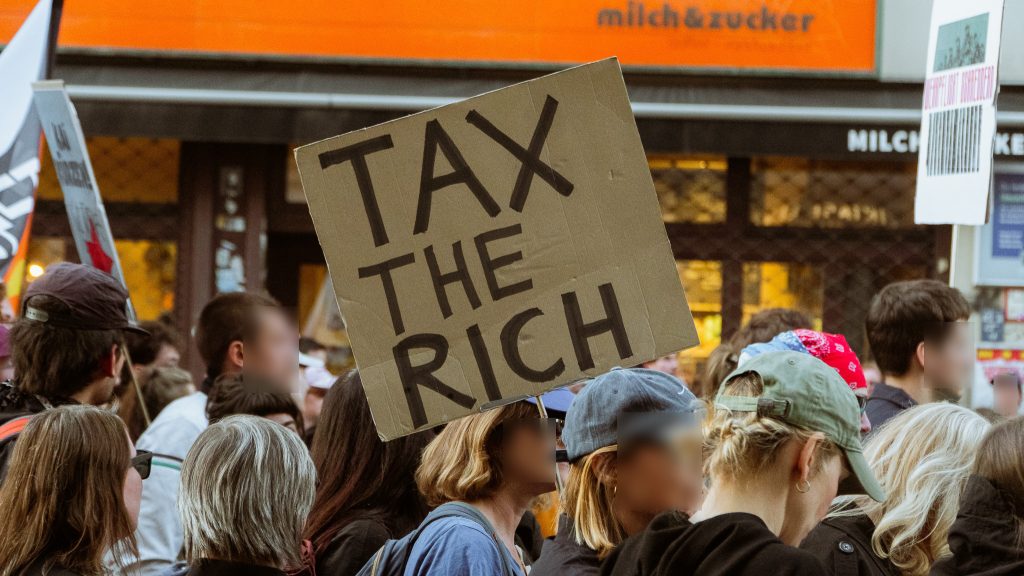
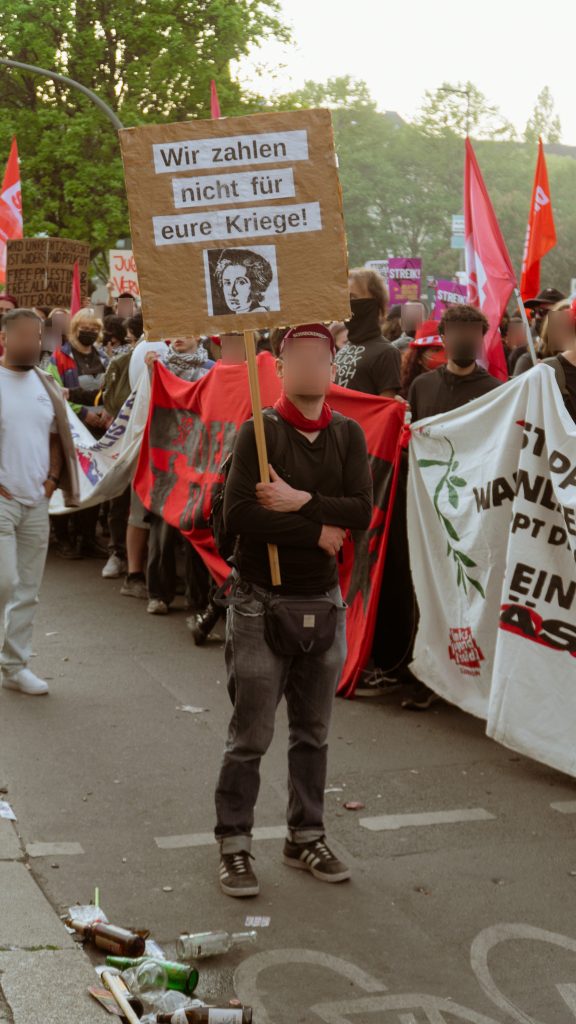
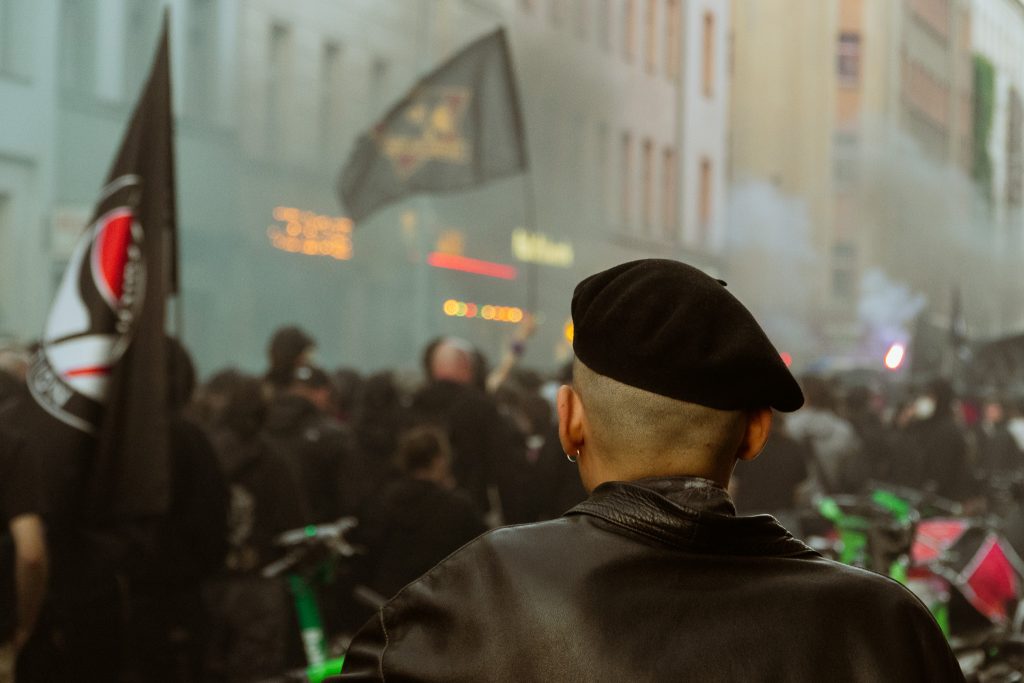
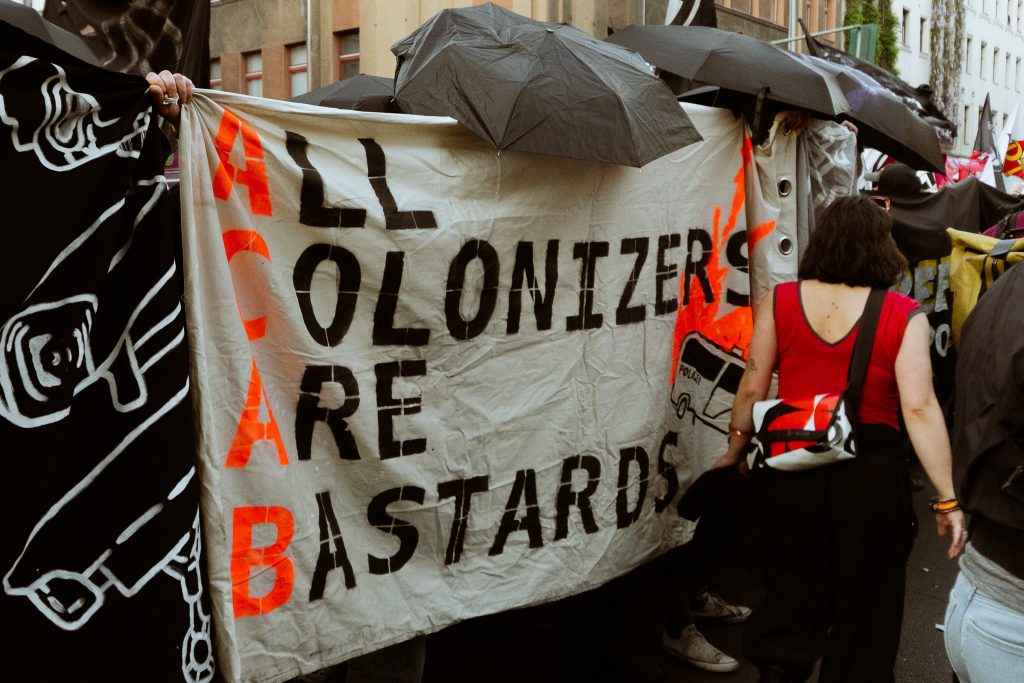

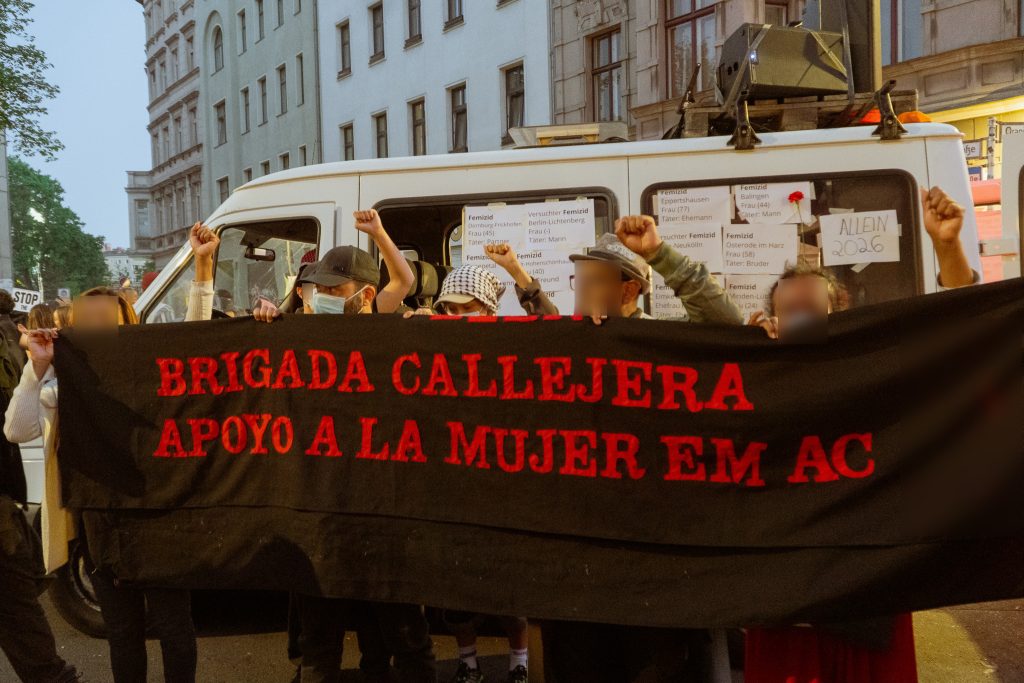
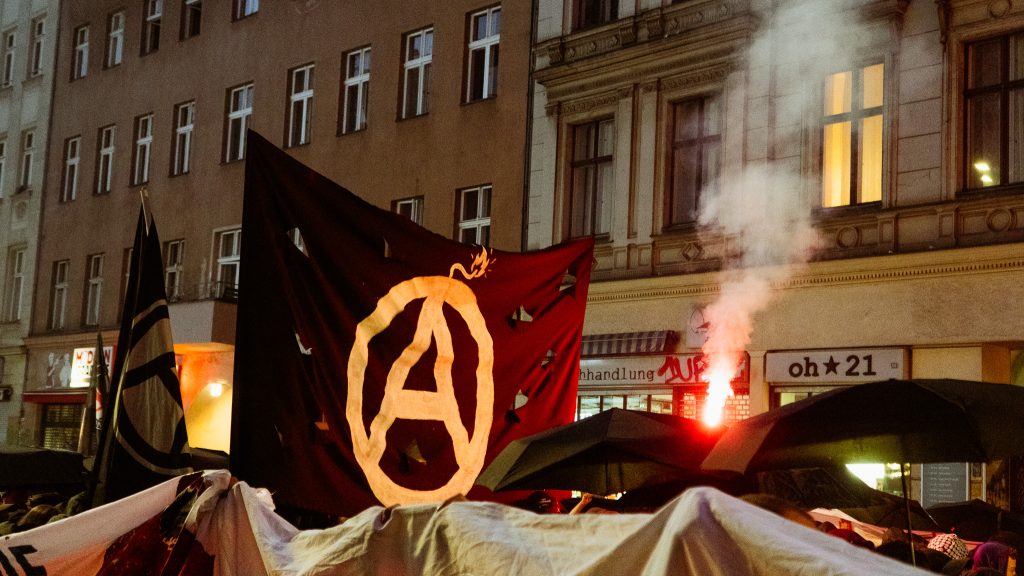
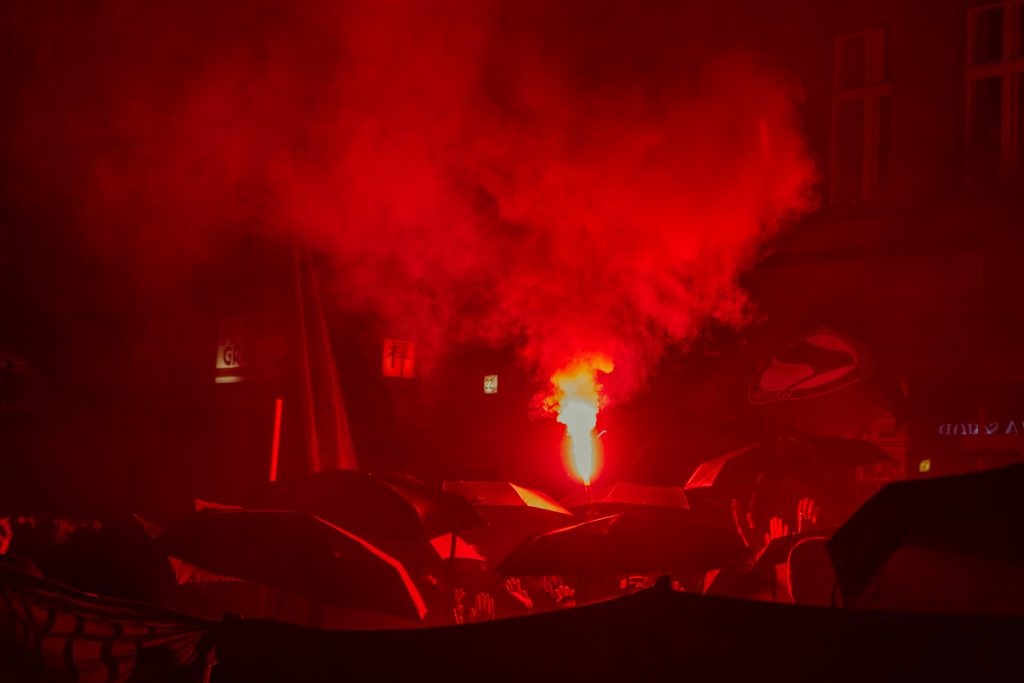
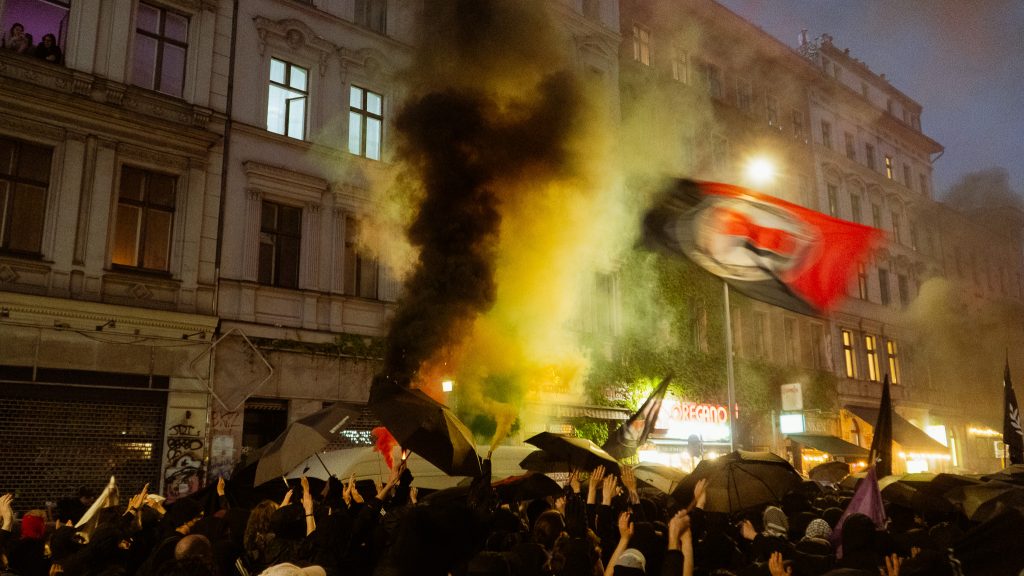
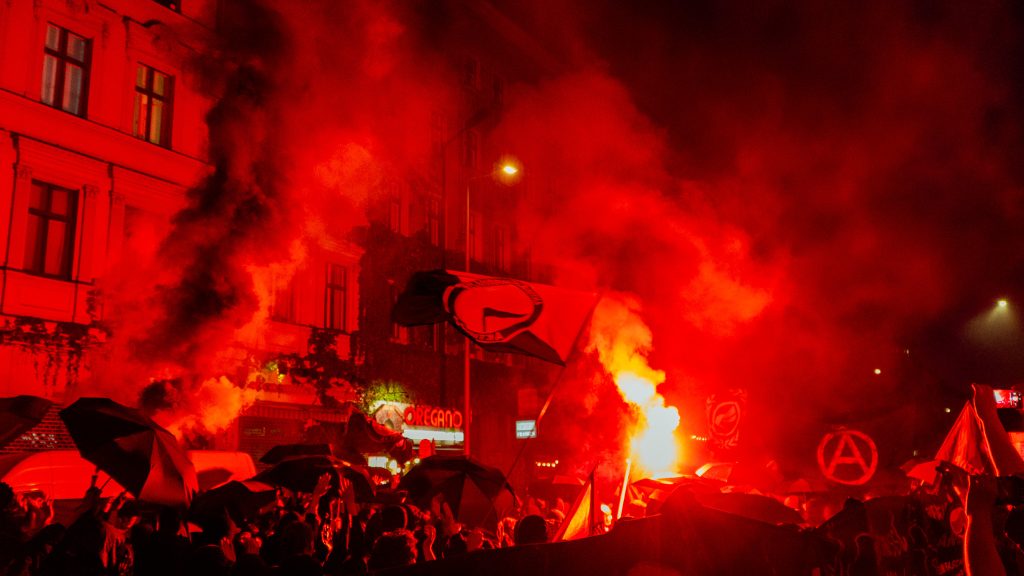
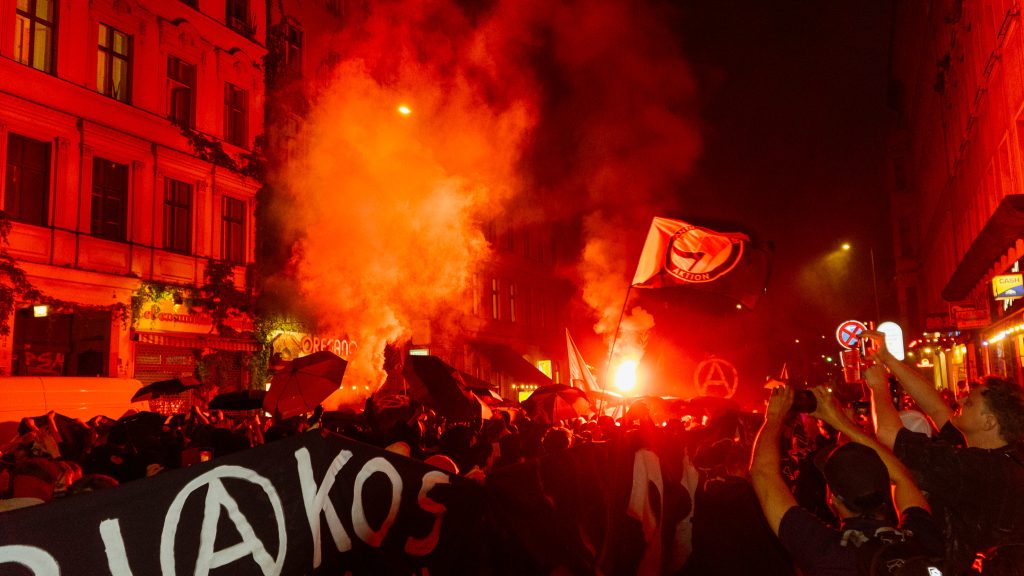
All photos: Cherry Adam
Kreuzberg and Neukölln. 1 May 2026
Cherry Adam
02/05/2026
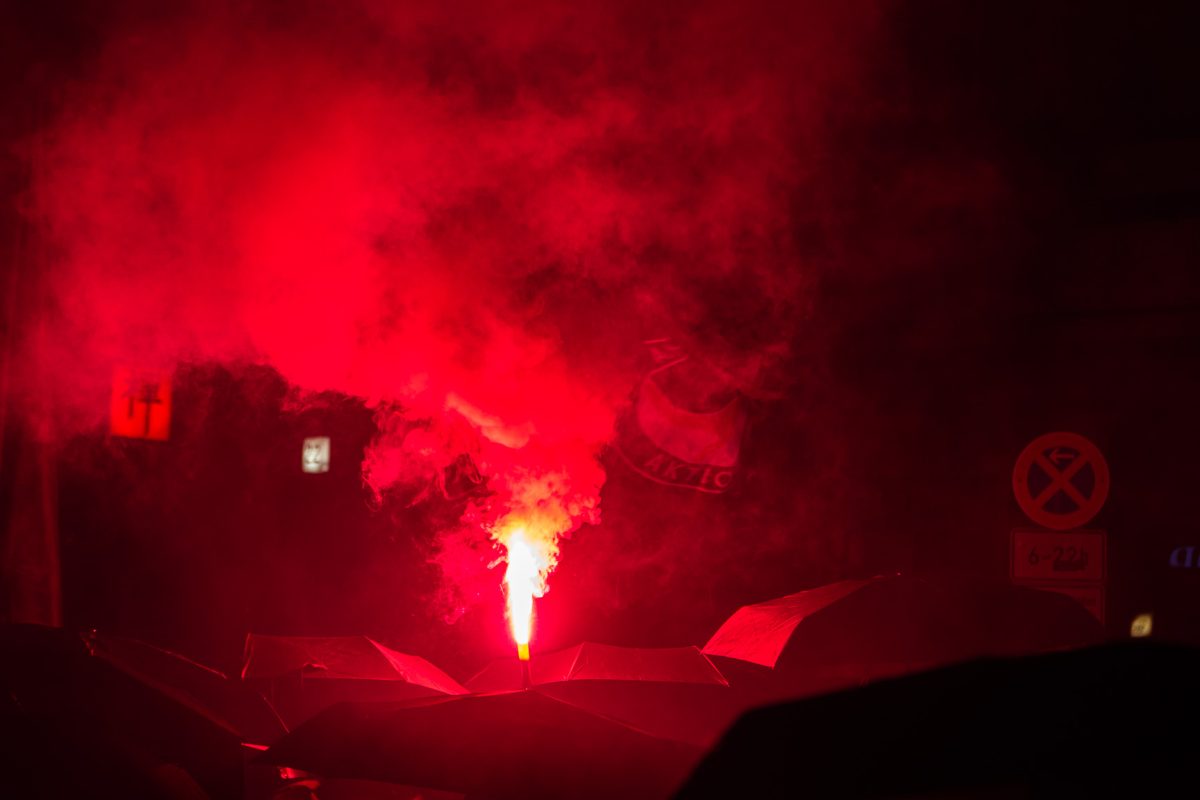
All photos: Cherry Adam
Social work student seeks German Palestine activist interviews for her thesis
Hi, there. Could you start by introducing yourself?
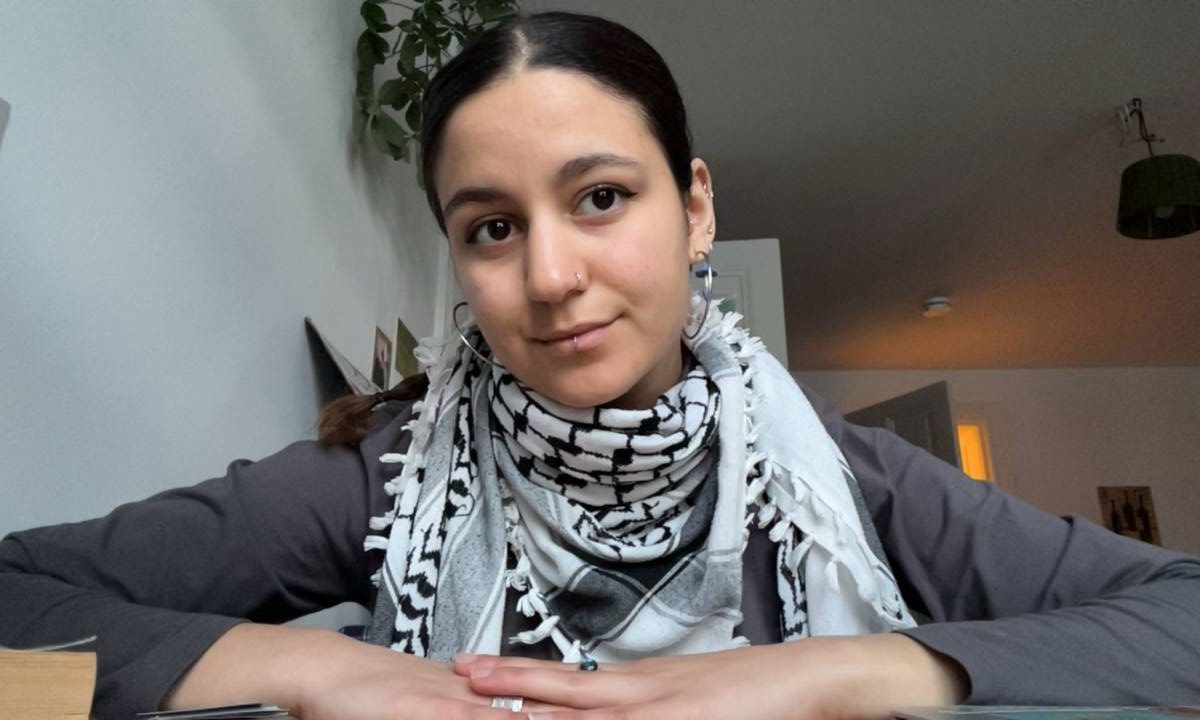
My name is Dima. I’m Palestinian. My parents are from Palestine. I was born and raised in Germany, but I consider myself Palestinian.
I’m a student in my last year. I’m studying social work at a Spanish university in Almeria. Currently I’m doing an internship working with unaccompanied minors who are refugees, and who came to Germany either by themselves or with a parent. At the same time I’m writing my dissertation.
And as part of this dissertation you are doing a survey?
Yes. It’s a research project, basically. The topic is the experiences of pro Palestinian activists in Germany with a special focus on violence and discrimination.
Are you trying to address all pro Palestinian activists, or just a particular sort?
I’m interested in talking to anybody who is active around Palestine. You don’t have to go to
demonstrations all the time, or consider yourself an activist. Some people are engaged and active, but they don’t consider themselves activists, and that’s completely fine.
I don’t care how old you are or what back story you have. All genders, all ethnicities are welcome. The important thing is that you’re open to talk to me. It’s obviously only in the way that you want to. I’m not looking for a specific profile. It just has to be activists in Berlin.
I’m interested in talking to anybody who is active around Palestine. You don’t have to go to
demonstrations all the time, or consider yourself an activist. Some people are engaged and active, but they don’t consider themselves activists, and that’s completely fine.
What are you interested in hearing about in particular, or won’t you know until you hear it?
I want to hear about experiences that either you had by yourself or you have observed in terms of discrimination and violence. So if you can tell me about something that happened to you that was discriminatory or difficult to handle, or that had an impact on you.
It can be police violence. It can be just violence on the street, family topics, or professional consequences of participating in something. That happens a lot as well. I’m looking to find out how that impacts people, because there is a huge difference in activism in different countries. And Berlin is very different from the rest of Germany.
I’m studying in Spain, and I lived in Spain for the past three and a half years. Activism is handled very differently there. Because it will be published in Spain, I want to show my university that there are huge differences between activism in Germany and Spain, using examples from people who have lived it.
Why are you specifically interested in Berlin? You could have done this about Spain or about Bayern. What’s so interesting about Berlin?
I didn’t know that Berlin was interesting in that sense until I moved here a couple of months ago. I wasn’t here before, but I saw it in the news a lot. Friends that I know here told me that the violence and polarization in Germany is brutal. Even if you’re a Leftist, it doesn’t guarantee that you are pro Palestinian, and that’s worrying for me.
Berlin is also such a concentration point for activism and political standing that I think it’s a really good place to analyse the dynamics and find out what the reality is for Palestinian activists living here.
What have you experienced about the differences between the Palestine movement in Germany and in Spain?
It’s so different. The first protest that I went to here was in March, about three weeks into me being in Germany, and the vibe was completely different. There were a lot more police. People were, like, really engaged with everything.
In Spain, often the protests are kind of cute and wholesome and really beautiful to see. I’m not saying the protests here aren’t beautiful, because it is beautiful to see a lot of people united and fighting for the same cause. But in Spain, you don’t have to be worried about anything. You don’t have to be worried about being discriminated against because you’re wearing a Palestine scarf or for expressing your political views. In that sense, the police are really, really chill.
If you have a leftist political opinion in Spain, then you’re pro Palestinian in Spain. I hung out with a lot of leftist people, and no one would ever consider defending Israel’s right to exist or the genocide. No one ever denied the definition of what’s happening in Gaza, which is a genocide.
Is there a difference between the Spanish and the German governments?
The Spanish government is pretty great in that sense. Well, Pedro Sánchez is. I’m not a huge fan of him, because I think there’s a lot of things that he’s not doing right, but regarding Palestine he’s doing the right thing. He condemns Israel’s actions. He condemns the genocide. He supported the flotilla. It’s really great. Such things as antisemitism accusations would just not happen.
And then there’s the German government. You’re not allowed to wear a Palestine jumper in parliament. I think that says it all.
Do you think that Sanchez means it, or is he responding to public opinion?
Great question. I think he wants to be popular as well. Obviously, he needs it. He would lose the vote very quickly if
he wasn’t responding to public opinion. I don’t think it’s great, but we’re in desperate times. If his actions are these, but his opinion is a different one, I think I have to just try to ignore that.
Tell us about your survey. You’ve only just started. How’s it going so far?
It’s going okay. My deadline is in five and a half weeks. I work well under pressure, so I hope the pressure will kick in soon. It’s difficult to get people to do an interview with me, because people are busy. Activists are busy. I know political work takes a lot of energy and courage and time. So sometimes people just can’t make the time, which I understand.
But sometimes I think people also don’t trust—not me, maybe, but my work, and maybe how safe they are. Maybe they think I expect too much, but I just want to have a normal conversation and then try to bring that into my work.
Obviously, everybody’s anonymous. You won’t be in danger.
To meet your other deadlines, the interviews should really be finished by around 10 May. How many interviews do you intend to do in that time?
My dream would be to have between 8 and 10 interviews. We’ve just done my third interview. I’ve got another one later on. Eight would be really good, because without that the research wouldn’t have that much credibility or weight.
I know it’s just a dissertation, but personally, it means so much to me. The more I can cause an impact, the happier I will be.
If someone wants help, how much of their time are you going to take?
All three interviews I’ve done so far were pretty exactly one hour and 20 minutes. We can make it quicker. We can make it longer. But between an hour and an hour and a half is normal.
But if someone only has half an hour, you can fit them in as well?
Yeah, of course. I can ask the important questions, but it’s always difficult to talk about Palestine within only half an hour.
Are there any findings you have made already, or have you done too few interviews to tell?
I can’t say exactly, and they were all three very different interviews, which I really like. But in terms of safety as an activist, people said similar things, also in terms of the perception of Palestinian activism in Berlin. The situation is difficult and it needs a lot of work and engagement.
Is there any specific sort of person who you haven’t interviewed yet that you really want to hear from?
I haven’t interviewed any Palestinian people yet, which would be really cool. But, I’m genuinely open to anything. I can do interviews in Spanish, English, and German. Arabic would be a challenge, but I can try with the help of friends or family. I’m open to anybody who’s interested.
What do you want to do with what you learn? Do you see further ways of using this knowledge to be able to help the movement?
I think with this dissertation, I wanted to show my university in Spain what the reality is there and here. It’s also an important piece of work for myself, because I want to know how to have a positive impact on the movement and find ways to make the movement grow.
One topic is the emotional work that you connect with Palestine activism. I want to see how people deal with those challenges and emotions, because I’m a social worker, so it would be cool to offer psychological and social health to people that suffer from oppression.
I want to help the movement. I’m also trying to find ways of bringing myself into activism in Berlin
What’s the next step for you personally? Are you going to stay in Berlin? Are you going to move back to Spain?
I’m staying in Berlin. Four months in Berlin is not enough. I want to stay in Germany. I was born and raised here, and I haven’t lived here in almost seven years. So I want to be back here.
I want to become a social worker. My internship is working with migrants and teenagers. I’d like to stay in that area.
Do you see a specific link between your social work and your Palestine activism? Or are they two separate things?
I can’t separate that very well. Social work means defending human rights and acting against repression, and my area will be antiracist practice. So it’s very combined.
As a social worker I have to work with the system, but at the same time I have to somehow trick the system to help people out.
You’ve only been here for a couple of months. Have you already got involved in the Palestine movement in Berlin?
I went to a plenum of the Gaza Committee on Monday, and I’m planning on going to a few more. I want to bring myself in there. I go to demonstrations whenever I can. I go to a lot of fundraisers and donate. I talk a lot about my type of activism as well, just spreading the word.
I know you’ve got to go in a minute to your next interview. So just quickly, if people are interested in talking to you, how can they contact you?
They can e-mail me at dj873@inlumine.ual.es.
Just say: “Hi, I’m interested. Can you tell me more?” If you’re unsure, I’m happy to respond to questions. I’d love to hear from people who are interested and want to help me make this project.
People have until 10 May, so rather sooner than later. And maybe you can write us something about the results when you’re finished?
I’d really love that. Thank you so much for the opportunity.
A Berlin court overturns the “extremist” designation of Jewish Voice
Jakob Reimann
01/05/2026
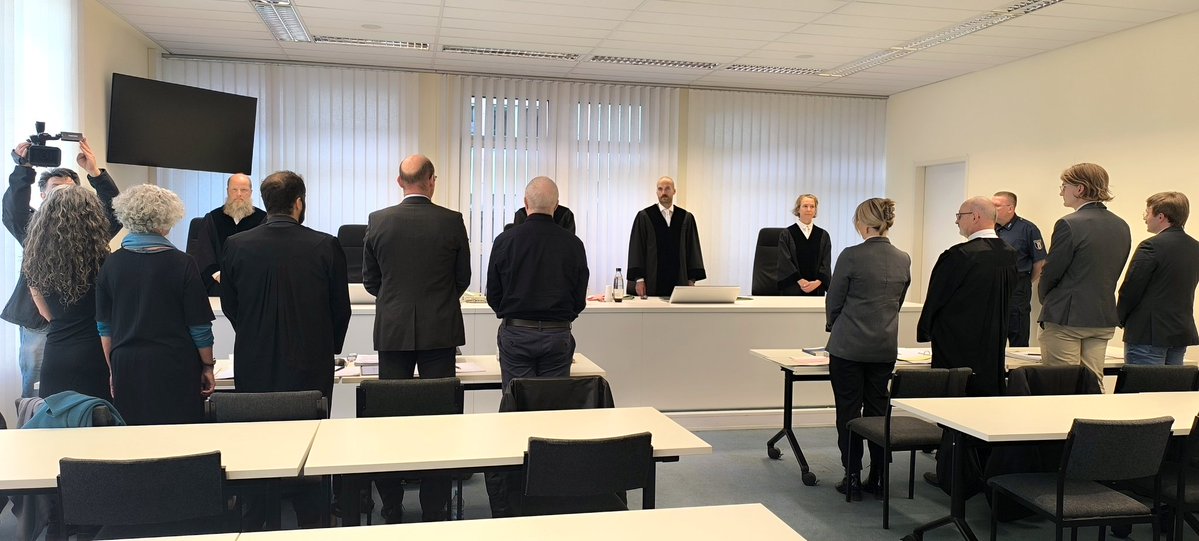
As criticism of Israel continues to be criminalized, Jewish anti-Zionists are increasingly coming into the crosshairs of the intelligence services and political actors.
A heavy blow to Germany’s Staatsräson: On Monday, the Berlin Administrative Court ruled against the Federal Republic of Germany and in favor of Jewish Voice for a Just Peace in the Middle East (JS). The domestic intelligence agency must remove its designation of the Jewish association as a “proven extremist endeavor”—the highest level of surveillance—from its 2024 report. There, JS had been listed in the sections on “left-wing extremism,” “foreign-related extremism,” and in a footnote on “extremist pro-Palestinian groups”—marking the first time since the secret service’s founding in 1950 that a Jewish group was included in its spy report. JS has now successfully challenged this in court.
The anti-Israeli and anti-Zionist positions of Jewish Voice did not justify its listing, the judges argued. The court found no call for violence, nor any endorsement of violence as a political means, in JS’s statements or its statutes—a requirement for listing an organization as a “proven extremist endeavor.” Much of the proceedings revolved around the question of where Jewish Voice stands on the so-called “right to exist” of Israel. For an anti-Zionist group, its position on this “right” is not difficult to guess. And, neither in international law nor in national legislation, is such a “right to exist” codified. It quite simply does not exist—which is why, one might argue, right-wing Staatsräson hardliners have to drift into the metaphysical and treat it as if it were divine: praising the invisible and persecuting its rejection as blasphemous heresy. Anyone who publicly “denies the right of the State of Israel to exist” is to be made criminally liable in the future, according to a draft law by the CDU-led Hessian state government—which would amount to punishing the denial of the existence of unicorns with up to five years in prison. A turn to mysticism and superstition shapes Germany’s march toward authoritarianism.
The initial inclusion of Jewish Voice in the domestic intelligence report triggered fierce criticism of the state and strong solidarity with JS from within the Palestine solidarity movement. In contrast to Germany’s treatment of Staatsräson-aligned Jewish organizations, this attack carries a distinctly sinister undertone. The Central Council of Jews in Germany represents around 89,000 members across 105 organized communities, which tend to be more conservative and pro-Israel in orientation—amounting to just over 40 percent of all Jews living in Germany. It receives 22 million euros annually from the state, constituting the dominant share of its budget. By contrast, an association of progressive, often secular Jews advocating for a just peace and opposing the crimes of the Israeli state is targeted by Germany’s domestic intelligence service: the Federal Republic, as the state continuation of the Third Reich, is once again dividing Jews into good and bad.
The court’s decision on Monday is “a scandal,” fumed Israel’s right-wing ambassador in Berlin, Ron Prosor, on X. “Does the perpetrator first have to quote ‘Mein Kampf’ before people are willing to clearly call out antisemitism?” Prosor asked, with breathtaking crudity toward the Jewish group, many of whose members’ relatives were persecuted, gassed, and tortured by Hitler’s henchmen. In a direct attack on the separation of powers, the right-wing Prosor assails the court’s decision and could thereby arguably run counter to the Vienna Convention on Diplomatic Relations, which in Art. 41 explicitly states that diplomats “have a duty not to interfere in the internal affairs of [the receiving] State”—but international law, as we know, hardly counts for the right-wing “value partners” within the Israeli government.
The significance of Monday’s proceedings for a potential ban of Jewish Voice was also discussed repeatedly during the hearings. Surveillance and data collection by the domestic intelligence agency would form the basis for such a ban procedure, the lawyer for the respondent explained. Bans have already targeted groups within the Palestine solidarity movement, such as the prisoner support network Samidoun, which is close to the Palestinian PFLP. Give it a few more years of rightward discursive shift and steroid-fueled pro-Israel self-radicalization in politics and media, and the German state will surely feel empowered to ban Jewish organizations again as well—all in the name of anti-antisemitism, of course.
Beyond the attacks by the domestic intelligence agency, Jewish Voice is also facing pressure from other actors. The group has been repeatedly debanked: in 2024, Berliner Sparkasse froze its account, and earlier the Bank für Sozialwirtschaft had already done so. Hesse’s “antisemitism commissioner,” Uwe Becker, called in January for JS to be banned entirely, claiming it acts “very clearly against the spirit of understanding between peoples.” In September 2024, the right-wing CDU politician honored soldiers of the Israeli army in a café in Frankfurt am Main; he said he had thanked “the soldiers for their service in defending Israel,” referring to a military that at that point had already been committing genocide for eleven months and was boasting of grave war crimes via livestreams on TikTok and Instagram. Last September, he also called for a ban on the Palestinian keffiyeh in German streets, arguing that it “glorifies terror.” Does Becker consider such openly racist attacks to be in line with “the spirit of understanding between peoples”?
While JS succeeded on Monday in having its designation removed from the 2024 domestic intelligence report, the chamber rejected its second request—to also prohibit the German government, on a preventive basis, from mentioning JS in its future spy reports and in other statements by the Interior Ministry. It therefore remains to be seen whether the domestic intelligence agency will include JS in its 2025 report. Its publication is expected in the coming months. Politically, that is certainly desired, but JS would also challenge such a designation in court. And it remains questionable whether the German state will prefer to spare itself another humiliation like the one on Monday.
For the intelligence agency’s lawyer, Wolfgang Roth of the law firm Redeker Sellner Dahs—which has repeatedly represented the German state in cases involving complicity in Israeli crimes, including over German arms deliveries to the Israeli regime for the genocide in Gaza and in the BT3P lawsuit against the 2019 anti-BDS resolution—delivered a truly poor performance. His argument, repeated several times, was that while JS had never actually uttered the words they would like to put in their mouths, it nonetheless did so—wily, as it were—“implicitly”; that “between the lines, everything is clear,” and that this is precisely the space where violence is “promoted.” All of this strongly recalls former Berlin State Minister for Culture Joe Chialo, who accused the left-wing migrant cultural center Oyoun in Berlin-Neukölln of harboring “hidden antisemitism.” Once again: the state, as it moves toward authoritarianism, must rely on elves and goblins to justify its repression—we may not be able to see them, but they are really there, scout’s honor, pinky swear!
Even if Monday’s ruling is to be welcomed, no one should be under any illusions. Isolated indications that the judiciary is (still) not fully politicized along Staatsräson lines, and that the separation of powers can still function, do not obscure the broader trend we are witnessing in this sick country. Germany is marching toward authoritarianism, and the broad-based attack on Palestine solidarity serves as the testing ground: brown, foreign, left-wing, majority-minoritized—the perfect object (because it lacks a lobby) for establishing the baton as the new normal in this country.
Yet, according to several polls, the population largely holds critical views of the Israeli government and its support by Germany—Staatsräson is a reactionary instrument of power wielded by political and media elites, forced through against the population and necessarily tied to a perversion of the concept of antisemitism. And increasingly, Jewish individuals are becoming targets of these attacks. The German state is, of all things, fighting Jews in the name of combating antisemitism.