The Left Berlin News & Comment

This is the archive template

Catherine Impey, Ida B Wells and Mika Feldman de Etchebéhère

Rebellious Daughters of History #15 by Judy Cox Catherine Impey (1847-1923) Catherine Impey was a radical Quaker who lived in Street, Somerset. She travelled around America 1870s and was horrified by the racism she witnessed. Her small home became a meeting place for black activists including Frederick Douglass who visited her in 1888. After meeting […]


04/06/2020


Rebellious Daughters of History #15

by Judy Cox

Catherine Impey (1847-1923)

Catherine Impey was a radical Quaker who lived in Street, Somerset. She travelled around America 1870s and was horrified by the racism she witnessed. Her small home became a meeting place for black activists including Frederick Douglass who visited her in 1888.

After meeting Douglas Catherine set up Anti-Caste, Britain’s first anti-racist newspaper, which she produced with her mother and sister. Anti-Caste gave a platform to Black writers to expose racism and horrific working conditions within the British Empire, for example on Indian tea plantations.

The journal opposed the racist ideology behind the British Empire and gave prominence to anti-lynching campaigns in the Southern states of the US. Catherine drew criticism for giving graphic accounts of lynchings.

In 1893 Catherine joined forces with Ida Wells. They a new organisation, The Society for the Recognition of the Universal Brotherhood of Man, which opposed racial segregation and lynching. Catherine invited Wells to tour England lecturing on lynching and racism.

Ida B Wells (1862-1931)

Ida B Wells was born into slavery in Mississippi and her family was freed by the Emancipation Proclamation during the Civil War. Despite having to support her orphaned siblings from the age of 16, Ida trained as a teacher and co-owned The Memphis Free Speech which campaigned against racism and segregation.

In the 1890s, Ida exposed the horrors of lynching, which was used to oppress and intimidate African Americans. Her reports made an impact in the national press, but her newspaper office was destroyed by racist mobs and she was frequently threatened with violence.

Ida moved to Chicago, where in 1895 she married and had a family, with two step-children and four of her own, but she never stopped campaigning against racism and segregation, being dragged off a segregated train carriage. She helped to set up the National Association for the Advancement of Coloured People.

Ida also and organised for women’s rights and suffrage. Ida had many sharp conflicts with racist female suffrage campaigners. In 1913, Ida set up the Alphra Suffrage Club to organise among Black women in Chicago. When the National American Woman Suffrage organisation organised a parade and demanded that Black women went to the back of the march, Ida forced her way to the front.

During World War One, Ida was under government surveillance as a ‘race agitator’. She worked with Marcus Garvey to report on the race riots of 1919. Ida strongly supported workers’ rights, urging all Black women’s organisations to support the strikes of the Brotherhood of Sleeping Car Porters.

Ida did more than any of her contemporaries to link the struggle against racism to that for women’s rights, at a time when many white women accepted racist idea.

Ida B Wells published a biography, Crusade for Justice.

Revolution in action: Mika Feldman de Etchebéhère (1902 – 1992)

Mika was the child of Russian Jewish immigrants, and grew up with stories of how revolutionaries escaped the pogroms and jails of Tsarist Russia. She became an anarchist at age 15. In 1920 while at university she met Hipólito Etchebéhère, who became her compañero.

They were first involved in the group “Insurrexit” influenced by both Marxism and anarchism. Then they joined the Communist Party, but were expelled two years later for their disagreement with the party leadership and their support for Trotsky. Mika then traveled through Patagonia collecting first-hand reports of the massacre of peasants by the army.

In 1931 they travelled to Europe, first to Spain, then in 1932 to Germany where they witnessed the rise of Nazism, then in 1933 to Paris where they were involved with the revolutionary group, Que Faire.

Three years later they returned to Spain where they joined a POUM, the anti-Stalinist militia set up to fight Franco during the Spanish Civil War. Hipólito was given command of a column but was killed at Atienza.

Mika was marginalised as militia men protested that women’s job was to wash and mend the men’s socks. Mika replied ‘The women who are with us are militia members. We fight together, men and women, equal, and nobody better forget it! And we are all volunteers!’

Mika defied expectations and fought alongside the men. She was then made Capitan and fought on the fronts of Sigüenza, Moncloa, Pineda de Húmera.

Mika was also a member of Mujeres Libres, an anarchist set up in 1936 to fight a double struggle for women’s liberation and social revolution. The organisation attracted around 30,000 members.

The women challenged the dominant idea on the left that women should wait til after the revolution to fight for their liberation. During the Spanish Revolution the Mujeres trained women in military skills so they could join the militias.

When the republicans were defeated in 1939, Mika fled to France, but returned to Argentina before she could be arrested by Vichy. Mika returned to France in 1946. In Paris in 1968, Mika was seen getting students to wear gloves as they dug up paving stones to throw at the cops, so their hands would be clean and there would be no evidence against them.

In 1977, she published a memoir of her time in Spain.

Helen Crawfurd and Selina Cooper

Rebellious Daughters of History #13 by Judy Cox Rent striker, suffragist and communist: Helen Crawfurd Helen Jack was born in the Gorbals, a working class area of Glasgow. Her mother worked a steam-loom and her father was a baker. Helen became active in the women’s suffrage movement around 1900, and in 1910 she joined the […]


02/06/2020


Rebellious Daughters of History #13

by Judy Cox

Rent striker, suffragist and communist: Helen Crawfurd

Helen Jack was born in the Gorbals, a working class area of Glasgow. Her mother worked a steam-loom and her father was a baker.

Helen became active in the women’s suffrage movement around 1900, and in 1910 she joined the radical Women’s Social and Political Union (WSPU). In 1912, she smashed the windows of Jack Pease, Minister for Education, and received a one-month prison sentence.

In March 1914, Helen was arrested in Glasgow when Emmeline Pankhurst was speaking, received another month in prison, and went on an eight-day hunger strike. Following one more arrest, she left the WSPU in protest at its support of World War I and in 1914, she joined the Independent Labour Party (ILP).

During the war Helen was a leading figure in the Red Clydeside Movement. In 1915 Helen led a mass community movement against rent increases and evictions. Helen was chair of the South Govan Women’s Housing Association and made successful efforts to win support from workers in the shipyards. She was also secretary of the Women’s Peace Crusade and in July 1916, she organised an anti war march of some 5,000 people.

In 1918 Helen was elected as Vice-chair of the Scottish division of the Independent Labour Party and she became a founder member of the ILP’s left-wing faction which campaigned for it to affiliate to the Communist International. Crawford went to Moscow in 1920 for the Congress of the Third Communist International and interviewed Lenin.

When the affiliation policy was defeated, she became a founder member of the Communist Party of Great Britain, within which she served on the Central Committee, with responsibility for reaching out to working class women.

Crawfurd ran in 1921 as the first Communist Party Candidate in the Govan Ward, in Bothwell at the 1929 general election and Aberdeen North in 1931, but did not come close to election.

During the 1930s, Crawfurd was prominent in the Friends of the Soviet Union. She was elected as Dunoon’s first woman Town Councillor shortly after the war,retiring in 1947 due to poor health.

Helen died in 1954 at Mahson Cottage, Kilbride Avenue, Dunoon, Argyll, age 76.

Selina Cooper, (1864-1946)

Selina was the daughter of a Cornish navy and when he died of typhoid fever Selina’s mother took the family to find work in the textile mills of northern England.

Twelve year old Selina worked in the local textile mill at Barnoldswick. She spent half the day in the factory and the other half at school. At 13, Selina left school and work full-time in the Barnoldswick Mill.

Selina joined the Nelson branch of the Cotton Worker’s Union. Although the vast majority of members were women, the union was run by men. Selina fought for the union to take up women’s issues.

In 1891 she became involved in a trade union dispute to force employers to provide decent toilet facilities. Selina also wanted the union to challenge the sexual harassment of women workers.

Selina also began attending education classes organised by the Women’s Co-operative Guild in Nelson. Selina read widely, including medical books so that she could help workers unable to afford a visit to the doctors. Her collection included The Law of Population, a book written by Annie Besant on birth-control.

In 1892 the Independent Labour Party (ILP) was formed in Nelson and Selina joined. It was at the local ILP that Selina met Robert Cooper, a local weaver who was a committed socialist and advocate of women’s suffrage and they married in 1896. Selina’s first child, John Ruskin, who was named after the writer who had most influenced her political ideas, died of bronchitis when he was four months old.

In 1900 Selina Cooper joined the North of England Society for Women’s Suffrage. Other members at the time included Esther Roper and Eva Gore-Booth. Selina helped organize a petition that was signed by women working in the Lancashire cotton mills. Selina alone collected the signatures of 800 women.

By spring 1901, 29,359 women from Lancashire had signed the petition in favour of women’s suffrage and Selina was chosen as one of the delegates to present the petition to the House of Commons.

In 1901 the Independent Labour Party asked Selina to stand as a candidate for the forthcoming Poor Law Guardians. Although the local newspapers campaigned against Selina, was the first working woman to be elected.

At the National Conference of the Labour Party in 1905, Selina urged the leadership to fully support women’s suffrage. Selina developed a national reputation for her passionate speeches in favour of women’s rights. In 1910 she was chosen to be one of the four women to present the case for women’s suffrage to Herbert Asquith, the British Prime Minister.

In 1911 Selina Cooper and Ada Nield Chew became a National organiser for the NUWSS. Selina was behind the NUWSS decision in April 1912 to support Labour Party candidates in parliamentary by-elections.

At a women’s suffrage rally in Haworth, she recalled, ‘men threw rotten eggs and tomatoes and all sorts of things… we sheltered in a café. Mrs Aldersley went out and came back crying – covered with eggs and tomatoes… My mother went out, and she said, “I’m stopping here, whatever you throw, so go and fetch all the stuff you’ve got to throw, because,” she says, “this blooming village would never have been known about but for three women – the Brontes.”

Selina opposed the First World War and campaigned against military conscription. In 1917 Selina persuaded over a thousand women in Nelson to take part in a Women’s Peace Crusade procession. The meeting ended in a riot and mounted police had to be called in to protect Selina and Margaret Bondfield, the two main speakers at the meeting.

Selina was elected to the town council and became a local magistrate. In the 1930s she played a prominent role in the campaign against fascism.

Selina died at home on 11th November 1946 shortly before her eighty-second birthday.

Nadezhda Udaltsova and Susanna Inge

Rebellious Daughters of History #12 by Judy Cox Painting the Revolution – Nadezhda Udaltsova (1885-1961) Nadezhda was one of a group of Russian avant-guard painters who were part of a great flowering of creative experimentation following the Revolution of 1917. Before 1914, Nadezhda studied painting in Paris, experimented with Constructivism and later joined the Suprematist […]


01/06/2020


Rebellious Daughters of History #12

by Judy Cox

Painting the Revolution – Nadezhda Udaltsova (1885-1961)

Nadezhda was one of a group of Russian avant-guard painters who were part of a great flowering of creative experimentation following the Revolution of 1917.

Before 1914, Nadezhda studied painting in Paris, experimented with Constructivism and later joined the Suprematist movement. In 1916, she joined Kazimir Malevich’s Supremus group.

Like many of her avant-garde contemporaries, Nadezhda embraced the October Revolution. They developed new styles of art to express the energy and optimism unleashed by the overthrow of the old regime.

In 1917, Nadezhda was elected to the Young Leftist Federation of the Professional Union of Artists and Painters and began work in various state cultural institutions, including the Moscow Proletkult. In 1918, she joined the Free State Studios, first working as Malevich’s assistant, and then heading up her own studio.

She also collaborated with Aleksandr Rodchenko, Malevich and others on a newspaper entitled Anarkhiia (Anarchy).

In 1919, Nadezhda contributed 11 paintings to the Fifth State Exhibition. She married her second husband, the painter Alexander Drevin. When Vkhutemas, the Russian state art and technical school, was established in 1920, she was appointed professor and senior lecturer.

In 1920 she also became a member of the Institute for Artistic Culture (InKhuK). InKhuK was set up to decide how art should develop and promote the new world they believed was being built in Russia.

This optimism and creativity were crushed by the rise of Stalin. In 1938 Nadezhda’s husband Alexander Drevin was arrested then murdered by Stalin and she was silenced until after Stalin’s death.

Chartist rabble-rouser Susanna Inge

Susanna Inge was a Chartist sensation – an outspoken young woman, defying expectations about status of working class women by lecturing on Chartism and for women’s right to engage in politics.

Susanna had little schooling and only learnt to write at the age of 16. She burst into public attention with an address “to the women of England” which appeared in the Northern Star (2 July, 1842), She signed herself a “Member of the Female Charter Association of the City of London”.

She argued that women should, “assist those men who will, nay, who do, place women in on equality with themselves in gaining their rights, and yours will be gained also”.

Many bitterly opposed Susanna’ defence of women’s right, sneering at her as a ‘hen-Chartist’. Some critics were on her own side. In October 1842, a meeting was called at the Chartist Hall at 55 Old Bailey “for the purpose of forming a ‘Female Chartist Association.”

A Mr Cohen, declared that he “did not consider that nature intended women to partake of political rights”. His speech caused a “sensation among the ladies” (Northern Star, 22 October 1842).

She too took on Mr Cohen, arguing that,”woman ought to be better educated, and that, if she were, so far as mental capacity, she would in every respect be the equal of men.”

After Chartism, Susanna Inge attempted to turn her hand to writing. On 18 February 1847, she gave birth to a son, James McGregor, outside marriage. In 1851, she was working as a furrier. In 1857 Susanna MacGregor and her son emigrated to New York, settling in Brooklyn, where she found work as a fur sewer.

She died on 26 December 1902 at the age of 82.

Ethel Carnie Holdsworth and Crystal Eastman

Rebellious Daughters of History #11 by Judy Cox Factory Girl, Socialist and Writer: Ethel Carnie Holdsworth (1886 – 1962), Ethel Carnie was born into a weaving family in Oswaldtwistle, Lancashire. She started working part-time work in the mill at age eleven and worked full-time from thirteen. In her later articles for the Woman Worker, she […]


31/05/2020


Rebellious Daughters of History #11

by Judy Cox

Factory Girl, Socialist and Writer: Ethel Carnie Holdsworth (1886 – 1962),

Ethel Carnie was born into a weaving family in Oswaldtwistle, Lancashire. She started working part-time work in the mill at age eleven and worked full-time from thirteen. In her later articles for the Woman Worker, she described her experience as “slavery”.

Ethel attended Great Harwood British School from 1892 until 1899. She was a passionate reader. Her first book of poems, Rhymes from the Factory, was published in 1907, when Ethel was just 21 years old. When this was republished in 1908 she achieved national recognition.

Socialist Robert Blatchford, proprietor of The Clarion newspaper, offered Ethel a job writing for The Woman Worker, in London. She edited the paper between July and December 1909. Carnie was dismissed after six months possibly because Blatchford did not like her increasingly political and feminist editorials.

A second book of poems, Songs of a Factory Girl, was published in 1911, and her third and final collection of poems, Voices of Womanhood, followed three years later.

Her themes relate to the things she had seen in life: the slavery of the factory system and of domestic service, women exhausted by work as well as family and domestic lives. But what speaks most strongly is Carnie’s faith in human goodness and a determination to declare this on behalf of her class – to show that the fight was a just one.

Ethel Carnie was a member of the Co-operative Society, and the Independent Labour Party and was strongly anti- capitalist. She protested against the introduction of conscription in WWI, addressed 20,000 women during the Women’s Peace Crusade. During the 1920s she lived in Hebden Bridge and edited The Clear Light, an anti-fascist journal, with her husband Alfred Holdsworth who she had married in 1915.

Ethel was the first working class woman to publish best-selling novels. Helen of Four Gates was made into a film in 1924. The novel This Slavery (1925) is about a strike and it’s characters are working-class socialists who read Capital.

The book is dedicated ‘To Mother and Father, slaves and rebels […] with a Daughter’s affection and a Comrade’s greetings’. This is from Rachels speech:

“I wonder when women’ll be free, mother An’ chaps, too, of course. But we, we somehow have a tradition behind us besides an economic slavery. We’ve got the race on our shoulders, an’ all th’ other besides”

Article: ‘Our Right to Play’ (The Woman Worker, April 14, 1909, p.342)

‘For God’s sake, women, go out and play.
Instead of staring round to see what wants polishing or rubbing, go out into the open and draw the breath of the moors or the hills into your lungs.

Get some of the starshine and sunlight into your souls, and do not forget that you are something more than a dish washer – that you are more necessary to the human race than politicians – or anything.

Remember you belong to the aristocracy of labour – the long pedigree of toil, and the birthright which Nature gives to everyone had entitled you to an estate higher than that of princes.’

Poem: ‘Power’

“They built the house of Power on Force and Fear,
And gave authority the key to hold,
Stamping it with the hall-mark of dead gold,
And rusting it in human Blood and Tear.

“Behold!” cried Power, “The glory of my state!
Here I conserve forever all that Is,
Here, manacled and gagged, my priests shall kiss
My sceptre. Prisons, dungeons, be my Gate!

Whilst outside millions claw and scratch for Bread,
And burdened lives go swiftly to the grave.
Hold fast my key, my mistress, and all’s well!”
But Liberty came by with rose-crowned head,
And piped upon her pipe to every slave
These words of Laughter, “Fear is all their spell.”

Revolutionary, campaigner for worker’s safety and journalist Crystal Eastman (1881-1928)

‘When the dead bodies of girls are found piled up against locked doors leading to exits after a factory fire, who wants to hear about a great relief fund? What we want is to start a revolution’.

Three Essentials for Accident Prevention, July 1912

Crystal Eastman was a lawyer, anti-war campaigner, suffragist and revolutionary socialist. Crystal moved to New York with her brother, Max Eastman, in 1907. In 1912 Max and Crystal worked on The Masses, a revolutionary magazine owned cooperatively by its editors alongside John Reed, Louise Bryant and novelist Upton Sinclair.

Crystal campaigned energetically for safer working conditions. In 1911 she explained her interest in industrial statistics, ‘it seems a tame thing to drop suddenly from talk of revolution to talk of statistics, but I believe in statistics as much as I believe in revolution. And what is more, I believe statistics are good stuff to start a revolution with’.

In 1913 she helped to launch the Congressional Union of Women Suffrage to campaign for the vote. During the First World War, she organised against American militarism and imperialism and her Women’s Peace Party greeted the outbreak of the Russian Revolution with, ‘mad, glad joy’.

In 1919 Eastman reported for another radical paper, The Masses, until the paper was closed down. Max and Crystal then co-founded another socialist magazine, The Liberator. Crystal made the dangerous journey to Hungary to give a first-hand account of the revolution in a series, ‘Inside Communist Hungary’.

Crystal also helped to form the American Civil Liberties Union and became co-author of the Equal Rights Amendment. In the same year, Crystal organised the first Feminist Congress. When she was black-listed in the red scare of 1919-20 she found work on radical journals, Equal Rights and Time and Tide.

In the first issue of The Liberator, at the high point of the wave of revolutions which ended World War One,Eastman wrote,

‘Never in all history before could one so joyfully and confidently enter upon the enterprise of publishing and propagating ideas.

Dedicating our admiration to the fearless faith in scientific intelligence of Karl Marx, and our energy to hopes that are even beyond his, we issue THE LIBERATOR into a world whose possibilities of freedom and life for all, are now certainly immeasurable’.

Crystal Eastman died in 1928 aged just 46.

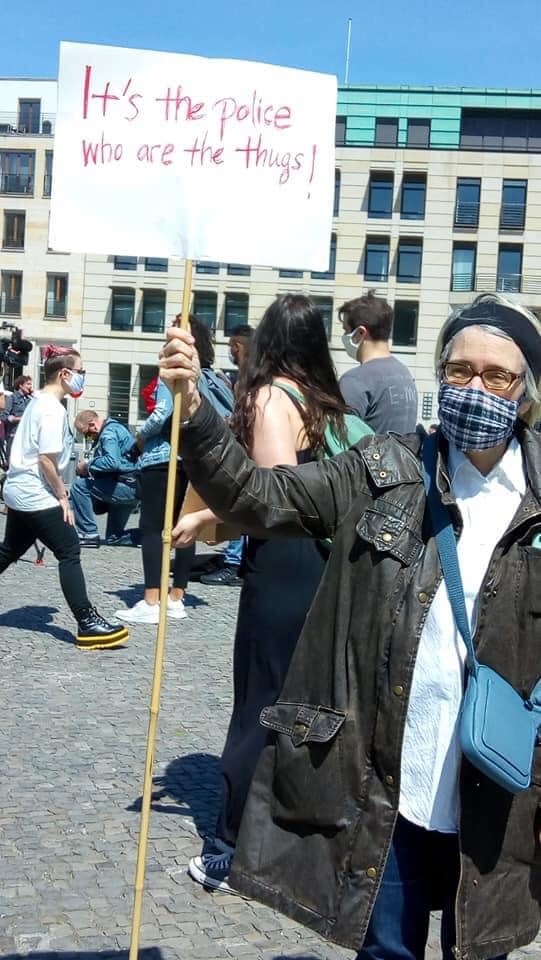
Gallery – Remember George Floyd. Protests in Berlin: 30-31 May

Photos by Bridget Kronqvist and Julie Niederhauser


Photos by Bridget Kronqvist and Julie Niederhauser