The Left Berlin News & Comment

This is the archive template

Open Letter | Oyoun must stay!

An open letter from Oyoun cultural center, in response to response to the Berlin Minister of Culture’s attempt to discontinue its funding because it hosted a Jewish organisation.


10/11/2023

Deutsche Version folgt

Since the Cultural Committee (Kulturausschuss) meeting on 6 November 2023, it is official: Berlin’s Senator for Culture Joe Chialo (CDU) is examining measures under subsidy law to discontinue funding for Oyoun. The far-right AfD has expressed its gratitude.

We call on the Berlin Senate to continue funding the state-owned cultural centre at Lucy-Lameck-Straße 32 in Berlin-Neukölln.

Since 2020, this venue has been called “Oyoun” and today employs 32, mostly marginalised, staff and fellows. Oyoun is an important venue in the intersectional art and culture scene, which primarily focuses on queer*feminist, migrant and decolonial perspectives and has already received several international awards for its work. In 2023, there were 5,872 requests to use the space, and 580 events took place over 327 days with approx. 82,100 visitors..

It is impossible to imagine cosmopolitan Berlin without Oyoun—but its existence is acutely under threat.

The impending closure of Oyoun was provoked by an event that took place on 4 November 2023 on the premises of Oyoun: an evening of “mourning and hope” by the organisation Jewish Voice for a Just Peace in the Middle East, the German section of the international umbrella group European Jews for a Just Peace. The association is dedicated to “informing about the necessity and possibility of a just peace between Palestine and Israel” and “actively working towards the realisation of a lasting peace that is viable for both nations”. In 2019, the organisation was awarded the Göttingen Peace Prize.

Oyoun had rejected the Berlin Senate’s request to cancel the event and explained its decision in a statement.

The cancellation of Oyoun’s funding would mark the end of freedom of speech and artistic freedom in Germany.

On 22 October 2023, 100 Jewish artists, writers and academics based in Germany signed an open letter “As our Arab and Muslim neighbours are beaten and silenced, we fear the atmosphere in Germany has become more dangerous—for Jews and Muslims alike—than at any time in the nation’s recent history. We condemn these acts committed in our names. We further call on Germany to adhere to its own commitments to free expression and the right to assembly as enshrined in its Basic Law.”

All these people should have the opportunity, within the framework of freedom of expression, to speak together and publicly, to mourn and enter into dialogue with one another. It seems ironic when Jewish people and groups are labelled or even defamed as anti-Semitic by German politicians and media.

However, on 31 October 2023, the Green parliamentary group published a press release entitled “Funding for Oyoun must be ended (Förderung von Oyoun muss beendet werden)“, in which MP Susanna Kahlefeld accuses the cultural centre Oyoun of acting in an antisemitic manner. Oyoun considers these accusations groundless and explicitly rejects them. Already on 1 November 2023, the Senator for Culture announced in the Berliner Zeitung that he would “fundamentally review the financial support of Oyoun […] to quickly come to a conclusion and take action”, after the Berlin Senate refused to talk to Oyoun six times.

The cancellation of funding means the end of an organisation that actively practises anti-discrimination and social criticism and contributes to Berlin’s religious, cultural, ethnic and political plurality.

Freedom of expression and artistic freedom also uphold the internationalism and cosmopolitanism of cultural life in Germany. It is the task and duty of publicly funded cultural venues to reflect diversity of opinions. Democracy needs places where marginalised, intersectional, pluralistic perspectives are presented and discussed in society, art and culture.

A policy of repressing critical voices causes serious damage to freedom of expression and thus to democracy in Germany. Berlin needs cultural spaces that are dedicated to the issues and concerns of its immediate neighbourhood.

We call on the Senate to grant further funding to Oyoun and protect migrant, queer*feminist and Jewish life in Germany.

Oyoun must stay. Especially in Germany. Especially now.

Further links (German)

Oyoun muss bleiben! 
Seit dem Kulturausschuss vom 06.11.2023 ist es offiziell: der Berliner Kultursenator Joe Chialo (CDU) prüft zuwendungsrechtliche Maßnahmen, um die Förderung für Oyoun einzustellen. Die AfD hat sich dafür bedankt.

Wir fordern den Berliner Senat auf, die finanzielle Förderung des landeseigenen Kulturstandortes in der Lucy-Lameck-Straße 32 in Berlin-Neukölln fortzusetzen.

Seit 2020 trägt das Haus den Namen „Oyoun” und beschäftigt heute 32, mehrheitlich marginalisierte, Arbeitnehmer*innen und Fellows. Das Oyoun ist ein bedeutender Ort der intersektionalen Kunst- und Kulturszene, der v.a. queer*feministische, migrantische und dekoloniale Perspektiven zentriert und für seine Arbeit bereits mehrfach international ausgezeichnet wurde. Im Jahr 2023 gab es 5872 Raumanfragen und 580 Veranstaltungen an 327 Veranstaltungstagen mit ca. 82.100 Besuchen.

Das Oyoun ist gerade aus dem kosmopolitischen Berlin nicht wegzudenken – doch seine Existenz ist akut gefährdet.

Der Grund für das drohende Aus von Oyoun ist eine Veranstaltung, die am 04.11.2023 in den Räumen des Oyoun stattfand: eine „Trauer- und Hoffnungsfeier“ der Organisation „Jüdische Stimme für einen gerechten Frieden in Nahost“, die deutsche Partnerorganisation der internationalen Menschenrechtsorganisation „European Jews for a Just Peace”. Der Verein sieht seine Aufgabe darin, „über die Notwendigkeit und Möglichkeit eines gerechten Friedens zwischen Palästina und Israel zu informieren” und sich „aktiv zur Verwirklichung eines dauerhaften und für beide Nationen lebensfähigen Friedens” einzusetzen. 2019 wurde der Verein mit dem Göttinger Friedenspreis ausgezeichnet.

Oyoun hatte die Aufforderung des Berliner Senats, die Veranstaltung abzusagen, zurückgewiesen und die Entscheidung in einem Statement erläutert.

Die Absage der Förderung würde das Ende der Meinungsfreiheit und der Kunstfreiheit in Deutschland markieren.

Am 22.10.2023 unterzeichneten 100 in Deutschland beheimatete jüdische Künstler*innen, Schrift­stel­le­r*in­nen und Wis­sen­schaft­le­r*in­nen einen offenen Brief „Wir befürchten, dass mit der derzeitigen Unterdrückung der freien Meinungsäußerung die Atmosphäre in Deutschland gefährlicher geworden ist – für Juden und Muslime gleichermaßen – als jemals zuvor in der jüngeren Geschichte des Landes. Wir verurteilen diese in unserem Namen begangenen Taten. Wir fordern Deutschland auf, sich an seine eigenen Verpflichtungen zur freien Meinungsäußerung und zum Versammlungsrecht zu halten, wie sie im Grundgesetz verankert sind.”

Alle diese Menschen sollten im Rahmen der Meinungsfreiheit die Möglichkeit haben, gemeinsam und öffentlich zu sprechen, zu trauern und miteinander in Austausch zu treten. Es wirkt zynisch, wenn jüdische Personen und Gruppen von Deutschen Politiker*innen und Medien in die Nähe des Antisemitismus gerückt werden oder sogar als antisemitisch diffamiert werden.

Am 31.10.2023 jedoch publizierte die Grüne Fraktion eine Pressemitteilung unter dem Titel „Förderung von Oyoun muss beendet werden”, in der die Abgeordnete Susanna Kahlefeld dem Kulturzentrum Oyoun vorwirft, antisemitisch gehandelt zu haben. Diese Vorwürfe erachtet das Oyoun als unbegründet und haltlos und weist diese ausdrücklich zurück. Bereits am 01.11.2023 kündigte der Kultursenator in der Berliner Zeitung an, die finanzielle Förderung von Oyoun „grundsätzlich zu überprüfen (…) schnell zu einem Ergebnis zu kommen und zu handeln” – und das nachdem der Berliner Senat das Gespräch mit Oyoun sechs Mal ablehnte.

Die Absage der Förderung bedeutet die Schließung einer Organisation, die aktive Antidiskriminierungsarbeit und Gesellschaftskritik praktiziert sowie zur religiösen, kulturellen, ethnischen und politischen Pluralität Berlins beiträgt.

Mit der Meinungs- und der Kunstfreiheit wird zugleich die Internationalität, die Weltoffenheit des kulturellen Lebens in Deutschland, verteidigt. Es ist die Aufgabe und Pflicht öffentlich geförderter Kulturorte, Meinungsvielfalt abzubilden. Die Demokratie braucht Orte, in denen marginalisierte, intersektionale, pluralistische Perspektiven in Gesellschaft, Kunst und Kultur präsentiert und diskutiert werden.

Eine Politik der Repression kritischer Stimmen fügt der Meinungsfreiheit und damit der Demokratie in Deutschland schweren Schaden zu. Berlin braucht Kulturangebote, die sich den Themen und Sorgen ihrer unmittelbaren Nachbarschaft widmen.

Wir fordern den Senat dazu auf, Oyoun weiterhin Mittel zur Verfügung zu stellen und dadurch migrantisches, queer*feministisches und jüdisches Leben in Deutschland zu schützen.

Oyoun muss bleiben. Gerade in Deutschland. Gerade jetzt.

Weitere Links:
Letter from the Editors, 9th November 2023

Corbyn cancelled, Temperature Rising, and keep on demonstrating for Palestine


08/11/2023


Hello everyone,

There are several demonstrations for Palestine happening this week. The two most important ones seem to be tomorrow (Friday) at 6pm at Checkpoint Charlie called by the Jüdische Stimme and others, and Saturday at 2pm at Oranienplatz, called by Global South United. On Friday, there is also a protest at Brandenburger Tor at 5pm, against the restriction of debate in the German cultural scene, particularly around Israel and Palestine. If you know of any other protests for Palestine, please contact us, and we will include them in our Events page and future Newsletters.

On Sunday, there will be two cultural events in support of Palestine. At midday, Rasha Al-Jundi will be holding a Palestinian embroidery workshop open to those of Palestinian or Arab roots in the city. There will be a €5 charge to cover material costs, and all extra money will go to Gaza. For more information, including the venue, you can register here. Rasha’s workshop Rooted / Verwürzelt is our Campaign of the Week.

Also on Sunday, from 7pm, there will be a Film Screening and fundraiser for Palestine in Bilgisaray, Oranienstraße 45. The Berlin LINKE Internationals will be showing two films – Gaza Calling and My Heart Beats Only for Her. The director of Gaza Calling, Nahed Awwad, will be attending and available to talk about the film. All funds raised will be donated to the Palästina Kampagne, the Kampagne für Opfer rassistischer Polizeigewalt (KOP), and for printing materials (such as posters). If the event is successful, it may be followed by a series of similar screenings.

On Wednesday, at 6pm, Brot für die Welt is organising a screening of the film Temperature Rising. As climate induced disasters are on the rise across Southern Africa, three activists grapple with what thinking globally and acting locally means in practise. Taking place between two major climate conferences – COP26 Glasgow and COP27 Sharm el-Sheikh, Temperature Rising uncovers the barriers to climate action and calls loudly for movement building from below, at a time where the very survival of large numbers of people depends on what activists can get political leaders to do. The film, in the EWDE, Caroline-Michaelis-Straße 1 will be followed by a discussion with the director Rehad Desai. To register, send an email to Jasmin.Skau@Brot-fuer-die-Welt.de.

Also on Wednesday, at 6.30pm, the Tech Workers Coalition is organising a meeting An Introduction to Works Councils. Interested in hearing about what Works Councils are, and what they can do? This session is for you! It will run from 6.30 to 8.30pm (2 hours total) Join us to learn the basics on forming a Works Council, what its role in the company is, hear other coworkers’ experiences and discuss your own situation during the Q&A. This training will be held in person at the ver.di headquarters: The Othello room @ ver.di Paula-Thiede-Ufer 10 10179 Berlin.

There are many more activities this week in Berlin, which are listed on our Events page. You can also see a shorter, but more detailed list of events in which we are directly involved in here.

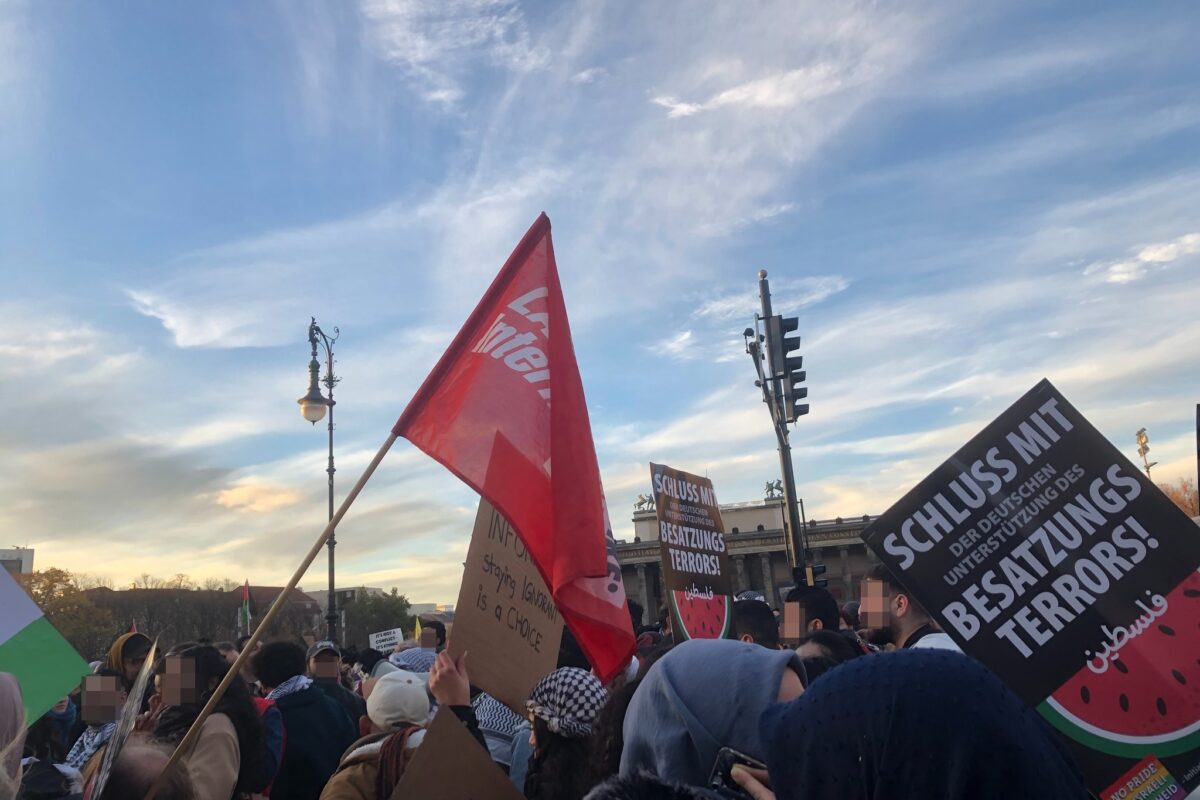
In News from Berlin, thousands march for Palestine through Berlin.

In News from Germany, CDU opposition to naming a street in Dortmund after a Jewish Communist, Habeck blames left for rise in antisemitism, ver.di announces strikes in the public sector, Chancellor Scholz rethinks Germany’s asylum policy, SPD announce new tax policy, and environmental organisations question government’s new investment plan.

Read all about it in this week’s News from Berlin and Germany.

In other news, the Volksbühne has uninvited keynote speaker Jeremy Corbyn because of his statements on Palestine. Corbyn was supposed to be talking about the EU tomorrow at a conference organised by the Rosa-Luxemburg Stiftung. Lena Fuchs, press spokesperson for the Volksbühne announced “because of the position that Jeremy Corbyn currently holds on the Middle East conflict, we have decided not to offer him any public space in the Volksbühne. You can contact Lena Fuchs with messages of complaint at presse@volksbuehne-berlin.de.

Meanwhile, a group of international activists in Berlin have written an Open Letter to the German Left on Palestine. Before they publish the letter, they are looking for first signatories, particularly international organisations based in Berlin or Germany. If you are a member of such an organisation or can help find signatories, you can contact them at solidaritypalestineberlin@gmail.com. More information in future Newsletters.

This week on theleftberlin, Nathaniel Flakin previews last week’s demonstration for Palestine, we have a picture gallery from that demo, Rasha Al-Junia introduces Palestinian embroidery, and Tareekh Yaadgar looks at German reactions to Palestine.

We also talk to Udi Raz about 20 years Jüdische Stimme in Germany and Shir Hever about boycotts and Israel’s economy, and publish a call for action against the narrowing of space for culture in Germany.

Outside Palestine, Andrei Belibou talks to people from the Bildungszentrum Lohana Berkins, an educational centre by migrants, for migrants.

This week’s Video of the Week shows one of the livelier blocks in last Saturday’s demonstration for Palestine in Berlin,

You can follow us on the following social media:

If you would like to contribute any articles or have any questions or criticisms about our work, please contact us at team@theleftberlin.com. And please do encourage your friends to subscribe to this Newsletter.

Keep on fighting,

The Left Berlin Editorial Board

Minutes of the meeting The Left Internationals, Die LINKE, and Palestine (6th November 2023)

On 6th November, around 35 people attended the open organising meeting of the Berlin LINKE Internationals. Before the main discussion, on die LINKE and Palestine, we made the following organisational announcements: The meeting we had planned on the legacy of French colonialism in Africa had to be postponed because of speaker unavailability (one of the […]

On 6th November, around 35 people attended the open organising meeting of the Berlin LINKE Internationals. Before the main discussion, on die LINKE and Palestine, we made the following organisational announcements:

  • The meeting we had planned on the legacy of French colonialism in Africa had to be postponed because of speaker unavailability (one of the planned speakers was involved in a car crash). We hope to organise this meeting at a later date
  • On Saturday, 9th December, we have booked Bilgisaray, Oranienstraße 45, for a Christmas party. If anyone would like to help us plan the programme, please contact us either by e-mail or through our Telegram group (contact details at the bottom of this report).
    A separate Telegram channel has been set up to organise the party-
  • We will have our annual Summer Camp on 29-30 June in the Naturfreundehaus Hermsdorf. We are currently getting together a team to plan the programme. If you are interested in joining this time, please get in touch.
    A separate Telegram channel has been set up to organise the Summer Camp.

Following these announcements, Palestinian activist Ramsy Kilani led a productive debate about the current situation in Gaza and the repression of Palestine activity in Germany.

Ramsy’s introduction

Ramsy started by speaking about the escalation in Gaza being rooted in the history of occupation.

Many human rights orgs have called Israel an apartheid state 1 2 3

Gaza is an open air prison which is under siege by air, ground and water. Israel controls food supply which restricts to a very small amount. Electricity is limited, many families died from fires started by candlelight. Unemployment in Gaza over 50%, for over 2 million people. 95% of water is not fit for human consumption. The UN estimated by 2020 it would be unliveable but reached that by 2017.

Ramsy referred to October 7th as a new 9/11 for the West, which contained, atrocities both real and fabricated. When raising the question of the Israeli hostages he asks what about Palestinian hostages who are still in Israeli prisons, where there is proof of systematic torture, including children. 95% of kids in Israeli prisons have been tortured

There are over 9,000 deaths we know of so far in the latest attacks. Infrastructure has been completely destroyed and more than half of Gazans don’t have homes anymore.

Leaders in Israel are openly talking about genocide, referring to Palestinians as animals who need to be destroyed. 1 2 3

In the rest of the occupied territories, West Bank, Jenin etc Palestinians are being evicted, tortured and killed by the IDF and settlers armed and supported by the IDF. 1 2 3 4

Israel is facing a lot of resistance since they are targeting all Palestinians and not simply Hammas. There is an explosion of Palestinian solidarity around the world which gives a lot of hope.

Ramsey summarised by reiterating the root cause of all of the violence is settler colonialism. While that structure exists, the violence will continue. Equal rights for Palestinians are needed and dismantling the apartheid state is crucial to a peaceful future.

General Discussion

There was a disagreement at the beginning about how not all of the stories of what happened on Oct 7th is propaganda

A few people in the discussion responded to this redirecting the purpose away from individual attacks and towards a more focused understanding of settler colonialism.

  • There’s nothing that justifies the current situation so arguing about the facts of 7th October doesn’t help. Large oil companies are speculating over Gaza right now.

  • It’s crucial to look at the system which is creating this violence rather than the individual violent acts. Settler colonialism everywhere have always been very violent systems

  • This idea of pointing to the violent acts dovetails really nicely with very racist ideas about Arab and Muslim people

How do we begin to talk about the basics?

  • Everyone is coming at it from different position so we have to be mindful

  • Phil spoke about the conversations he’s been having in his Linke branch. He found starting by looking at Police repression before discussing Palestine explicitly helped a lot. Also going back to basics explaining what life is like for an average Palestinian living under occupation.

How do we approach Germans who might not have all of the information that we see?

  • Can we ignore the people who are resistant to change and reach out to the people on the demonstrations?

  • The potential for hope in the demonstrations is much stronger than the despair of arguing with people who don’t want to know. Where is the future of solidarity and are there worker’s movements and unions we can bolster to throw more power against German imperialism.

German unions are all very pro-Israel – is there a way to get over that?

Concerning the condemning Hamas discussion. To say that they are a Jewish hating terrorist group reduces them down to nothing but a one-dimensional racist depiction – this is an ongoing effort to delegitimize Palestinian resistance.

The protest on Saturday gave a lot of hope and reminded of the BLM demonstrations with young white Germans out in a positive way – how can we make the links to bring the two together and empower people

What are the next steps? How do we sustain a movement beyond the protests to lead to the change that we want? We need to capitalise on the power we have now before people become too tired.

Are the regional forces a real issue or is this a distraction?

  • Hossam was very depressed that there were no demonstrations in Egypt planned for Nakba – a historical importance in Egypt. El-SiSi called one to take control of it but it was out of his control, they went to Tahir square and he hasn’t called one since. The memory of the Arab Spring is still there and there is still power there.

The protest felt a bit nervous at the beginning – people were worried about chanting. How do we get those nervous people to keep coming?

The Antifa scene is Anti-Deutsch or compliant. We need to be confident enough to name names and stand up to them properly

Do we want to be a powerful block against them?

  • We need to be open to change – Antifa NordOst came out in solidarity with Palestine after being silent for a while.

  • We need a multi-pronged attack to it.

Ramsy’s Summing Up

The ratio of civilian deaths is around 65% according to Ha-aretz.I can’t find the HaAretz article but this speaks to it with lots of sources  It is difficult to distinguish between military and civilian in Israel because the settlers at the frontier are armed and supported by the IDF. Also Israeli citizens who are born there are forced to join service at 16.

He referenced other anti-colonial uprisings and how unfortunately there are always atrocities against unarmed civilians e.g. Haiti, Algeria and South Africa. Every death is a tragedy but every death is also because of settler colonialism.

German guilt cannot explain away anti-semitism in Germany. It is rooted in nationalism and imperialism. There are cold, calculated reasons behind this ideology in establishing Germany as a major power on the world stage.

Unfortunately the Palestinian working class is very disenfranchised, split up, killed etc

So does that mean we look to the settler society? No – due to Israel’s economic relationship to other  imperialist states, Israeli citizens benefit. In Israel there is a hierarchy of oppression in which the worst treated still side with the state.

Imperialism has a stranglehold on North Africa, connected via Israel. There is a growing conflict though between people and their regimes who are supporting Israel. Revolutionary uprisings in the region is the way forward to free Palestine.

In Germany we are not there- but there are changes. Germany cannot be separated from the rest of the world as it wants.

How do we win in the union context?

It is highly bureaucratic and not very good on many issues, not just Palestine. Class struggle is the way forward

The first step is to work as a broad front which tackles wider issues, with a harder core exposing the global exploitation and oppression.

Palestine and die LINKE

In the second part of the discussion, we talked about the role of die LINKE. On a national level, the party has issued statements, which at best have shown a “both-sideism” position which does not reflect the asymmetrical nature of the conflict. At worst, the party, alongside with the CDU and others, called a demonstration in solidarity with Israel.

On a local level, die LINKE has been slightly better. In Neukölln, the party issued a statement which, while not perfect, was better than those on a national level. In Mitte, the party supported the demonstration on 4th November, and sent a good delegation from the Wedding branch.

After the meeting we learned that the Volksbühne disinvited Jeremy Corbyn from a meeting organised by the rosa Luxemburg stiftung because of his position on Palestine. Corbyn was due to speak about the EU.

This is not good enough for us, and puts die LINKE, and the German Left as a whole, out of step with what the international Left is saying and doing. Following the discussion we made the following decisions:

  • We unanimously agreed to issue a statement expressing our dissatisfaction with the way die LINKE has reacted to the attacks on Gaza. If anyone would like to join the editorial group which is drafting this statement, please get in touch
  • In an indicative vote, a small majority (with many abstentions) supported staying in die LINKE and fighting for our positions. We also agreed to review our attitude. The next opportunity will be at our next open organising meeting (provisional title “Die LINKE – benefits, problems, and alternatives” on Monday, 4th December in Schierker Straße 26.

So what do we do?

In the final part of the discussion, we talked about how we can build international solidarity for Palestine in Berlin, including the following initiatives:

  • The presence of White internationals on Palestine demos has made it much easier to attract German Leftists who had reservations about attending a demo which was made up mostly of Arabs (we know, but it’s unfortunately true). We should continue to mobilise for and attend the demos. The next two big demos are on Friday at 6pm at Checkpoint Charlie and on Saturday at 2pm at Oranienplatz
  • To stay informed of demos and other events, we recommend that you subscribe to theleftberlin Newsletter and regularly visit the website’s Events page. The website also contains excellent coverage in English on the Palestine movement in Germany and beyond.
  • A group of Spanish activists in Berlin have written an Open Letter to the German Left on Palestine. Before they publish the letter, they are looking for first signatories, particularly international organisations based in Berlin or Germany. If you are a member of such an organisation or can help find signatories, you can contact them at solidaritypalestineberlin@gmail.com.
  • We have set up a group on Signal for internationals to exchange information on Palestine events, and to organise leafletting and stickering actions. Please contact us if you want to be added to this group.
  • We are planning a series of film screenings and fundraisers on Palestine. The first will be on Sunday, 12th November at 7.30pm in Bilgisaray, Oranienstraße 45. More information to follow.
  • The LINKE Internationals are discussing setting up a reading group on Palestine. Watch this space for more information.
  • If you are interested in writing about Palestine, you can contact theleftberlin editorial board on team@theleftberlin.com
  • There is a whole number of other individual Events which you can find on theleftberlin Events page.

Contact us

  • Email: lag.internationals@die-linke-berlin.de
  • Telegram

The Particular and the Familiar

Palestinian liberation is the most intersectional of all struggles in the world today

In the night of our ignorance, all foreign forms seem to take the same shape. For people in the Global North, accustomed to floods of information, Palestine is situated in the imagination as just one of many innumerable injustices in the world; a rather terrible but nevertheless unexceptional case of injustice. When we try to exceptionalise causes closest to our hearts, we risk fragmentation into an amorphous collection of interest groups that are motivated more by a desire for self-aggrandisement than by a desire to end injustice. Therefore, it begs the question, whether the current situation in Palestine is truly exceptional or just another terrible example of injustice.

Seen from any single vantage point, Palestine is a familiar story. Palestinians are not the first people to suffer death and dispossession. Within the same decade as the Nakba, meaning catastrophe in Arabic, approximately six million Jews were industrially slaughtered by Germans in the Shoah, meaning catastrophe in Hebrew. The mere juxtaposition of these two catastrophes is to invite fury, particularly among a German audience that believes that the Shoah was a singular, incomparable tragedy. And furthermore, based on current events and narratives, no entity understands the Shoah better than the Germans; not even the descendants of Jews murdered in the Shoah. It is a peculiar possessiveness on their part and I am left to wonder, if the Shoah is some trophy to be jealously guarded?

The Holocaust cannot be relegated to being an exclusive lesson for Germans nor an exclusive memory for Jews. It must be remembered that alongside Jewish people, Roma and Sinti peoples, disabled people, and homosexuals were targeted for summary execution. To excluvise the Holocaust then is to deny its voraciousness for human life. For its reverberations are felt to this day, its memory a permanent warning to all generations. If it is a singular event in human history, it is because its lessons are so universal whether one directly participated in it or fell victim to it.

Seen in this context, the German state’s zealous policing of thought around the subject betrays a desire to assimilate the Holocaust into a perverse nationalist identity. The ultimate expression of this perverse nationalism is a tribalistic allegiance to the state of Israel. Germany, in its eagerness to avoid being on the wrong side of history ever again, engineers a self-fulfilling prophecy whereby it condemns itself to being an accomplice in the ethnic cleansing and potential genocide of Gazans.

I for one hate comparing the severity of tragedies. Can’t a tragedy just be a tragedy without being weighed on some arbitrary scale of comparative suffering? Don’t Palestinians have a right to name their catastrophe without being accused of trying to steal attention from the catastrophe of Jewish people by some clone of Friedrich Merz? Must we wait until a genocide reaches its bloody conclusion before we make a comparison to another? When all there is left to do is to document the destruction. Wouldn’t it be better if we acted with abundant caution and at the first sign of overlap between the past and present, acted swiftly to prevent a recurrence? Or would we rather deny anything like a genocide or ethnic cleansing is happening until it becomes indisputable and irreversible?

The response of the Global North towards the actions of the Israeli state, the stubborn belief that Israel is a homeland for Jews, that only Israel can speak for Jewish interests or protect Jewish lives, all stem from a desire for convenience. Unflinching support for Israel has been particularly convenient for sanitising the unapologetic antisemitism of the single greatest threat to Jewish life in Europe: the far-right. By sacrificing Palestinian lives, Christian Europe helps bury its collective guilt for the prosecution of the Holocaust while simultaneously resuscitating the political forces that delivered it; no nation serves as a better example of this dynamic than Germany, where the neo-fascist AfD has surged to second place in the backdrop of Islamophobic discourses around “imported” antisemitism.

“…the prospect of a partnership with the people who had presided over Auschwitz scandalised Israeli Jews, especially the survivors, many of whom already found Ben-Gurion’s state to be a chilly place. When his negotiations with Konrad Adenauer were made public, Ben-Gurion had to call in the army to suppress a demonstration in Jerusalem at which Begin described reconciliation with Germany as ‘the most shameful event in our people’s history’. But, as Ben-Gurion saw it, ‘money has no odour.’ The Germans, keen to be rehabilitated in the eyes of the West, were easy to persuade. By the end of the decade the Germans were supplying Israel with arms and buying Uzis.” (We are conquerors – Adam Shatz)

Palestine is exceptional not because it is different, but because it is so strikingly familiar. It is as if all the horrors that can be visited upon a people are being visited simultaneously on them, in an age that has the living memory of witnessing all of this once before but refuses to acknowledge it is happening again.

Steinbeck wrote: An unbelieved truth can hurt a man much more than a lie. It takes great courage to back truth unacceptable to our times. There’s a punishment for it, and it’s usually crucifixion.” I write these words in the context of a systematic denial of Palestinian suffering that has become institutionalised in the Global North. A few examples here, here, and here.

Just as Palestinians claim a right to return to the lands and homes they were displaced from, so do the Chagos Islanders, a five decade old struggle. Neither are the Palestinians the only victims of occupation and overt colonisation in the world today. The people of Western Sahara have been abandoned by the international community to the whims of an absolute monarchy, namely Morocco. Coincidentally, the flag of Western Sahara, subtracting a star and crescent, becomes the flag of Palestine. Palestinians are not the only people being bombarded by a vastly more powerful military. The people of Iraq, Syria, Lebanon, Libya, and Ukraine can attest to the horror of indiscriminate attacks on civilians by a foreign power. Nor are the Palestinians of Gaza the first to suffer a prolonged siege, for the people of Srebrenica and Sarajevo experienced it all in the 90s. Palestinians in the West Bank live under a system of apartheid, a relic of segregation in South Africa, as attested by several international organisations like Human Rights Watch and Amnesty International.

But I think I may have stumbled upon one truly unique aspect of the Palestinian experience. The attacks on Gaza are the first case of witnessing genocide via Instagram. I recall the image of a distraught father waving the remains of his child in a plastic bag and it struck me that Gazans are currently being forced to desecrate their children’s remains in order to garner enough sympathy for the genocide to merely pause. I couldn’t think of a single case where people felt the need to use the mutilated remains of their loved ones in real time. Billions of people have access to these images today in a way they did not have for Srebrenica.

And the intent is always the same, which is to say “take pity on us at last and convince someone to stop our brutalisation”. In response, many of us struggle, quite literally, to lift a finger to hit the like button. How can one “like” something so grotesque as a mutilated corpse? Yet for the sake of the Palestinians, this is what we are being asked to do, if only to help amplify the sound of their suffering so it may reach the right, usually white, ears being drowned out by propaganda meant to dehumanise an entire people. Unlike previous attempts at genocide, where we could claim a degree of ignorance, where the fog of war and the paucity of verifiable information caused hesitation to act, we are today faced with the prospect of having abundantly graphic evidence and simply tune it out of our minds. Like some pauper on the street begging for change, our humanity seems so withered that we now witness an entire people’s annihilation with apathy.

I am reminded of my brother’s funeral, where my father was able to bury his son at a time, a place, and in a manner that gave him some sense of closure. I then force myself to imagine, if all that remained intact of my brother’s flesh was an arm and a mutilated face, and then, my father had to display these remains in front of a camera, in the hope that perhaps what’s left of his family and his community could be spared enduring a similar fate.

I refuse to say how Palestine is different from, say, the Kurds being bombed under Erdogan’s orders in Rojava, or the Ukrainians being killed by Russia in its doomed attempt at colonial conquest, or the Bosnians killed by Serbs, or the Jews killed by Christian Europe over centuries, or the Chagossians expelled from their homes, or the South Africans who suffered under apartheid, or the Irish under British occupation, or the Uyghurs under Chinese repression. Palestine is everything, everywhere, and all at once. And that is what makes Palestine exceptional.

Palestinian liberation is the most intersectional of all struggles in the world today. If we can achieve justice for Palestinians, we will set an example that will endure for generations. Justice for the Palestinians would be a rising tide that will lift all boats but for that very reason it is the most difficult and, consequently, demoralising struggle on the planet today. To speak up for Palestine, is then to resist a corrosive fatalism. To speak up, to stand up, to strive for Palestine is to share the undying spirit of a people that have refused to be annihilated. Who can still find a song to sing as the bombs menace them from the skies.

So long as Palestinians breathe in defiance of the terror being wrought on them, humanity’s heart will go on beating. I do not condemn those of us who, despite feeling sympathy for Palestinians, fail to act for them. I merely feel pity that they have succumbed to fatalism. Yet with each passing day of inaction, humanity’s heartbeat fades. Regardless, such a death is not permanent and there is still time to resuscitate ourselves from the fatal kiss of nihilism.

Rooted / Verwürzelt

Nurturing the Seeds of our Existence – Palestinian Embroidery Workshop


Palestinian and Arab friends in Berlin:

Rasha Al-Jundi will be holding another Palestinian embroidery workshop on Sunday 12th November from 12:00-15:00.

This one is open to those of Palestinian or Arab roots in the city.

Please register via this Google Form. You will then be sent the location of the Event.

It is limited to 15 participants. Rasha will confirm the location later in the week.

A small fee of €5 will cover material costs. Any other donations will go 100% to Gaza.

Rasha hopes to nurture our roots and pass what she was taught through her family to you.

Open for all genders.